

Pink Sahara: Magnetically Levitated Domes That Drift Across the Desert
Solar-powered geodesic dwellings inspired by Tuareg nomadic culture float across the Sahara on magnetic levitation systems.


What if buildings could migrate? In the Sahara, where the Tuareg people have followed seasonal microclimates for centuries, a fixed dwelling is a contradiction. Pink Sahara resolves that tension with a proposition that sounds like science fiction but is rooted in real material systems: geodesic domes wrapped in semi-flexible solar panels and ETFE membranes, powered to reposition themselves across the sand on magnetic levitation. The structure doesn't resist the desert; it moves with it.
Designed by Hao Yue, Chenyu Qiu, and Yuan Shuai, the project was shortlisted for the Extreme Habitat Challenge 2019. The brief demanded architecture capable of sustaining life in one of the planet's harshest climates. Pink Sahara answers not with fortification but with fluidity, proposing a self-sufficient habitat system that channels Tuareg nomadic traditions through solar energy harvesting, modular scalability, and a regenerative approach to arid land.
A Micro-Ecosystem Planted in Sand
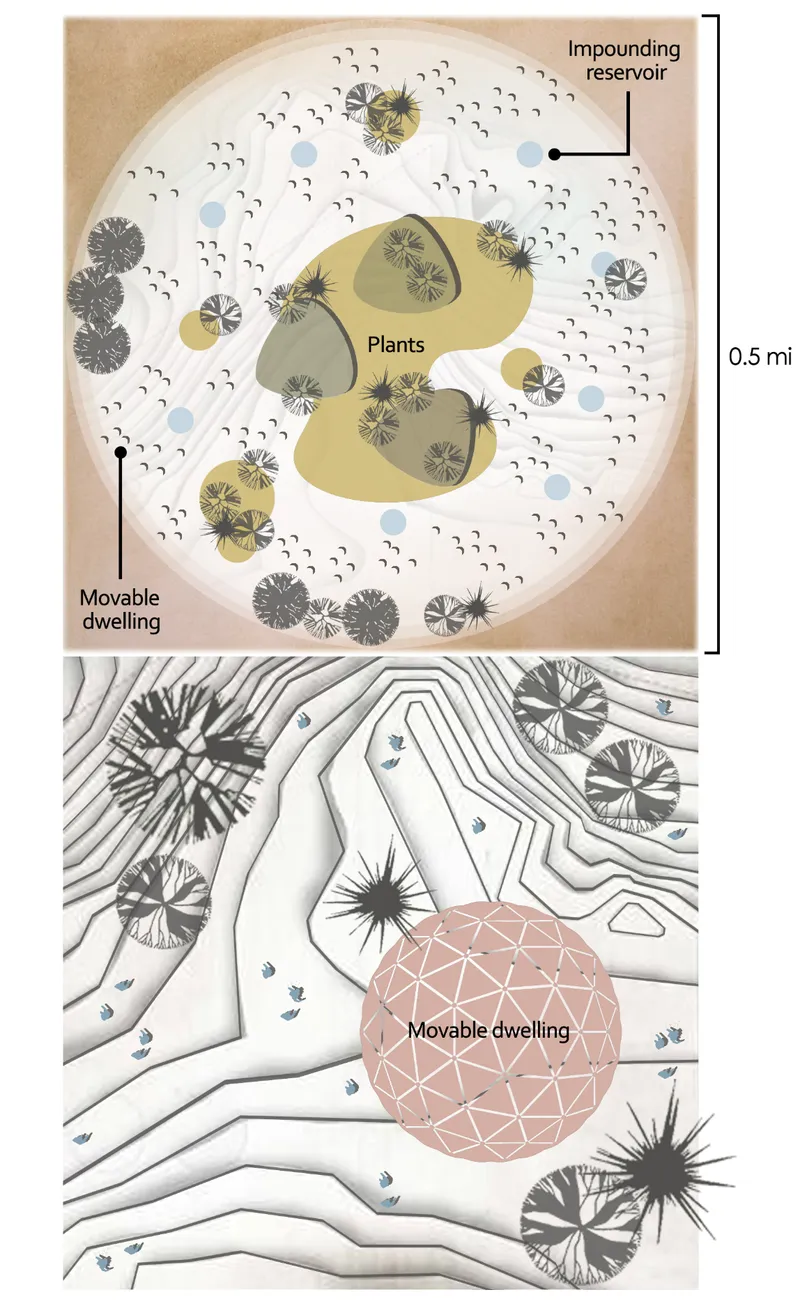
The site plan reveals something more ambitious than a cluster of shelters. Dome groupings encircle impounding reservoirs and cultivated vegetation zones designed to collect and preserve the desert's scarce water. These planted patches, visible as green pockets among the geodesic structures, are intended to gradually transform barren terrain into a regenerative oasis. The strategy turns habitation into an ecological act: living in the desert means slowly greening it.
The modular logic is critical here. Individual domes can link to form larger communities or stand alone in extreme isolation, each unit maintaining full energy independence through its solar skin. The site plan shows how this scalability plays out spatially, with loose clusters that feel organic rather than gridded, respecting the irregular topography of dune landscapes.
Desert Flowers at Dusk and Under Stars
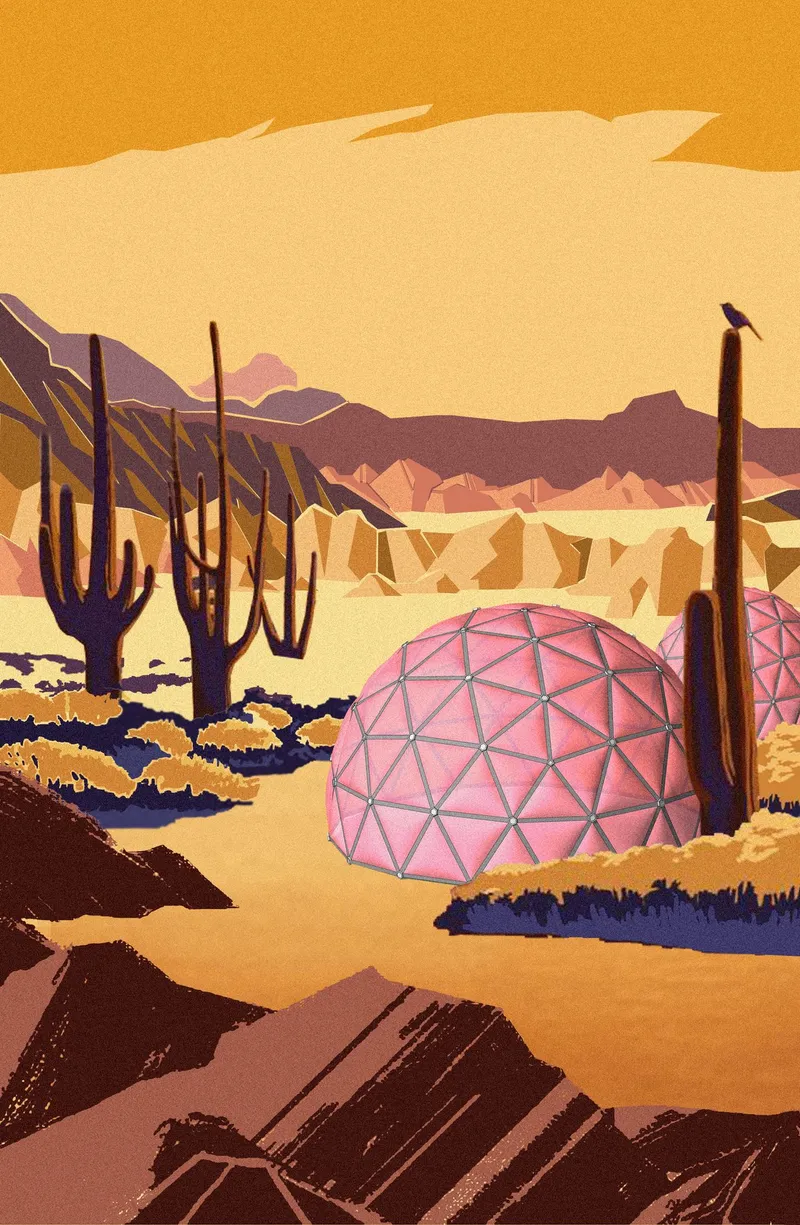
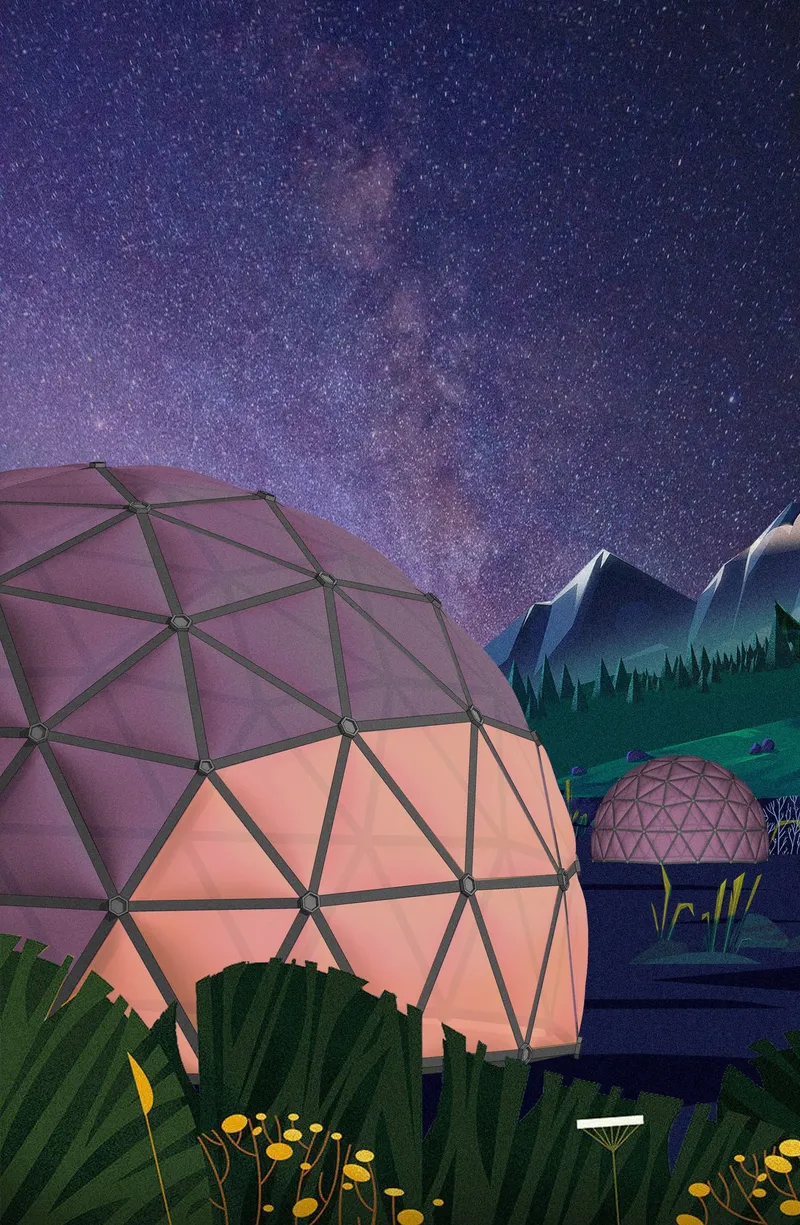
The soft pink tones of the domes are not arbitrary. They reference the ochre palette of the Sahara itself, minimizing visual intrusion while lending the structures a surreal, almost biological quality. At sunset, with cacti and distant mountains framing the scene, the domes read as desert flowers, lightweight yet resilient. The ETFE membrane that forms the outer shell provides transparency and recyclability while layered insulation and solar film regulate temperature and light intensity, reducing heat gain during the day.
At night, the same solar panels that absorb sunlight become sources of soft illumination. Under the Milky Way, the domes glow from within, their translucent panels transforming the settlement into a constellation on the ground. The energy stored during the day powers not only interior systems but the magnetic levitation mechanism itself, allowing the structures to reposition effortlessly across terrain in pursuit of optimal thermal conditions and resources.
Double-Height Living Inside a Geodesic Shell
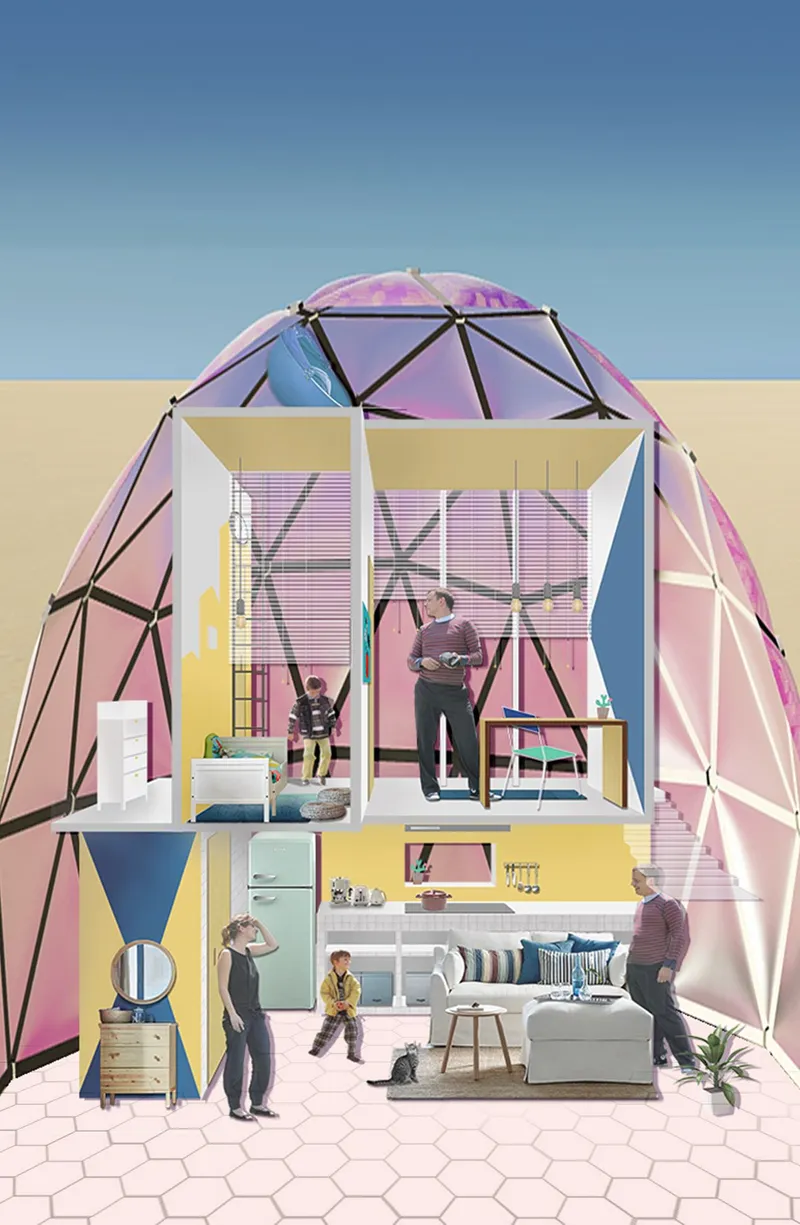
The section cutaway strips away the futuristic exterior to expose something surprisingly domestic. A two-story interior accommodates a family's full range of daily life: sleeping, cooking, gathering. The double-height living area maintains visual openness while geometric partitioning creates zones of privacy. Lightweight furniture and pastel materials establish a calm interior atmosphere that deliberately contrasts with the severity of the climate outside.
What stands out is the designers' insistence that sustainable architecture must also address emotional well-being. The layered spaces, the soft light filtering through the ETFE membrane, and the vertical connections between floors all work to make these extreme-climate shelters feel genuinely habitable rather than merely survivable. The section drawing makes the argument clearly: resilience and comfort are not competing goals.
Nomadic Settlements Across the Dunes

Seen from a distance, the domes scattered across rolling sand dunes evoke the Tuareg encampments that inspired them. Figures walking along a ridge give scale to the structures and reinforce the project's core cultural reference: architecture as a companion to movement, not an anchor against it. The dynamic mobility enabled by magnetic levitation means these settlements can follow microclimates seasonally, optimizing resource use and thermal comfort without leaving a permanent scar on the landscape.
The image captures the poetic dimension of the proposal. Pink Sahara doesn't imagine conquering the desert; it imagines participating in its rhythms. The dwellings are temporary presences, light enough to arrive and depart without the infrastructure of roads or foundations. It is a vision of habitation as reciprocity, where the built environment gives back to the ecology that sustains it.
Why This Project Matters
Pink Sahara operates at the intersection of speculative technology and genuine cultural intelligence. Magnetic levitation as an architectural mobility system remains firmly in the conceptual realm, but the underlying logic is sound: if extreme climates demand adaptability, then buildings should be capable of adaptation. By grounding that ambition in Tuareg nomadic traditions rather than treating it as pure technological novelty, the designers give the project a cultural legitimacy that many speculative proposals lack.
More practically, the material and environmental strategies here offer transferable lessons. ETFE membranes with integrated solar harvesting, modular energy-independent units, and site planning that incorporates water collection and vegetation cultivation are all approaches with real application potential in arid regions worldwide. Pink Sahara's strongest contribution may be its reframing of desert habitation itself: not as a problem of endurance, but as an opportunity for ecological partnership.
View the Full Project
About the Designers
Designers: Hao Yue, Chenyu Qiu, Yuan Shuai
Enter a Design Competition on uni.xyz
uni.xyz runs architecture and design competitions year-round that reward proposals with spatial conviction and real site intelligence.
Project credits: Pink by Hao Yue, Chenyu Qiu, Yuan Shuai.


Popular Articles
Popular articles from the community


The Amber Palace Opera: A Geological Fiction Surfaces on Tallinn's Baltic Waterfront
Pierre Brillard reimagines a Baltic legend as a public landscape, opera house, and waterfront promenade rooted in Tallinn's coastal identity.
Tsunami Convergenics: Turning Catastrophic Ocean Forces into Underwater Housing Infrastructure
A speculative underwater settlement off the coast of Onagawa, Japan, treats tsunamis and typhoons as energy sources rather than threats.

Cloaked Colonization: A Mobile Underwater Habitat That Moves Like a Fish
Micah Abaya's shortlisted EHC Pacific entry reimagines ocean settlement as a dispersed network of self-sustaining architectural organisms.

Opera on the Sea: Driftwood Logic Shapes a Timber Opera House on Estonia's Coast
Trevor Orgill's opera house translates the entangled drift of floating timber into a civic building where wood, water, and music converge.

Similar Reads
You might also enjoy these articles
Yenisei Monitoring Center: A Sun-and-Moon Sphere Anchors a Research Campus on Siberia's Great River
In Krasnoyarsk, shifting square blocks, a glazed central sphere and descending window rhythms turn river science into a public spectacle on the Yenisei.
Andretta Artist's Village: A Node-Based Masterplan That Lets the Hills Write the Plan
A cultural landscape strategy for Palampur's artist colony threads studios, residences and stages along a porous spine shaped by the Dhauladhar terrain.
Street Children Rehabilitation Center: A Brick Campus That Eases Children From Street to Safety
A low-rise courtyard campus where learning streets, uthans and shaded verandahs stage a gradual passage from street into protective, family-scale life.
The NEON Culture: A Field of Pavilions Built for the 24-Hour City
Smaran Alva spreads galleries, stages, clubs and markets across a varied site, treating light, sound and ramped movement as the real building materials.


Comments (0)
Please login or sign up to add comments
No comments yet. Be the first to comment!