
Pinwheel House by JM Architecture – A Prefabricated Timber Pavilion Overlooking Lake Maggiore
Prefabricated pentagon-shaped timber pavilion by JM Architecture, overlooking Lake Maggiore, blends minimalist design, sustainable systems, and panoramic forest-lake views.


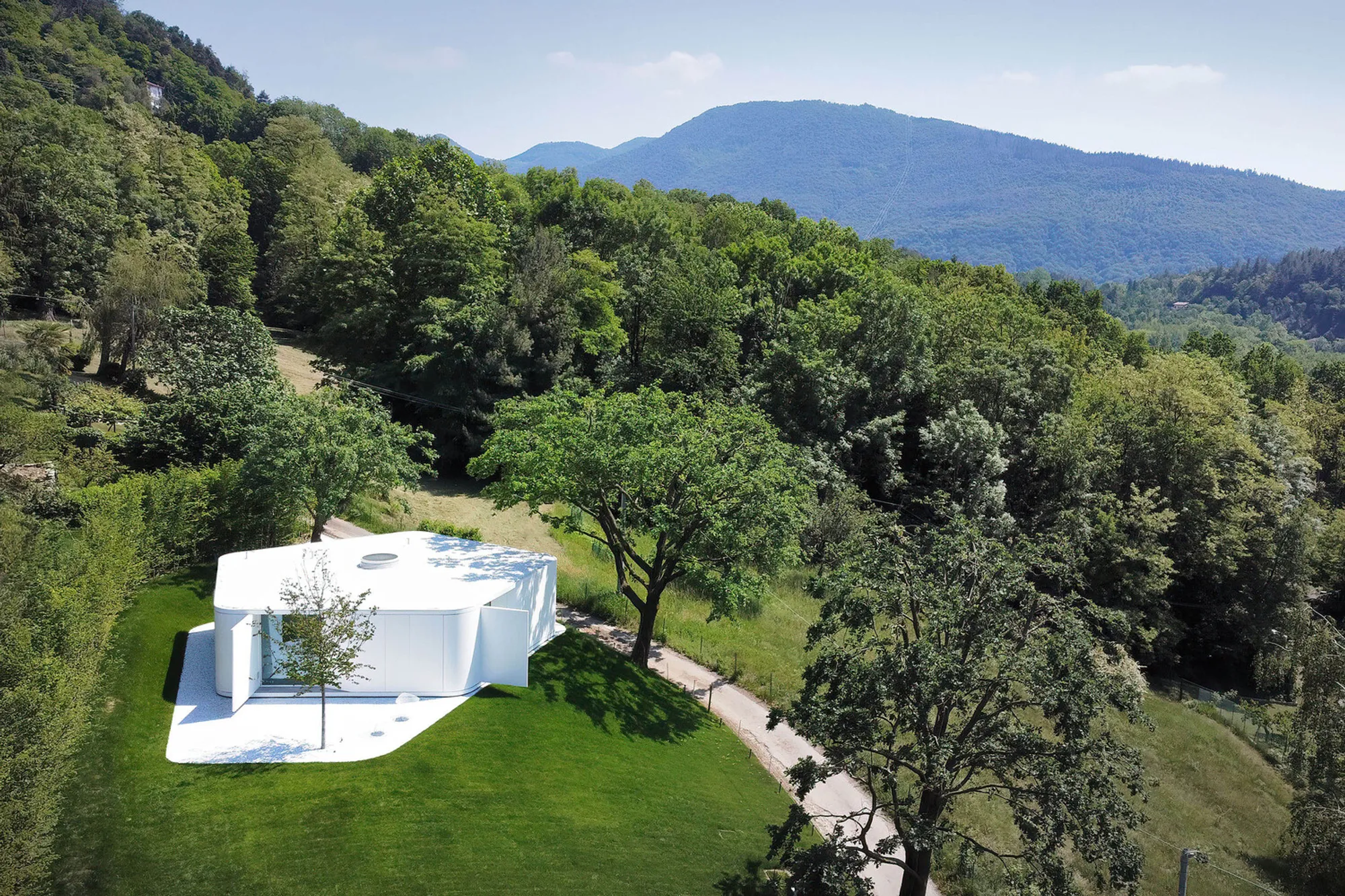
Perched on the serene hills surrounding Lake Maggiore in Luino, Italy, the Pinwheel House by JM Architecture is a refined example of how contemporary architecture can merge prefabricated efficiency with site-sensitive design. Completed in 2022 and spanning 200 m², this custom-designed timber home was built and fully furnished in just six months, showcasing the potential of modern modular construction.
Site & Context
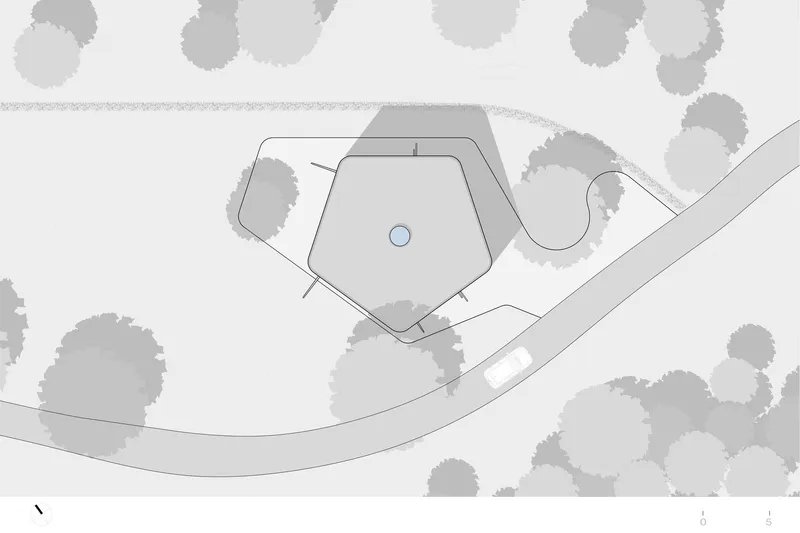
Nestled in a natural glade within the oak forests characteristic of this Italian–Swiss border region, the Pinwheel House occupies a small sloping plot. The buildable footprint aligns with a natural terrace in the site’s narrowest section, dictating the structure’s compact yet dynamic pentagonal form. The design respects strict building setback regulations while orienting key living spaces toward breathtaking views of the lake valley.

Architectural Form & Spatial Layout
The home’s pentagon shape is not a stylistic whim, but the outcome of topographical constraints and careful volumetric study. At the heart of the single-story pavilion is a circular skylight above the central staircase — a functional and symbolic “center of gravity” that eliminates corridors, allowing every space to connect fluidly.
- Upper Level: Open-plan living, kitchen, and study areas share an airy, light-filled space. Two bedrooms and two bathrooms form the only enclosed rooms on this floor.
- Lower Level: A cozy movie room, storage spaces, and technical rooms wrap around the central stairwell, maximizing every square meter.
Prefabrication & Materiality
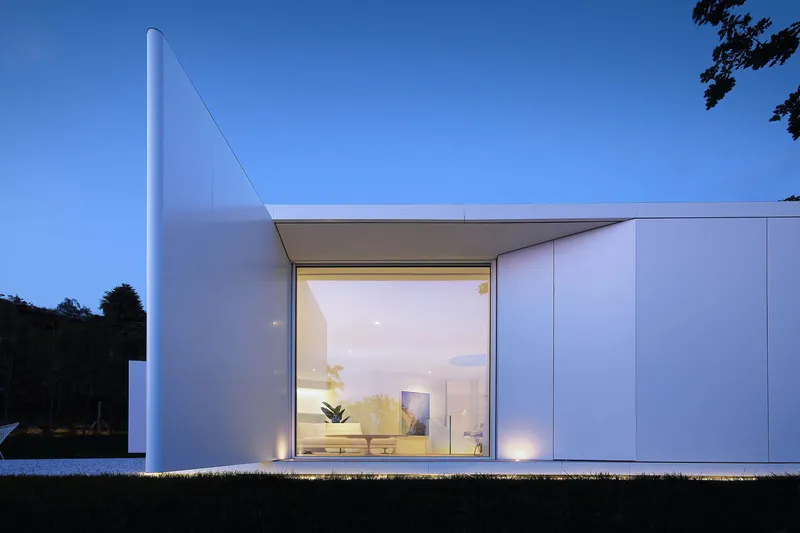
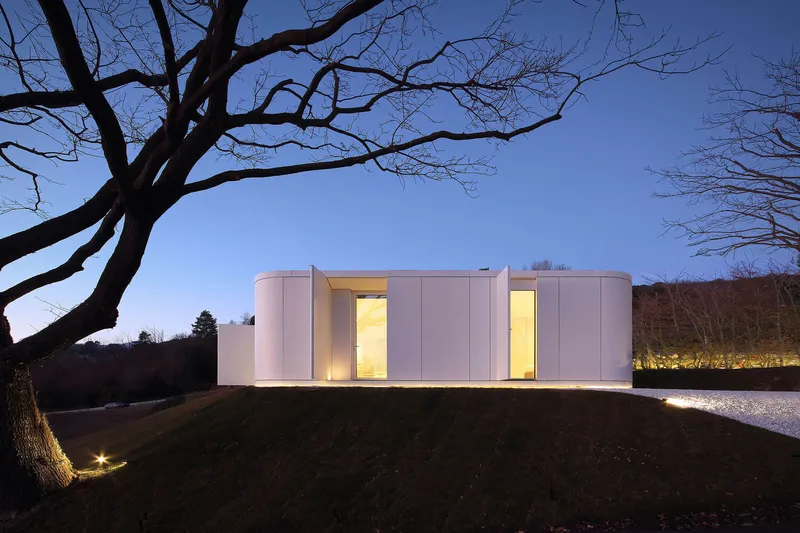
The above-ground volume was crafted from a highly insulated timber-frame prefabricated system, assembled onsite in just one week atop a cast-in-place concrete basement. The façade combines white concrete panels with composite aluminum shutters, creating a crisp modern look. Large glazed openings in communal spaces frame panoramic landscapes, while smaller windows in private areas ensure privacy and controlled light.
Inside, the palette is minimal and unified — white concrete floors, plastered walls, and monochrome furnishings enhance the sense of purity and brightness. The rounded building edges reinforce the pavilion’s flowing geometry, giving the structure its “pinwheel” identity.

Landscape & Outdoor Living
Minimal intervention defines the landscape approach. A white gravel path links the property to a narrow countryside road, doubling as a parking space to the east and an intimate outdoor sitting area to the west — the perfect sunset spot overlooking the valley.

Sustainability & Energy
Efficiency From the outset, low maintenance and reduced energy consumption were core design goals. The timber structure ensures thermal efficiency, while a radiant floor heating system and electric heat pump — powered by a remote photovoltaic solar farm — provide eco-friendly comfort year-round.
Pinwheel House exemplifies sustainable luxury — a fusion of architectural precision, environmental responsibility, and the timeless beauty of the Italian lakeside landscape.
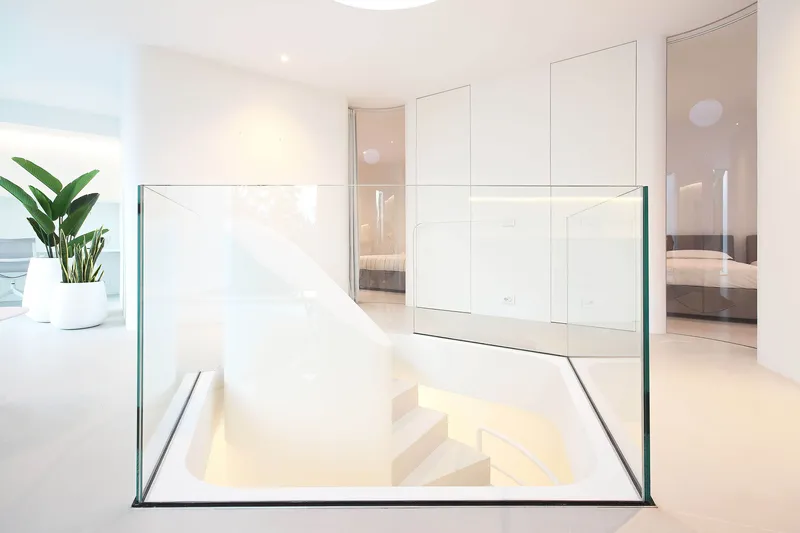
All photographs are works of Jacopo Mascheroni




Popular Articles
Popular articles from the community


Lunar Spiral: Space Architecture Shaped by the Mathematics of the Universe
Lunar Spiral reimagines space architecture through Fibonacci geometry, lunar regolith, levitating habitats, and self-sustaining Moon living.

The Musturak Paradise: Senior Living Architecture for a Connected Future in Temara, Morocco
The Musturak Paradise reimagines senior living architecture in Temara via private homes, social spaces, culture, community, and shared care.

Co-Life: Senior Housing Design That Reconnects Older Adults With the City
Co-Life reimagines senior housing design through healing gardens, shared streets, workshops, and a sustainable community across generations.

The Ocean Hive: Sustainable Architecture for a Self-Sufficient Civilization at Sea
The Ocean Hive imagines sustainable architecture at sea, where modular habitats, algae, wave power and ocean waste sustain a growing colony.

Similar Reads
You might also enjoy these articles


Hodi-Mandai Geram
Project Function: Preservation and revitalization of the Intangible heritage and socio-spatial identity of the Hodi by Housing, Cultural Memory Center, Sacred Grove, landscape, local tourism economy


Olio Towers: A Mid-Rise for Performers That Fuses Housing, Rehearsal, and Stage
Located blocks from Houston's Theater District, this modular tower stacks living units around a central performance atrium.

Oasis: Modular Green Housing Carved into Dhaka's Urban Fabric
A shortlisted Plugin Housing entry reclaims unauthorized settlements in Dhaka with stepped concrete volumes, green roofs, and ventilation-driven design.

Black Hole: A Floating Megastructure for the Post-Physical Era
Emiliano Mazzarotto envisions a spherical, self-scaling arena where e-sports, digital hotels, and holographic stadiums replace traditional public space.

Explore Architecture Competitions
Discover active competitions in this discipline



Challenge to reimagine the Iron Throne


Photograph architecture without architects


Illustrate the lost glory of Angkor Wat - Render Challenge


Design challenge to reuse E-waste
Comments (0)
Please login or sign up to add comments
No comments yet. Be the first to comment!