

PL-T Architecture Studio Carves a Gravity-Flow Winery into the Tibetan Hillside
Quzika 1865 Winery steps down toward the Lancang River in Markam County, Tibet, using local stone and terraced water to echo ancient salt fields.


At the foot of the Dameiyong Snow Mountain in Markam County, Tibet, a winery has been quietly embedded into the hillside as if it grew there. Designed by PL-T Architecture Studio and completed in 2021, Quzika 1865 Winery spans 8,334 square meters of terraced stone volumes that descend toward the Lancang River. The project takes its name from 1865, the year French missionaries are believed to have introduced winemaking to this remote valley. More than a century and a half later, the winery's mission is overtly social: generating income for local Tibetans through cultural tourism and a working wine production facility.
What makes the project genuinely compelling is how literally it interprets its site. The stepped terraces are not decorative; they are the winemaking process made spatial. Grapes enter at the top and move downward through crushing, fermentation, and aging entirely by gravity, eliminating the need for mechanical pumps. The rooftops double as shallow water basins fed by snowmelt, recreating the layered reflective surfaces of the thousand-year-old salt fields that sit nearby along the river. It is a building that reads its context with unusual precision and then performs it.
Terraces as Process

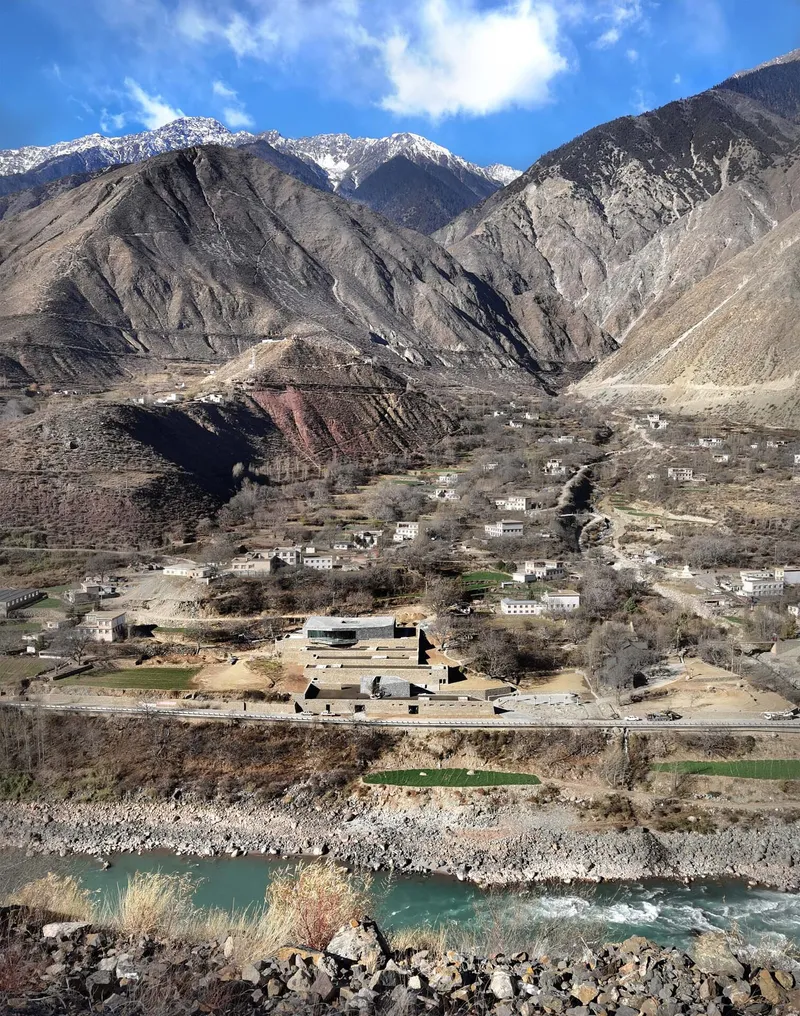
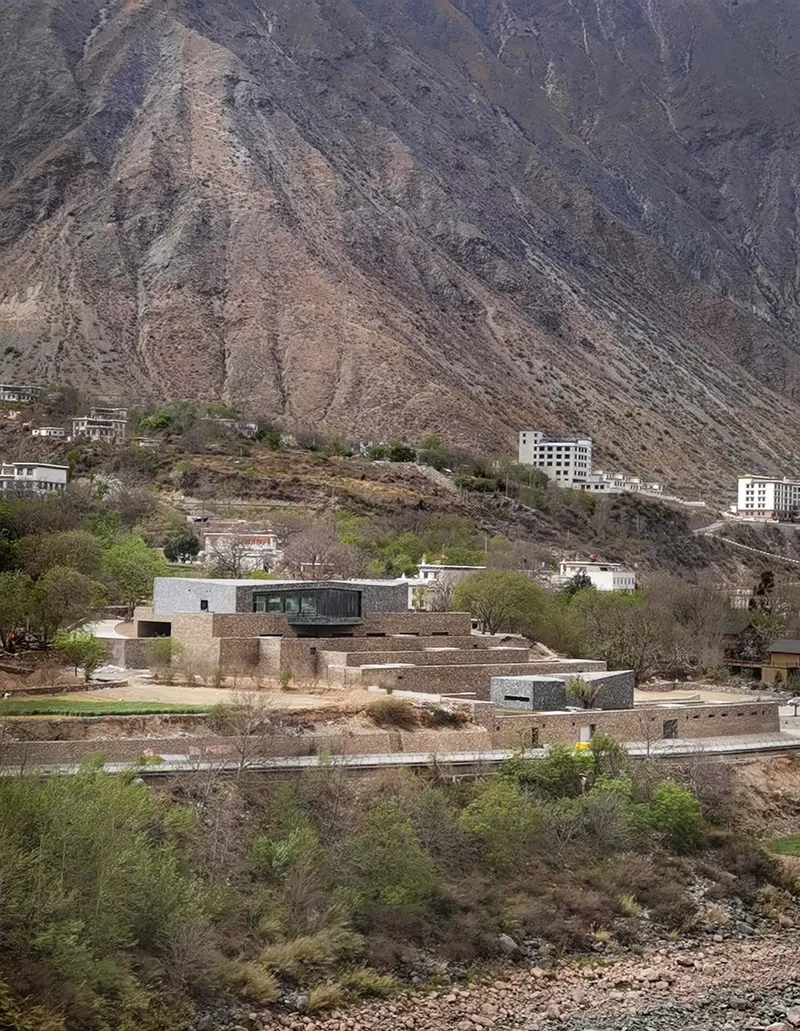
The building's most consequential decision is its section. Rather than sitting on the hillside, the winery cuts into it, creating a cascade of stone platforms that step from mountain to river. Each terrace corresponds to a stage of production: receiving and crushing at the upper elevations, fermentation in the middle, aging in vaulted cellars below. The height differential across the site allowed the architects to achieve a complete gravity-flow process while simultaneously balancing the earthwork, meaning virtually no soil was removed from or added to the site.
The staggered plan also serves a preservation function. Century-old walnut trees and ancient grape vines already occupied the slope, and the building fragments itself around them rather than displacing them. Horses graze in the courtyards between volumes. The result reads less like a single structure and more like a loose aggregation of stone enclosures, which is precisely the point.
Stone from the Ground Beneath
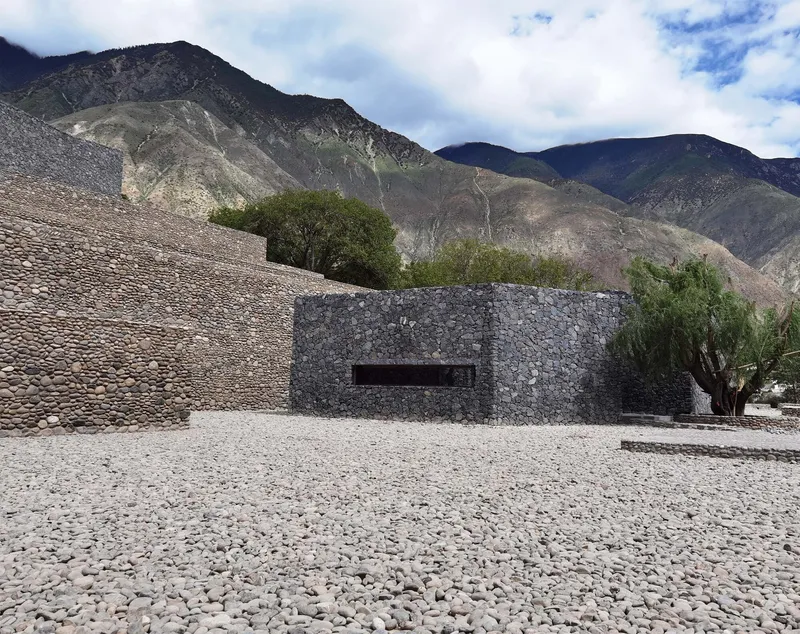
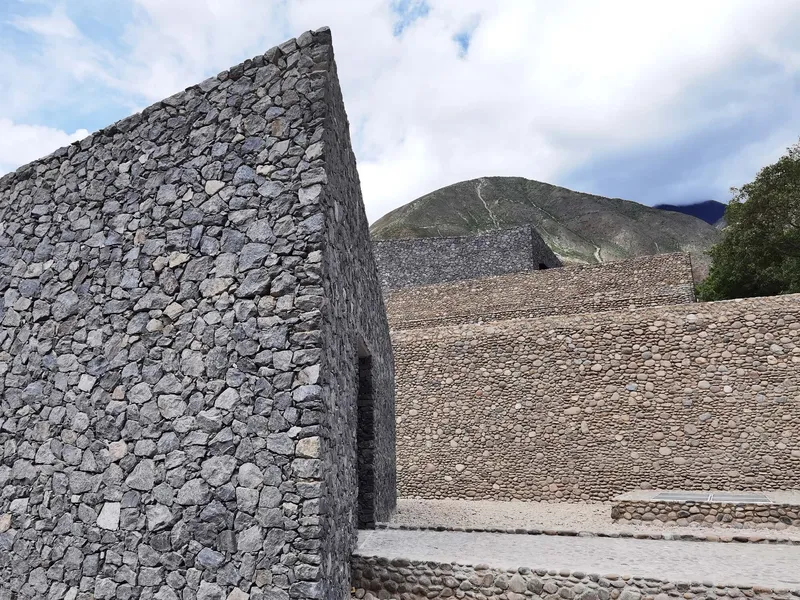

The exterior walls are built from stones sourced directly from the site, many of them river-rounded boulders pulled from existing dry stone walls and the surrounding terrain. This is not gabion-as-ornament; it is continuity. The irregular grey rock ties the building to the geology of the valley in a way that concrete or imported cladding never could. Thermal mass is the practical bonus: the thick stone walls regulate temperature in the brewing and aging spaces, a critical advantage at this altitude where diurnal swings are extreme.
Construction photographs show local workers on scaffolding, assembling the walls by hand. PL-T's team reportedly entered Tibet twenty times over two years during the design process, and the decision to use locally available materials and local labor was deliberate. The building was designed to be buildable by the community it serves.
Water as Roof
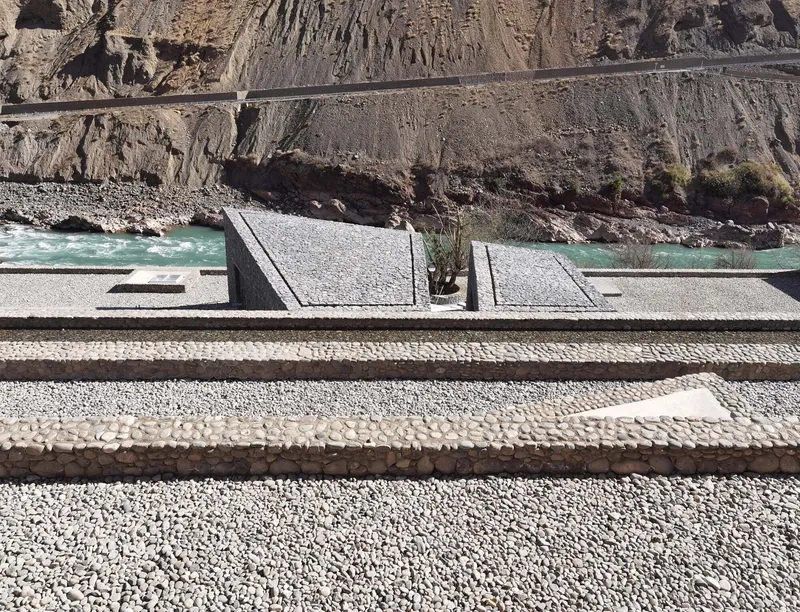

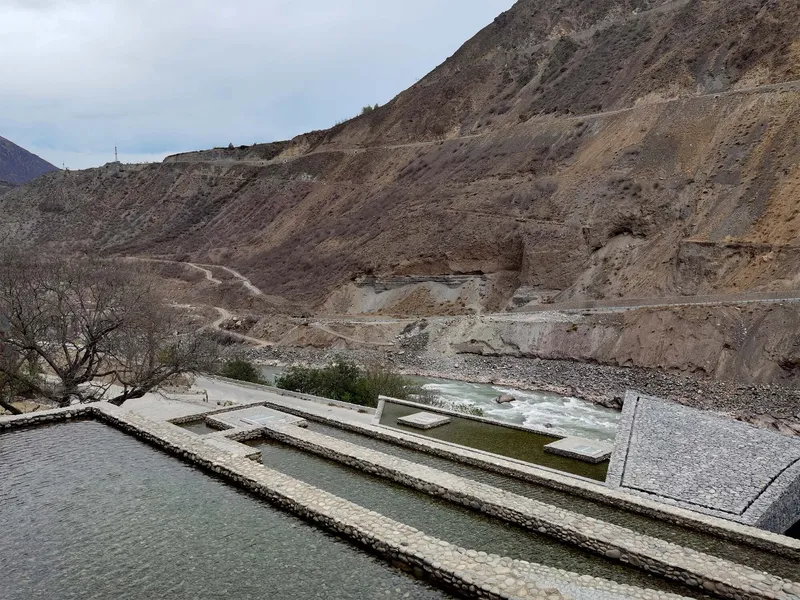
The rooftops of the processing terraces hold shallow pools of water fed by natural springs descending from the snow-capped mountains. As the seasons change, snowmelt volumes rise and fall, creating varying water levels that shift the reflective surfaces across the building. The water eventually cascades down through stone channels and rejoins the Lancang River below. This roofscape is modeled on the nearby thousand-year-old salt fields, where brine is channeled across terraced platforms and left to evaporate in the sun.
The visual effect is striking: horizontal planes of turquoise and silver that mirror the sky and mountains, edged by white cobbles and rough stone borders. But the system also functions as passive cooling and humidification for the spaces below. It is landscape infrastructure disguised as poetry, or perhaps the reverse.
The Vaulted Cellars
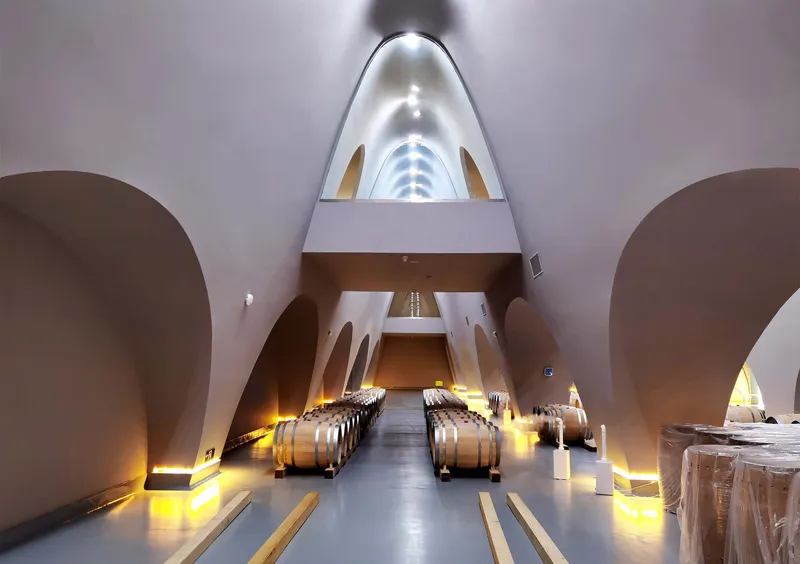


Below the terraces, deep in the hillside, the wine aging cellars adopt a completely different spatial language. White vaulted ceilings arch over rows of oak barrels, lit by warm amber uplighting that washes up the curved surfaces. The architects cite the arches of the only Catholic church in Tibet, located nearby, as inspiration. It is an unexpected reference for a winery in a Buddhist region, but it connects directly to the 1865 missionary history that brought viticulture here in the first place.
The contrast between the raw exterior stone and these smooth, luminous interiors is deliberate and effective. You move from a landscape of geological roughness into something hushed and almost sacred. The temperature drops, the light shifts from daylight to amber, and the program shifts from public reception to private production. The section does all the narrative work.
Courtyards and Passages
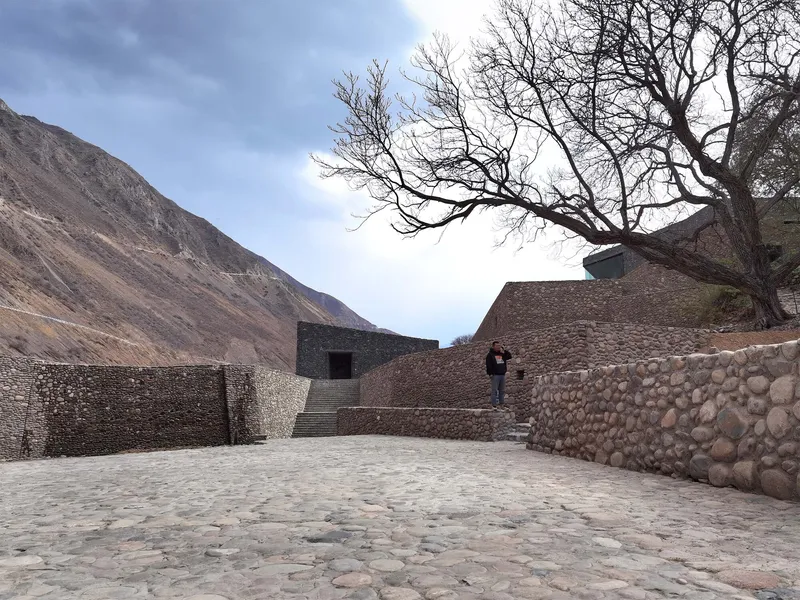
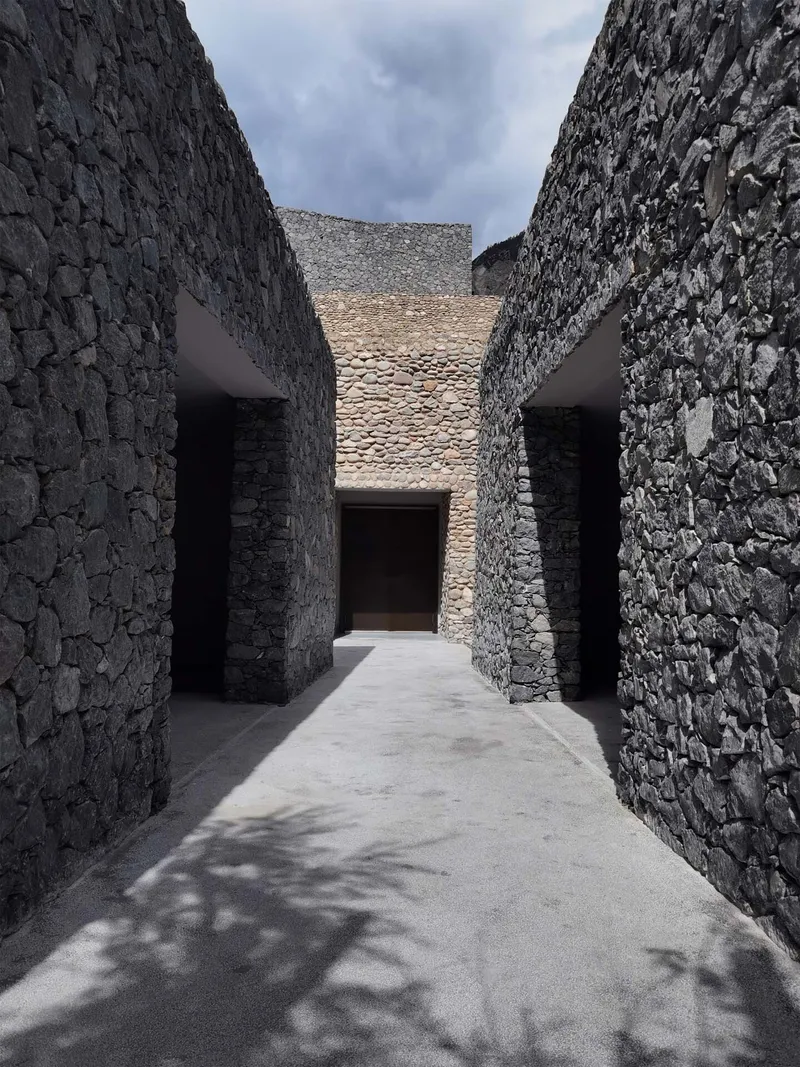

Movement through the winery is choreographed through narrow stone passages, cobbled courtyards, and open staircases that frame specific views of the valley. The circulation is not efficient in the corporate sense; it is deliberately slow, forcing visitors to navigate between tall stone walls, pass through compressed thresholds, and then emerge into open courtyards where the mountains suddenly reappear. The sequence echoes the experience of walking through a Tibetan village more than a modern winery.
The public program, which includes a museum, restaurant, book bar, and reception center, is distributed across three separate stone volumes that the architects describe as "rocks scattered on the salt field." They sit on the upper plateau, separate from the production terraces, connected by paths that wind through the old walnut trees. The fragmentation keeps the scale intimate and prevents any single volume from dominating the landscape.
Gabion and Water: Surface Details

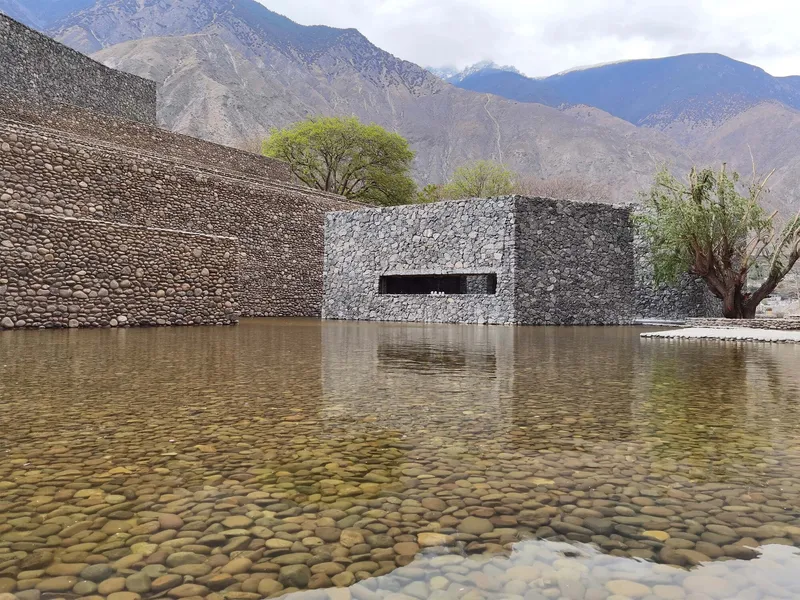
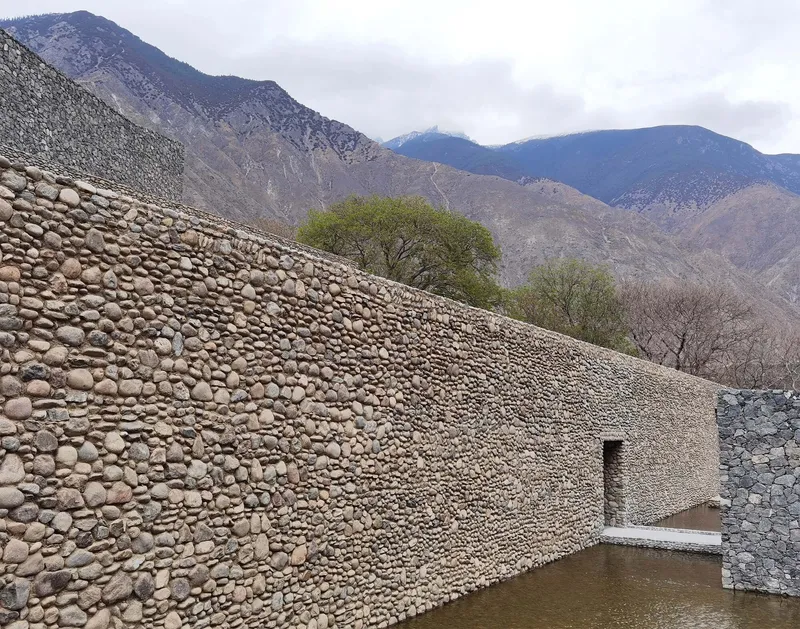
Where the gabion walls meet reflecting pools, the building achieves its most photogenic moments. The rough stone facades are doubled in still water, and the mountain ridgelines appear again in miniature. Single recessed doorways punctuate the walls, creating deep shadows that read as dark rectangles against the grey texture. These compositions are simple and repetitive, but they work because the material is genuinely local and the water genuinely comes from the mountain above. There is nothing imported about the scene.
Landscape Integration
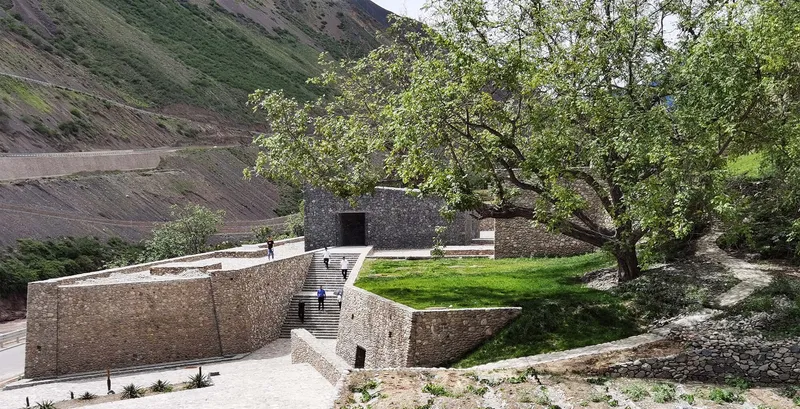
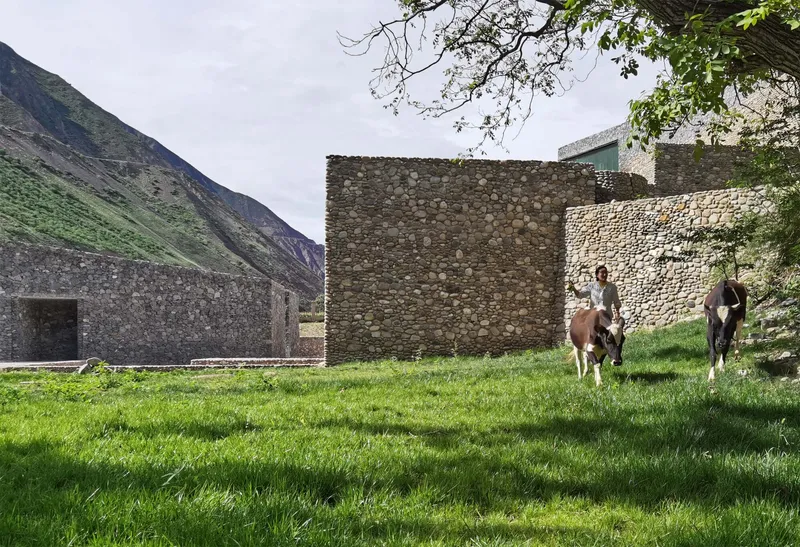
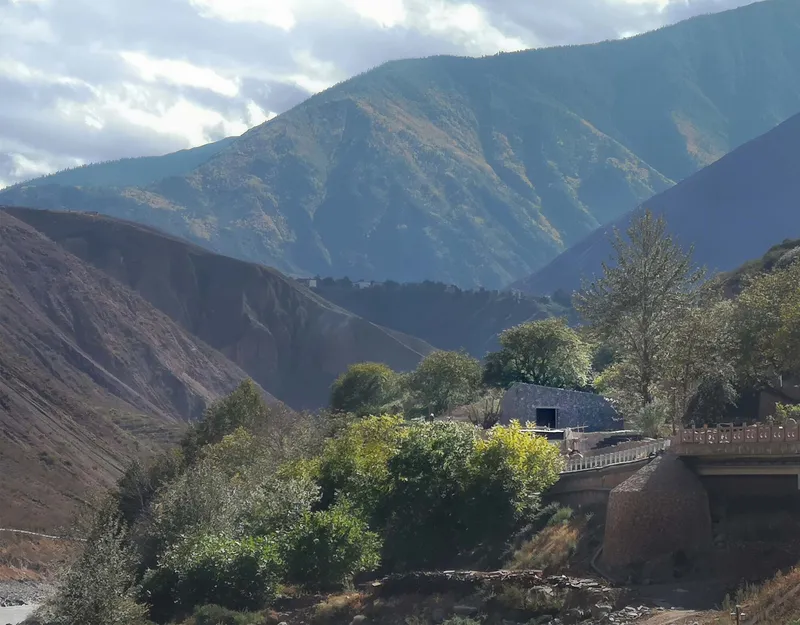
With the mountain at its back and the river in front, the winery acts as a physical link between the two, extending the terrain downward through its stepped form. Horses grazing on the lawn terraces, bare trees casting long shadows across stone walls, agave and cacti planted in cobblestone beds: the landscape is not manicured into submission. It is managed loosely, allowed to remain a working agricultural environment rather than a designed garden.
The site also contains the remains of an ancient water mill, and the architects have threaded new water channels through the complex that reference this older infrastructure. The building positions itself not as an arrival but as a continuation, one more layer of human occupation in a valley that has been farmed, mined, and prayed in for centuries.
Plans and Drawings
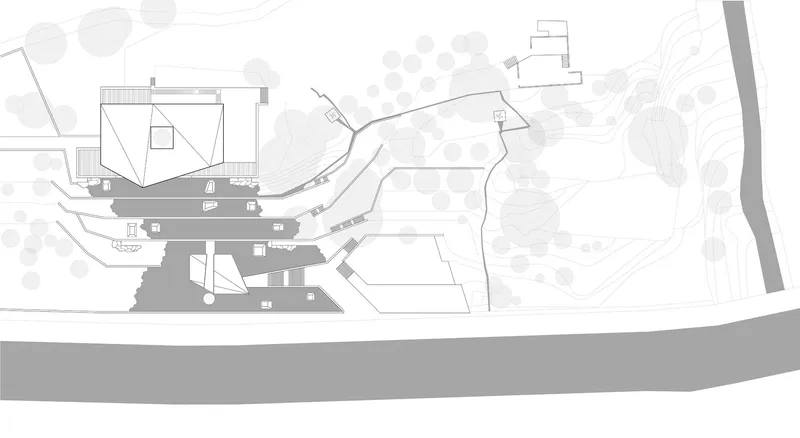

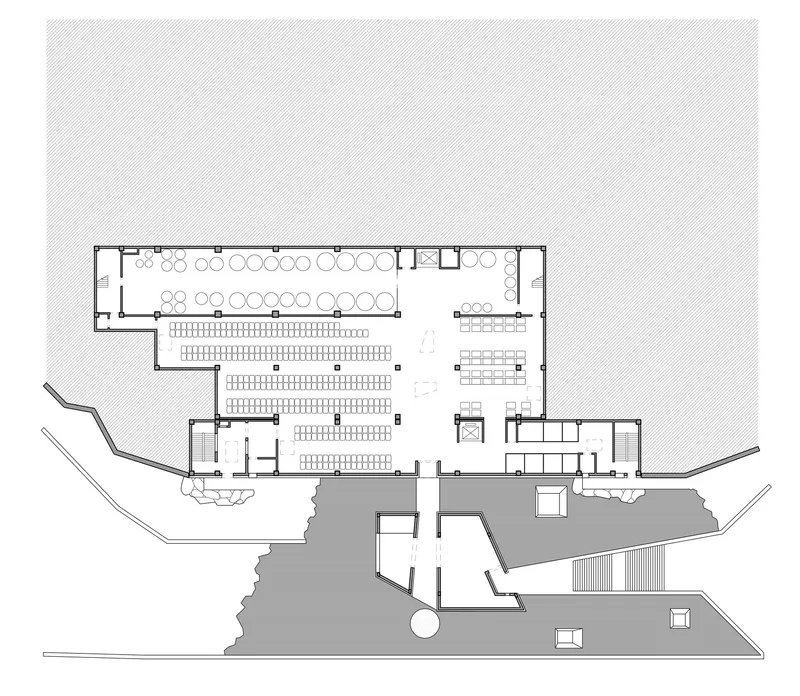
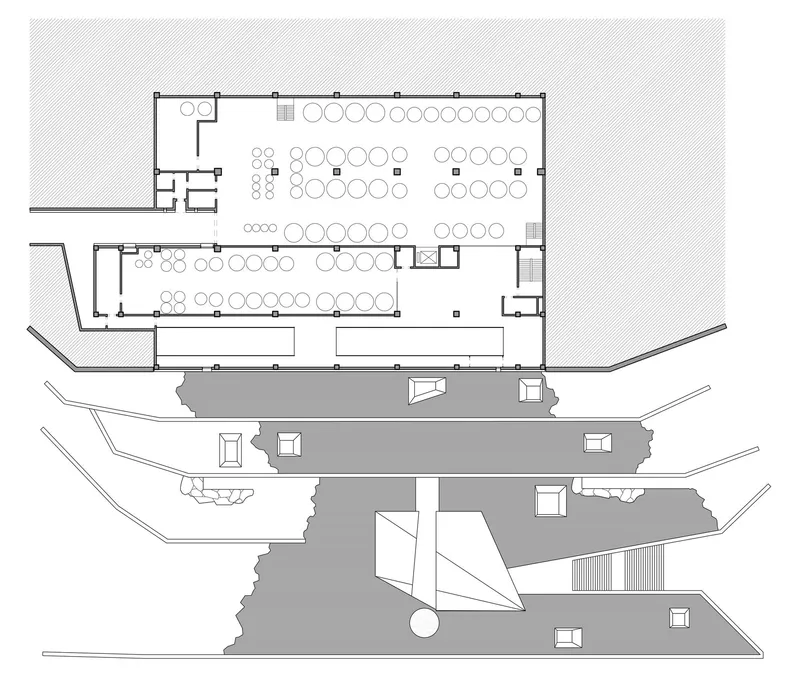
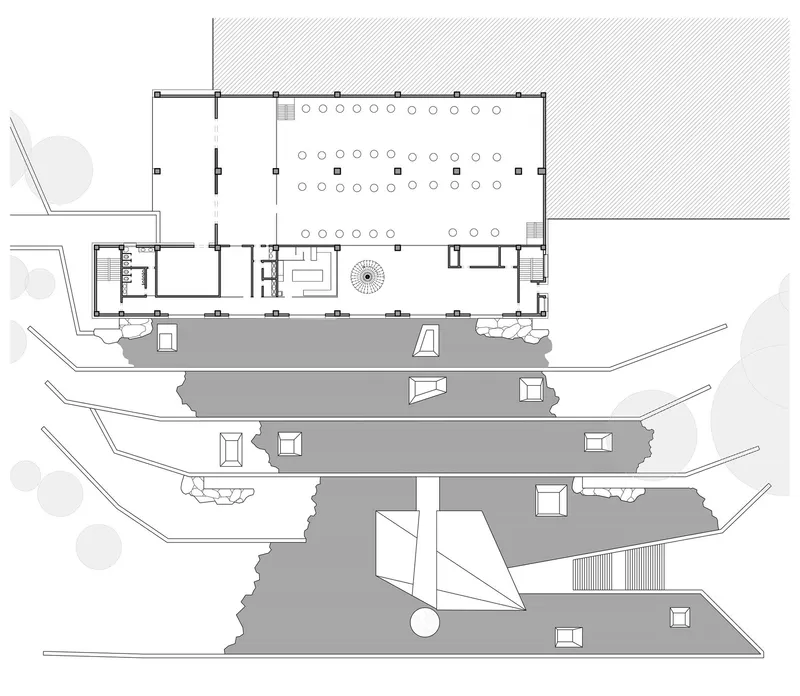
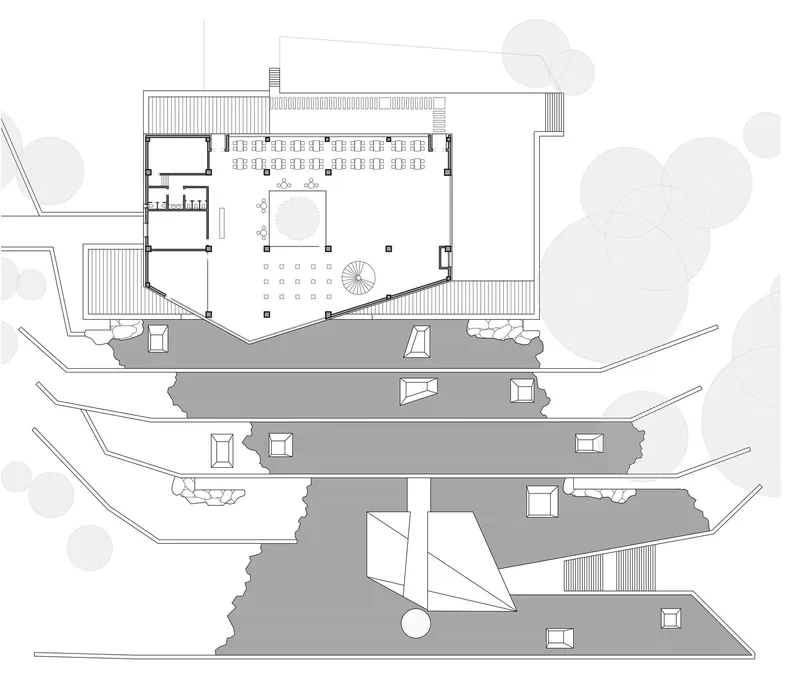


The site plan reveals the full logic of the terracing: building footprints follow the curve of the riverbank, with each level offset to preserve existing trees and respond to the natural contour. Floor plans show how the public volumes, with their auditorium seating and circular stairs, are kept separate from the linear production spaces below. The sections are the most revealing drawings, confirming that the arched cellars are fully buried within the hillside while the upper terraces open to the sky. The cascading profile reads as a geological cross-section, with architecture occupying the strata between surface and bedrock.
Why This Project Matters
Quzika 1865 Winery is rare in that it refuses to separate its architectural ambitions from its social ones. The building was conceived as an economic engine for the local Tibetan community, and its design decisions, from locally sourced stone to gravity-flow production to buildability by local labor, all serve that goal. There is no tension between the project's beauty and its utility. The terraced water roofs function as passive climate systems. The narrow passages slow visitors down so they spend more time, and more money, in the public areas. Form and program are aligned at every level.
More broadly, the project demonstrates what becomes possible when architects commit to reading a site with real depth. The salt fields, the Catholic church, the ancient water mill, the century-old trees: PL-T did not invent a concept and impose it. They found the concept already written into the landscape and made it buildable. In a moment when "contextual architecture" often means matching a neighboring facade's color palette, Quzika 1865 offers a more ambitious model. Context here means geology, hydrology, agricultural process, religious history, and economic need, all made legible through stone and water.
Quzika 1865 Winery by PL-T Architecture Studio. Located in Markam County, Tibet, China. 8,334 m². Completed 2021. Photography by Jianfeng Wang.
About the Studio
Share Your Own Work on uni.xyz
If projects like this are the kind of work you want to make, uni.xyz is a place to publish your own, find collaborators, and enter design competitions.


Popular Articles
Popular articles from the community


Jaramillo Van Sluys Arquitectura and Urbanismo Turn a Demolished Registry Lot in Quito into an Orchard Plaza
In Quito's Centro Histórico, a 2,800 m² plaza exposes the San Agustín convent wall and redraws its lost Augustinian orchard in volcanic stone.

Juan García Correa, John González and Claudia Rueda Sink a Circular Amphitheater into a Manizales Engineering Building
On the La Nubia campus in Manizales, Colombia, the S1 Building folds labs and offices into a hillside of ramped lawns that double as a campus route.

David Ortega Stacks a Two-Story Mexico City Penthouse Around a Steel Stair and a Pergola-Shaded Roof Terrace
In Colonia Roma, a 300 m² penthouse uses oak joinery, a planted steel stair and a slatted roof pergola to make a new-build apartment feel like a house.

longwave studio Reorganizes a 112 m² Tainan Apartment Around the Daily Routines of a Family and Two Cats
In Tainan, Taiwan, birch plywood, rust-red furniture and a freestanding plaster wall link arrival, storage, work and family life in one apartment.

Similar Reads
You might also enjoy these articles


LAVA Architecten Gives Vocational Education a Sawtooth-Roofed Face on a Mechelen School Campus
In Mechelen, Belgium, a 2,053 m² STEM school on a 6×6 m grid turns workshops and classrooms into rooms that can be rearranged as teaching changes.

KEMA Studio Turns a Derelict Marvila Attic into a 60 m² Lighthouse Apartment Above Lisbon
In Lisbon's Marvila district, a rebuilt roof, four skylights and two plywood volumes turn an unlivable attic into a bright home facing the Tagus.

Pixel Gardens: One Repeated Module Stacked Into a Terraced Social Housing Tower for Famagusta
Salem Bader's shortlisted housing tower builds a vertical neighbourhood from one repeated module, offsetting units to carve terraces, light and air.

Bao Huynh Watercolor Atelier: A Serene Art Retreat in Hội An
Bao Huynh Watercolor Atelier in Hội An blends multifunctional art spaces, sustainable design, local materials, and family-friendly living in a serene environment.

Explore Architecture Competitions
Discover active competitions in this discipline

Challenge to reimagine the Iron Throne

Photograph architecture without architects

Illustrate the lost glory of Angkor Wat - Render Challenge

Design challenge to reuse E-waste
Comments (0)
Please login or sign up to add comments
No comments yet. Be the first to comment!