

Place Pouchet Social and Cultural Center by MCBAD Architecture & Urban Design – A Human-Scale Urban Intervention in Paris
A compact cultural hub reconnecting fragmented urban surroundings, offering transparent, human-scale spaces that foster community interaction between Paris, Clichy, and Saint-Ouen.


The Place Pouchet Social and Cultural Center in Paris stands as a powerful example of how architecture can reconcile dense infrastructure with human-centered community spaces. Designed by MCBAD Architecture & Urban Design, the 550 m² project completed in 2024 creates a vibrant social anchor point within a complex urban environment, strengthening inter-neighborhood connections between Paris, Clichy, and Saint-Ouen.
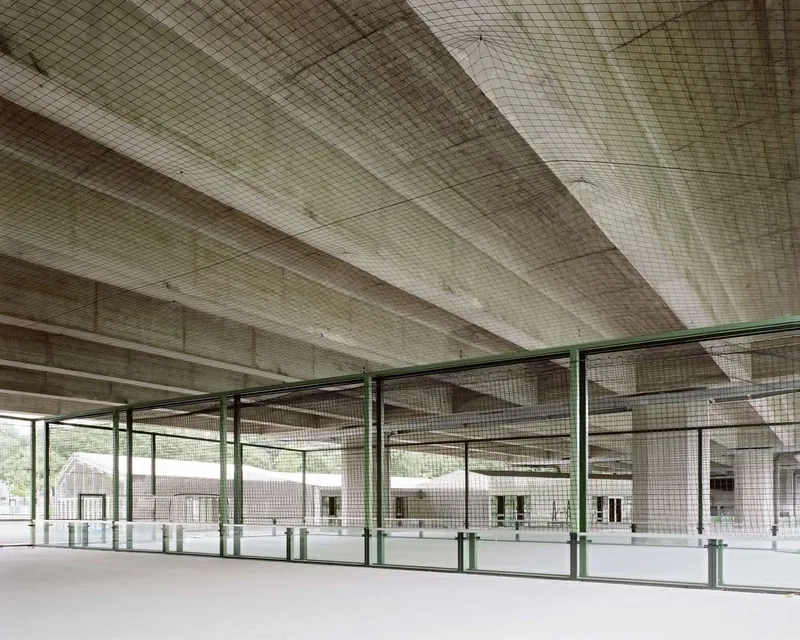


Reinventing Social Infrastructure in a Disrupted Urban Landscape
Located at a strategic threshold surrounded by large-scale infrastructure, the Social and Cultural Center redefines what it means to “live with infrastructure and nature.” The architects envisioned a micro-building scaled intentionally to the daily life of residents—an architectural counterpoint to the imposing road networks and urban structures that typically dominate the area.
Through this compact yet expressive design, the project reexamines the role of social architecture in areas marked by fragmentation, offering a space where people, infrastructure, and environmental considerations can coexist. By addressing the area’s physical and social separation, the building aims to restore continuity and invite community life back into a challenging urban setting.
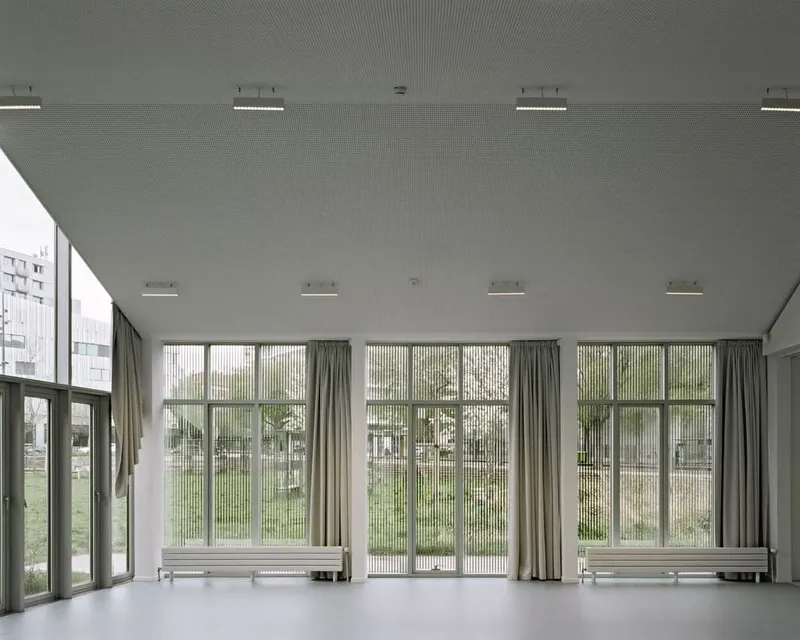
A Human-Scale Response to an Inhospitable Site
With its refined geometry, transparent surfaces, and sensitive urban positioning, the center responds to a location historically hostile to pedestrian activity. Its architecture introduces a more welcoming public presence, using openness and clarity to encourage engagement.
Large glass façades create visual permeability, allowing activity to spill out into the surroundings, while the interior spaces remain warm, flexible, and light-filled. The project thus provides a safe, familiar, and accessible environment, softening the impact of the surrounding infrastructure through thoughtful materiality and spatial organization.
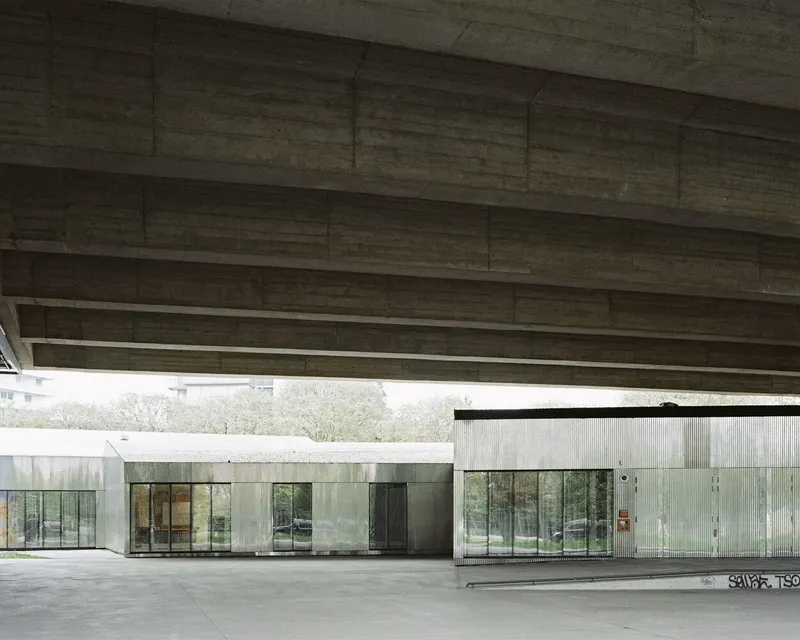
Connecting Communities Across Municipal Boundaries
Beyond its architectural qualities, the Place Pouchet Center acts as a connective urban device. Positioned at the interface of three municipalities—Paris, Clichy, and Saint-Ouen—it supports inter-municipal relationships and encourages shared uses between neighboring communities.
The project strengthens pedestrian pathways, enhances permeability, and invites cross-boundary circulation, transforming what was once an overlooked gap into a civic asset. This role is essential in a context where urban borders often create social and spatial discontinuities.


Architecture for Social Cohesion and Environmental Awareness
MCBAD’s design emphasizes environmental integration and urban resilience. The building’s scale, orientation, and transparency foster a natural dialogue between built and natural elements while bringing residents closer to civic resources. The center does more than house programs—it acts as an ecological and social mediator within a disrupted urban fabric.

All photographs are works of Julien Hourcade




Popular Articles
Popular articles from the community


Hill & Cross Opera: Sculptural Opera House Architecture Shaped by Tallinn’s Landscape and Identity
Hill & Cross Opera reimagines opera house architecture in Tallinn through its sculptural hill, civic plaza, glass wave and a luminous cross.

The Ocean Hive: Sustainable Architecture for a Self-Sufficient Civilization at Sea
The Ocean Hive imagines sustainable architecture at sea, where modular habitats, algae, wave power and ocean waste sustain a growing colony.
EW PARK: Sustainable Architecture Reimagines the Future of Urban Parking
EW PARK reimagines city parking as a modular wooden tower combining automation, solar energy, electric mobility, and adaptable urban design.
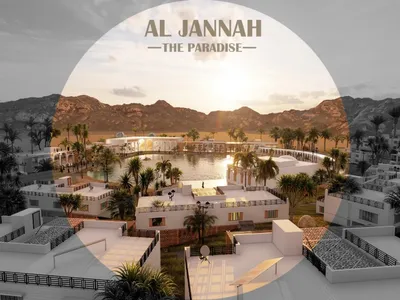
AL-JANNAH: Sustainable Architecture and Permaculture for Afghan Widows
AL-JANNAH uses sustainable architecture and permaculture to create resilient oasis of housing, learning, work and renewal for Afghan widows.


Similar Reads
You might also enjoy these articles


Hodi-Mandai Geram
Project Function: Preservation and revitalization of the Intangible heritage and socio-spatial identity of the Hodi by Housing, Cultural Memory Center, Sacred Grove, landscape, local tourism economy


Olio Towers: A Mid-Rise for Performers That Fuses Housing, Rehearsal, and Stage
Located blocks from Houston's Theater District, this modular tower stacks living units around a central performance atrium.

Oasis: Modular Green Housing Carved into Dhaka's Urban Fabric
A shortlisted Plugin Housing entry reclaims unauthorized settlements in Dhaka with stepped concrete volumes, green roofs, and ventilation-driven design.

Black Hole: A Floating Megastructure for the Post-Physical Era
Emiliano Mazzarotto envisions a spherical, self-scaling arena where e-sports, digital hotels, and holographic stadiums replace traditional public space.


Explore Architecture Competitions
Discover active competitions in this discipline



Challenge to reimagine the Iron Throne


Photograph architecture without architects


Illustrate the lost glory of Angkor Wat - Render Challenge


Design challenge to reuse E-waste
Comments (0)
Please login or sign up to add comments
No comments yet. Be the first to comment!