
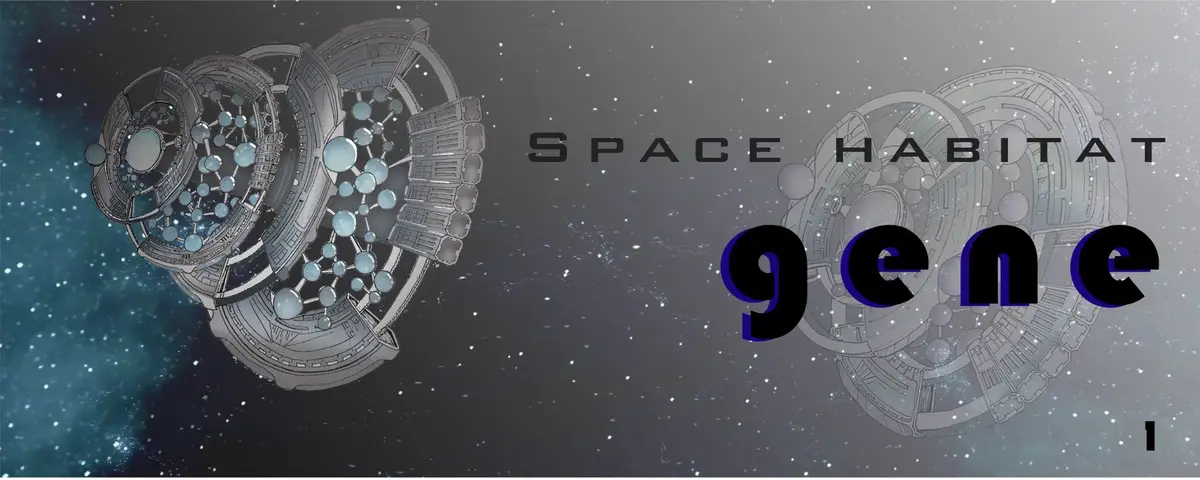
Gene: A Ring-Shaped Space Habitat Built Around Biology
Shortlisted in the Origyn competition, Gene encodes human life into an annular orbital architecture with closed-loop ecosystems and modular expansion.


What if the architecture of a space habitat could mirror the very code that makes us alive? Gene proposes exactly that: a ring-shaped orbital station whose structural logic borrows from DNA and ecological systems rather than from the steel-and-panel vocabulary of conventional space stations. The central motif is an annular configuration, a continuous loop that works both as a metaphor for life's continuity and as a practical geometry for orbital stability and centrifugal gravity generation.
Gene was shortlisted in the Origyn competition, which challenged designers to imagine architectures that extend humanity's reach into the cosmos. The project is the work of Shengyu Xia, Haowen Duan, Haibo Sun, and Lining Mei. Their response is a habitat organized around the idea of "sending human genes into space," distributing astronaut accommodations like genetic nodes across a modular ring structure bound together by a helical circulation spine that recalls the double helix of DNA.
A Closed-Loop Biosphere at the Core

Gene's most ambitious claim is that it functions not as a building but as a living system. The ecosystem diagram lays this out plainly: producers (plants), consumers (humans and animals), and decomposers (microorganisms) operate in a closed-loop cycle that recycles oxygen, water, and nutrients. This is terrestrial ecology transplanted into orbit, a self-sustaining biosphere designed for long-term survival in deep space without relying on continuous resupply from Earth.
The diagram traces energy flows between these three biological roles, making visible a metabolic architecture where waste from one system feeds another. It is a compact argument for why space habitation must be conceived ecologically rather than mechanically. The habitat does not merely contain life; it circulates it.
Programming Movement Across Research, Residence, and Recreation
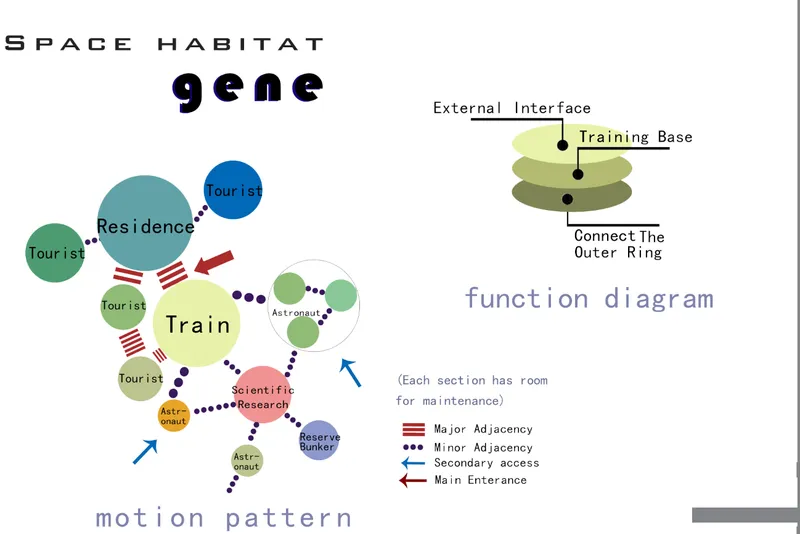

The functional diagram reveals how Gene organizes daily life through color-coded adjacency relationships. Residence zones, scientific research labs, tourist quarters, and entertainment areas are linked by transit routes that manage flow between gravity-enabled outer zones and microgravity inner zones. The motion patterns show a habitat that thinks carefully about how people move, not just where they sleep. A train system connects the major programmatic nodes, treating circulation as infrastructure worthy of its own design logic.
The ring-shaped plan reinforces this zoning. Scientific research, astronaut quarters, tourist accommodations, and vertical traffic shafts each claim distinct sectors of the annulus, color-coded for legibility. The central traffic shaft acts as the vertical circulation core, a tubular helix that is not merely symbolic but functional, modular, and expandable. This spine allows zones to be reconfigured or appended as populations grow or mission objectives evolve, giving the habitat a built-in capacity for architectural scalability.
The Helical Spine and Spherical Nodes
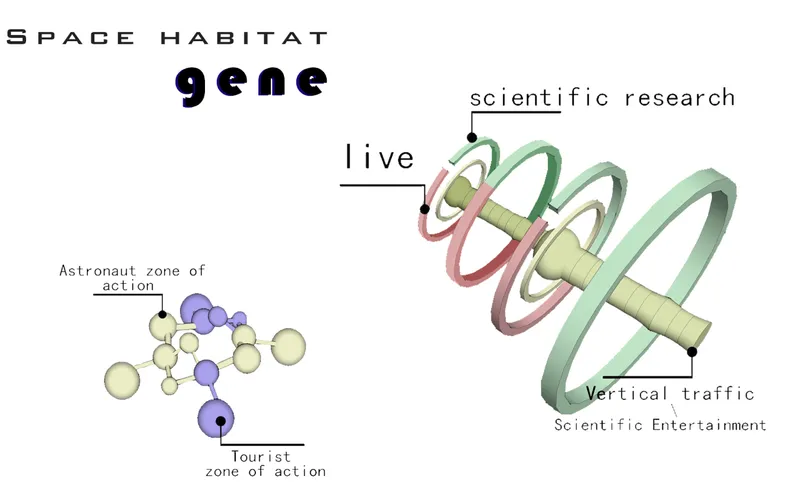
The axonometric diagram pulls Gene apart to show its spatial anatomy. Spherical volumes house astronaut and tourist zones, attached to the helical circulation spine like beads on a twisted strand. Research areas branch off at intervals, each module connectable through the central tubular structure. The outer ring rotates to generate artificial gravity via centrifugal force, enabling walking, exercise, and social activity in a familiar gravitational environment, while the central axis remains in microgravity for weightless experimentation and play.
This modular extension capability is Gene's structural insurance policy. Each ring module clips onto the spine, so additional zones or specialized functions can be added in stages without reworking the whole. The design anticipates that a space habitat is never finished; it grows, adapts, and responds to demands that its creators cannot fully predict. The DNA-like geometry becomes both a structural and organizational principle, encoding flexibility into the habitat's very form.
Why This Project Matters
Gene stands out because it refuses to treat space architecture as a purely engineering problem. By grounding its design in biological metaphors that actually perform, from the closed-loop ecosystem to the modular helix spine, it makes a case for habitats that grow like organisms rather than assemble like machines. The zoning strategy, which balances scientific research, mental health, and leisure, acknowledges that long-duration space living is as much a psychological challenge as a technological one.
For a student team working at the speculative edge of architecture, the project demonstrates real discipline in systems thinking. The integration of centrifugal gravity zones with microgravity cores, the ecological metabolism, and the modular scalability all point toward a habitat designed with life, for life, in a place where life has never existed before. Gene does not just imagine a future in space; it proposes the organizational DNA for building one.
View the Full Project
About the Designers
Designer: Shengyu Xia, Haowen Duan, Haibo Sun, and Lining Mei
Enter a Design Competition on uni.xyz
uni.xyz runs architecture and design competitions year-round that reward proposals with spatial conviction and real site intelligence.
Project credits: Planet Earth's First Space Habitat-gene by Shengyu Xia, Haowen Duan, Haibo Sun, and Lining Mei Origyn (uni.xyz).


Popular Articles
Popular articles from the community


FCC Arquitectura Expands a Portuguese Granite House with a Board-Marked Concrete Wing
In Portugal, JV House pairs a cleaned-up whitewashed and granite dwelling with a timber-shuttered concrete extension, courtyards and a garden pool.


The Amber Palace Opera: A Geological Fiction Surfaces on Tallinn's Baltic Waterfront
Pierre Brillard reimagines a Baltic legend as a public landscape, opera house, and waterfront promenade rooted in Tallinn's coastal identity.

Aquadapt: An Underwater Habitat That Rewrites Its Rooms by the Hour
Curved modules ring the seabed while one shell shifts from breakfast room to cinema, farm and football pitch as residents' needs change.

graciastudio Turns a Viewless Tijuana Lot Inward Around a Courtyard of Concrete, Timber and Trees
In Tijuana, Jorge Gracia's GA2 House stacks a timber-clad private floor over exposed concrete and replaces a missing view with a planted interior patio.

Similar Reads
You might also enjoy these articles

Cube Design Draws an Ecological Corridor Between Two Shenzhen Hills with the Nankai Building
Beside Shenzhen's container docks, the Nankai Building pairs stacked balconies with a climbing green screen to connect two hillsides across its height.

Praksis A and Studio Sted Bend a Red Timber Cabin Across the Granite of Norway's Southern Coast
On the southern Norwegian coast, a 105 m² cabin follows the rock on slender posts, pairing red cladding outside with pine, brick and plywood within.

David Ortega Stacks a Two-Story Mexico City Penthouse Around a Steel Stair and a Pergola-Shaded Roof Terrace
In Colonia Roma, a 300 m² penthouse uses oak joinery, a planted steel stair and a slatted roof pergola to make a new-build apartment feel like a house.

PARALELA and LB2 Thread a Public Walkway Through the Base of a Las Condes Residential Tower
In Las Condes, Santiago, the Hamlet Building gives its fenceless ground floor to a 70-metre wooded passage linking two streets and the metro.

Comments (0)
Please login or sign up to add comments
No comments yet. Be the first to comment!