
Plantation Rhythm: Architecture Rooted in the Grid of Cocoa Canopies
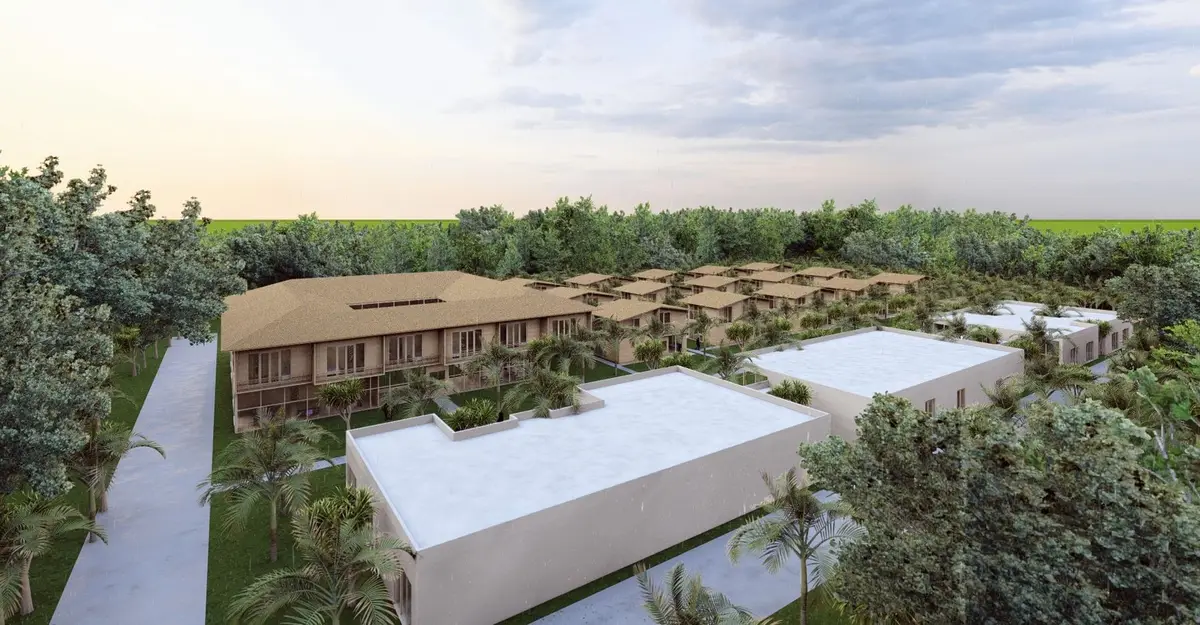
A 6x6 grid derived from cacao tree canopy diameters organizes buildings, pathways, and courtyards across Tabasco's cocoa heartland.


What if a building's floor plan took its cues not from a developer's spreadsheet but from the spacing of trees already on the ground? In Comalcalco, Tabasco, a region responsible for nearly 68% of Mexico's cocoa production, Mehtap Çelmeli proposes exactly that. "Plantation Rhythm" lays a 6x6 grid over the project site, its module derived from the average canopy diameter of local cacao trees. Architecture becomes a guest within the plantation, occupying the gaps between root systems and shade patterns rather than clearing them away.
Shortlisted in the Xocolatl competition, the project situates workshops, cafes, accommodation units, and learning spaces across historic cocoa fields. Drawing on Maya civilizational heritage and vernacular building logic, Çelmeli treats the landscape as both client and collaborator: the grid preserves the plantation's existing geometry while generating the spatial rhythm for every walkway, courtyard, and volume. The result is a masterplan where nature dictates proportion and architecture follows.
Timber, Thatch, and Rammed Earth as Plantation Vocabulary
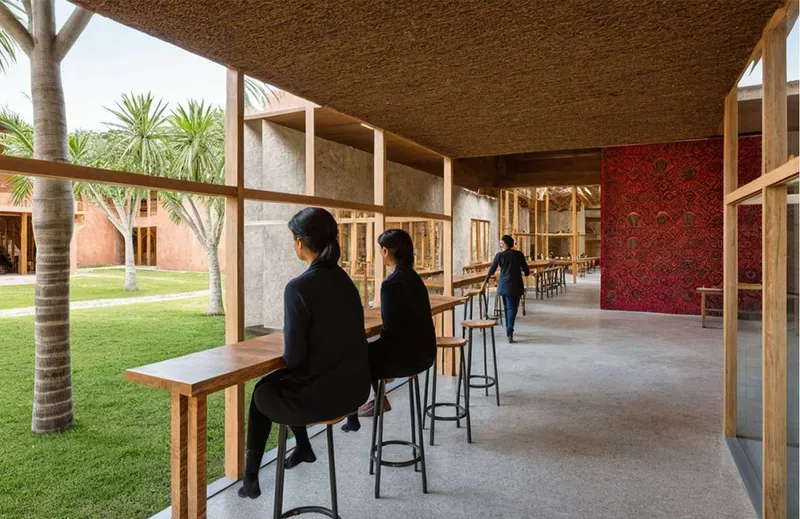
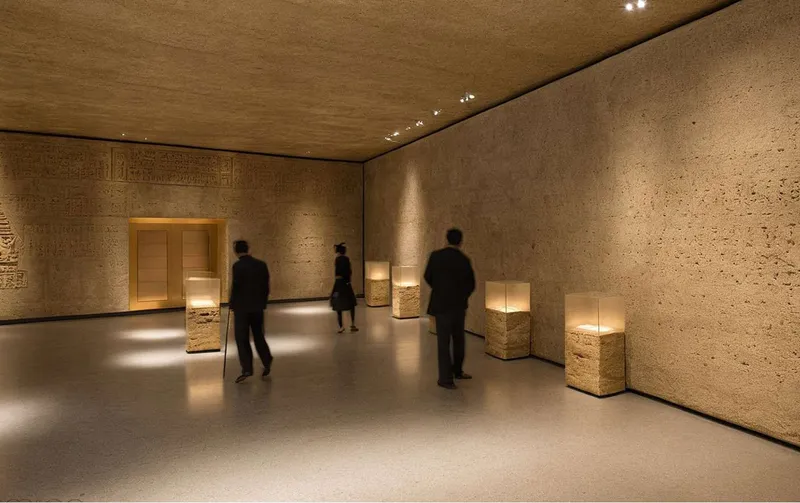
The covered bar area reveals the project's tectonic ambition: timber framing supports a woven ceiling that filters tropical light while remaining open to a palm-filled courtyard. There is no sealed envelope here, only a negotiation between shelter and exposure tuned to the region's hot, humid climate. The material palette stays deliberately close to the ground. Rammed earth walls appear in the gallery spaces, their layered texture providing thermal mass and a tonal warmth that echoes Tabasco's soil.
Inside the gallery room, illuminated stone plinths display artifacts against those same earthen walls, turning the act of exhibition into a meditation on provenance. Light enters sparingly, controlled to protect objects and maintain cool interior temperatures. Passive design techniques and locally sourced materials are not afterthoughts; they constitute the architectural language itself, reducing environmental impact while anchoring the project in its geographic context.
Colonnades and Canopies: Public Ground Between Built and Planted
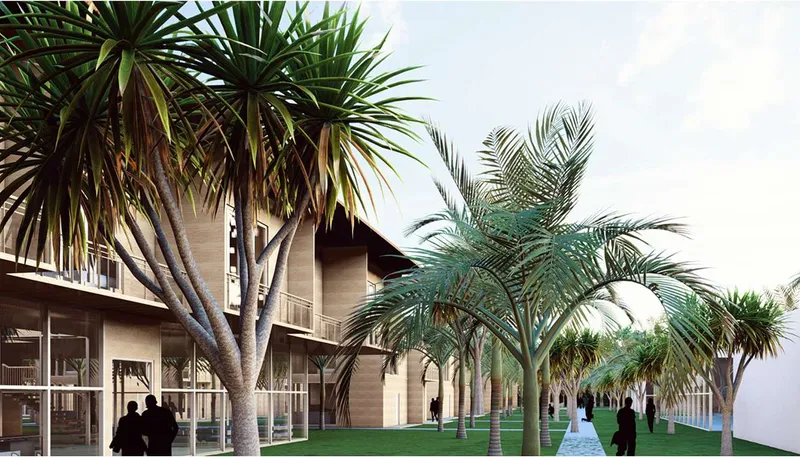
A stone colonnade frames a planted lawn, establishing a threshold condition that recurs throughout the scheme. Columns stand at the grid's intersections, marking the boundary between programmed interior space and the open plantation beyond. The proportions are restrained, heavy enough to register as architecture yet porous enough to let breeze and vegetation pass through. This is bioclimatic design at its most legible: structure as climate mediator.
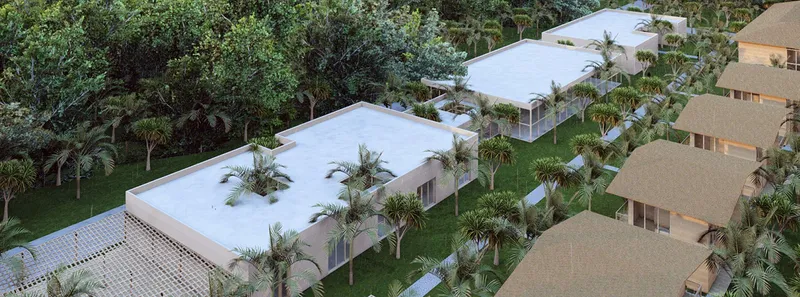
From above, the masterplan reads as a mosaic of white flat roofs punctuated by palm crowns alongside thatched timber pavilions. Two main access routes carve through the site, connecting accommodation, learning zones, and community hubs without severing the continuity of the cocoa rows. The aerial perspective makes the 6x6 grid unmistakable. Every building footprint, every courtyard void, aligns with the canopy module, confirming that the plantation's geometry preceded and governed every architectural decision.
Vertical Layering: Public Below, Retreat Above
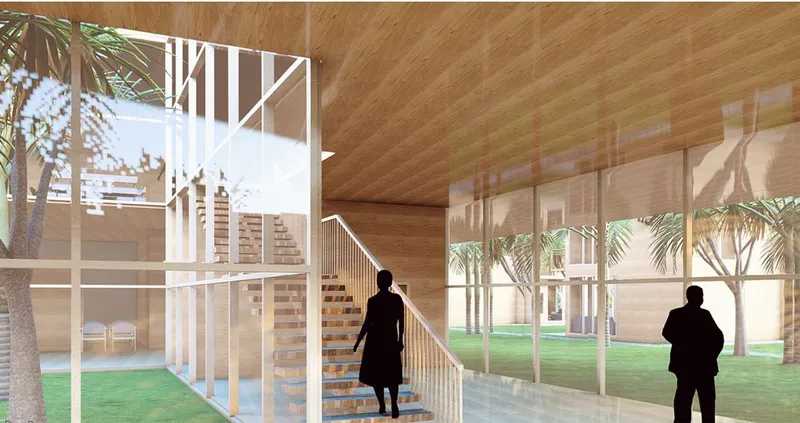
A double-height atrium with a timber ceiling and a white-framed staircase visible through floor-to-ceiling glass illustrates how Çelmeli manages vertical program distribution. Lower levels facilitate public interaction: workshops, cafes, and experiential spaces where visitors learn about cocoa cultivation and traditional practices. Upper levels pull back into quieter retreats, offering panoramic views across the plantation canopy. The section strategy keeps social energy at ground level while granting privacy upward, a simple hierarchy executed with clarity.
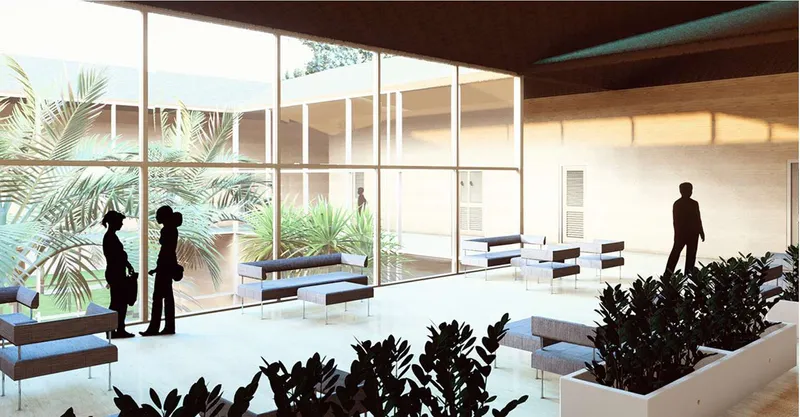
In the interior lounge, planted beds push through the floor plane, blurring the line between inside and out. Full-height windows open onto a palm-lined courtyard, maintaining the gentle visual connection to the landscape that defines every inhabited space in the project. Accommodation units are positioned for seclusion within the cocoa rows, framing specific views of the plantation while natural ventilation channels air through the building cross-sections. Comfort here is a product of orientation and material intelligence, not mechanical systems.
Courtyards as Cultural Connectors
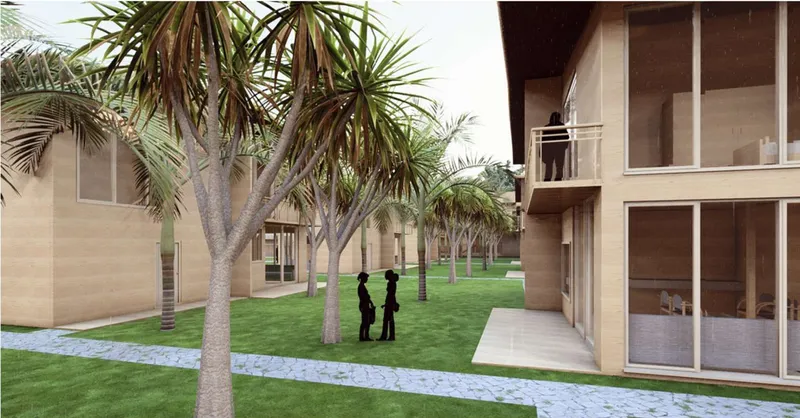
The courtyard rendering distills the project's thesis into a single scene: patterned pathways, timber-clad volumes, and palm trees coexisting within a shared spatial field. Two figures stand at the threshold between pathway and garden, occupying exactly the kind of pause-point that Çelmeli designs for throughout the scheme. Open courtyards pay homage to vernacular construction logic and serve as the social glue between programmatic zones. They invite visitors to move, stop, and absorb a landscape shaped by centuries of agricultural practice.
Earthy tones and bamboo-inspired geometry reinforce the cultural dimension without lapsing into pastiche. The architectural language is contemporary in its detailing yet rooted in the proportional system of the plantation itself. By allowing the grid of cacao canopies to govern form, texture, and spatial sequence, Çelmeli positions architecture as an instrument of storytelling, one calibrated to Tabasco's cocoa heritage.
Why This Project Matters
"Plantation Rhythm" offers a compelling model for designing within productive agricultural landscapes. Rather than treating the site as a blank canvas, Çelmeli accepts the constraints of the existing cocoa field and converts them into generative design rules. The 6x6 canopy grid is more than a clever conceit; it enforces discipline on building footprint, pathway alignment, and courtyard proportion, ensuring that every new structure respects the ecological and cultural systems already in place.
At a moment when sustainable architecture risks becoming a label rather than a practice, this project demonstrates what the term can actually mean: passive environmental strategies, locally sourced materials, and a masterplan logic drawn directly from the living landscape. The result is architecture that does not compete with its context but amplifies it, turning a visit to a cocoa plantation into a spatial experience as layered as the commodity it celebrates.
View the Full Project
About the Designers
Designer: Mehtap Çelmeli
Enter a Design Competition on uni.xyz
uni.xyz runs architecture and design competitions year-round that reward proposals with spatial conviction and real site intelligence.
Project credits: Plantation Rhythm by Mehtap Çelmeli Xocolatl (uni.xyz).


Popular Articles
Popular articles from the community


Co-Life: Senior Housing Design That Reconnects Older Adults With the City
Co-Life reimagines senior housing design through healing gardens, shared streets, workshops, and a sustainable community across generations.

Play: Fragments of Their World
Familiar architecture becomes modular playground design, creating safe spaces where displaced children can learn, connect, imagine and play.

Little Red Riding Hood: Architectural Design as a Journey Through Fear, Light, and Storytelling
Little Red Riding Hood reimagines the fairy tale through architectural design shaped by fear, light, scale, memory, uncertainty, and choice.

Co-life: Sustainable Architecture for Age-Friendly Community Living
Co-life reimagines sustainable architecture for seniors through courtyards, rammed earth, shared gardens, and spaces designed for belonging.

Similar Reads
You might also enjoy these articles

ALGAL REALM: A Bio-Integrated Lunar Habitat Design for Life Beyond Earth
ALGAL REALM reimagines lunar habitat design with algae-powered life support, 3D-printed regolith, and vertical living for a lunar future.

Cinema Futurismo: Futuristic Architecture Reimagining the Future of Cinema
Cinema Futurismo merges futuristic architecture, holographic projection, intimate seating, and landscape into a new social cinema.
Little Red Riding Hood: Architectural Design as a Journey Through Fear, Light, and Storytelling
Little Red Riding Hood reimagines the fairy tale through architectural design shaped by fear, light, scale, memory, uncertainty, and choice.
Playducation: Modular Architecture That Turns Play Into a Space for Learning
Playducation transforms modular architecture into a flexible world of play, learning, and healing for children in refugee settlements.


Comments (0)
Please login or sign up to add comments
No comments yet. Be the first to comment!