
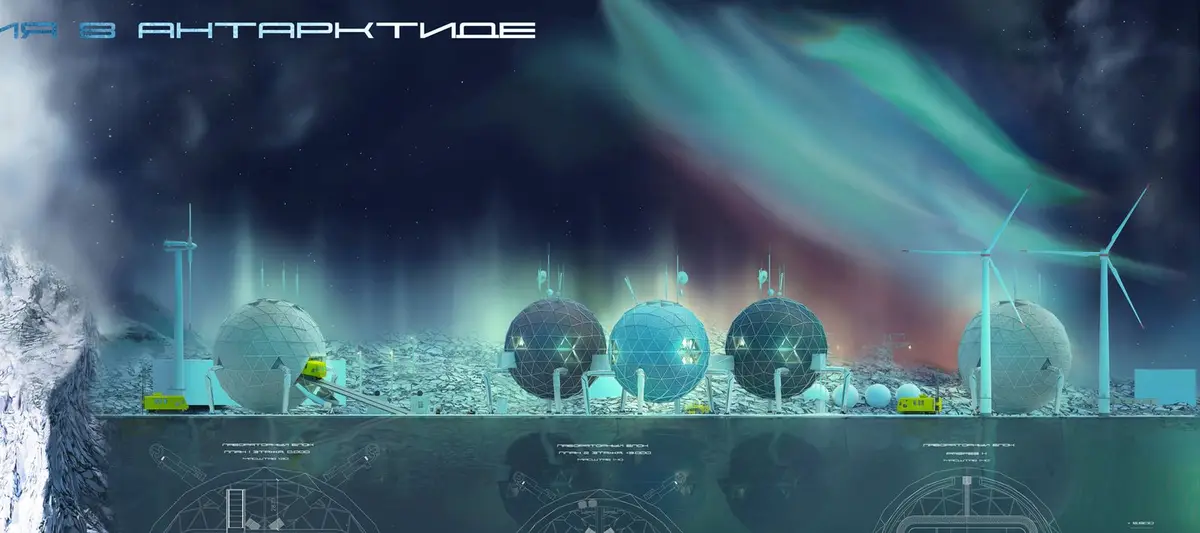
Polar Station: A Moving Geodesic Shell That Keeps Antarctic Research Stable Inside
Ekaterina Bondareva separates motion from inhabitation: a geodesic sphere travels across shifting ice while a stable research station rides within.


Most Antarctic bases are built on an assumption the continent keeps disproving: that ground stays put. Ice drifts, snow piles up against walls, and terrain shifts under fixed foundations until a station becomes a liability. Polar Station rejects that premise. Instead of anchoring research to one spot and fighting the consequences, it treats movement as the starting point. The result is a geodesic sphere that travels across the ice while the station inside holds still.
The project comes from Ekaterina Bondareva and is published on her uni.xyz profile. It sits within the tradition of Antarctic research station architecture but asks a sharper question than most entries in that field. The question is not how to survive in one place, but how to keep scientific work running while the place itself keeps changing. Her answer is a mobile, self-sustaining system. Its architecture depends on one clear move: separating the part that moves from the part that is lived in.
A Sphere That Moves So the Rooms Don't Have To
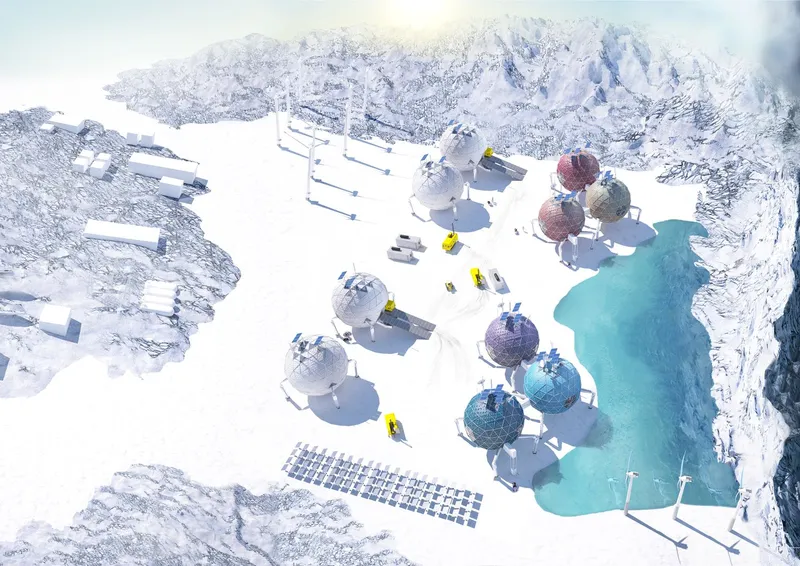
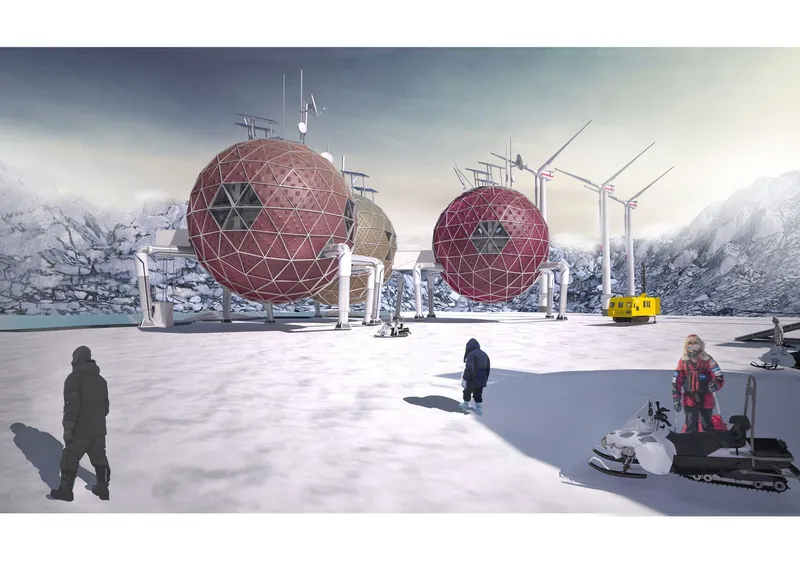
The geodesic envelope does two jobs at once: it is the station's protection and its means of travel. The outer sphere is designed to move across the icy terrain, while the internal volume stays fixed and level. This split between propulsion and inhabitation is the core of the concept. It is also what makes the proposal more than a stylistic dome. People working inside never feel the journey their building is taking.
The geometry earns its place through performance. A geodesic frame spreads loads evenly, so it resists wind pressure, snow loading and large temperature swings. A sphere also exposes the least surface area for the volume it holds, which cuts heat loss and helps the shell move through Antarctic storms aerodynamically. Integrated supporting legs add another layer of control. They allow the station to be raised, stabilised and repositioned, whether it is on the move or bracing against severe weather.
Two Blocks, One Thermal Logic: Laboratory and Living Quarters in Section
Inside, the programme is divided into two blocks. The Laboratory Block holds the research spaces, station control and monitoring, water treatment and technical services, plus a compact kitchen and dining area. The Living Block contains private sleeping quarters, sanitary and laundry facilities, a second set of station control interfaces, and climate-buffered circulation. Placing control in both blocks is a sensible kind of redundancy. In a place where moving between zones is never trivial, the station can be run from wherever the crew happens to be.
The sectional drawings are where the plan becomes convincing. The footprint is small, so efficiency comes from layering space vertically rather than spreading it out. Vertical circulation and internal insulation work together to keep the interior usable through extreme seasonal temperature swings. The buffered circulation zones matter here too. They act as thermal airlocks between rooms, so warmth is not lost every time someone crosses the station.
Building the Shell in Layers: From 3D-Printed Models to Insulated Skin
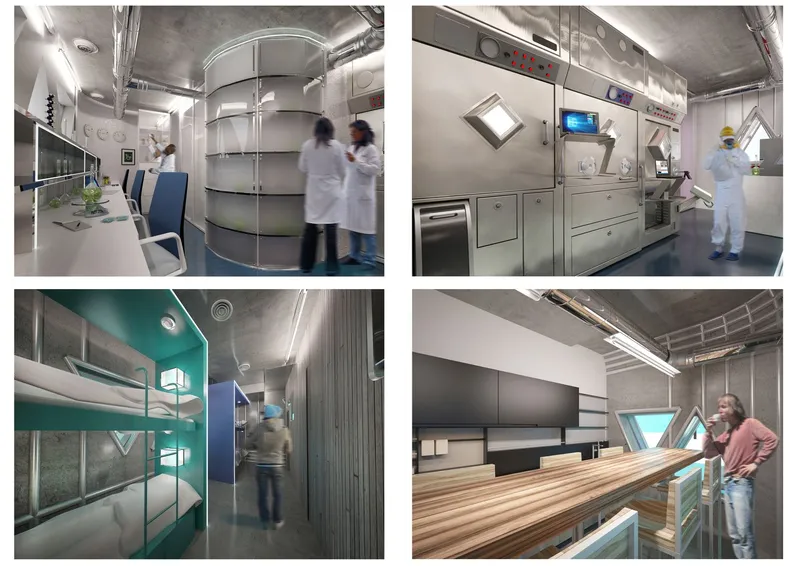
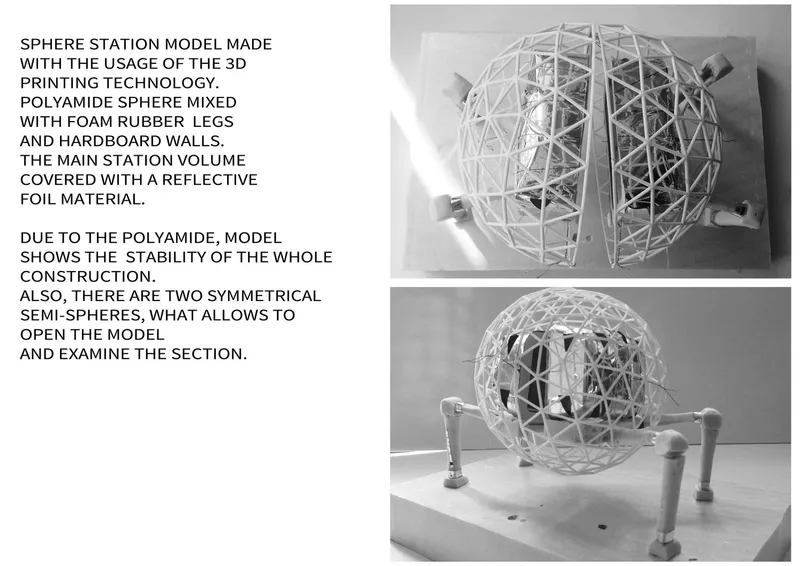
Bondareva tests the idea through physical models. These use 3D printing, polyamide structural members, foam rubber supports and reflective foil surfaces, all chosen to keep weight low while adding durability. That focus on lightness is not a modelling convenience. For a building meant to travel, every kilogram carries a cost.
The proposed envelope is built up layer by layer. Stainless steel liners form the inner face. Behind them sit polyethylene and wooden insulation panels, then polystyrene insulation blocks. Composite outer panels and flexible membranes form the outer skin. Each layer has a defined role in thermal stability or structural resilience. Read together, the build-up shows a designer thinking about the wall as a working system rather than a surface.
Sealing Up for the Journey: A Three-Stage Transformation
Before it moves, the station changes shape in three stages. First, it opens and prepares on its base. Next, protective shutters close over the openings in a partial transformation. Finally, rubber membranes seal the whole envelope. Each stage guards the sensitive interior against wind-driven ice particles, sudden temperature shocks and the structural stress of relocation. The sequence gives the building two distinct states: an open, working station at rest and a sealed vessel in transit.
Energy follows the same logic of independence. Solar arrays and wind turbines are built into the system to reduce reliance on external supply chains. That dependence is the weak point of any remote base, and it becomes even more acute for one that refuses to stay in one place.
Why This Project Matters
Polar Station is valuable because it changes the problem rather than polishing the usual answer. Fixed polar bases spend enormous effort resisting drift and snow build-up. This proposal accepts both as conditions and designs around them. Separating a moving shell from a stable interior is a clear, testable idea. It could reach beyond Antarctica to any setting where the ground cannot be trusted to stay still.
Questions remain about how a sphere of this size would actually move across ice, and those deserve rigorous engineering. What the project already shows is a designer who thinks in systems. Structure, insulation, transformation and energy are not treated as separate add-ons. Each one supports the central promise that research continues no matter where the station ends up. For a young designer, that coherence is the strongest part of the work.
View the Full Project
About the Designers
Designer: Ekaterina Bondareva
Enter a Design Competition on uni.xyz
uni.xyz runs architecture and design competitions year-round that reward proposals with spatial conviction and real site intelligence.
Project credits: Polar Station by Ekaterina Bondareva.


Popular Articles
Popular articles from the community


LT2A and OPEN Architectes Thread a Brick and Glass High School Through a Wooded Belgian Campus
In Braine-l'Alleud, a 3,000 m² wing for Collège Cardinal Mercier pairs pale brick with a glazed colonnade, deferring to a small chapel and a dense wood.

GROUP A Strips a 1969 Rotterdam Harbor Headquarters to Its Frame and Wraps It in Timber Louvers
In Rotterdam's M4H harbor district, Ferro Offices reuses a 1969 frame, adds one timber storey and reaches BREEAM-NL Outstanding.

Juan García Correa, John González and Claudia Rueda Sink a Circular Amphitheater into a Manizales Engineering Building
On the La Nubia campus in Manizales, Colombia, the S1 Building folds labs and offices into a hillside of ramped lawns that double as a campus route.

David Macias Steps a Doorless Stone and Plaster House Down a Tropical Colombian Hillside
In the humid hills of Colombia, Threshold House replaces the front door with an open void and terraces its 850 m² down the slope instead of fighting it.

Similar Reads
You might also enjoy these articles
Healing Façade: A Modular Chapel System That Restores Ethiopia's Sacred Forests
Winner of the Eco-Chapel competition, this circular timber façade collects water from air to rebuild soil and reforest degraded Ethiopian landscapes.
Kaffeebühnen: Where Coffee Shop Architecture Becomes a Civic Stage in Vienna
A linear sequence of timber boxes, transparent shells, and open yards turns the Viennese café tradition into a public performance space.
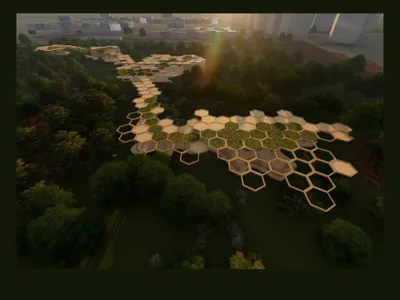
Eco Chapel: A Modular Forest Pavilion That Grows Like the Landscape It Protects
Hexagonal timber modules weave through existing trees, turning a chapel into a living system for prayer, education, and reforestation.


Urban Forest: A Vertical Ecosystem for 5,000 Workers in Singapore's Changi Business Park
Radially stacked pods and layered green decks turn a 7-acre plot into 47 acres of ecological workspace projected for 2040.

Explore Architecture Competitions
Discover active competitions in this discipline

Challenge to reimagine the Iron Throne

Photograph architecture without architects

Illustrate the lost glory of Angkor Wat - Render Challenge

Design challenge to reuse E-waste
Comments (0)
Please login or sign up to add comments
No comments yet. Be the first to comment!