
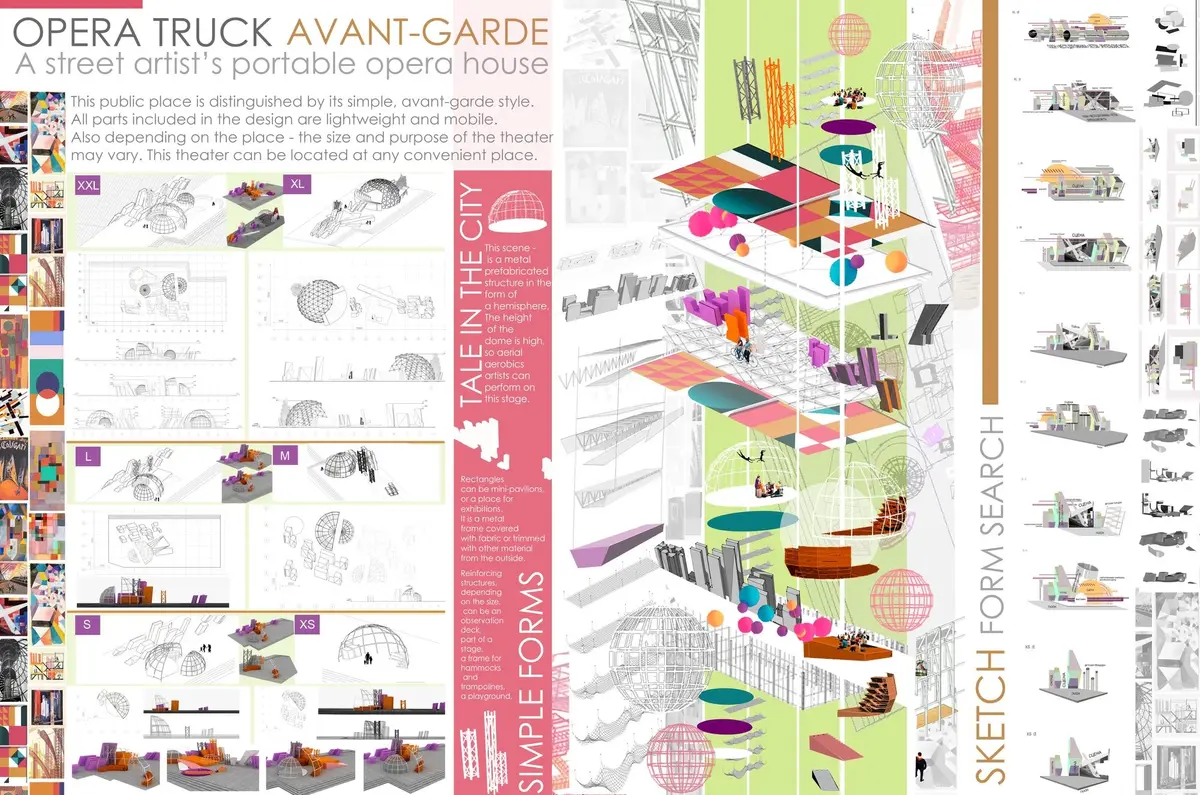
Tale in the City: A Portable Avant-Garde Theater That Scales from XXL to XS Across Urban Space
Sophia Moshi's shortlisted Opera Truck entry breaks opera into lightweight domes, netted platforms and modular frames that move across the city.


Opera has long been staged behind heavy doors, in buildings designed to signal that culture lives somewhere apart from the street. Tale in the City argues the opposite. It takes the theater apart into a kit of domes, suspended platforms, open grids and modular frames, then lets those pieces settle into whatever public space the city offers. The result is less a building than a portable cultural landscape, one that can be quiet and contemplative on one site and loud and festive on the next.
The proposal, titled Avant-garde Theater "Tale in the City", is by Sophia Moshi and was shortlisted in the Opera Truck competition. The brief asked for mobile performance architecture, and Moshi answers with a lightweight public installation that can be assembled in different locations, scaled to the event at hand, and read by passersby as a playful landmark rather than an institution.
A Theater Plotted Across the Street Map
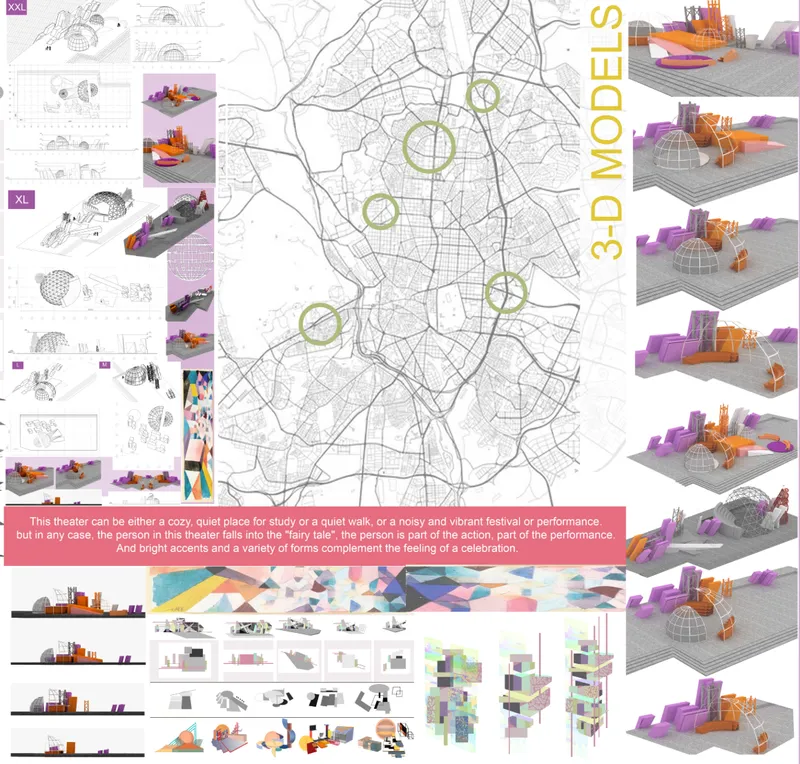
The opening board sets the project's terms: a street map ringed with green circles, surrounded by purple and orange massing models and plan drawings. The circles mark the theater as a network of possible stops rather than a single address. That shift matters. Once the venue is understood as something that moves, the question changes from what a theater should look like to how it should behave in each place it lands.
Moshi's answer is adaptability. Depending on its location, the installation can act as an exhibition space, a quiet retreat or a full public performance venue, which gives it a real chance of activating underused corners of the city instead of competing with established cultural districts.
Five Netted Levels Stacked for Simultaneous Use
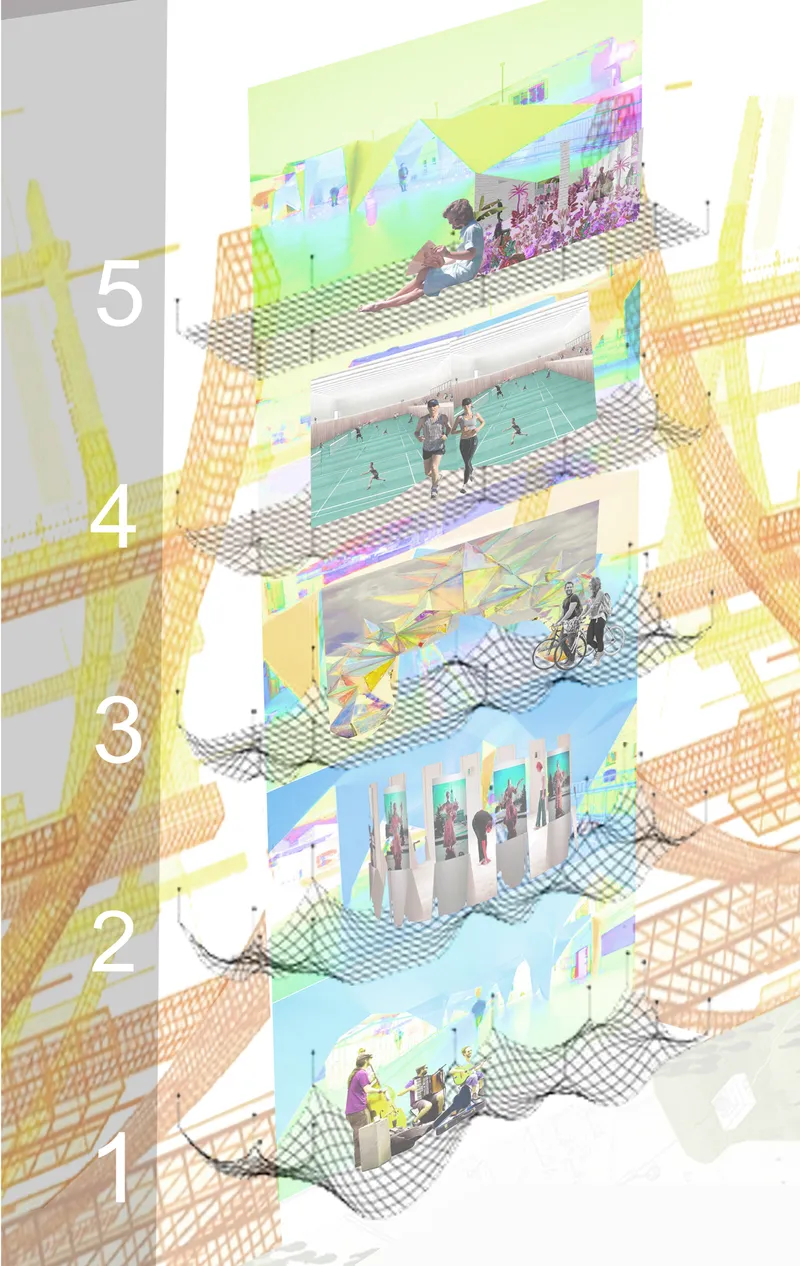
The exploded axonometric pulls the structure into five stacked levels, each with netted floors and people engaged in different activities against translucent colored backdrops. This is where the project's social ambition becomes spatial. Rather than one audience facing one stage, the section allows several groups to occupy the frame at once, watching, lounging, climbing or simply passing through.
The netted floors carry much of the idea. They keep the structure visually porous, let light and sightlines run vertically through the stack, and turn the act of standing on the building into part of the experience. The theater works as gathering place, observation platform and recreational environment as much as a stage.
A Size Range from XXL to XS
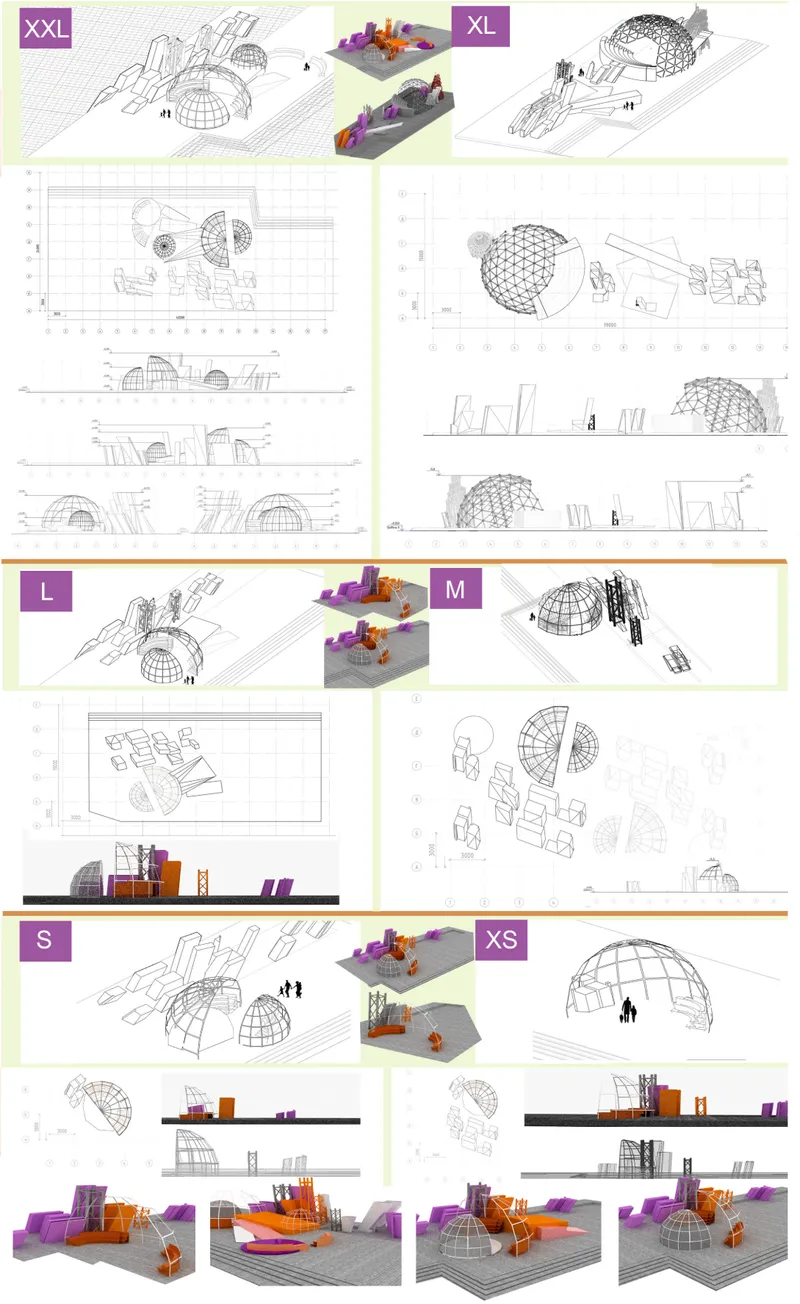
The most practical sheet in the set lays out domed theater configurations in sizes from XXL to XS, supported by plans, elevations, axonometrics and orange and purple models. Labelling the variants like clothing sizes is a smart move: it treats the theater as a product line calibrated to the occasion rather than a one-off object.
Smaller arrangements suit intimate artistic gatherings, while the larger ones can take on festivals, opera performances or multimedia installations. For a mobile brief, this graduated system answers the real constraint, which is that no two urban sites offer the same footprint, and no two events draw the same crowd.
Wireframe Spheres, Steel Towers and Tiered Orange Seating
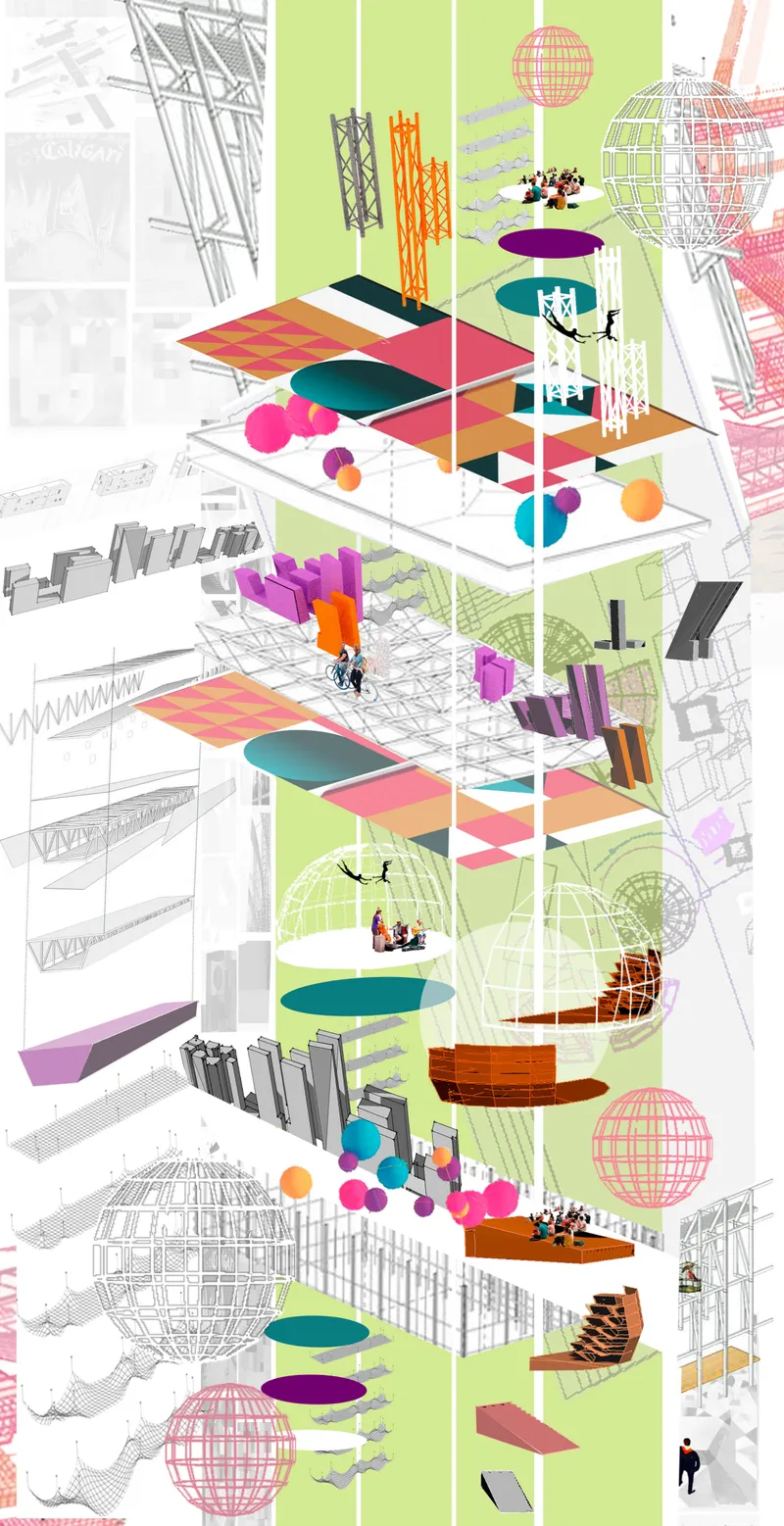
The collage axonometric shows the full vocabulary in play: layered platforms, wireframe spheres, steel towers and tiered orange seating, with small figures gathered on every level. The spheres read as the project's signature, light enough to feel temporary yet distinctive enough to register from a distance.
The vivid palette does deliberate work. Opera houses tend to project formality; this composition projects invitation. By leaning into color and open frameworks, the design lowers the threshold for people who would never buy a ticket to a conventional venue, and it makes the components easy to read as interchangeable parts that can be rearranged to fit a site.
Form-Searching Through Sketch Models
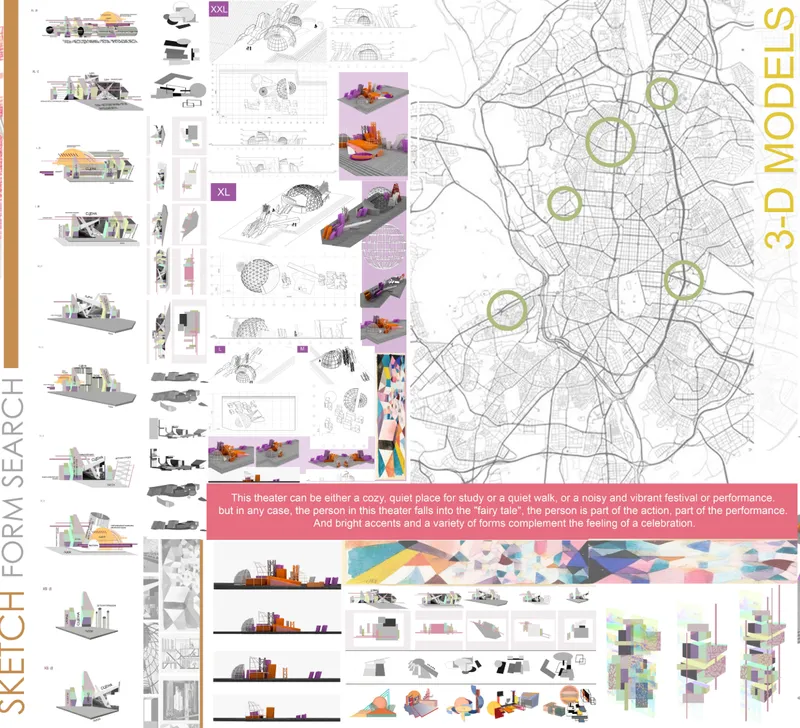
The final board pairs sketch form-search models with the green-circled street map, 3-D model drawings and a pink text banner. Showing the process alongside the outcome is useful here, because it reveals how the domes and frames emerged from iteration rather than arriving as a fixed image. The return of the map ties that formal experimentation back to the city, reminding the viewer that every variation is meant for a specific kind of place.
Why This Project Matters
Tale in the City takes the Opera Truck brief beyond simple mobility and asks what a theater could become if it belonged to the street. Its strongest contribution is the pairing of a modular kit with a clear sizing logic, so the playful image rests on a system that could plausibly respond to very different sites and audiences.
The project also makes a case for cultural infrastructure as social infrastructure. A structure that people can climb, sit on and look out from during the day, then fill with performance at night, earns its place in public space continuously rather than only during showtimes. That is a valuable provocation for any city trying to bring culture closer to everyday life.
View the Full Project
About the Designers
Designer: Sophia Moshi
Enter a Design Competition on uni.xyz
uni.xyz runs architecture and design competitions year-round that reward proposals with spatial conviction and real site intelligence.
Project credits: Avant-garde Theater "Tale in the city by Sophia Moshi Opera Truck (uni.xyz).


Popular Articles
Popular articles from the community


U.GA Architects Wraps an Oval Rooftop Pool in Curved Board-Formed Concrete on Busan's Jeollidan-gil
In Busan's Jeonpo-dong, a 454 m² mixed-use block stacks a neighborhood facility, guest rooms and an oval rooftop pool inside spiraling concrete walls.

Architekt Andreas Gruber Scatters 23 Dark Timber Chalets Across a South Tyrolean Forest Edge
In Molini di Tures, Amonti Chalets breaks a resort into a hamlet of gabled timber houses, with parking, storage and services pushed into the slope.

LT2A and OPEN Architectes Thread a Brick and Glass High School Through a Wooded Belgian Campus
In Braine-l'Alleud, a 3,000 m² wing for Collège Cardinal Mercier pairs pale brick with a glazed colonnade, deferring to a small chapel and a dense wood.

David Macias Steps a Doorless Stone and Plaster House Down a Tropical Colombian Hillside
In the humid hills of Colombia, Threshold House replaces the front door with an open void and terraces its 850 m² down the slope instead of fighting it.

Similar Reads
You might also enjoy these articles
Healing Façade: A Modular Chapel System That Restores Ethiopia's Sacred Forests
Winner of the Eco-Chapel competition, this circular timber façade collects water from air to rebuild soil and reforest degraded Ethiopian landscapes.
Kaffeebühnen: Where Coffee Shop Architecture Becomes a Civic Stage in Vienna
A linear sequence of timber boxes, transparent shells, and open yards turns the Viennese café tradition into a public performance space.
Eco Chapel: A Modular Forest Pavilion That Grows Like the Landscape It Protects
Hexagonal timber modules weave through existing trees, turning a chapel into a living system for prayer, education, and reforestation.


Urban Forest: A Vertical Ecosystem for 5,000 Workers in Singapore's Changi Business Park
Radially stacked pods and layered green decks turn a 7-acre plot into 47 acres of ecological workspace projected for 2040.


Comments (0)
Please login or sign up to add comments
No comments yet. Be the first to comment!