

Natura Futura and Juan Carlos Bamba Build a Floating Home to Save a Vanishing River Village in Ecuador
La Balsanera revives centuries-old floating traditions on the Babahoyo River using local timber, recycled materials, and modular porticos.


Two hundred floating houses once lined the Babahoyo River in Ecuador, serving as homes, workshops, and rest stops along the commercial route between Guayaquil and Quito. Today, only 25 remain. Government relocation policies and the decline of river trade have gutted a way of life that Ecuador itself recognizes as intangible human heritage. La Balsanera, designed by Natura Futura Arquitectura and Juan Carlos Bamba, is a 70 square metre floating house built for a family of three who have lived on the water for more than three decades. It is not a museum piece. It is a working home with a boat workshop, a food preparation terrace, and a deliberate argument that floating architecture deserves a policy framework, not a death sentence.
What makes this project genuinely interesting is the economy of its logic. The architects took an existing 6m x 7m platform, extended it two metres on each side, and organized the entire program around modular wooden porticos spaced at two-metre intervals. Materials from a Sharjah Architecture Triennial exhibition were reused to build the house, closing the loop on what would otherwise have been ephemeral construction waste. The result is a structure that looks like it belongs on the river because it was designed by people who understand that this river is not just a site; it is a livelihood.
A Village Seen from Above
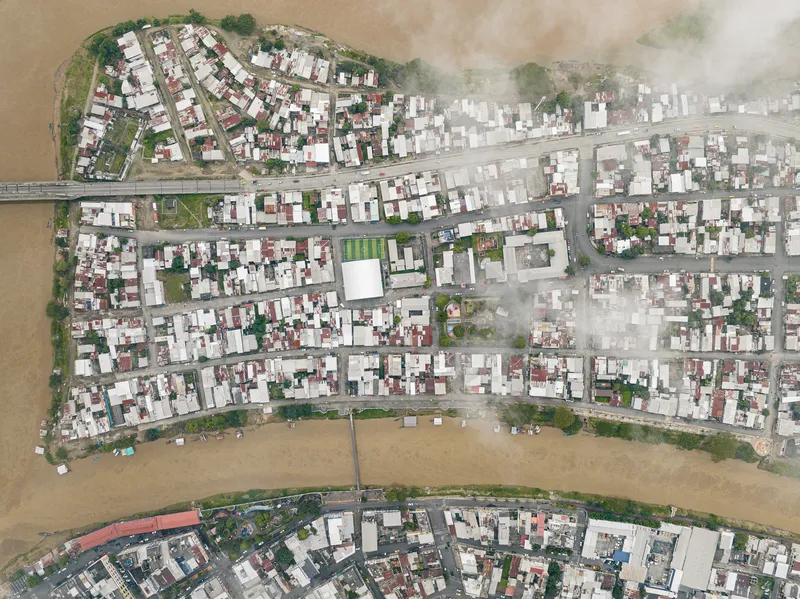
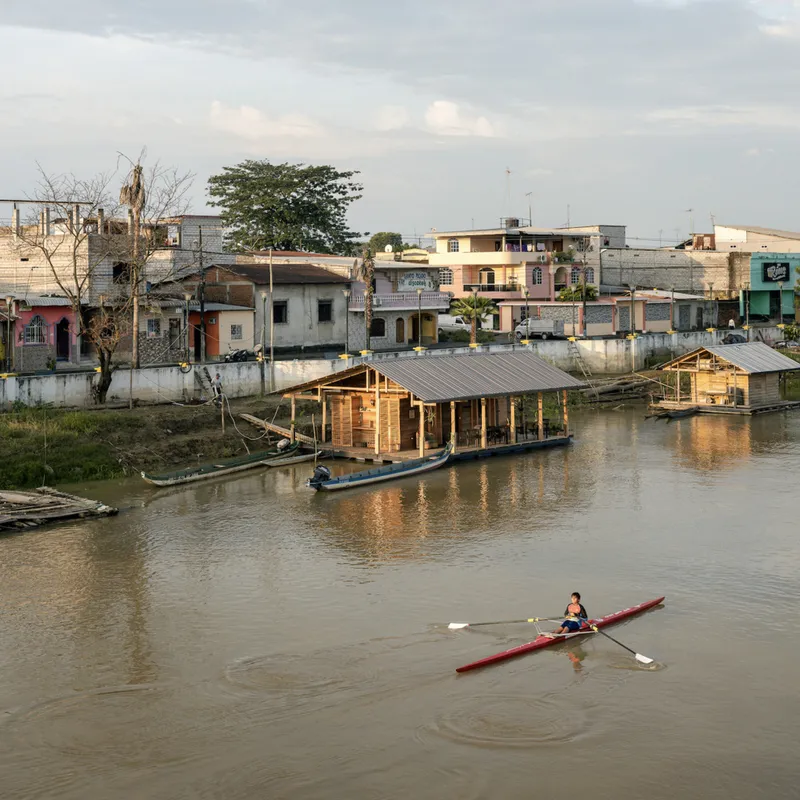
The aerial view of Babahoyo makes the stakes legible. Dense residential blocks press against a winding river, and the floating structures cling to the water's edge like a footnote to the city's built fabric. The dusk shot, with a lone rower passing two timber pavilions, captures both the beauty and the fragility of this settlement pattern. These are not houseboats in the recreational European sense. They are permanent dwellings for families whose economic activity depends on proximity to water.
Context matters here because the design decisions in La Balsanera are responses to a specific social and environmental pressure. The architects are not proposing floating architecture as a novelty. They are trying to keep an existing community alive by demonstrating that its housing typology can be improved, not replaced.
Timber Frame and Corrugated Skin
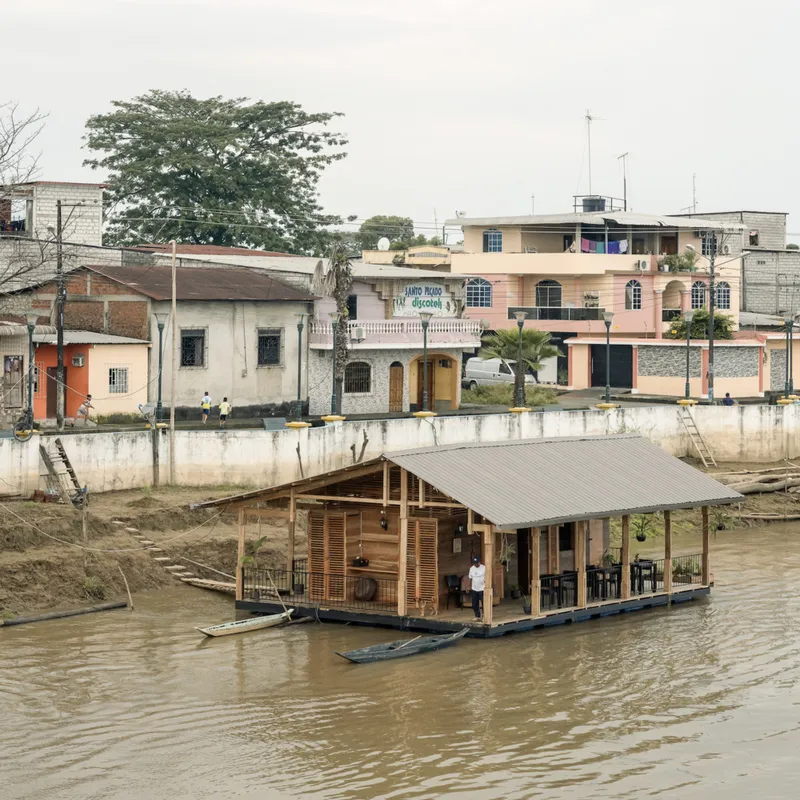
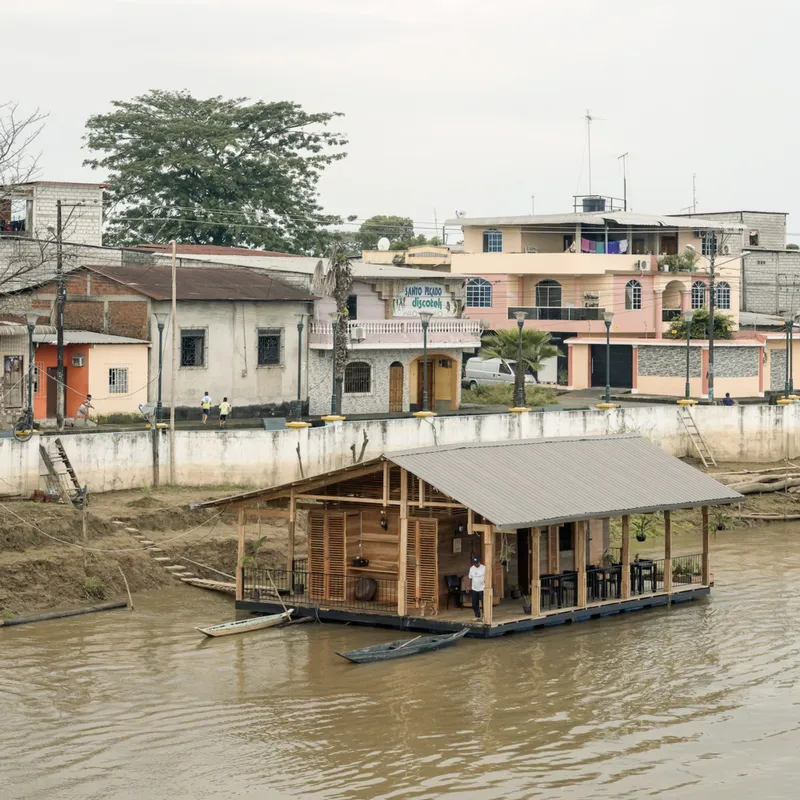
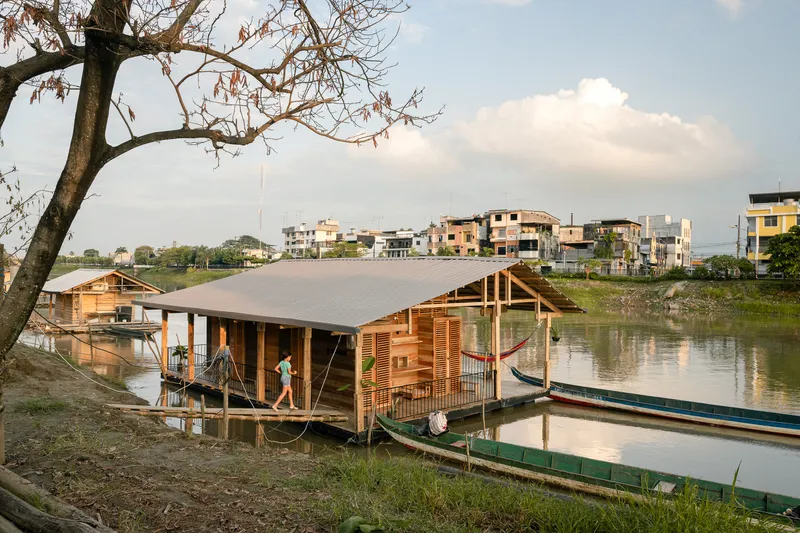
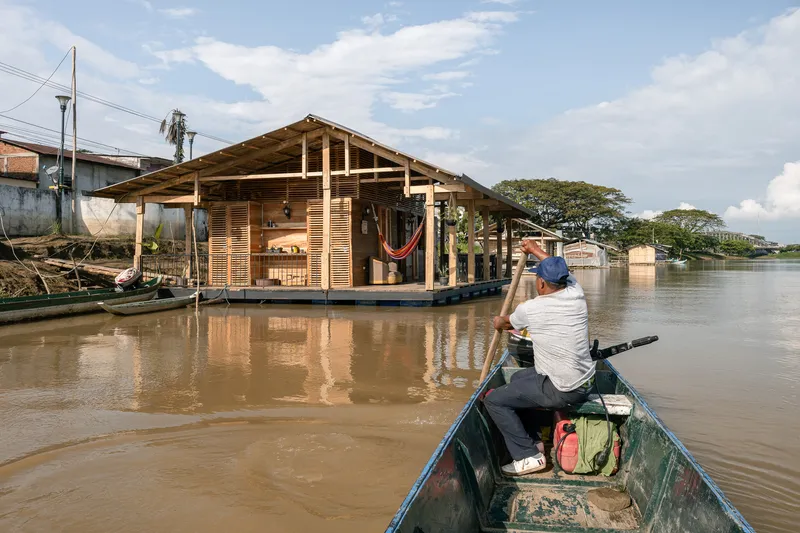
The structural system is visible from every angle: local wood porticos form a gabled truss that repeats every two metres, creating a rhythm that is both structural and spatial. A corrugated metal roof keeps rain out, while recycled wood chazas, the traditional slatted openings known locally by that name, handle ventilation and light filtration. The materiality is honest to the point of being blunt. There is no cladding concealing the frame, no finish coat smoothing over the joints.
The gabled profile and the louvered walls give La Balsanera a lantern-like quality during the day, when light filters through the slats, and an even stronger presence at night when the interior glow turns the whole structure into a signal on the dark river. The corrugated roof may not win beauty contests, but it performs. In a region with heavy seasonal rains, pragmatism is not a compromise; it is the design.
Life on the Deck
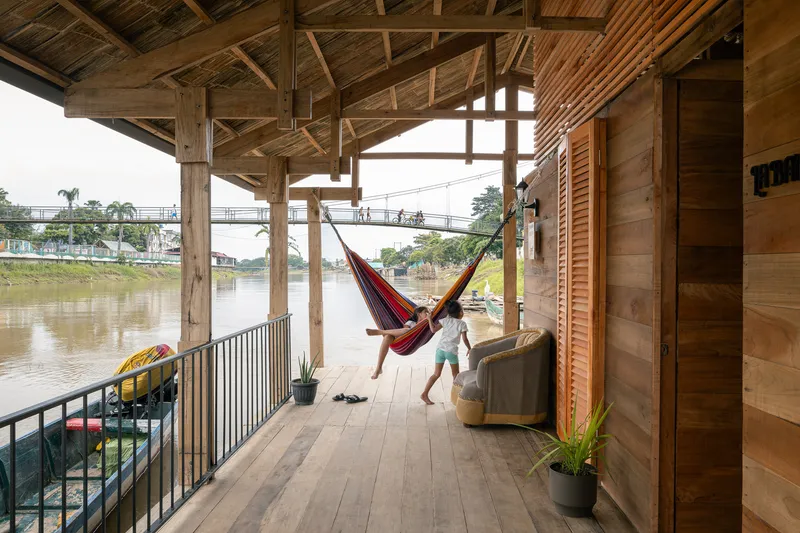
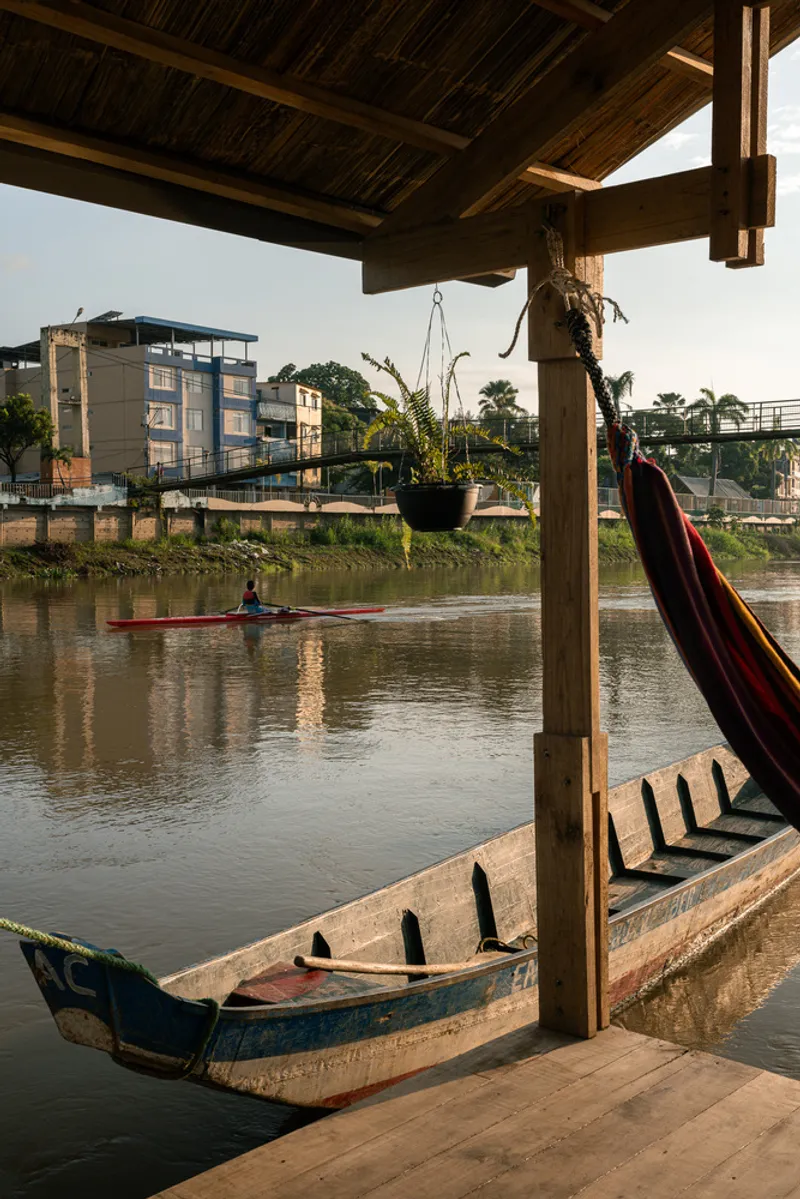
The covered deck is the social heart of the house. A hammock strung between columns, a wooden canoe moored at the edge, the exposed roof framing overhead: these images describe a space that is simultaneously domestic and productive. Teresa prepares food here for sale to passing boats and visitors. The terrace facing the river doubles as a docking point for tourist vessels, creating an economic interface between the family and the broader community.
The architects understood that for this family, living space and working space are the same thing. Separating them would have been a design failure. Instead, the productive terrace extends the platform directly into the river's activity, and the overhanging roof provides shade without enclosure. It is a porch, a market stall, and a dock in one gesture.
Interior Warmth in Modest Means
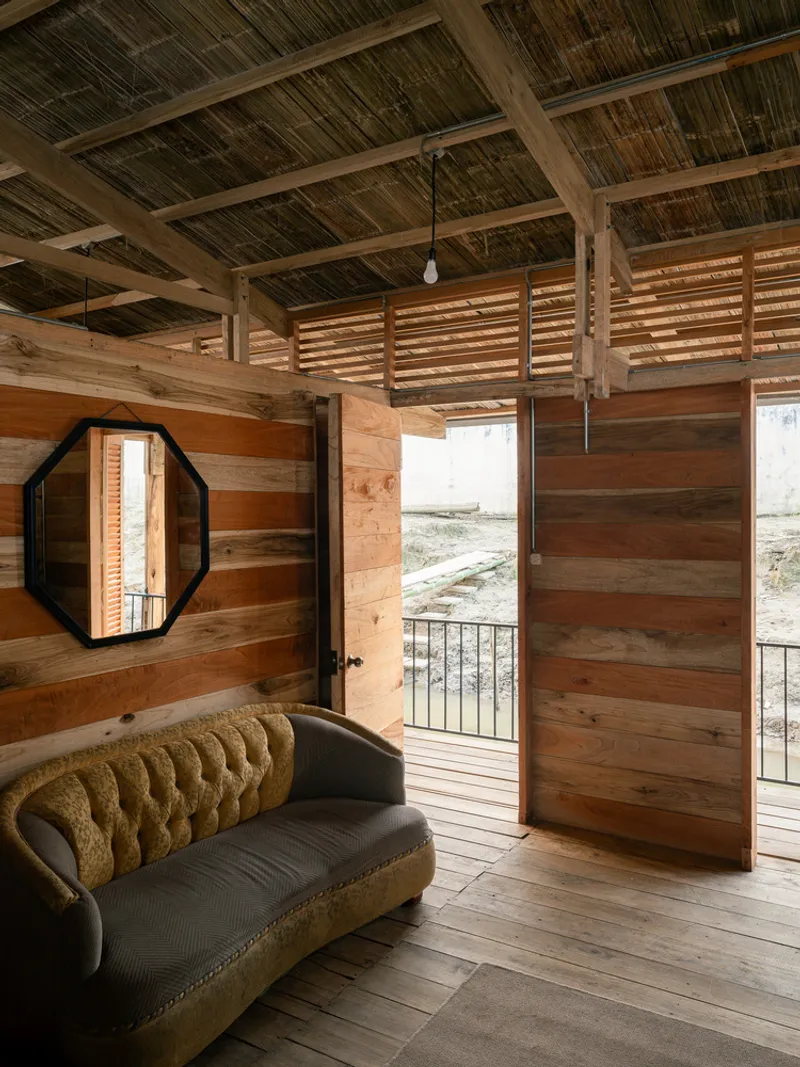
Inside, horizontal wood planks line the walls, a bamboo mat finishes the ceiling, and an octagonal mirror beside a doorway catches light in a room that could feel cramped but instead reads as warm and composed. The central zone houses a shared living room, dining area, kitchen, and two bedrooms. At 70 square metres total, the proportions are tight, but the two-metre module provides enough rhythm to prevent the space from feeling monotonous.
The slatted openings are doing real environmental work here. The sufficient height of the gabled truss, combined with the chazas along the upper edges, creates a stack ventilation effect that pulls warm air up and out. In a tropical river environment, this passive cooling strategy is essential. Air conditioning is not an option when your house floats.
The Waterline View
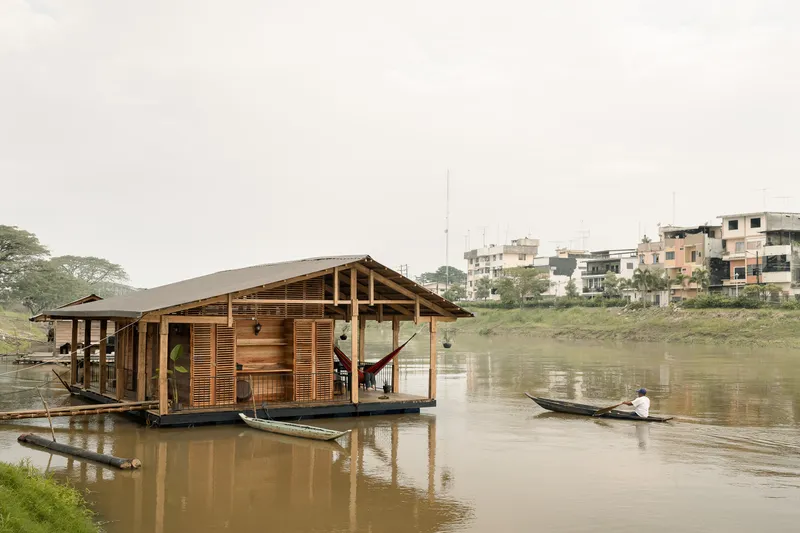
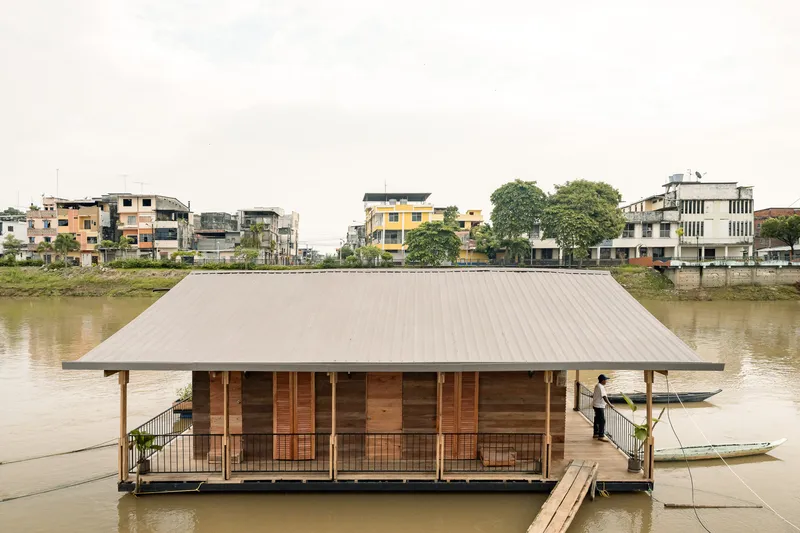
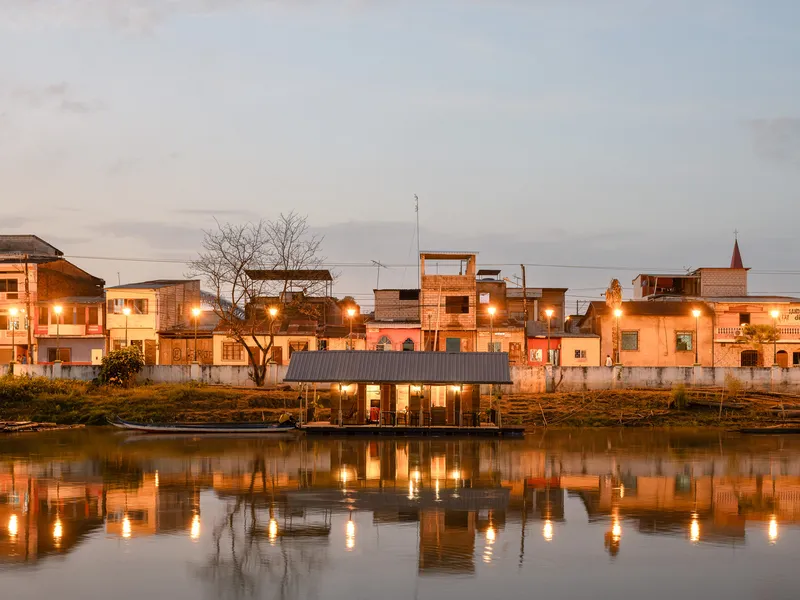
From the river, La Balsanera reads as a clean volume with a strong gabled silhouette, its metal roof and timber walls registering differently depending on the light. In the afternoon, the louvered walls appear solid and warm. At dusk, the house transforms: the illuminated interior reflects perfectly in the still water, and the structure becomes a doubled presence, half real and half mirrored. The night image is arguably the most powerful photograph of the project because it communicates something the plans cannot, which is the emotional weight of a lit home on a dark river.
The perimeter deck and the metal-roofed profile also demonstrate how the house relates to its neighbors along the residential waterfront. It is recognizably part of the floating village's vernacular, not an alien object dropped into the landscape. The architects clearly studied the existing structures before proposing their intervention, and the result is a building that improves on the typology without abandoning it.
Plans and Drawings
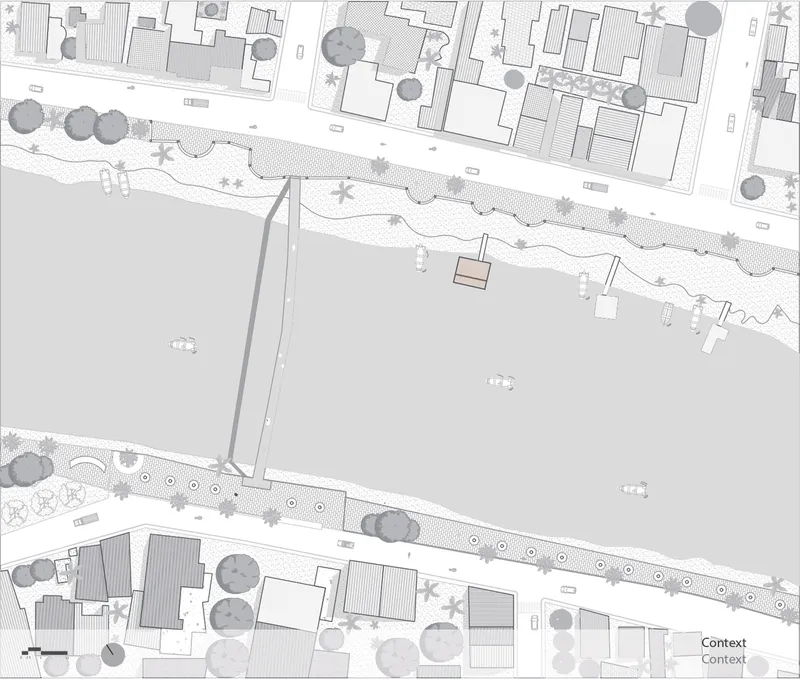
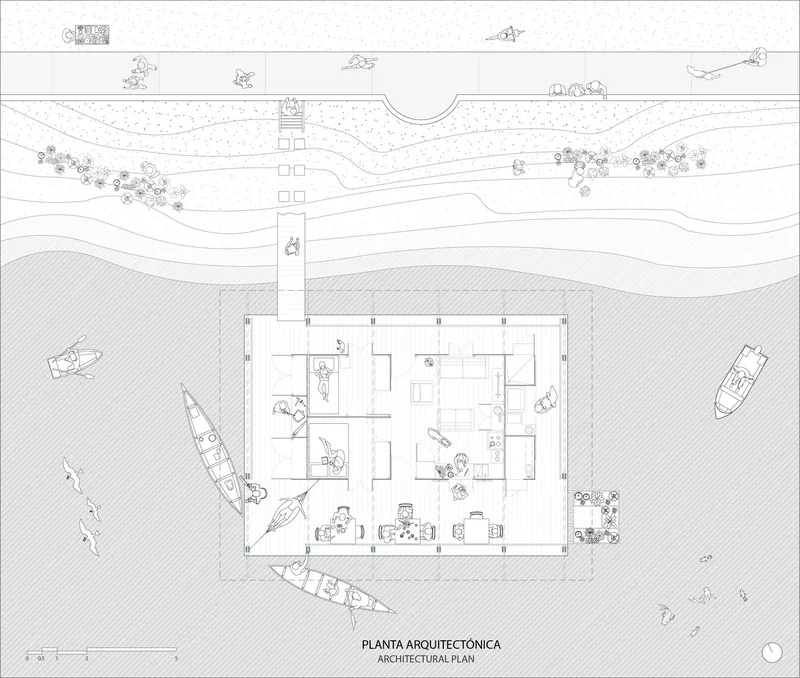
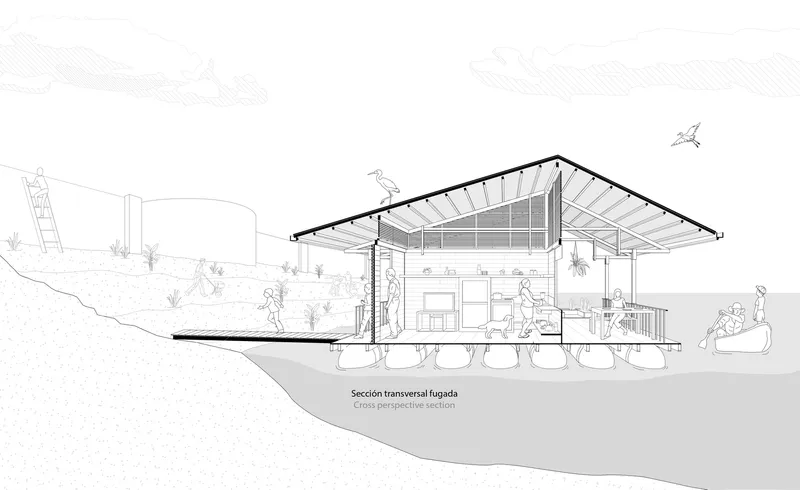
The site plan clarifies the house's position between street and waterfront, a threshold condition that defines its dual role as dwelling and public interface. The floor plan, populated with figures and boats in the surrounding water, is unusually generous in showing the life that animates the architecture rather than just the walls that contain it. You can see Carlos's boat workshop at one end and the food service terrace at the other, with domestic life sandwiched in the center.
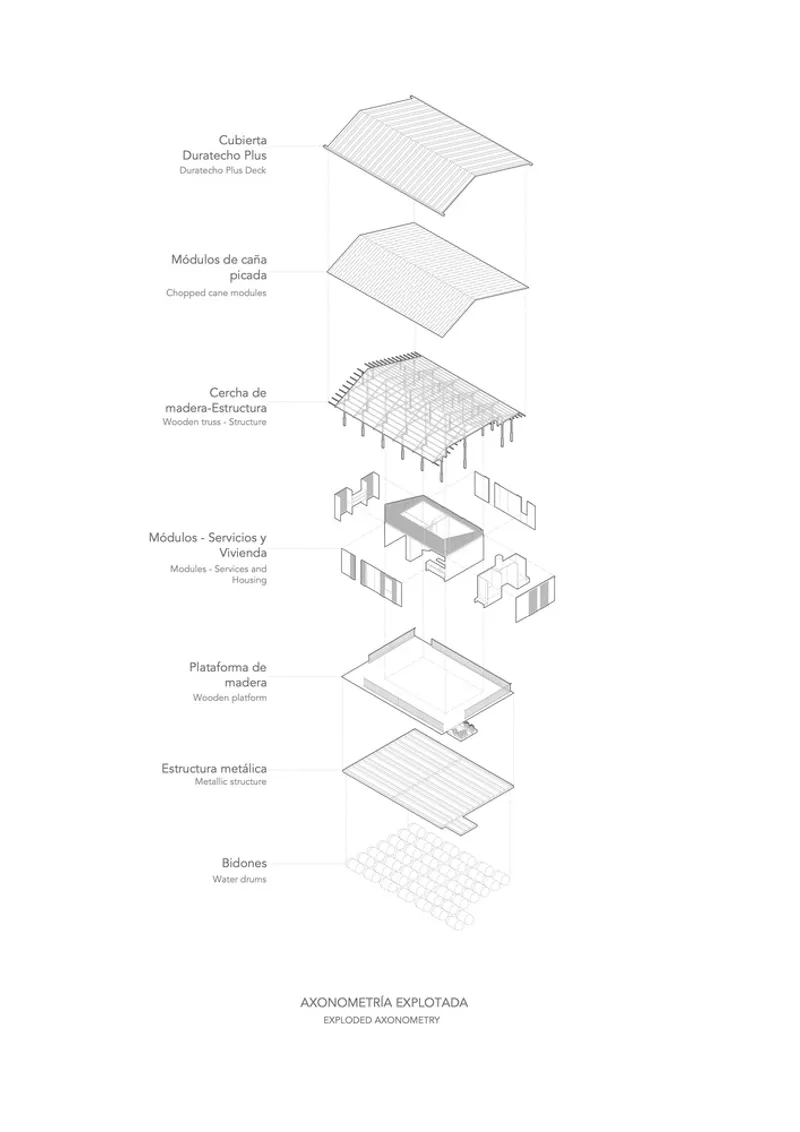
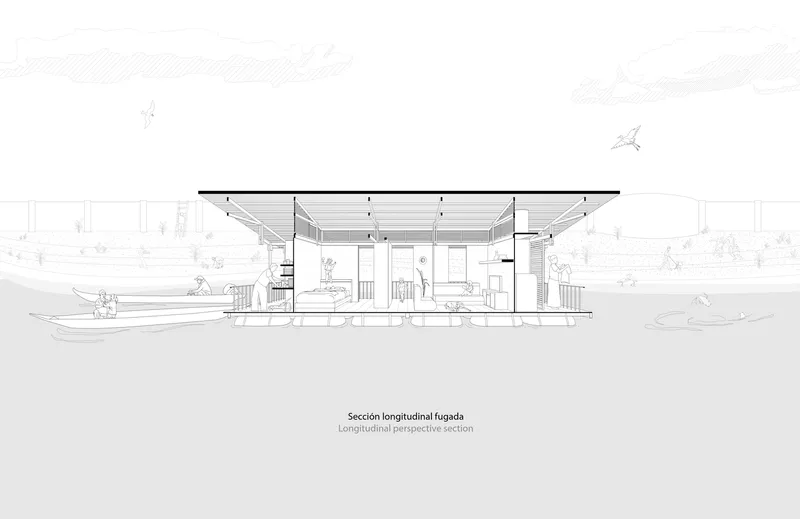
The exploded axonometric is the most instructive drawing. It reveals the layered assembly: cylindrical pontoons at the base, a platform deck, the repeating timber post-and-beam frame, the slatted screen envelope, and the corrugated roof as a final cap. Each layer is legible and separable, which speaks to the modular logic that makes this prototype replicable. The longitudinal and transverse sections confirm the generous interior height of the gabled truss and show how the structure sits above the pontoons, maintaining clearance from the fluctuating water level.
Why This Project Matters
La Balsanera matters because it treats a disappearing community as worthy of architectural investment. In a discipline that often chases novelty, this project does something more difficult: it intervenes in an existing typology with precision, improving habitability and productivity without erasing the cultural knowledge embedded in floating construction. The reuse of materials from the Sharjah Architecture Triennial is not just a sustainability talking point. It is a concrete demonstration that resources flowing through the global exhibition circuit can be redirected to communities that need them.
The collaboration between Natura Futura Arquitectura and Juan Carlos Bamba produced a building that functions simultaneously as a home, a workshop, a food stall, and a manifesto for policy change. If Ecuador's floating houses are recognized as intangible heritage, then the logical next step is to support the people who maintain them, not relocate them to dry land. La Balsanera is a prototype that makes this argument in timber and corrugated steel, 70 square metres at a time.
La Balsanera (Productive Floating House) by Natura Futura Arquitectura and Juan Carlos Bamba. Babahoyo, Ecuador. 70 m². 2023. Photography by Francesco Russo.
About the Studio
Share Your Own Work on uni.xyz
If projects like this are the kind of work you want to make, uni.xyz is a place to publish your own, find collaborators, and enter design competitions.


Popular Articles
Popular articles from the community


U.GA Architects Wraps an Oval Rooftop Pool in Curved Board-Formed Concrete on Busan's Jeollidan-gil
In Busan's Jeonpo-dong, a 454 m² mixed-use block stacks a neighborhood facility, guest rooms and an oval rooftop pool inside spiraling concrete walls.

Juan García Correa, John González and Claudia Rueda Sink a Circular Amphitheater into a Manizales Engineering Building
On the La Nubia campus in Manizales, Colombia, the S1 Building folds labs and offices into a hillside of ramped lawns that double as a campus route.

LT2A and OPEN Architectes Thread a Brick and Glass High School Through a Wooded Belgian Campus
In Braine-l'Alleud, a 3,000 m² wing for Collège Cardinal Mercier pairs pale brick with a glazed colonnade, deferring to a small chapel and a dense wood.

Cube Design Draws an Ecological Corridor Between Two Shenzhen Hills with the Nankai Building
Beside Shenzhen's container docks, the Nankai Building pairs stacked balconies with a climbing green screen to connect two hillsides across its height.

Similar Reads
You might also enjoy these articles


Hodi-Mandai Geram
Project Function: Preservation and revitalization of the Intangible heritage and socio-spatial identity of the Hodi by Housing, Cultural Memory Center, Sacred Grove, landscape, local tourism economy


Olio Towers: A Mid-Rise for Performers That Fuses Housing, Rehearsal, and Stage
Located blocks from Houston's Theater District, this modular tower stacks living units around a central performance atrium.

Oasis: Modular Green Housing Carved into Dhaka's Urban Fabric
A shortlisted Plugin Housing entry reclaims unauthorized settlements in Dhaka with stepped concrete volumes, green roofs, and ventilation-driven design.

Black Hole: A Floating Megastructure for the Post-Physical Era
Emiliano Mazzarotto envisions a spherical, self-scaling arena where e-sports, digital hotels, and holographic stadiums replace traditional public space.

Explore Housing Competitions
Discover active competitions in this discipline

Challenge to reimagine the Iron Throne

Photograph architecture without architects

Illustrate the lost glory of Angkor Wat - Render Challenge

Design challenge to reuse E-waste
Comments (0)
Please login or sign up to add comments
No comments yet. Be the first to comment!