
Project 0050: A Permaculture Grid Where AI Orchestrates Multi-Species Workspaces
A modular framework driven by artificial intelligence adapts its spatial configuration for humans, animals, and food forests in real time.


What if the future workplace were less an office and more an ecosystem? Project 0050 takes that question seriously, proposing a grid-based modular architecture where artificial intelligence continuously repositions functional modules in response to solar patterns, seasonal shifts, and community needs. The result is a building that refuses to sit still: its components slide, merge, and divide, transforming marketplaces into energy hubs, workshops into animal shelters, and courtyards into food forests. It is architecture conceived not as a static container for labor but as a living, self-regulating organism that serves humans, animals, and plants in equal measure.
Designed by Selim Ege Özcan and Ege Ileri, this shortlisted entry for the Breaking Work: Singularity competition traces the evolution of human labor from agricultural and industrial revolutions through the digital age, arguing that the accelerating obsolescence of traditional professions demands an equally radical rethinking of workspace architecture. Rooted in permaculture principles, the project embeds food forests, water systems, and biodiversity corridors within a modular urban framework, positioning sustainability not as an add-on but as the structural logic of the entire scheme.
Programmatic Layering in a Multi-Level Complex
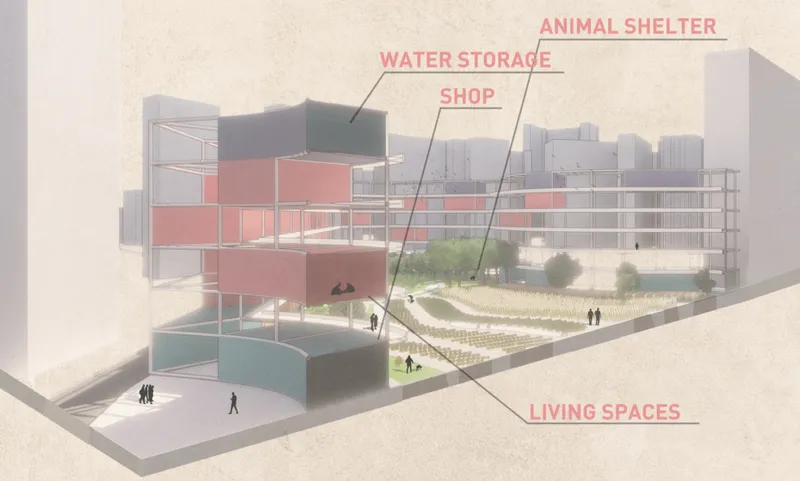
The axonometric drawing reveals the project's ambition to stack distinct programmatic zones vertically while keeping them visually and spatially connected. Labeled zones identify workshops, living spaces, animal shelters, storage, and shops, each occupying specific positions within a white structural frame. Walking figures at multiple levels signal that circulation is continuous; people move through the building as they might move through a landscape, encountering different micro-environments at every turn. The drawing communicates something important: this is not a building with floors, it is a building with ecologies layered on top of each other.
Solar Geometry and the Glass-Paneled Courtyard
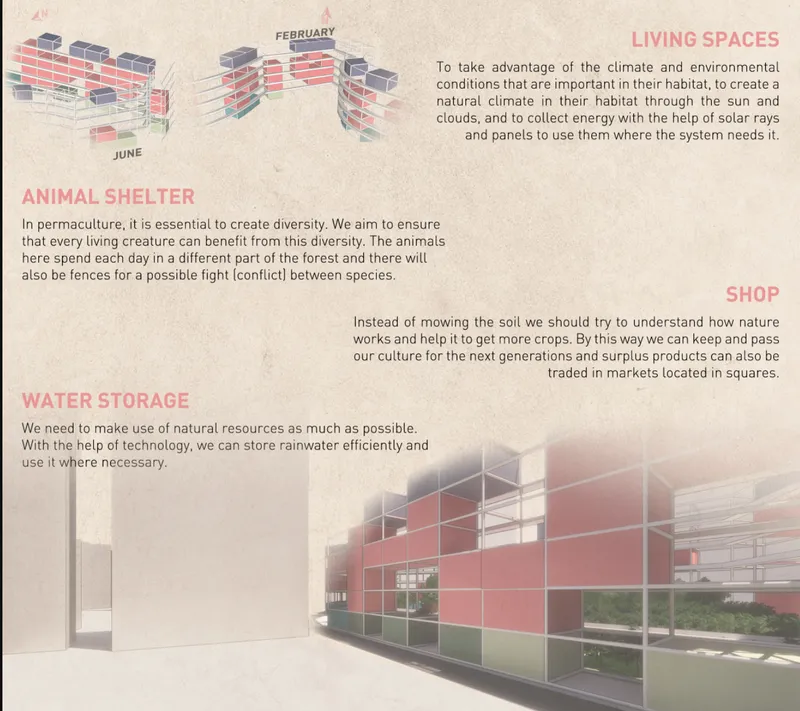
A diagram of seasonal sun paths makes explicit how the modular system responds to environmental input. Glass-paneled courtyards capture light during winter months while shaded configurations emerge in summer, all governed by AI monitoring of real-time conditions. The greenery visible within the courtyard sections is not decorative; it is integral to the permaculture strategy, producing food and filtering air within the building's core.
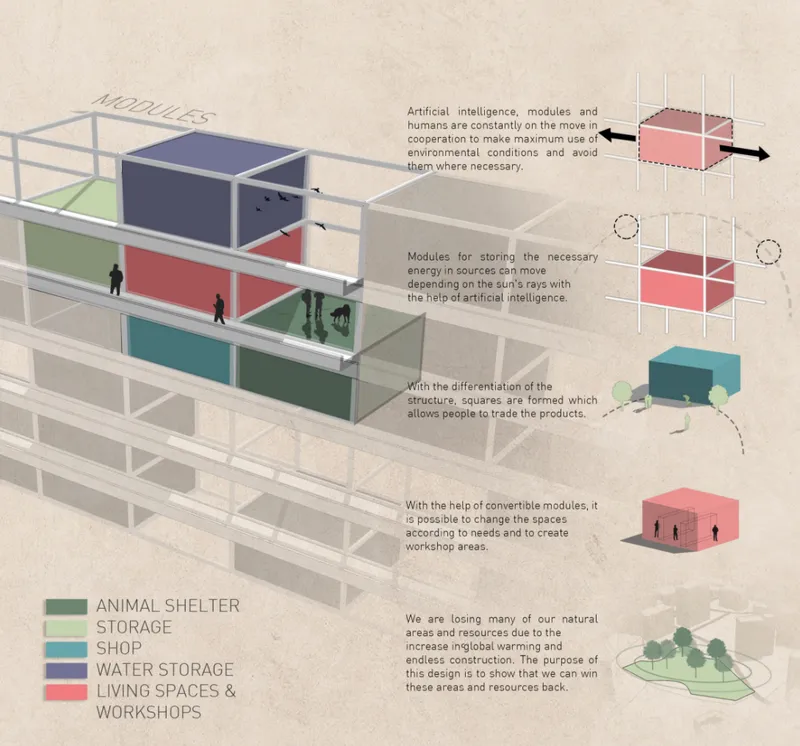
The exploded axonometric pulls the system apart to show how colored modules sit within, and can be repositioned across, the white structural frame. Each color corresponds to a function: animal habitat, water storage, shop, or workshop. The critical insight here is that the frame is permanent but the content is not. The building's identity shifts over time as AI reallocates modules according to population flow, resource availability, and ecological demand. It is a spatial ecosystem that evolves rather than ages.
A Three-Lobed Footprint Within the Urban Fabric
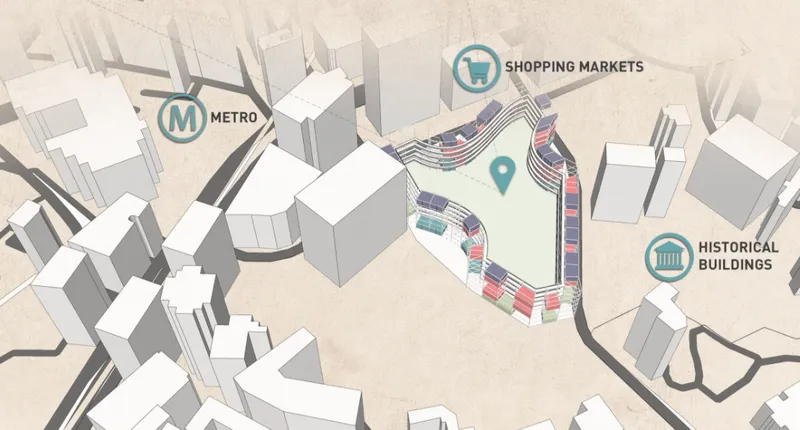
The site plan positions the building's distinctive three-lobed footprint within surrounding urban blocks and infrastructure, clarifying how the project negotiates between its regenerative interior and the existing city grid. The lobes create interstitial outdoor spaces that function as food forests and biodiversity corridors, blurring the boundary between building and landscape. Infrastructure lines, roads, and neighboring blocks are drawn with precision, grounding what could easily read as utopian speculation in a legible urban context.
Inside the Grid: Color, Structure, and Open Air
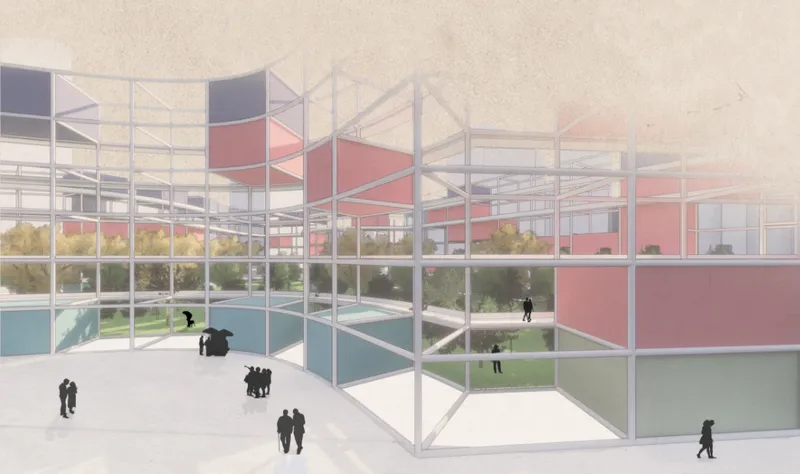
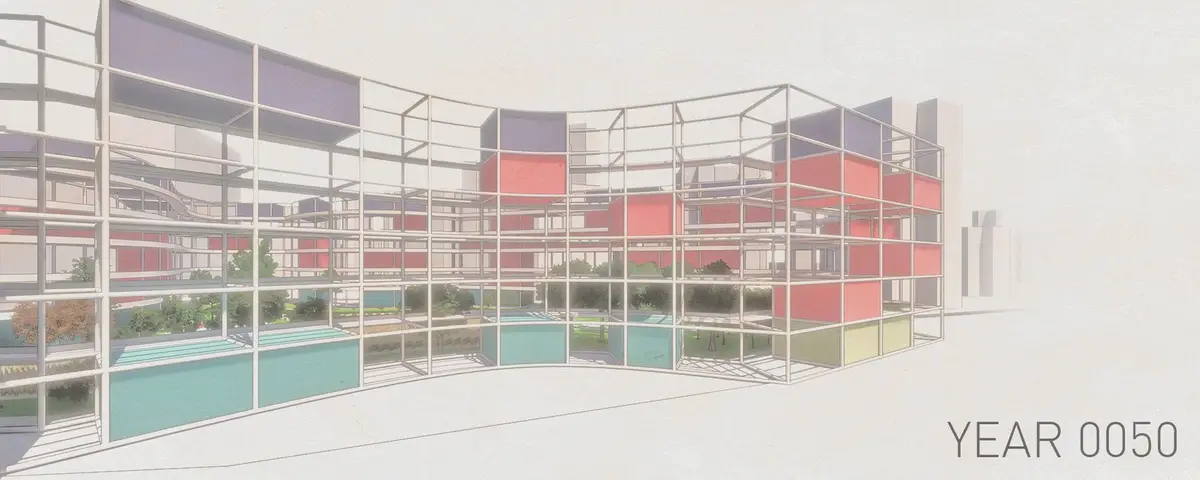
The interior courtyard view is the project's most compelling image. Seen through the white structural grid, colored panels punctuate the frame in greens, oranges, and blues, each marking a functional module. Figures stand and walk on a generous lawn at the building's base, occupying a space that feels simultaneously architectural and pastoral. The grid creates rhythm and order; the colored modules inject variety and adaptability; the open sky above ensures the courtyard never reads as enclosed. It is a workspace that breathes.
Why This Project Matters
Project 0050 matters because it refuses the false choice between technological advancement and ecological responsibility. By placing AI at the service of permaculture, Özcan and Ileri propose that intelligence, whether artificial or natural, should optimize for biodiversity, food production, and community resilience rather than for profit margins or square-meter efficiency alone. The modular framework is not speculative hand-waving; the exploded axonometric and sun-path diagrams demonstrate a system with clear operational logic.
More broadly, the project challenges the assumption that workspaces are for humans only. Designing animal shelters, food forests, and water systems as co-equal programmatic elements reframes architecture as a multi-species contract. In a competition asking designers to confront the singularity of work, this entry answers with a provocation: the future workplace is not a smarter office, it is an ecosystem in motion.
View the Full Project
About the Designers
Designers: Selim Ege Özcan, Ege Ileri
Enter a Design Competition on uni.xyz
uni.xyz runs architecture and design competitions year-round that reward proposals with spatial conviction and real site intelligence.
Project credits: Project 0050 by Selim Ege Özcan, Ege Ileri Breaking Work: Singularity (uni.xyz).


Popular Articles
Popular articles from the community


The Amber Palace Opera: A Geological Fiction Surfaces on Tallinn's Baltic Waterfront
Pierre Brillard reimagines a Baltic legend as a public landscape, opera house, and waterfront promenade rooted in Tallinn's coastal identity.


Cube Design Draws an Ecological Corridor Between Two Shenzhen Hills with the Nankai Building
Beside Shenzhen's container docks, the Nankai Building pairs stacked balconies with a climbing green screen to connect two hillsides across its height.

Opera on the Sea: Driftwood Logic Shapes a Timber Opera House on Estonia's Coast
Trevor Orgill's opera house translates the entangled drift of floating timber into a civic building where wood, water, and music converge.

ETEH Reworks the Shared Spaces of São Domingos School in Brazil Around Timber, Color and Hanging Plants
At São Domingos School in Brazil, 436 m² of hall, refectory and library are recast with timber joinery, a yellow and blue code and trailing greenery.

Similar Reads
You might also enjoy these articles

Vereda Arquitetos Renovates a 40-Square-Meter Apartment Inside Niemeyer's Copan Building
A compact unit in São Paulo's most iconic residential tower gets a material overhaul that pairs exposed concrete with bold blue Formica.

Shakur's House: Exposed Brick as an Interior Organiser in a 168 m² Mashhad Residence
Brick moves indoors in this Mashhad residence, where masonry walls, glass partitions and teal planes sequence a compact home without closing it off.

Day and Night Park: A Time-Based Urban Newsstand in Beijing
A temporary urban newsstand in Beijing blending travel, light, and reading through poetic colors, compact form, and community-focused design.

Modernist Patio Renovation in El Masnou, Barcelona by Oliver Segura Arquitectura + Cebrià Arquitectura
Modernist patio renovation blending tradition and innovation with a movable pool, leveled floors, and Catalan materials in El Masnou.

Comments (0)
Please login or sign up to add comments
No comments yet. Be the first to comment!