

PROP: Turning Urban Scaffolding into Public Gathering Spaces
A universal attachment system transforms construction scaffolding into lit, draped, and furnished street-level installations for civic life.


Scaffolding is the one architectural element every city shares but nobody claims. London, New York, Paris, Hong Kong: wherever buildings are renovated, restored, or erected, steel and bamboo frameworks colonize sidewalks for months at a time, forcing pedestrians into narrow corridors of inconvenience. PROP asks a pointed question: what if these temporary skeletons could become temporary public spaces instead?
Designed by Rahman Ismail and Christopher Green, PROP was a runner-up entry in the Elevate 2019 competition. The project proposes a universal attachment system that can be applied to any scaffolding configuration, converting utilitarian frameworks into immersive street-level installations using LED lighting, translucent construction drapes, modular seating, and performance zones. Rather than enduring scaffolding, PROP invites people to inhabit it.
The Scaffolding Condition: A Global Urban Constant
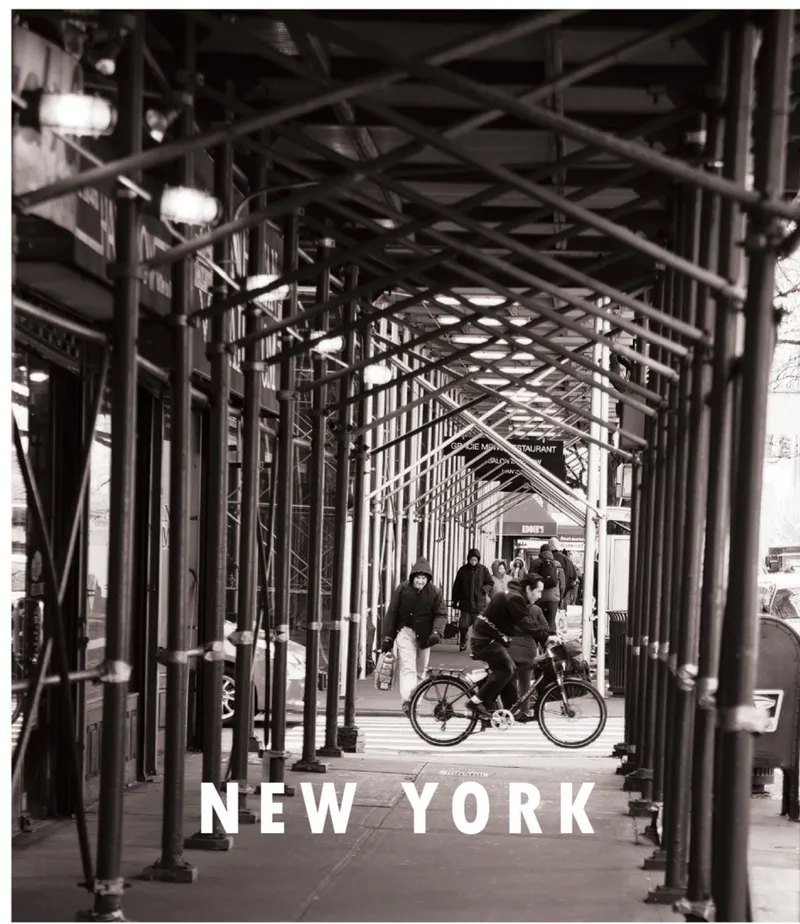

The project begins with observation. A covered pedestrian passage reveals exposed steel trusses and diagonal columns overhead, while a cyclist slips through what has become a de facto tunnel. Nearby, a clock tower stands encased in tubular steel scaffolding during restoration, its civic presence reduced to a cage of pipes under an overcast sky. These are the everyday realities PROP responds to: scaffolding does not simply surround buildings, it replaces the public experience of them.
From these conditions, Ismail and Green extract an argument. Scaffolding is not a neutral backdrop. It reshapes how people walk, where they look, and whether they linger. If it already has this much power over pedestrian space, the designers reason, it should be designed to give something back.
Scaffolding as Material Vocabulary
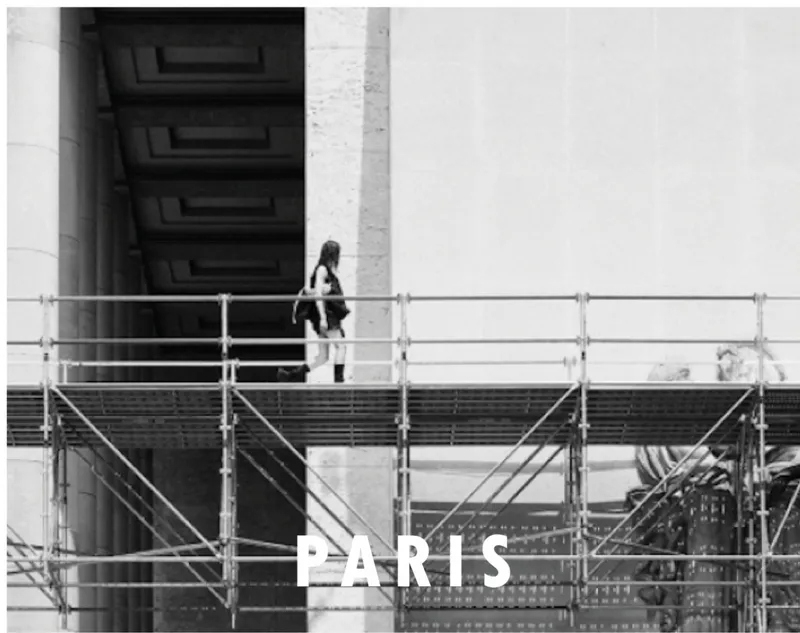
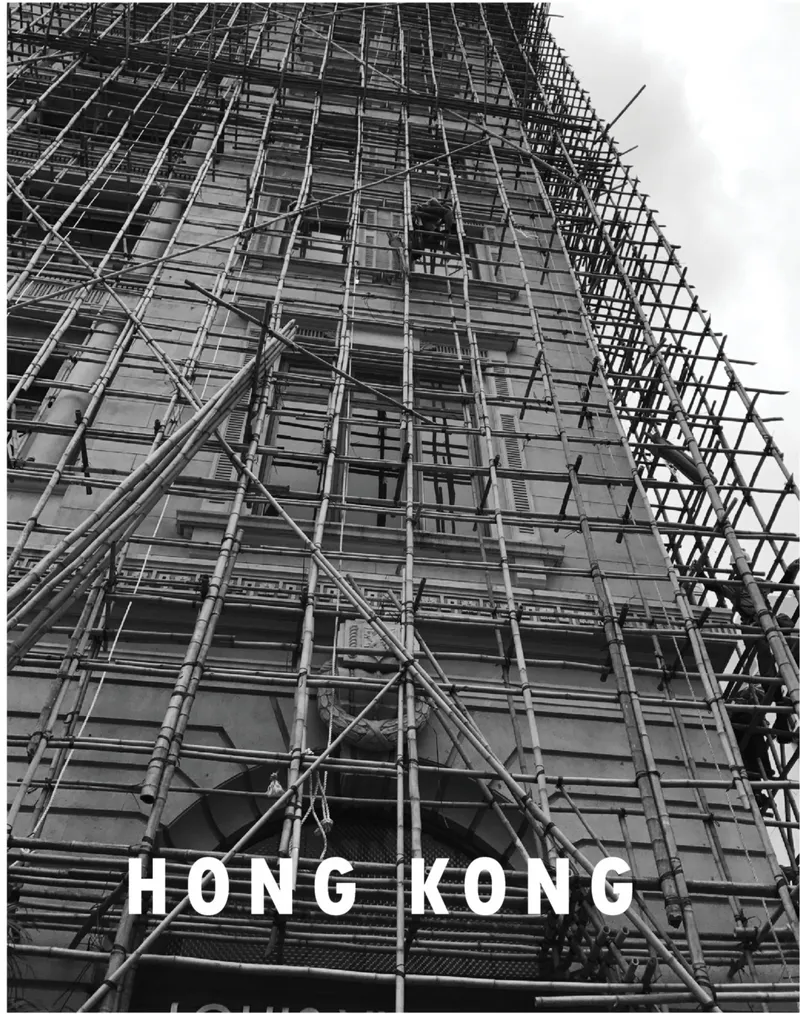
PROP treats scaffolding not as a problem to solve but as a material vocabulary to work with. A concrete wall with a recessed opening and metal scaffolding shows the raw condition: a woman walks across a platform, navigating the structure as an obstacle. In contrast, an upward view of bamboo scaffolding wrapping a facade with triangular bracing against the sky reveals the latent geometric beauty within these systems. The bracing patterns, the rhythm of joints, the layered transparency of overlapping members all carry spatial potential that goes untapped when scaffolding is treated purely as a construction tool.
The universality of the proposed attachment system is critical here. Because scaffolding configurations vary wildly across cities and building types, PROP's modular approach avoids prescribing a single form. Instead, it offers a kit of parts: LED strips that clip onto horizontal members, translucent drapes that stretch between verticals, and seating elements that lock into standard tube diameters. The system is designed to adapt, not dictate.
From Installation Sequence to Activated Street
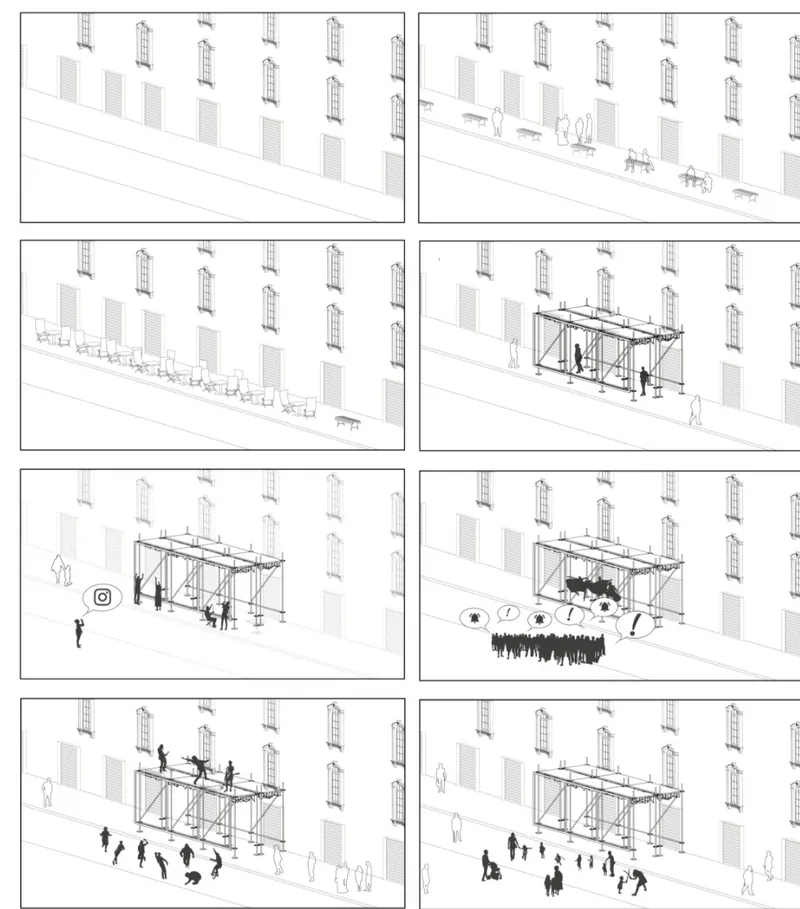
A sequence drawing lays out the logic of deployment. Starting with a bare building facade, the drawing tracks the installation of a street canopy structure, layer by layer, until the scaffolding framework transforms into a sheltered zone for gathering and performance. The phased approach matters: PROP does not require the scaffolding to be rebuilt or redesigned. It operates as an overlay, applied after the construction scaffolding is already in place, which keeps costs low and avoids interfering with the construction timeline.
Light, Translucency, and the Evening City

The project's most compelling image arrives at dusk. A translucent ground-floor facade glows with backlit panels, silhouetted figures visible through the layers, while string lights trace the edges of the structure above. The effect is neither theatrical nor minimal; it sits precisely at the threshold where a construction site becomes an event. People pause, look, and step inside. The drapes soften the industrial geometry of the scaffolding while the LED lighting draws attention from the street, turning what was once a visual obstruction into a beacon.
The designers note that social media engagement is integral to the project's lifecycle. By creating installations that are visually distinctive and spatially inviting, PROP encourages citizens to photograph, share, and discuss the interventions, amplifying their reach far beyond the physical footprint of a single scaffold. The installation becomes a catalyst for public discourse about who owns the sidewalk and what construction owes to the people it displaces.
Why This Project Matters
PROP operates in the gap between architecture and infrastructure, a territory that few designers bother to claim. Scaffolding is typically the jurisdiction of health and safety officers, not spatial designers. By asserting that these temporary structures deserve design attention, Ismail and Green expand the definition of adaptive reuse beyond buildings to include the construction processes that surround them. The logic is sound: if a scaffold will occupy a sidewalk for six months, those six months should count for something.
What makes the project particularly relevant is its scalability. A single LED-lit drape costs almost nothing relative to the construction budget it accompanies, yet it fundamentally changes the pedestrian experience. PROP does not ask cities to overhaul their construction regulations or builders to adopt new structural systems. It asks only for a small act of generosity toward the street, delivered through a universal kit that clips onto what is already there. In a discipline that often struggles to bridge the gap between speculative thinking and practical implementation, that pragmatism is worth paying attention to.
View the Full Project
About the Designers
Designers: Rahman Ismail, Christopher Green
Enter a Design Competition on uni.xyz
uni.xyz runs architecture and design competitions year-round that reward proposals with spatial conviction and real site intelligence.
Project credits: PROP by Rahman Ismail, Christopher Green Elevate 2019 (uni.xyz).


Popular Articles
Popular articles from the community


Extended Shell: Retrofitting Kolkata's Balconies as Living Urban Thresholds
A modular retrofit system recovers the social and environmental intelligence of Kolkata's historic verandas for contemporary Park Street residents.

The Amber Palace Opera: A Geological Fiction Surfaces on Tallinn's Baltic Waterfront
Pierre Brillard reimagines a Baltic legend as a public landscape, opera house, and waterfront promenade rooted in Tallinn's coastal identity.

Manzana Morphosis: Stretching Barcelona's Grid into a Living Landscape for 2050
A radical reworking of the Eixample manzana turns density into a tool for generous public space, vertical ecology, and environmental performance.
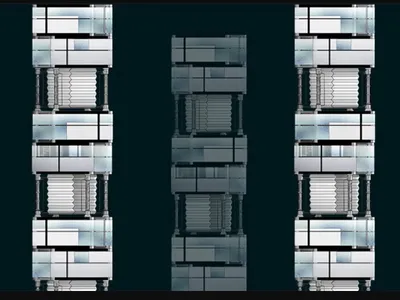
Tsunami Convergenics: Turning Catastrophic Ocean Forces into Underwater Housing Infrastructure
A speculative underwater settlement off the coast of Onagawa, Japan, treats tsunamis and typhoons as energy sources rather than threats.

Similar Reads
You might also enjoy these articles

Play: Fragments of Their World: Remembered Architecture Rebuilt as a Modular Playground for Refugee Camps
Tom Gardner abstracts domes, arches and towers from the homelands of displaced families into a kit of child-scaled play parts for camp settlements.
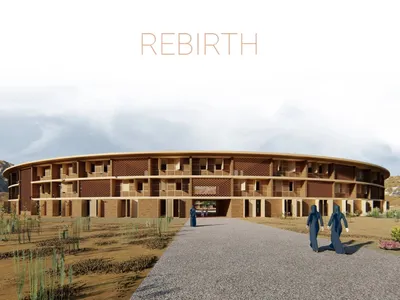
REBIRTH: A Circular Settlement Where Afghan Widows and Their Children Rebuild Life Together
A shortlisted Resile entry turns the circle into a protective ring of timber and brick, gathering homes, classrooms and gardens around a shared landscape.
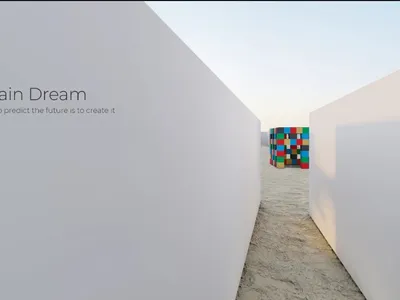
The Main Dream: A Recycled Plastic Kit That Lets Refugee Children Build Their Own Playground
Thirty-centimetre interlocking cubes that connect on three axes turn play into construction, letting children author the spaces they occupy.

Lunar Spiral: A Fibonacci-Driven Moon Settlement Rising from Shackleton Crater
Golden-spiral geometry organises buried infrastructure and orbiting habitable spheres into a lunar base designed to grow as life on the Moon expands.

Explore Scaffolding Competitions
Discover active competitions in this discipline

Challenge to design a portable theatre

Challenge to design a portable music platform

Challenge to design an open learning module for the elderly
Comments (0)
Please login or sign up to add comments
No comments yet. Be the first to comment!