

Proximity Island: An Offshore Oil Rig Recast as a Timber Sanctuary for Reflection and Repentance
Charlie Isham and Adam de Vere graft timber towers and gabled boardwalks onto a former oil rig, turning extraction into a floating place of learning.


An offshore oil rig is about as unambiguous as industrial architecture gets: a steel machine planted in open water for the single purpose of pulling resources out of the earth. Proximity Island refuses to demolish that machine or pretend it never happened. Instead, it keeps the rig standing and asks it to atone, converting a structure built for consumption into a floating modular city for art, research, education and contemplation. The proposal frames the whole intervention as an act of repentance, and that single word gives the project its moral spine.
Designed by Charlie Isham and Adam de Vere, the entry received an Honorable Mention in the Proximity Island 2019 competition. Its site is the sea itself: a former extraction platform isolated in open water, far from urban distraction. The designers treat that isolation as an asset, describing the island as an oasis suspended between civilization and wilderness, where visitors can confront ecological realities that stay invisible in everyday life.
Warm Timber Towers Perched on Cold Industrial Legs

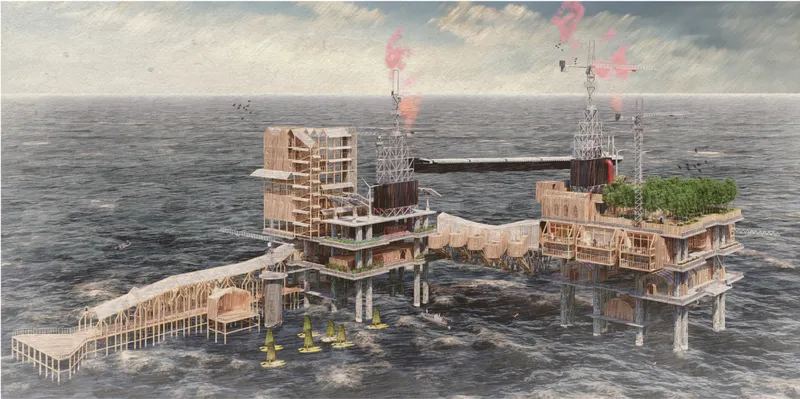
The opening views establish the project's central tension in a single frame. Two timber-clad towers sit on the original platform legs, joined by a curved bridge, while pink flare smoke drifts across choppy water and a tugboat works below. The rig's history is not scrubbed away; the new architecture simply occupies it, with soft, domestic cladding laid over a structure engineered for heavy industry.
The second view widens out to show how the buildings link together through bridges and a long gangway pier marked by yellow buoys. This is where the idea of a modular floating community becomes legible. Individual structures are distributed across the existing framework rather than replacing it, so the rig becomes a scaffold for a network of experiences that rewards exploration instead of a single monumental object.
Arriving by Sea Beside the Machinery of the Past
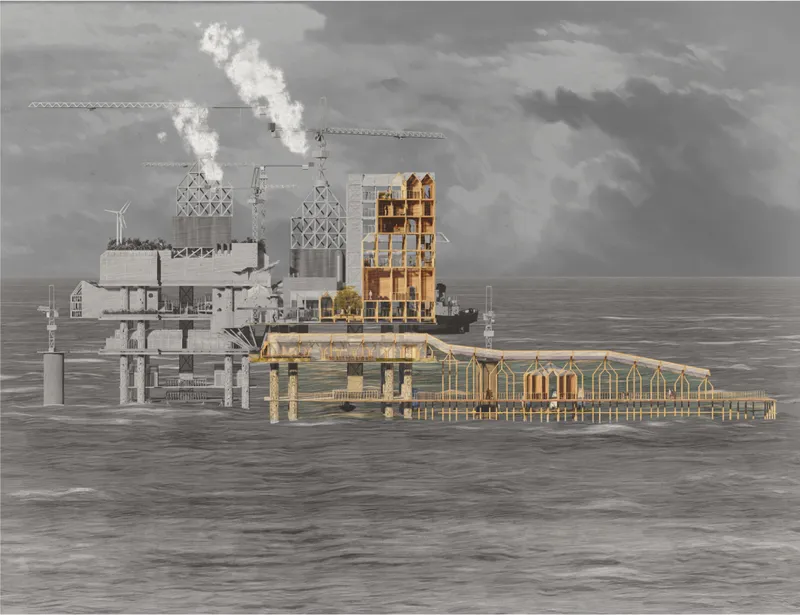

The section view places a timber tower and its long pier directly beside grey platform structures under heavy storm clouds and white smoke. The juxtaposition is deliberate and unsentimental: the new program does not displace the old infrastructure so much as stand next to it, inviting comparison. Visitors read the rig's past and its proposed future in the same glance.
The arrival sequence reinforces this. Seen from the bow of a boat, the timber pier leads toward a gabled walkway and stacked platform towers, with cranes still visible and two elderly figures watching from the edge. Approaching by water slows the visitor down and makes the journey part of the experience, which suits a project whose goal is to heighten awareness of the marine environment rather than offer quick entertainment.
Gabled Boardwalks That Frame the Open Ocean
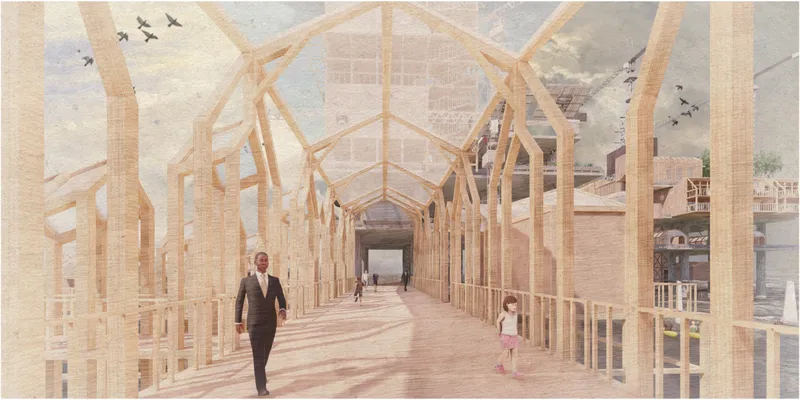
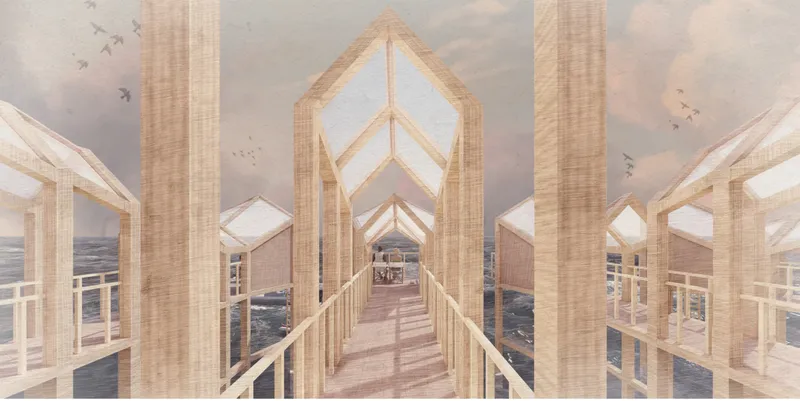
The circulation spaces are where the proposal finds its most convincing character. A timber-framed gabled walkway hosts a man in a suit and a child walking together, birds circling overhead, a quiet image that suggests the island is meant for everyone from professionals to families. The repeated gable frames give rhythm to movement and turn a functional link into a space with its own identity.
The symmetrical view down the boardwalk at dusk sharpens that effect. Translucent roofs filter the light while the open sea stays visible on both sides, so the structure frames the ocean rather than shutting it out. This is the project's argument made spatial: walking between programs becomes a sustained encounter with the water, the horizon and the wildlife that the rig once threatened.
Galleries and Planted Edges Where Art Meets Ecology

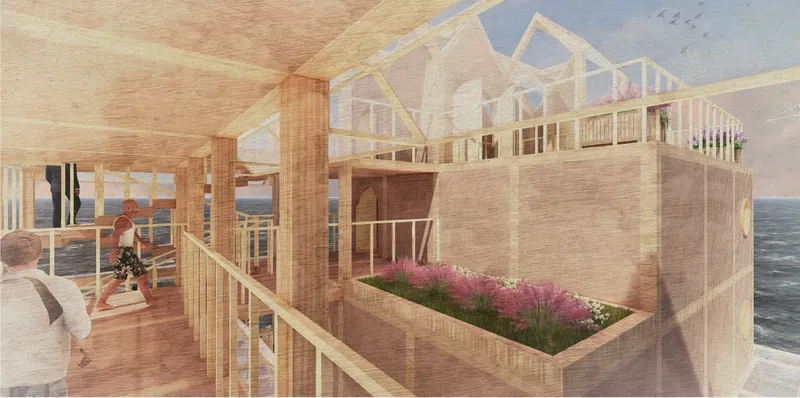
Inside, the timber gallery holds framed paintings, round windows and hanging plants, with visitors moving beside a railed void lit by shafts of light. The interior supports the proposal's mix of uses, in which art installations invite emotional and cultural responses alongside research facilities that study marine ecosystems and educational spaces that explain the impacts of industrial extraction. Science and art share one framework, reflecting the designers' view that environmental understanding requires collaboration across disciplines.
The final view pairs a railed timber walkway with a planted box of pink grasses, the open sea and gulls stretching beyond. It is a small detail that carries weight: vegetation now grows on a platform once dedicated to fossil fuel extraction. Combined with observation decks that overlook the ocean's expanse, these planted edges turn the rig into a place where regeneration is visible rather than merely promised.
Why This Project Matters
Adaptive reuse usually stops at preservation, extending the life of a useful shell. Isham and de Vere push further by treating the oil rig as a cultural artifact with a guilty history, and they make that history the point of the visit. Rather than erasing the rig's role in ecological damage, the proposal stages its conversion as an act of repentance, asking architecture to change attitudes toward nature and not just to house new functions.
As obsolete offshore infrastructure accumulates around the world, the question of what to do with it becomes harder to avoid. Proximity Island offers one compelling answer: keep the structure, soften it with timber and planting, fill it with research, art and education, and let the isolation of the sea do the rest. It shows how a machine of consumption might become a platform for awareness, and it does so with a clarity of intent that explains its Honorable Mention.
View the Full Project
About the Designers
Designers: Charlie Isham, Adam de Vere
Enter a Design Competition on uni.xyz
uni.xyz runs architecture and design competitions year-round that reward proposals with spatial conviction and real site intelligence.
Project credits: Proximity Island by Charlie Isham, Adam de Vere Proximity Island 2019 (uni.xyz).


Popular Articles
Popular articles from the community


Cube Design Draws an Ecological Corridor Between Two Shenzhen Hills with the Nankai Building
Beside Shenzhen's container docks, the Nankai Building pairs stacked balconies with a climbing green screen to connect two hillsides across its height.


Manzana Morphosis: Stretching Barcelona's Grid into a Living Landscape for 2050
A radical reworking of the Eixample manzana turns density into a tool for generous public space, vertical ecology, and environmental performance.

Singing Woman: An Opera House That Performs Before the Curtain Rises
Ovidiu Cristian Pavel's conceptual opera house translates Estonia's choral identity into a sculpted waterfront landmark facing the Baltic Sea.

Aquadapt: An Underwater Habitat That Rewrites Its Rooms by the Hour
Curved modules ring the seabed while one shell shifts from breakfast room to cinema, farm and football pitch as residents' needs change.

Similar Reads
You might also enjoy these articles
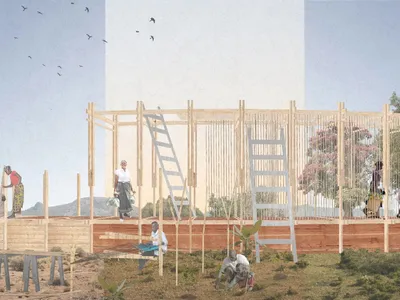
Healing Façade: A Modular Chapel System That Restores Ethiopia's Sacred Forests
Winner of the Eco-Chapel competition, this circular timber façade collects water from air to rebuild soil and reforest degraded Ethiopian landscapes.
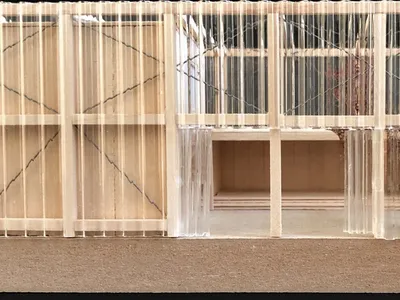
Kaffeebühnen: Where Coffee Shop Architecture Becomes a Civic Stage in Vienna
A linear sequence of timber boxes, transparent shells, and open yards turns the Viennese café tradition into a public performance space.
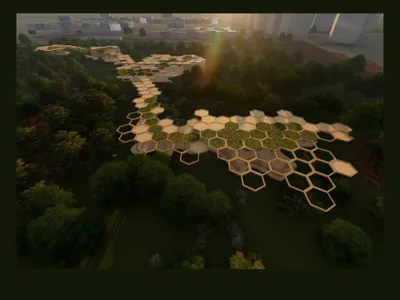
Eco Chapel: A Modular Forest Pavilion That Grows Like the Landscape It Protects
Hexagonal timber modules weave through existing trees, turning a chapel into a living system for prayer, education, and reforestation.


Urban Forest: A Vertical Ecosystem for 5,000 Workers in Singapore's Changi Business Park
Radially stacked pods and layered green decks turn a 7-acre plot into 47 acres of ecological workspace projected for 2040.

Comments (0)
Please login or sign up to add comments
No comments yet. Be the first to comment!