

PSA Studio Weaves a Steel-Framed Extension Around Courtyards in Serindang House 2
A hospitality extension in Kecamatan Beji, Indonesia bridges a two-decade gap between old and new with exposed steel, planted courtyards, and a quiet pool.


Designing an extension to a building that has stood for nearly two decades is an exercise in negotiation. The original Serindang House was completed in 2008, and its successor, Serindang House 2, arrives seventeen years later into a different design vocabulary, a different climate of materials and expectations. PSA Studio, led by Ario Wirastomo and Ditta Astrini Wijayanti, had to reconcile those two eras without pretending the gap didn't exist. The result is a 280 m² hospitality extension in Kecamatan Beji, Indonesia that reads as a low, deliberate companion piece: steel-framed pavilions organized around courtyard gardens and a lap pool, oriented inward rather than outward.
What makes the project genuinely interesting is how it treats structure as finish. The exposed steel grid that runs across ceilings and defines the roofline is not hidden behind plaster or cladding. It is the architecture. Combined with terracotta floor tiles, timber framing, and generous glazing onto planted courtyards, the building produces a kind of honest warmth that many hospitality projects in the region avoid in favor of polished minimalism. Serindang House 2 is not polished. It is calibrated.
A Boundary That Breathes
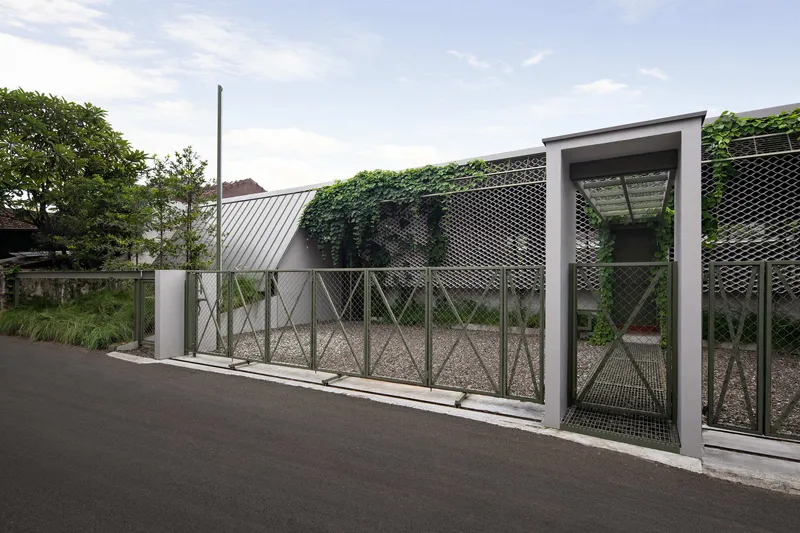
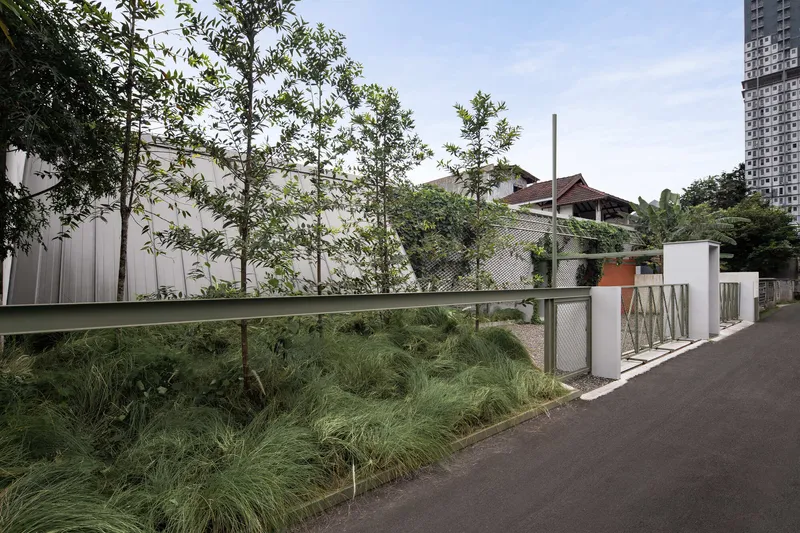
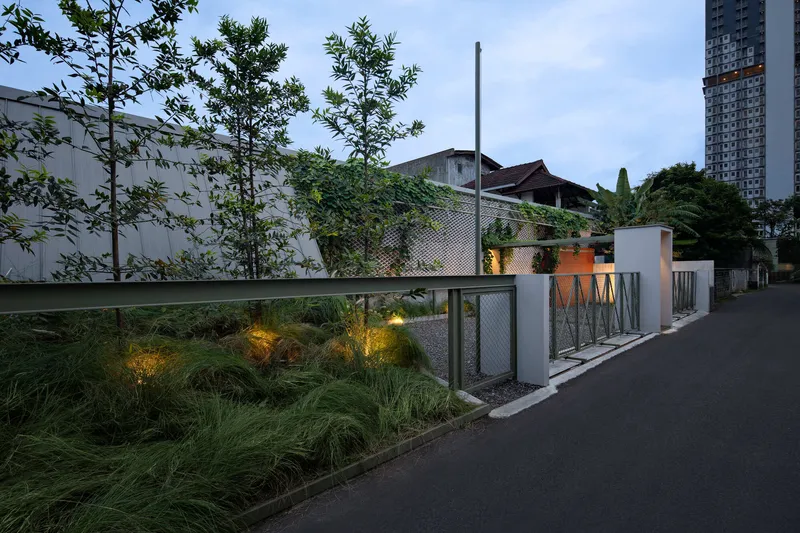
The perimeter of Serindang House 2 is the first signal that this is not a fortress compound. Perforated metal panels and vertical slat screens compose the street-facing boundary, layered with ornamental grasses and climbing vines that soften the edge between public road and private interior. At dusk, warm light filters through the planted buffer, turning the fence into a lantern rather than a wall.
It is a thoughtful move for a hospitality project. Privacy is maintained, but the building does not turn its back on the street. The chain-link fencing, slat panels, and planted grasses create a gradient of transparency that allows glimpses without revealing the whole. You know something is happening inside, but the specifics remain withheld.
The Courtyard as Organizing Principle
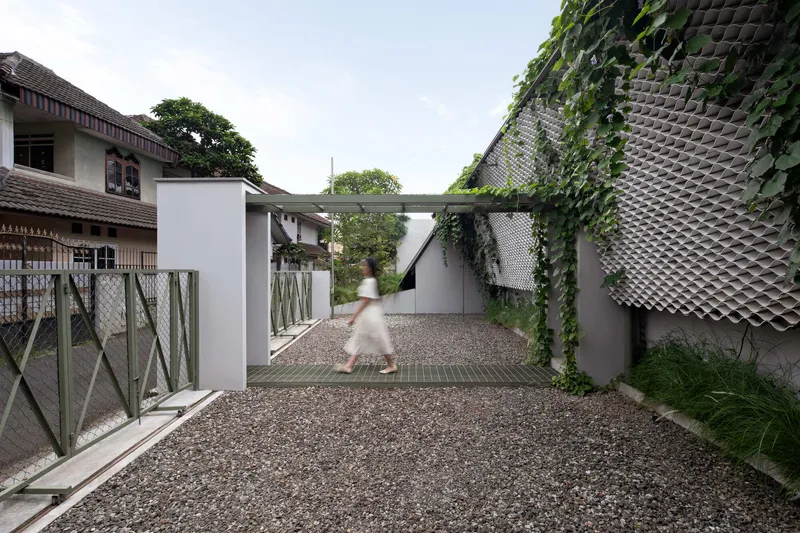
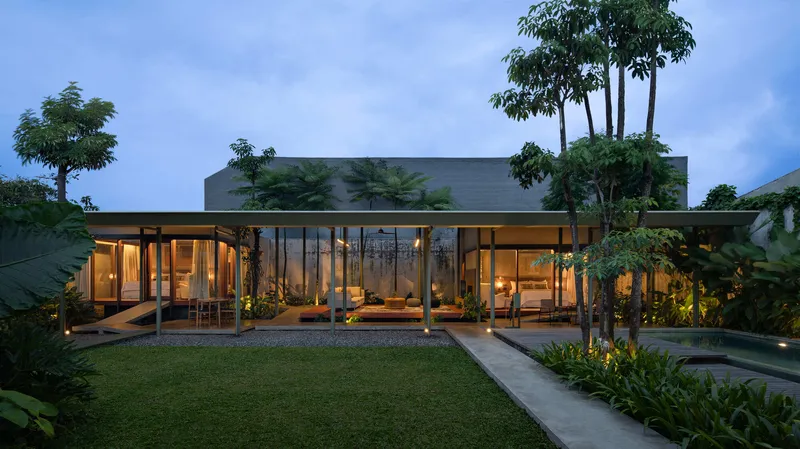
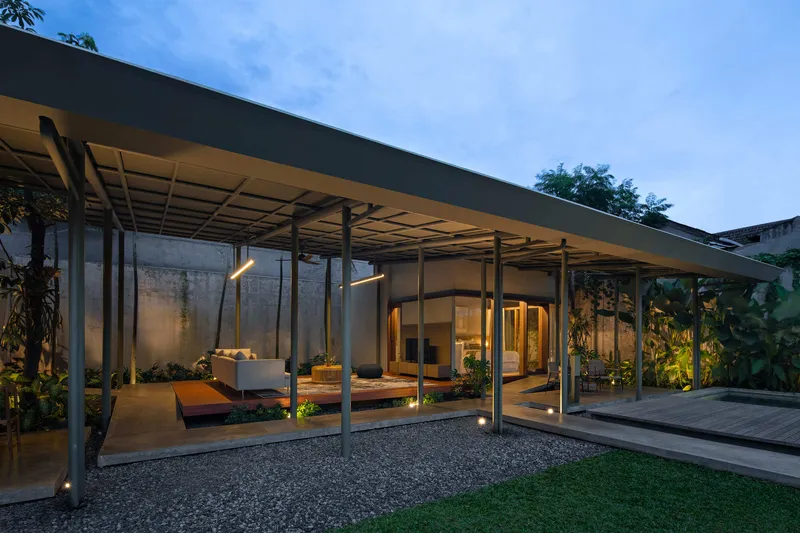
Every room in Serindang House 2 answers to the courtyard. The floor plan distributes living volumes, bedrooms, and service spaces around a central open-air zone that holds the swimming pool, timber decking, and planted beds. Gravel paths and vine-covered perforated walls create secondary outdoor rooms within this larger garden court, so the experience of walking through the building is punctuated by shifts between enclosure and exposure.
The glazed pavilion facades, visible at dusk with their warm interior glow, reinforce the idea that inside and outside are not separate categories here. They are gradients. White plaster volumes float above the gravel courtyard, and a single figure walking beneath them gives you a precise sense of how the scale works: intimate, not monumental.
Steel Grid, Warm Skin
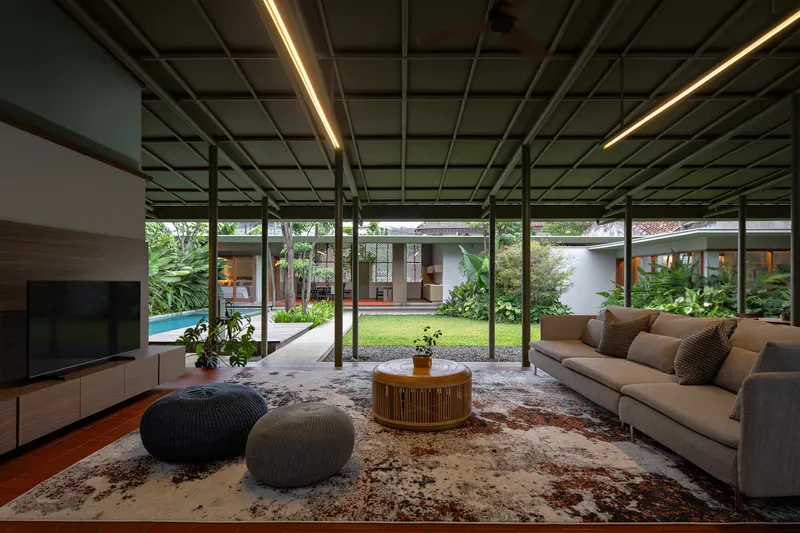
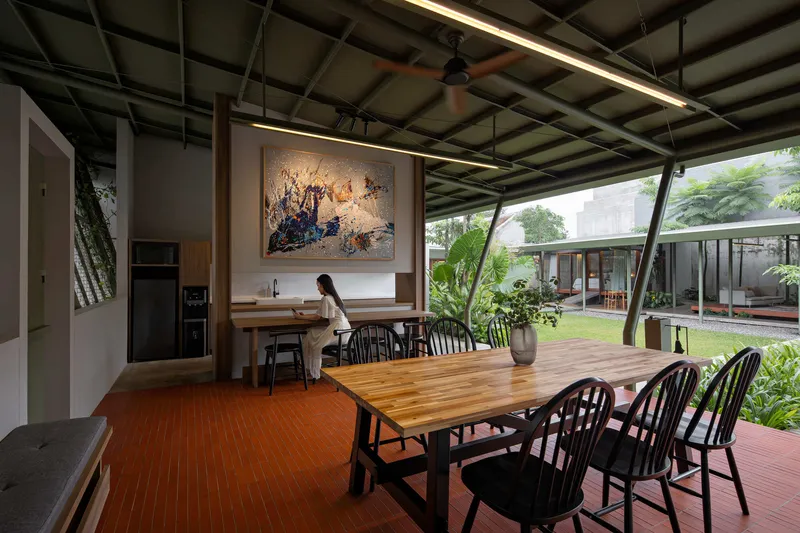
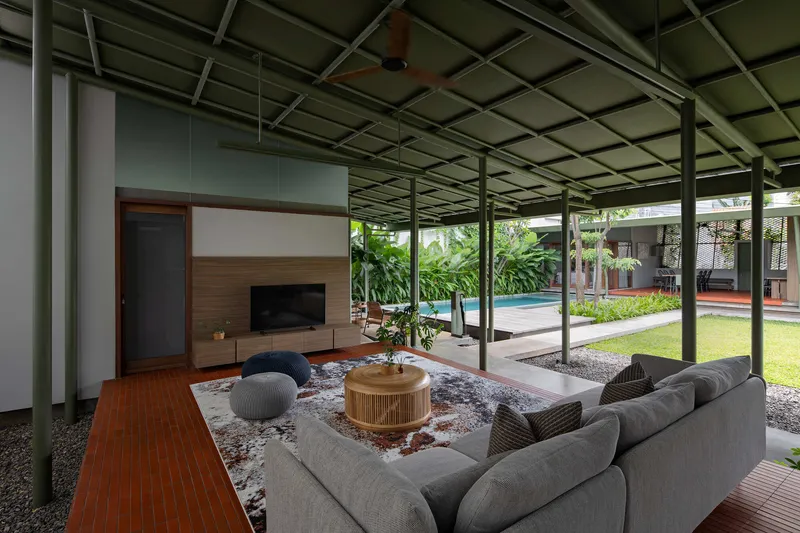
The exposed steel ceiling grid is the signature element of the interior. In the living areas and dining spaces, it runs continuously overhead, defining a rhythm of bays and allowing linear lighting to sit within the structure rather than being applied to a surface. The grid is neither decorative nor minimal. It is straightforwardly structural, and that directness gives the spaces a legibility that more ornamented approaches often lack.
What keeps it from feeling industrial is the warmth layered beneath. Terracotta floor tiles, timber framing at glazing edges, and the green of the courtyard visible through canted glass walls create a material counterpoint. The steel is cool and precise; everything else is warm and textured. The combination works because neither side overwhelms the other.
Dining on the Threshold
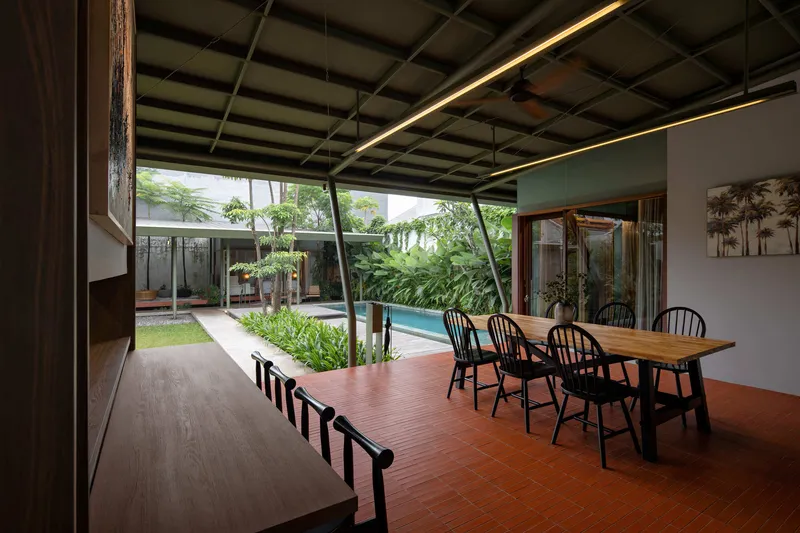
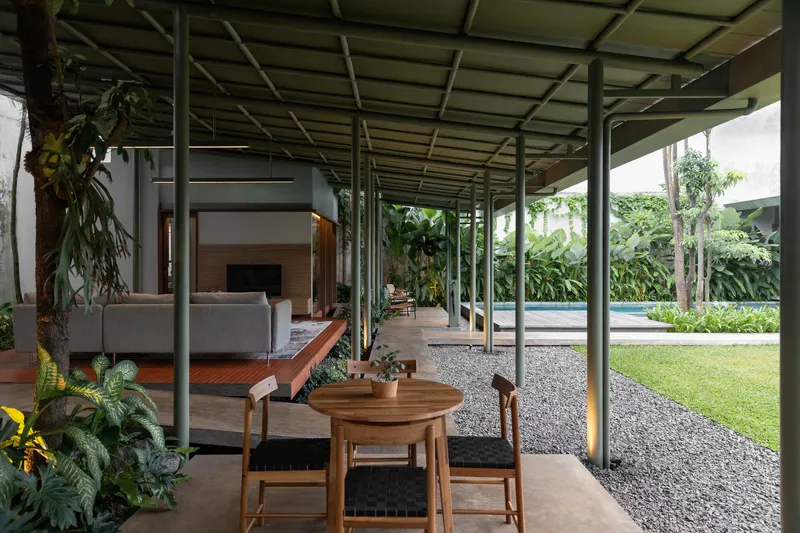
The dining areas occupy a threshold condition, sitting at the edge where built volume meets courtyard. In one configuration, a covered pavilion supported by slender steel columns opens directly onto the gravel court and pool. In another, the dining room looks through a gridded ceiling toward a lawn bounded by the pool deck. Both set up long sightlines that make the rooms feel larger than their footprint, borrowing space from the landscape.
Hospitality architecture in tropical climates often collapses the distinction between indoor and outdoor dining. Serindang House 2 handles this with restraint. The roof overhead and the framed views keep the experience structured. You are not simply eating outside. You are eating in a room that happens to have no wall on one side.
Bedrooms Turned Inward
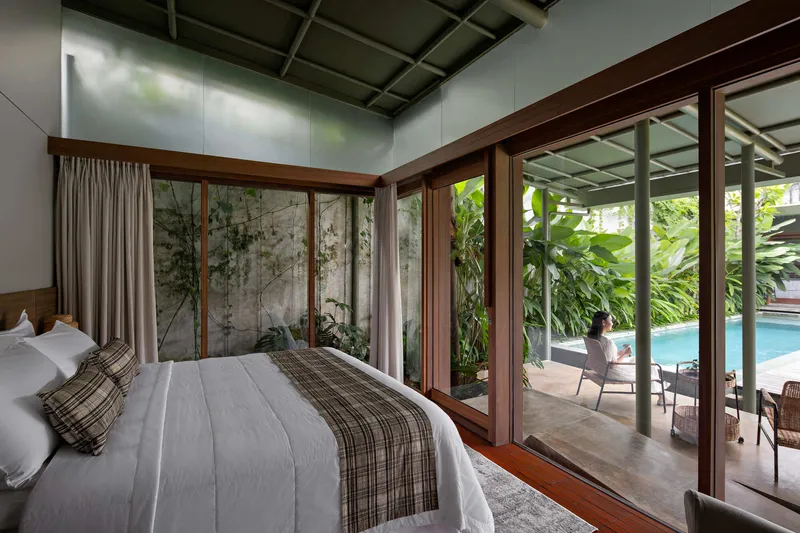
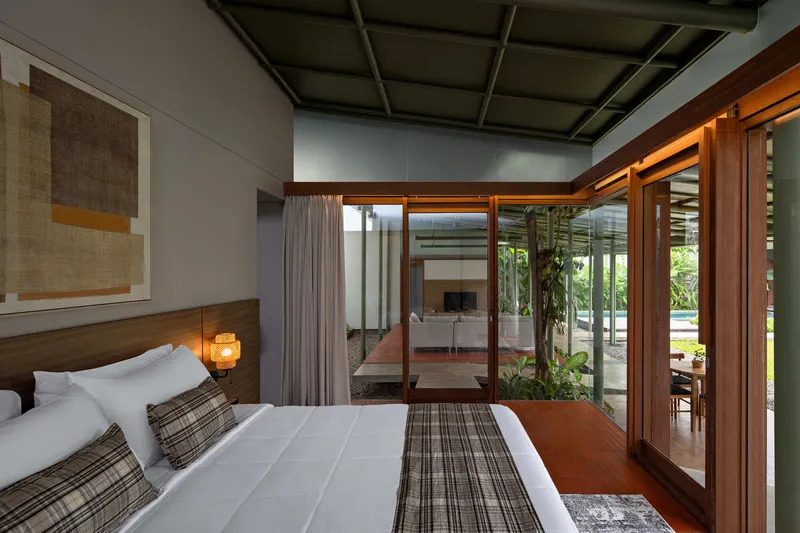
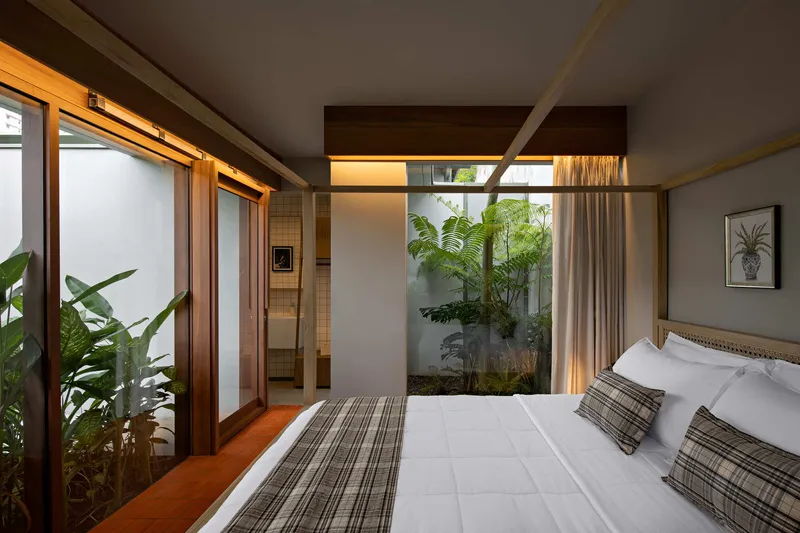
The bedrooms follow the same courtyard logic but at a more private register. Timber-framed glazing opens onto planted internal gardens thick with tropical foliage, ferns, and skylit volumes that deliver natural light without direct exposure to neighboring sightlines. One bedroom frames a view across the bed toward a small garden with ferns overhead, lit from above by a skylight. The effect is of sleeping inside a terrarium.
These are rooms that prioritize atmosphere over square footage. The coffered ceiling in one bedroom, the warm timber sliding doors in another, the careful placement of planting just beyond the glass: every detail supports a single idea, which is that rest happens best when you are surrounded by green and sheltered from the world.
Material Details at Close Range
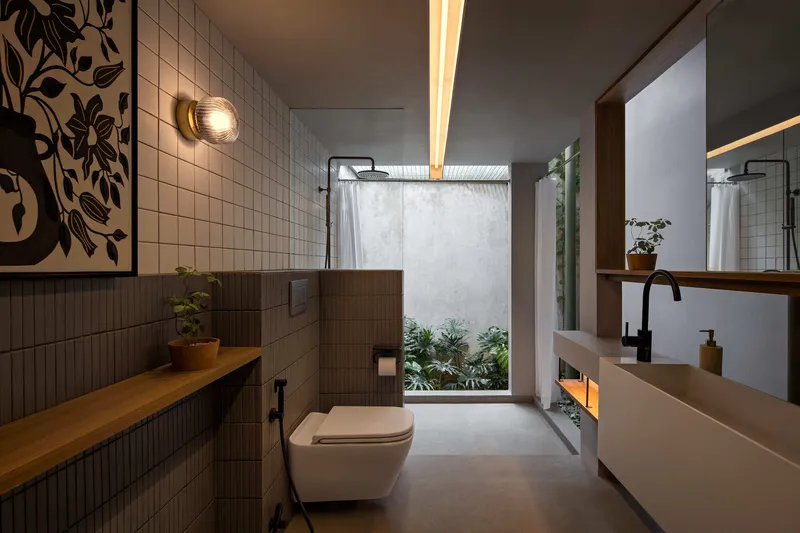
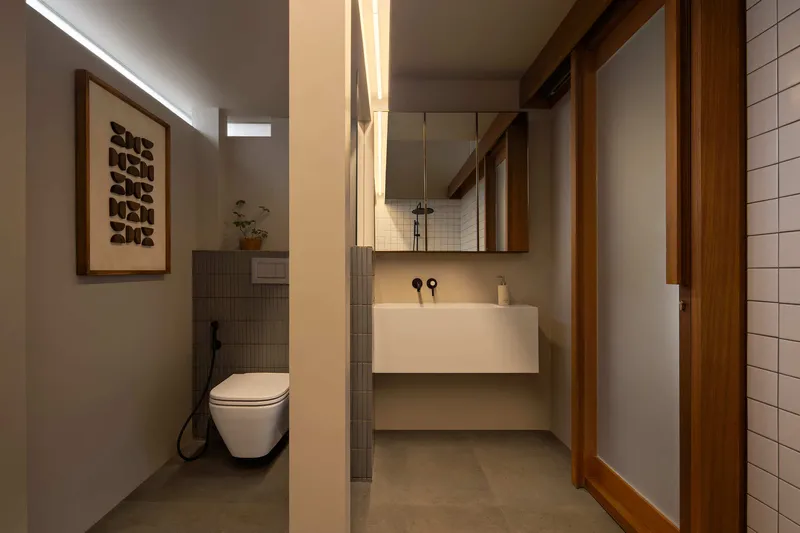
In the bathrooms and private quarters, the material palette tightens. Square tile walls, floating vanities, timber-framed mirrors, and vertical strip lighting compose spaces that are quiet but not austere. One bathroom opens to a small planted lightwell, introducing a sliver of green and daylight into a utilitarian room. It is a small gesture, but it connects even the most functional spaces back to the courtyard principle that governs the whole building.
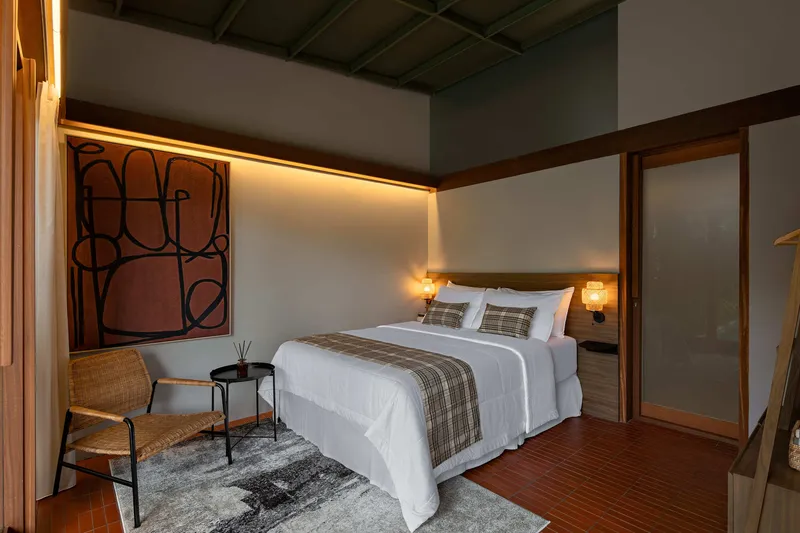
The bedroom interiors under evening light reveal an exposed coffered ceiling that echoes the steel grid of the living areas in a warmer, timber-clad register. The consistency is important. Whether you are in the most public room or the most private, the structural logic is visible and legible. Nothing is concealed for the sake of sleekness.
The Pool as Center
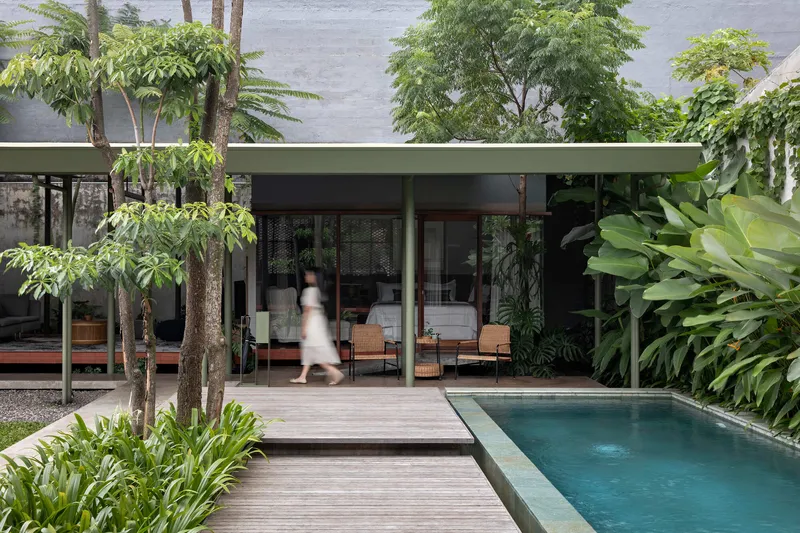
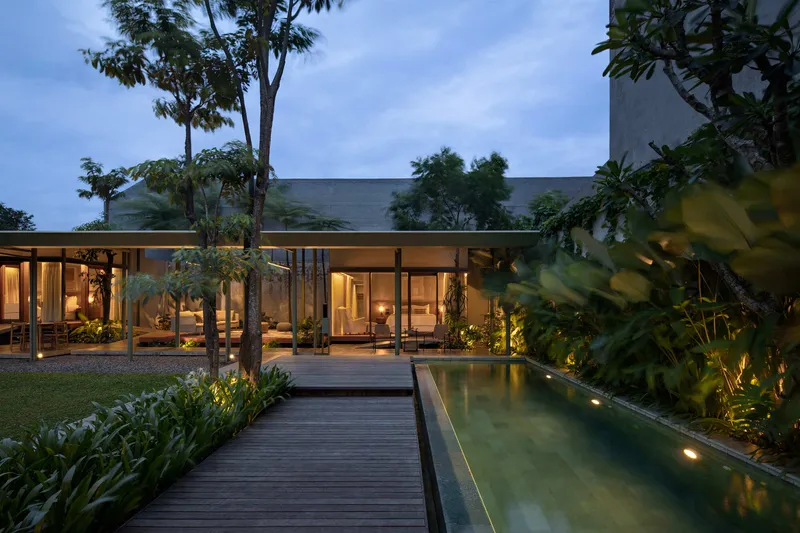
The lap pool and its timber deck are the gravitational center of the project. Positioned in the courtyard between the glazed pavilions, the pool is visible from the living areas, the dining spaces, and several of the bedrooms. At twilight, the surrounding volumes glow from within, and the water surface catches the last of the sky. A figure walking beneath the flat roof overhang gives the scene its scale.
This is the moment where the hospitality function of the building becomes clearest. The pool is not an amenity bolted onto a residential plan. It is the reason the rooms are arranged as they are. Everything faces it, and everything is measured against its calm, reflective surface.
Plans and Drawings
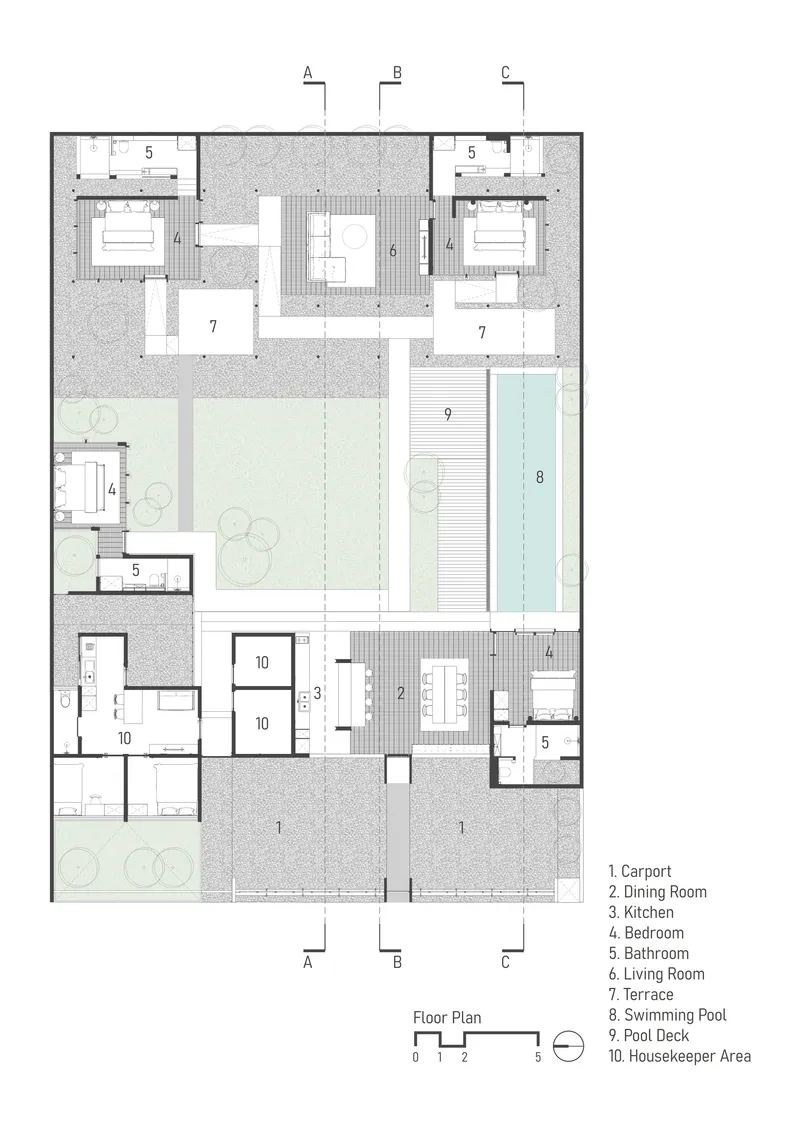
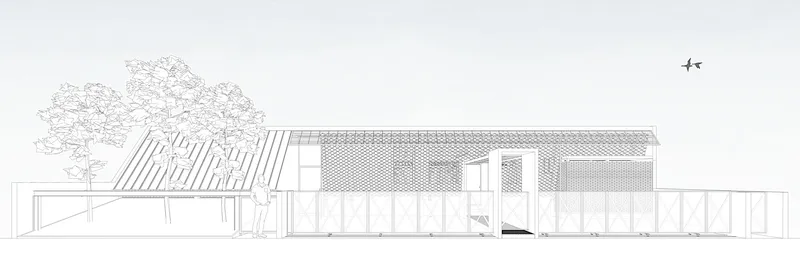
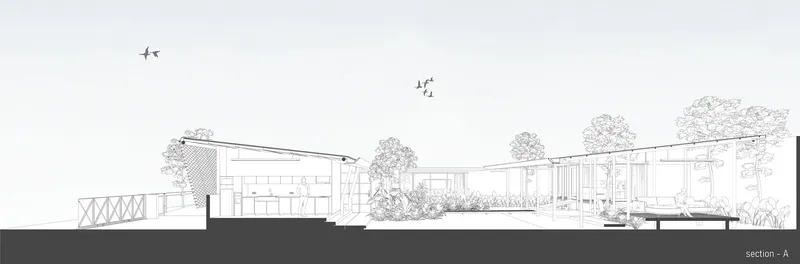
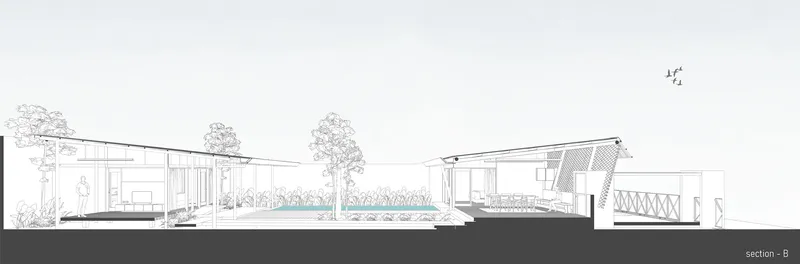
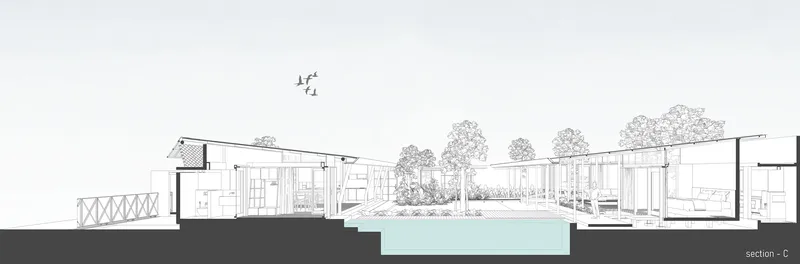
The floor plan confirms what the photographs suggest: the building is a constellation of volumes arranged around a central void. The swimming pool and deck occupy the heart, with living, dining, and bedroom wings radiating outward to meet the perimeter wall. The sections reveal how the flat and gently sloped roof forms create variation in ceiling height across the building, and how planted courtyards are sunk between volumes to bring light deep into the plan.
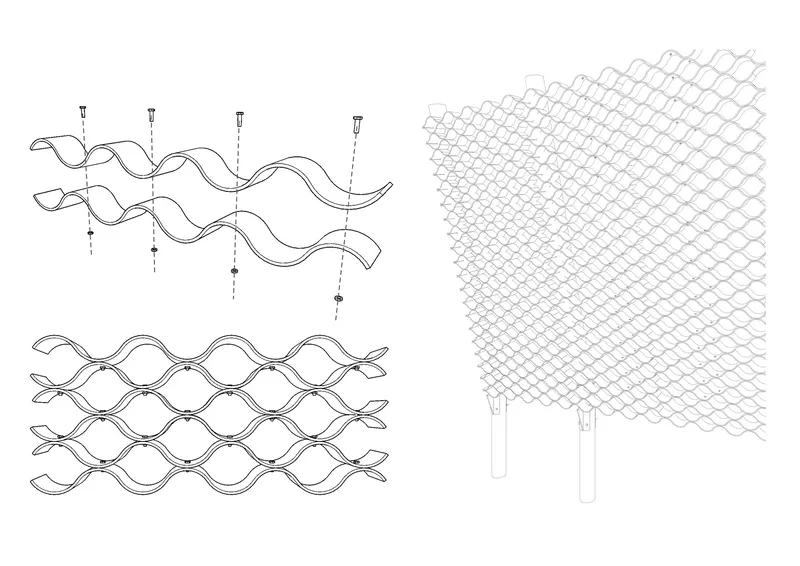
The axonometric drawing is particularly revealing. It shows a layered, woven lattice structure supported by cylindrical columns, a detail that does not read immediately in the photographs but explains the textured quality of the ceilings and roof canopies. The sections also make clear how the pool and courtyard level relates to the interior floors, reinforcing the threshold condition that defines the experience of moving through the building.
Why This Project Matters
Serindang House 2 is a reminder that extensions do not need to mimic or defer to their predecessors. PSA Studio has built a structure that acknowledges the seventeen-year gap between original and addition by working in a contemporary material language, exposed steel and generous glazing, while remaining loyal to a spatial principle that is timeless in tropical architecture: organize everything around a courtyard, let the landscape do the rest.
The project also demonstrates that hospitality architecture in Indonesia does not need to default to either luxury resort aesthetics or rustic craft narratives. There is a third path, one built on structural honesty, careful material layering, and an understanding that the most powerful room in any tropical building is the one without a roof. Serindang House 2 walks that path with confidence.
Serindang House 2 by PSA Studio (lead architects Ario Wirastomo and Ditta Astrini Wijayanti), with landscape architecture by Desain Padu. Located in Kecamatan Beji, Indonesia. 280 m². Completed 2025. Photography by Mario Wibowo.
About the Studio
Share Your Own Work on uni.xyz
If projects like this are the kind of work you want to make, uni.xyz is a place to publish your own, find collaborators, and enter design competitions.


Popular Articles
Popular articles from the community


Architekt Andreas Gruber Scatters 23 Dark Timber Chalets Across a South Tyrolean Forest Edge
In Molini di Tures, Amonti Chalets breaks a resort into a hamlet of gabled timber houses, with parking, storage and services pushed into the slope.

Cube Design Draws an Ecological Corridor Between Two Shenzhen Hills with the Nankai Building
Beside Shenzhen's container docks, the Nankai Building pairs stacked balconies with a climbing green screen to connect two hillsides across its height.

longwave studio Reorganizes a 112 m² Tainan Apartment Around the Daily Routines of a Family and Two Cats
In Tainan, Taiwan, birch plywood, rust-red furniture and a freestanding plaster wall link arrival, storage, work and family life in one apartment.

David Macias Steps a Doorless Stone and Plaster House Down a Tropical Colombian Hillside
In the humid hills of Colombia, Threshold House replaces the front door with an open void and terraces its 850 m² down the slope instead of fighting it.

Similar Reads
You might also enjoy these articles


LAVA Architecten Gives Vocational Education a Sawtooth-Roofed Face on a Mechelen School Campus
In Mechelen, Belgium, a 2,053 m² STEM school on a 6×6 m grid turns workshops and classrooms into rooms that can be rearranged as teaching changes.

KEMA Studio Turns a Derelict Marvila Attic into a 60 m² Lighthouse Apartment Above Lisbon
In Lisbon's Marvila district, a rebuilt roof, four skylights and two plywood volumes turn an unlivable attic into a bright home facing the Tagus.

Pixel Gardens: One Repeated Module Stacked Into a Terraced Social Housing Tower for Famagusta
Salem Bader's shortlisted housing tower builds a vertical neighbourhood from one repeated module, offsetting units to carve terraces, light and air.

Bao Huynh Watercolor Atelier: A Serene Art Retreat in Hội An
Bao Huynh Watercolor Atelier in Hội An blends multifunctional art spaces, sustainable design, local materials, and family-friendly living in a serene environment.

Explore Residential Building Competitions
Discover active competitions in this discipline

Comments (0)
Please login or sign up to add comments
No comments yet. Be the first to comment!