
DF Arquitectos Carves a Clubhouse for Young Footballers into a Volcanic Quarry in Mexico City
Built from the very stone it sits against, the Pumas Clubhouse at UNAM shelters 110 aspiring players across 3,700 square meters.


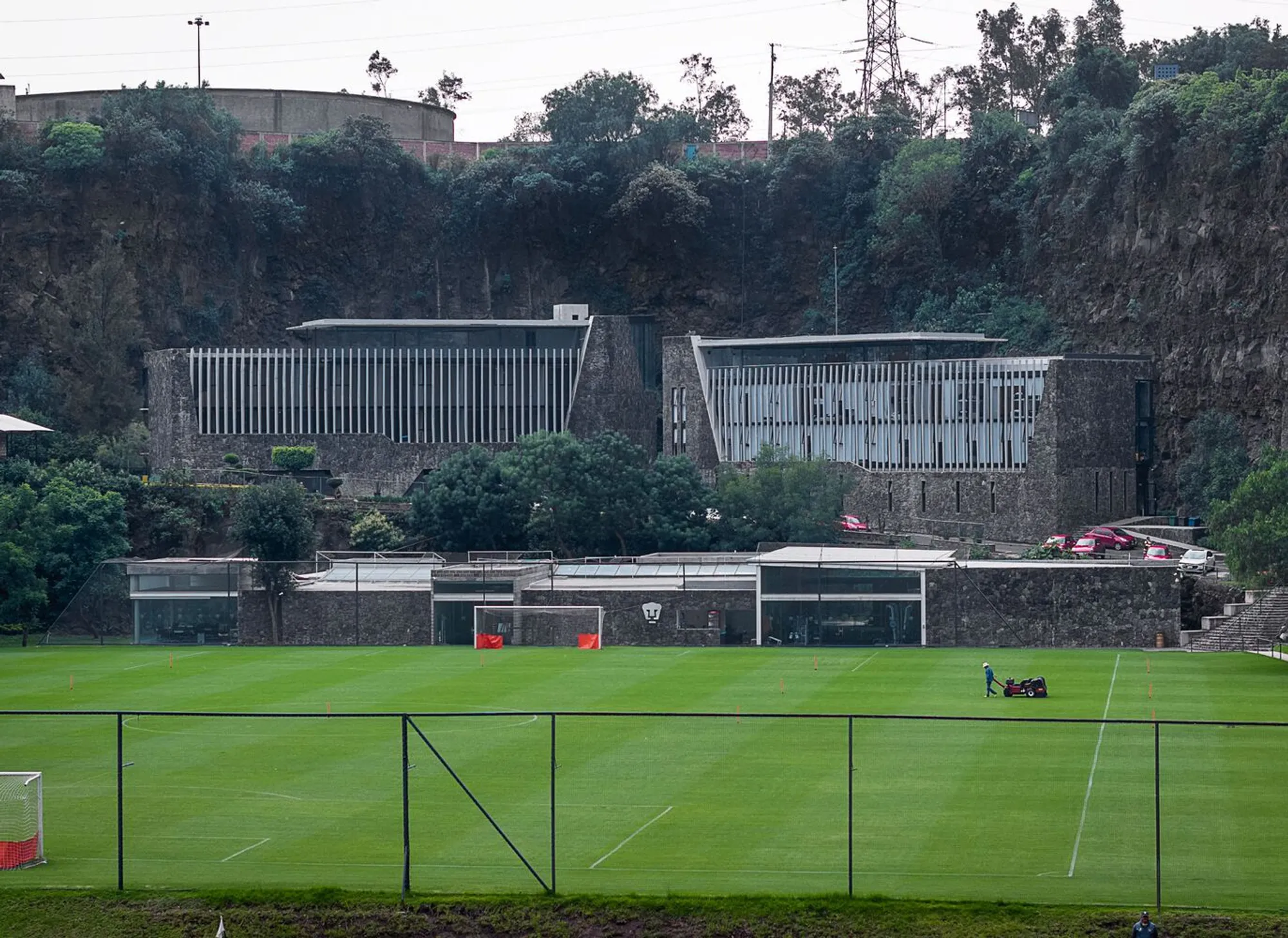
The Cantera, literally "the Quarry," is where Club Universidad Nacional (Pumas UNAM) has developed football talent for decades. Now the training complex has a building that takes the name seriously. Designed by DF Arquitectos, the Pumas Clubhouse is a 3,700 square meter residential and educational facility for up to 110 young players, and it is made, in large part, from the Xitle volcanic stone that defines the site itself. Two trapezoidal four-story volumes sit perpendicular to each other, pressed against the quarried rock face as though they grew out of it.
What makes the project genuinely interesting is not that it houses footballers. Dormitories are common enough. It is that the architects treated the geological context as the primary design driver rather than an obstacle. Seventy-five percent of the facade is volcanic stone extracted from the immediate area, and the remaining envelope is a lattice of precast concrete fins whose irregularity deliberately mimics the rough, imperfect walls of the quarry. The result is a building that reads as an extension of the cliff rather than something placed in front of it, a rare case where "blending with the landscape" is not marketing language but a verifiable material fact.
Stone and Lattice: Two Facade Languages
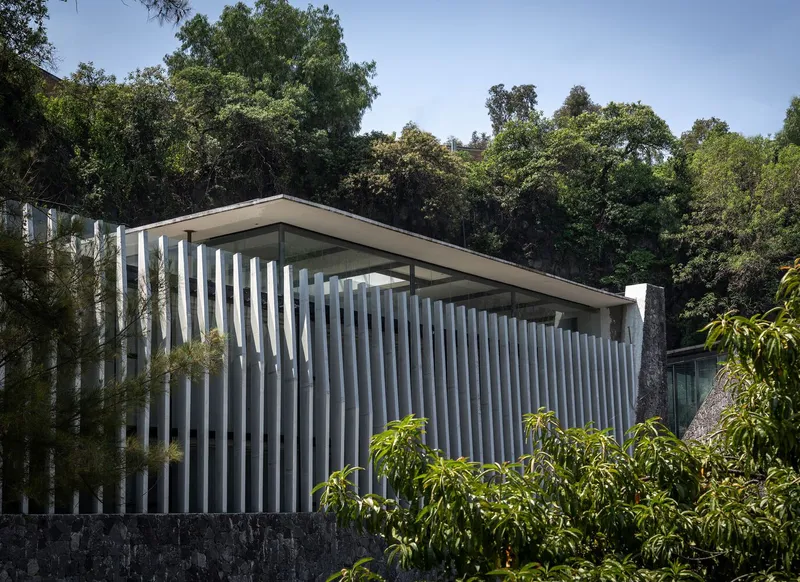
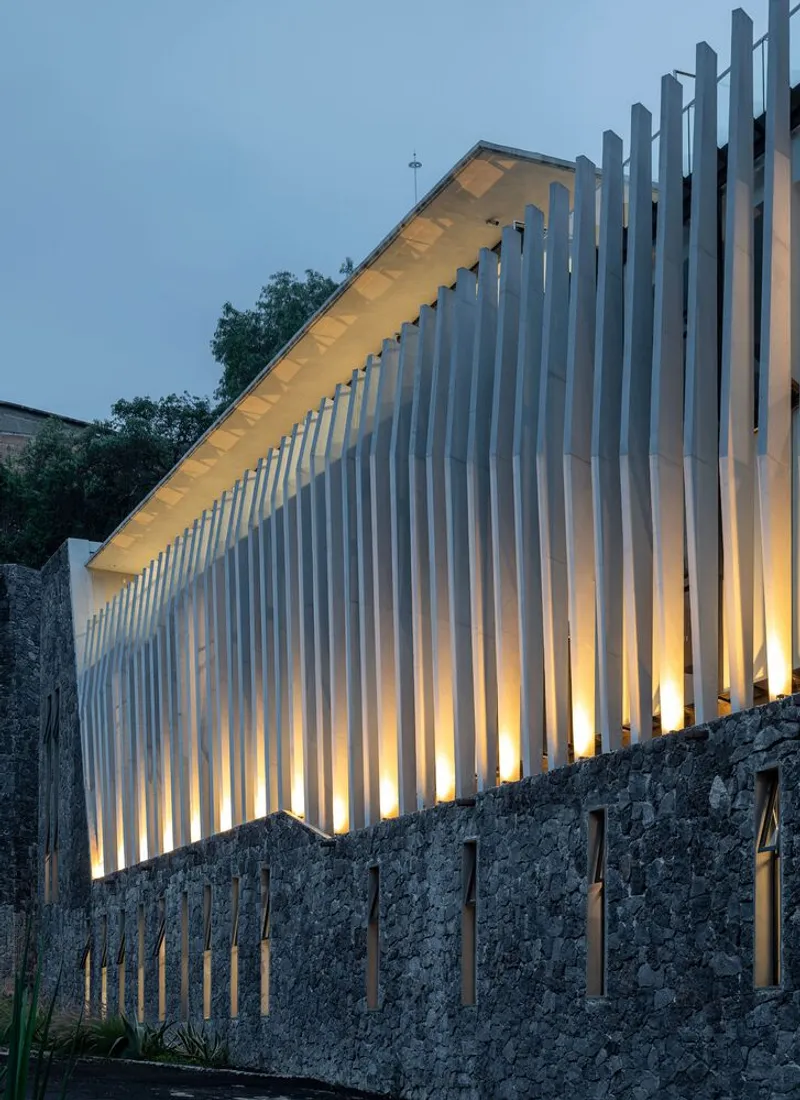
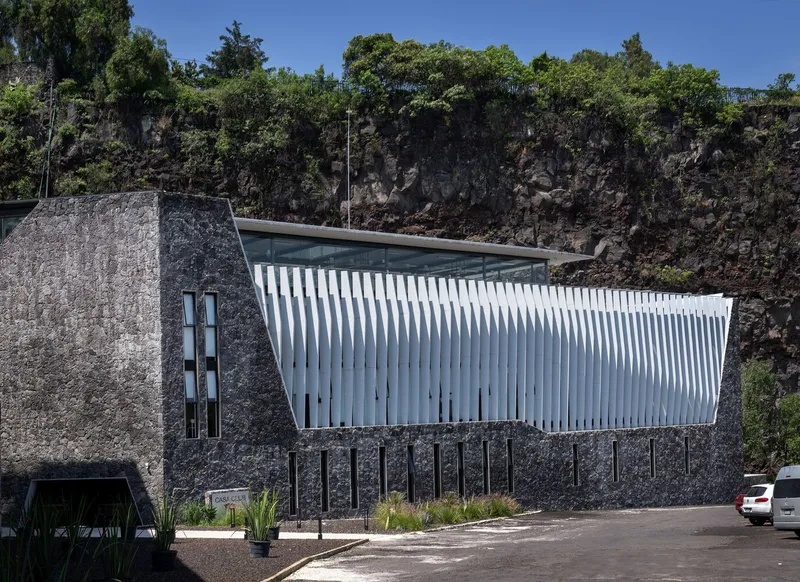
The clubhouse operates with a split facade logic. At the base, rough volcanic stone retaining walls anchor the building to the quarry, establishing continuity with the cliff behind. Above, vertical precast concrete fins wrap the sleeping levels in a directed lattice that filters daylight and creates shading without sealing the rooms off from air or views. At dusk, the slats glow from interior light, transforming the building into a lantern against the dark rock face. By day, the white fins read as a precise geometric counterpoint to the organic irregularity of the stone below.
The transition between these two materials is intentionally abrupt. There is no gentle gradient. Stone stops, concrete begins. That honesty about the difference between natural geology and manufactured element gives the facade its tension and keeps it from sliding into pastiche.
Anchored to the Rock
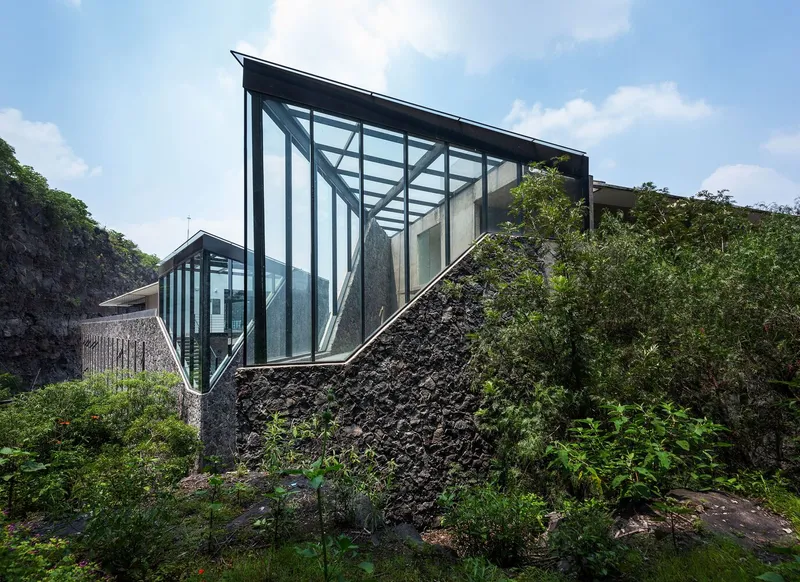
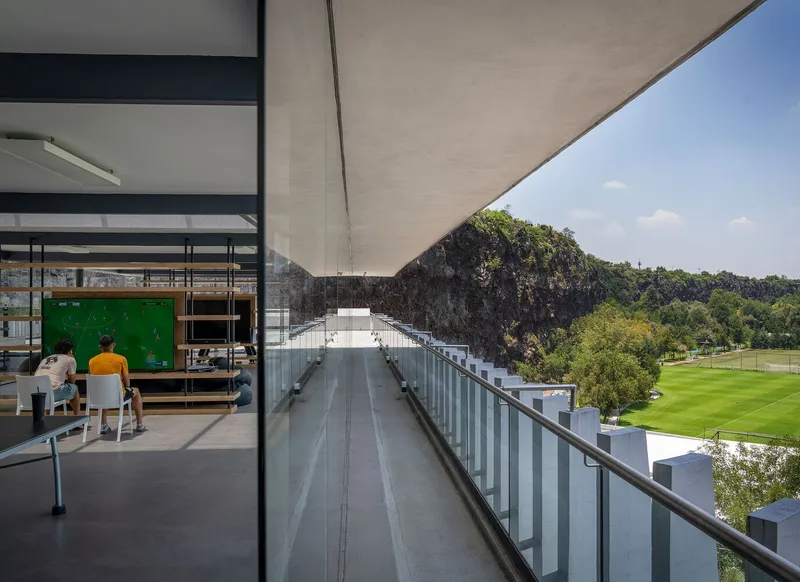
The relationship between building and cliff is the project's most compelling spatial condition. A glass pavilion with an exposed steel frame cantilevers over a rough volcanic stone retaining wall, making the geologic substrate visible and structural at the same time. Elsewhere, a covered terrace extends its concrete soffit directly toward the rock face, framing it as though it were a garden wall rather than a leftover from quarrying. The playing field sits just beyond, so the view from these outdoor spaces compresses cliff, architecture, and sport into a single frame.
Sheltering the buildings against the quarried land formation is a climate move as much as a scenic one. The mass of the cliff provides thermal buffering on one side, while the lattice screens handle solar control on the exposed facades. For a dormitory housing teenagers in a warm climate, keeping interiors cool without excessive mechanical load is not trivial.
Life Between Levels
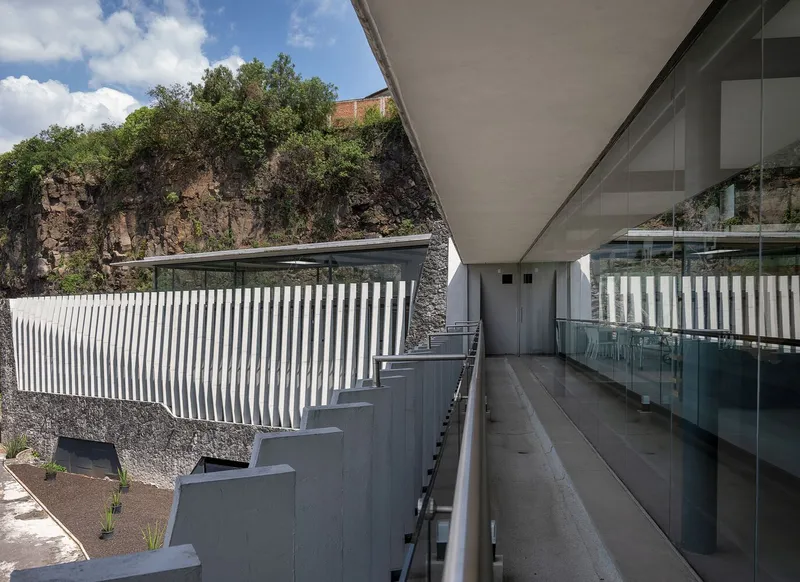
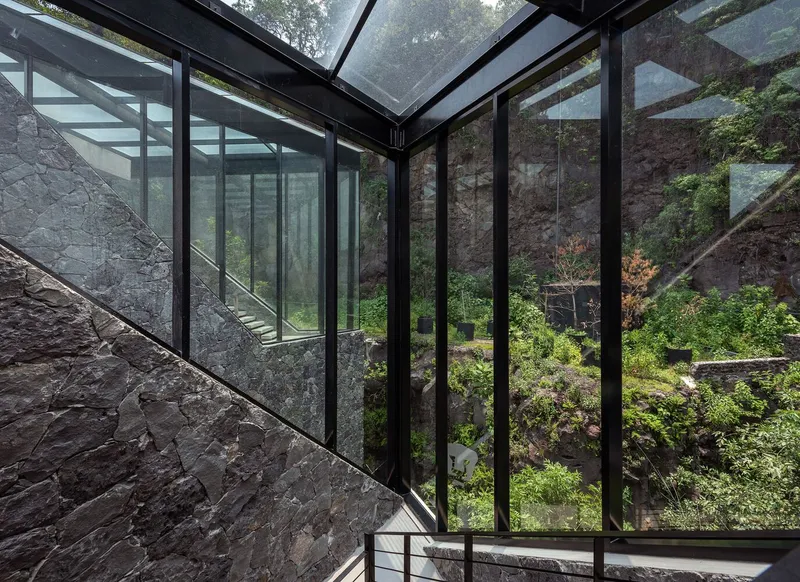
The program is stacked with clear intent. The ground floor holds the communal and educational spaces: a library, study classrooms, cafeteria, kitchen, laundry, and meeting rooms where visiting families can gather. Levels one and two contain 44 rooms, each with a private bathroom, organized along corridors that look out through the concrete lattice. The top floor is given over to recreation, entertainment, and open terraces with views across the entire sports complex. The vertical sorting follows a gradient from public to private and back to semi-public, a logic that recognizes young athletes need structured routines but also decompression.
Terrace walkways with glass balustrades serve as intermediate zones, places to pause between a training session and a meal, or between study and sleep. These corridors overlook planted courtyards carved into the hillside, reinforcing the sense that the building is always looking inward at its own geology. The landscaped courtyard visible from the glass-walled stairwell is not decoration. It is a functional buffer between the two perpendicular volumes, bringing light and vegetation into what could have been a dark seam.
Vertical Circulation as Event
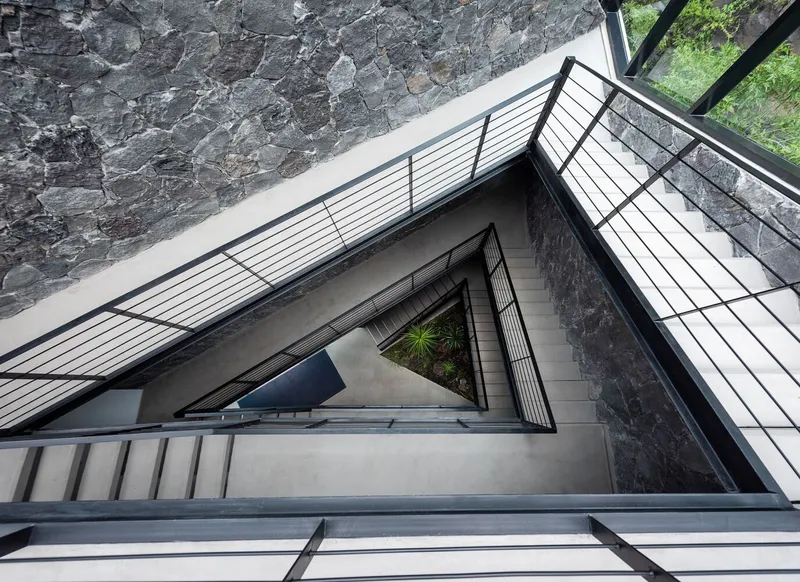
DF Arquitectos treats the stairwells as more than functional connectors. A triangular stair void with black steel railings rises through several floors to a polycarbonate skylight, pulling daylight deep into the plan. The geometry is tight and angular, creating a visual compression that makes arriving at the top level, with its open terraces and panoramic views, feel like a genuine release. In a building where the residents are teenagers, these small spatial dramas matter. They counteract the institutional flatness that plagues most dormitory typologies.
The Quarry as Context and Material Source
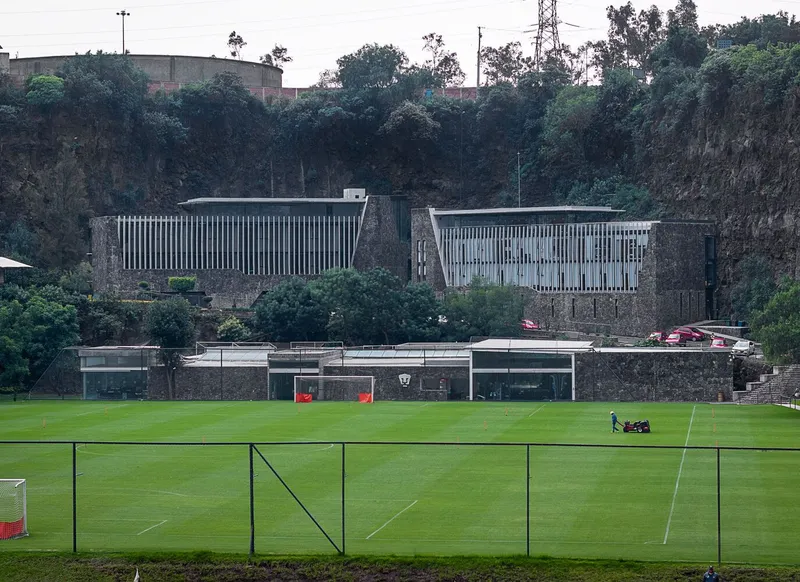
The long view across the football pitch reveals the full ambition of the siting strategy. The louvered volumes bridge between stone cliff walls, occupying the quarry cut as though filling a gap in the rock. The Xitle volcanic stone that makes up three-quarters of the facade was sourced from the construction site itself, which closes a material loop that most sustainability narratives only aspire to. The stone does not merely reference the quarry. It is the quarry, relocated and reassembled.
Located within the campus of the National Autonomous University of Mexico (UNAM), the project also carries an institutional weight. UNAM's campus is a UNESCO World Heritage site, and its mid-century buildings by architects like Juan O'Gorman already established a tradition of integrating volcanic stone with modernist form. DF Arquitectos is working within that lineage, updating it with prefabrication techniques and a program that did not exist in the 1950s but doing so with a material palette that would not look foreign to anyone who knows the campus.
Why This Project Matters
Sports infrastructure in Latin America is too often either lavish and disconnected from context or purely functional and devoid of spatial ambition. The Pumas Clubhouse refuses both extremes. It is a building with a serious program, housing and educating more than a hundred young athletes in an area where youth development carries social as well as sporting significance. And it accomplishes that program within a design framework that takes its site, its materials, and its climate seriously. The precast lattice is not ornament. It is a shading device. The volcanic stone is not cladding. It is structure and identity.
For architects working on institutional projects in geologically rich settings, the Pumas Clubhouse offers a clear lesson: the site is not a constraint to mitigate but a resource to deploy. DF Arquitectos built with the quarry rather than on it, and the distinction shows in every view, from the dusk-lit lattice to the raw stone retaining walls to the stairwell that frames the hillside like a landscape painting. The result is a building that young players will remember not because it was expensive but because it felt like it belonged exactly where it stood.
Pumas Clubhouse by DF Arquitectos. Located in Ciudad de México, Mexico. 3,700 m². Photography by Jaime Navarro.
About the Studio
Share Your Own Work on uni.xyz
If projects like this are the kind of work you want to make, uni.xyz is a place to publish your own, find collaborators, and enter design competitions.



Popular Articles
Popular articles from the community


The Earth Pod: 3D Printed Homes for Resilient Refugee Communities
The Earth Pod reimagines refugee housing through 3D printed homes made from clay, combining resilience, self-sufficiency, and rapid shelter.

Lunar Spiral: Space Architecture Shaped by the Mathematics of the Universe
Lunar Spiral reimagines space architecture through Fibonacci geometry, lunar regolith, levitating habitats, and self-sustaining Moon living.

Co-life: Sustainable Architecture for Age-Friendly Community Living
Co-life reimagines sustainable architecture for seniors through courtyards, rammed earth, shared gardens, and spaces designed for belonging.

Riyadh For All: Intergenerational Urban Design for Active Aging in Rabat
Riyadh For All reimagines urban design in Rabat with intergenerational co-living, adaptive courtyards, and Moroccan cultural exchange today.
Similar Reads
You might also enjoy these articles


Hodi-Mandai Geram
Project Function: Preservation and revitalization of the Intangible heritage and socio-spatial identity of the Hodi by Housing, Cultural Memory Center, Sacred Grove, landscape, local tourism economy


Olio Towers: A Mid-Rise for Performers That Fuses Housing, Rehearsal, and Stage
Located blocks from Houston's Theater District, this modular tower stacks living units around a central performance atrium.

Oasis: Modular Green Housing Carved into Dhaka's Urban Fabric
A shortlisted Plugin Housing entry reclaims unauthorized settlements in Dhaka with stepped concrete volumes, green roofs, and ventilation-driven design.

Black Hole: A Floating Megastructure for the Post-Physical Era
Emiliano Mazzarotto envisions a spherical, self-scaling arena where e-sports, digital hotels, and holographic stadiums replace traditional public space.

Explore Architecture Competitions
Discover active competitions in this discipline



Challenge to reimagine the Iron Throne


Photograph architecture without architects


Illustrate the lost glory of Angkor Wat - Render Challenge


Design challenge to reuse E-waste
Comments (0)
Please login or sign up to add comments
No comments yet. Be the first to comment!