

Punta Cana House by Mareines Arquitetura + Patalano Arquitetura: A Masterpiece of Organic Architecture in the Caribbean
Punta Cana House blends organic design, Brazilian furnishings, and high-tech construction, embracing natural light, ventilation, and Caribbean landscapes seamlessly.


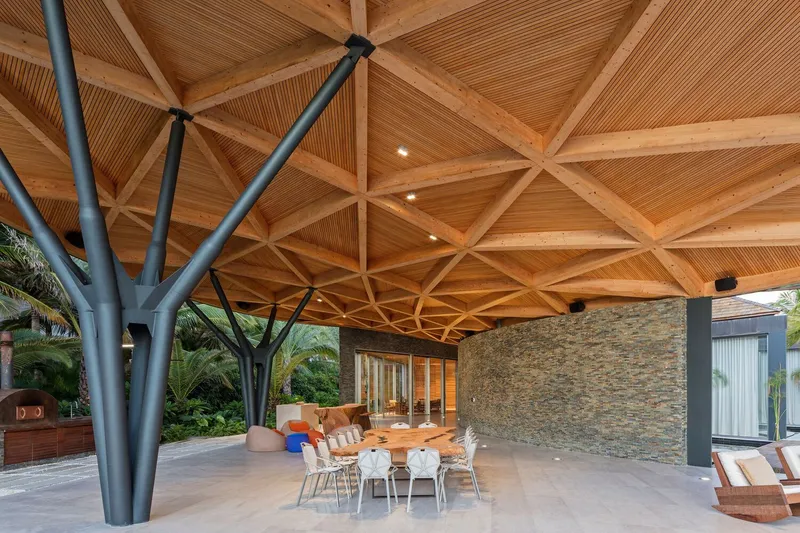
Located in the heart of the Dominican Republic’s stunning coastline, Punta Cana House by Mareines Arquitetura and Patalano Arquitetura redefines contemporary tropical living. Completed in 2017 and spanning 1,723 square meters, this extraordinary residence seamlessly blurs the boundaries between indoor and outdoor spaces, embracing the Caribbean landscape with an open, organic structure.
Photographed by Leonardo Finotti, the Punta Cana House showcases a harmonious balance of sustainability, high-tech engineering, and artisanal craftsmanship, delivering a sensory experience that evolves with the natural elements surrounding it.


An Organic Dialogue Between Architecture and Nature
The clients, an American family deeply involved in every stage of the project, envisioned a single-story residence that would be both expansive and intimately connected to nature. Responding to this, the architects crafted a layout that challenges traditional spatial concepts of "inside" and "outside." Aptly nicknamed the "Breeze House," the design invites natural ventilation and abundant daylight, creating a dynamic atmosphere that shifts throughout the day.
The house’s layout is divided into two main wings:
- The north block features six independent suites, each with private gardens and unique views.
- The south block accommodates the dining room, gourmet kitchen, bar, games room, gym, and all service areas.
Anchoring the residence is the central Family Room, a communal space designed to bring together family members and friends scattered across the globe.


A Journey Through Fluidity and Light
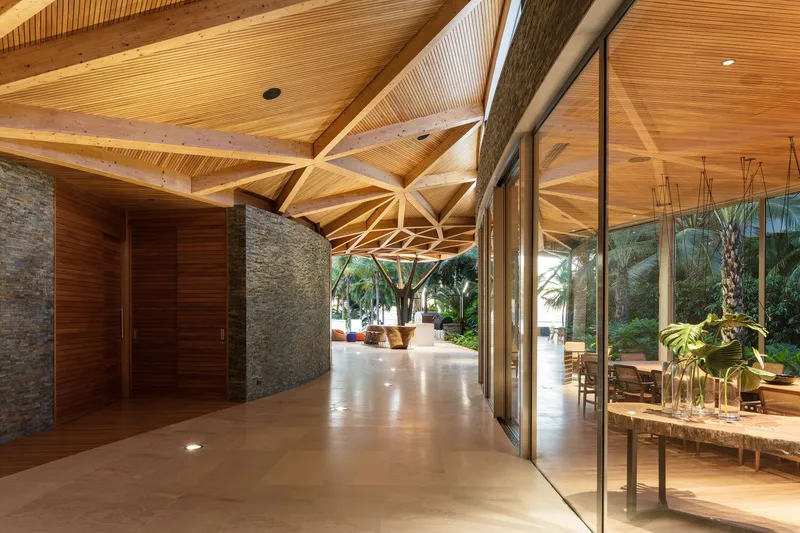
One of the most striking features of Punta Cana House is its serpentine layout, a sinuous balcony stretching 700 square meters that guides movement through a constantly changing interplay of light, shadow, openness, and intimacy.
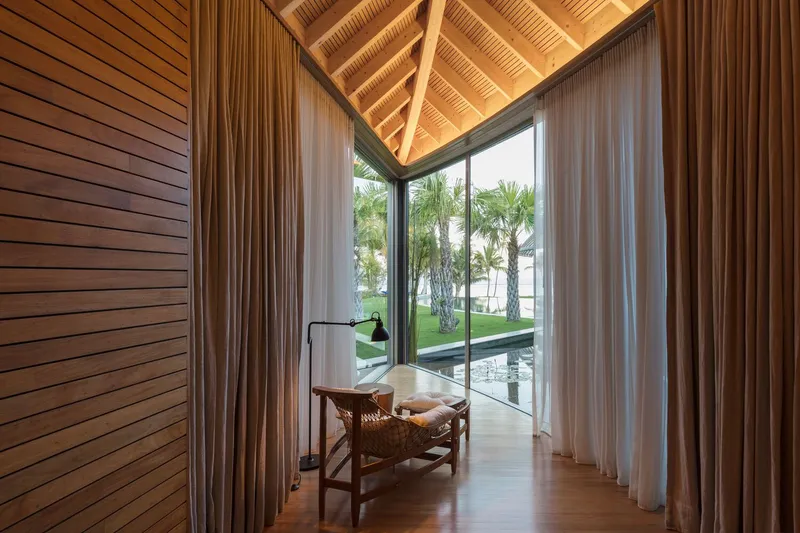
As visitors navigate the home, they experience “tears”—architectural openings in the roof and walls—that blur the lines between structure and garden, between water and earth. These apertures allow sunlight to animate the interiors across the day, casting shifting patterns that lend life and poetry to every space.
The organic design culminates in a rooftop garden, the only exception to the house's single-level concept. This elevated landscape merges seamlessly with the terrain, offering a lookout point with panoramic views of the sea and a venue for outdoor celebrations.


High-Tech Craftsmanship Meets Artisanal Detailing
Given the Dominican Republic’s exposure to extreme weather, especially hurricanes with winds reaching up to 300 km/h, the architects employed advanced CAD-CAM (Computer-Aided Design and Manufacturing) technology—an innovation rarely used in local construction at the time.
Key construction elements were sourced internationally:
- The laminated double-curvature wood beams were manufactured in France.
- Steel structural columns were prefabricated and imported from France.
- Glass frames and the clip-on copper roofing system were fabricated in Spain.
- Specialized sealing and insulation materials arrived from the United States.
Local labor, however, played a critical role. Skilled Dominican artisans meticulously executed the foundations, concrete walls, and exquisite finishing in stone, wood, and natural copper, imbuing the project with both technical precision and handcrafted warmth.
The house is elevated on a 2-meter-high compacted caliche platform to mitigate potential sea incursions during hurricanes. Additionally, all structural joints were designed internally to minimize coastal corrosion. The natural copper roof was intentionally left untreated, designed to patinate beautifully over time, integrating the architecture even more deeply into its seaside environment.


Brazilian Design Sensibility and Caribbean Spirit
The interiors are furnished almost entirely with pieces by renowned Brazilian designers, reflecting the clients' passion for contemporary Brazilian design. Subtle, neutral tones dominate the palette, allowing the natural textures of wood, stone, and metal to stand out against the lush Dominican landscape.
The landscaping further strengthens the house’s organic integration: a collaboration between Brazilian and Dominican horticulturists resulted in a living tapestry of vertical gardens and expansive horizontal lawns.
An Architectural Experience Beyond Walls
At every turn, Punta Cana House reveals itself not merely as a building, but as an immersive architectural journey—one where the Caribbean breeze, sunlight, and gardens are as essential to the experience as the structure itself.
As Ivo Mareines describes, “Walking through the house is already a rewarding experience. Spaces open, close, embrace, and surprise you. It’s a dance between architecture and nature, with no clear boundary between where the house ends and where the garden begins.”
Through its fusion of advanced technology, environmental responsiveness, and refined design, Punta Cana House stands as a beacon of innovative tropical architecture, setting a new benchmark for sustainable luxury living in the Caribbean.


All Photographs are works of Leonardo Finotti


Popular Articles
Popular articles from the community


Cube Design Draws an Ecological Corridor Between Two Shenzhen Hills with the Nankai Building
Beside Shenzhen's container docks, the Nankai Building pairs stacked balconies with a climbing green screen to connect two hillsides across its height.

David Macias Steps a Doorless Stone and Plaster House Down a Tropical Colombian Hillside
In the humid hills of Colombia, Threshold House replaces the front door with an open void and terraces its 850 m² down the slope instead of fighting it.

GROUP A Strips a 1969 Rotterdam Harbor Headquarters to Its Frame and Wraps It in Timber Louvers
In Rotterdam's M4H harbor district, Ferro Offices reuses a 1969 frame, adds one timber storey and reaches BREEAM-NL Outstanding.

longwave studio Reorganizes a 112 m² Tainan Apartment Around the Daily Routines of a Family and Two Cats
In Tainan, Taiwan, birch plywood, rust-red furniture and a freestanding plaster wall link arrival, storage, work and family life in one apartment.

Similar Reads
You might also enjoy these articles


Hodi-Mandai Geram
Project Function: Preservation and revitalization of the Intangible heritage and socio-spatial identity of the Hodi by Housing, Cultural Memory Center, Sacred Grove, landscape, local tourism economy


Olio Towers: A Mid-Rise for Performers That Fuses Housing, Rehearsal, and Stage
Located blocks from Houston's Theater District, this modular tower stacks living units around a central performance atrium.

Oasis: Modular Green Housing Carved into Dhaka's Urban Fabric
A shortlisted Plugin Housing entry reclaims unauthorized settlements in Dhaka with stepped concrete volumes, green roofs, and ventilation-driven design.

Black Hole: A Floating Megastructure for the Post-Physical Era
Emiliano Mazzarotto envisions a spherical, self-scaling arena where e-sports, digital hotels, and holographic stadiums replace traditional public space.

Explore Architecture Competitions
Discover active competitions in this discipline

Challenge to reimagine the Iron Throne

Photograph architecture without architects

Illustrate the lost glory of Angkor Wat - Render Challenge

Design challenge to reuse E-waste
Comments (0)
Please login or sign up to add comments
No comments yet. Be the first to comment!