

TOOB Studio Threads Light and Heritage Through a 45m² Hanoi House on a Historic Village Street
On one of Quan Nhân Street's narrowest stretches, red clay tiles and fired brick anchor a slender home to its ancient village roots.


Hanoi devours its villages. The capital's expansion has, over the past two decades, folded ancient settlement patterns into a continuous urban fabric of shophouses, motorbike repair stalls, and concrete-frame apartments. Quan Nhân Street, which traces back to the old Quan Nhân village in the Kẻ Mọc area, is one of those places where temples and heritage sites still punctuate a streetscape that has otherwise fully commercialized. It is exactly the kind of context where a new building either erases memory or reinforces it, and TOOB Studio's response here manages the latter without resorting to nostalgia.
Working with a site area of just 45 square meters on the street's narrowest section, the architects split the program into a ground-level rental space for commercial use and elevated living quarters above, a pragmatic dual-income arrangement common in Vietnamese tube houses. What makes the project worth studying is not the program split itself but the section: a vertical sequence of voids, skylights, and material shifts that pulls daylight deep into the plan and gives a home hemmed in by neighbors an almost vertical relationship with the sky.
A Vertical Light Well as Organizing Spine
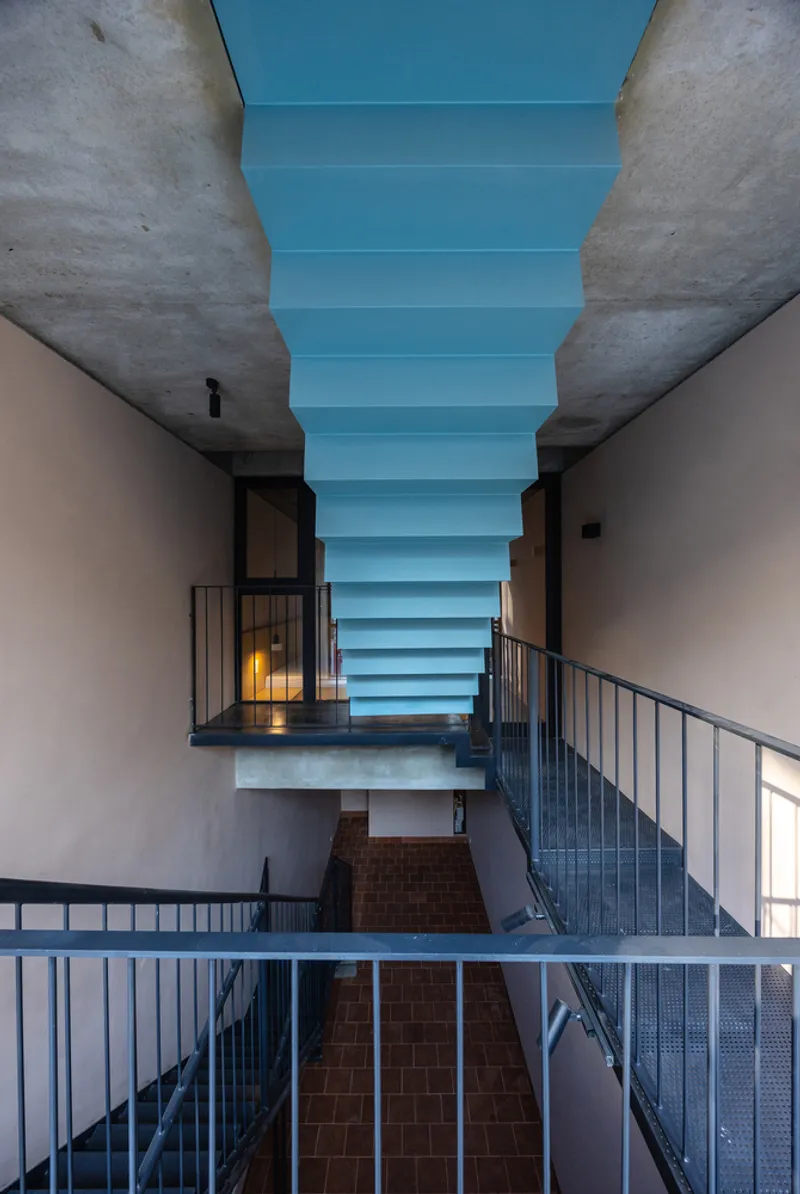
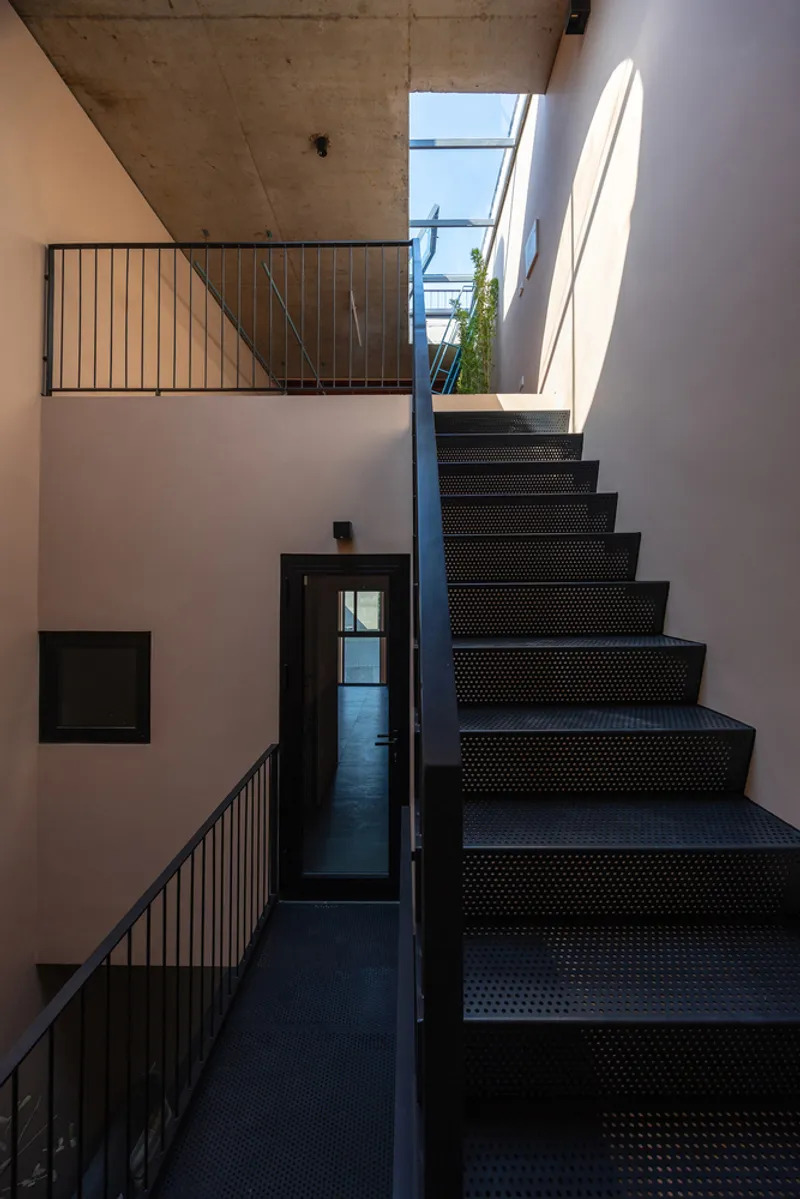
The section is the real drawing here. A multi-level atrium cuts through the building's core, stacking horizontal skylights between exposed concrete walls and threading a black perforated steel staircase upward through white-walled shafts. The result is a building that breathes vertically: air and light descend through layered openings rather than relying on the street-facing facade alone. In a neighborhood where party walls block any lateral connection, this strategy is essential.
The steel stair, punched with perforations, lets light filter through its treads and landings, turning circulation into a second diffuser. Steel railings at each level frame views back down through the void, giving the narrow house an unexpected sense of depth and spatial generosity.
Street Edge and Threshold
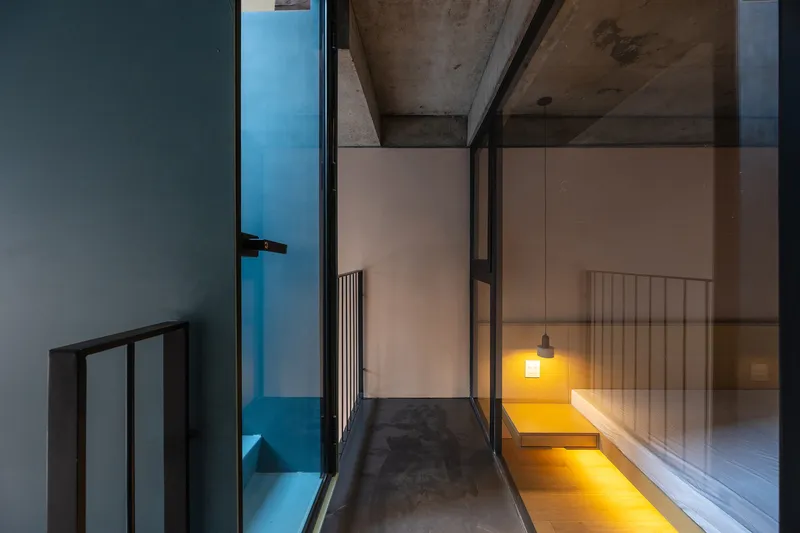

The ground floor faces Quan Nhân Street's bustling commercial strip, and the architects handle the transition from public to private with a narrow passage framed by exposed concrete overhead and glazed doors that glow warmly at dusk. There is no grand entrance sequence here, only a compression through the slot of the lot that makes arriving feel deliberate. The passage doubles as a buffer, filtering street noise before it reaches the living levels above.
At the rear, a courtyard terrace introduces bamboo planting beside a blue metal stair, and a slatted timber screen above mediates between open sky and enclosed room. It is a compact version of the traditional Vietnamese courtyard, scaled to fit a lot barely wider than a car, yet it performs the same climatic and psychological function: a pause between interior zones, a pocket of greenery, a source of cross-ventilation.
Material Palette: Brick, Timber, Concrete
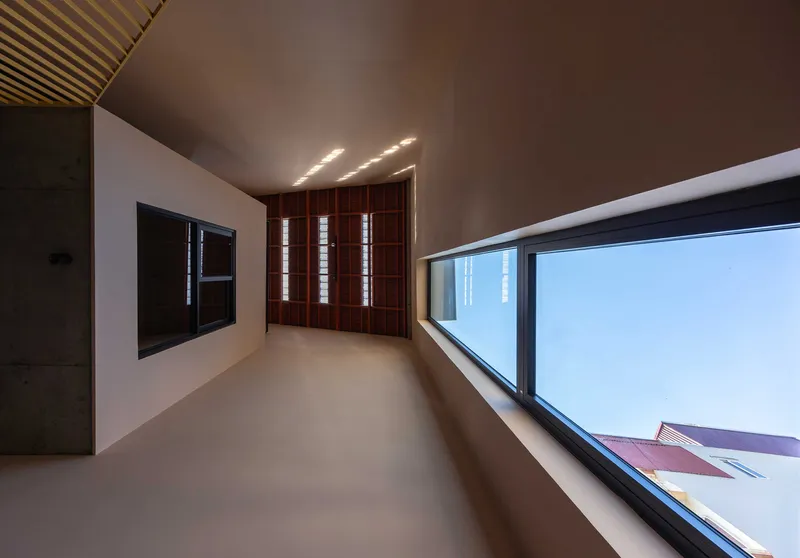
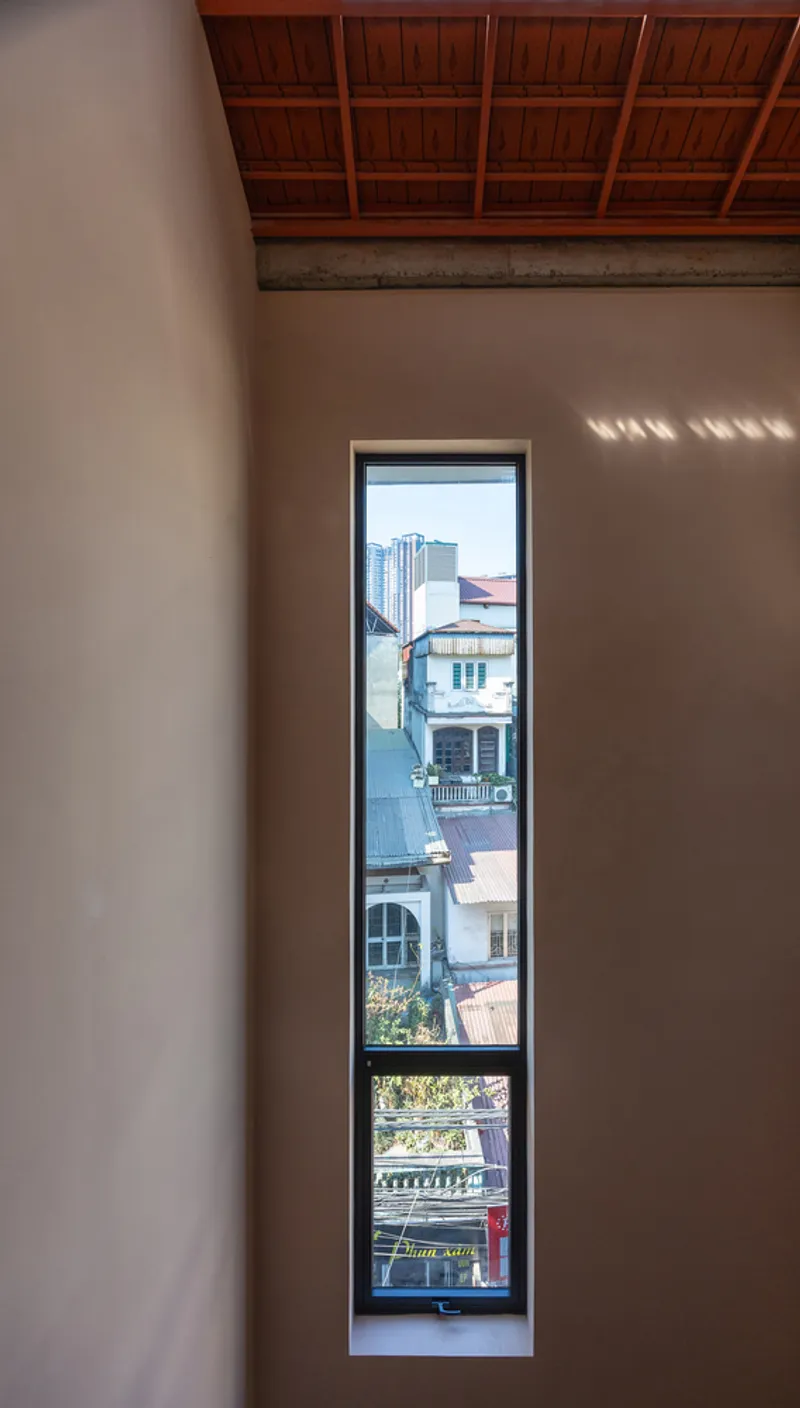
TOOB Studio's material choices are pointed. Red clay roof tiles and fired brick reference the building vocabulary of Vietnamese village architecture without mimicking its forms. Slatted timber walls with recessed lighting appear in the upper corridors, giving warmth to surfaces that might otherwise read as utilitarian. Concrete is left exposed at ceilings and beams, an honest expression of the structure that also keeps costs in check.
One particularly effective moment: a tall, narrow window framed by a timber coffered ceiling and a concrete beam, looking out over neighboring rooftops. The view is nothing special, just the terracotta and corrugated metal patchwork of Hanoi's residential fabric, but the framing turns it into something deliberate. It reminds occupants that they live within a texture, not apart from it.
Living in the Section
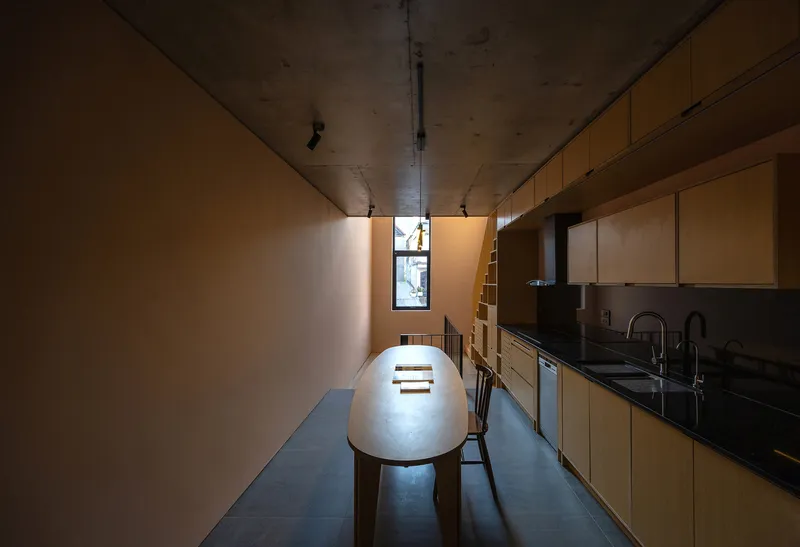
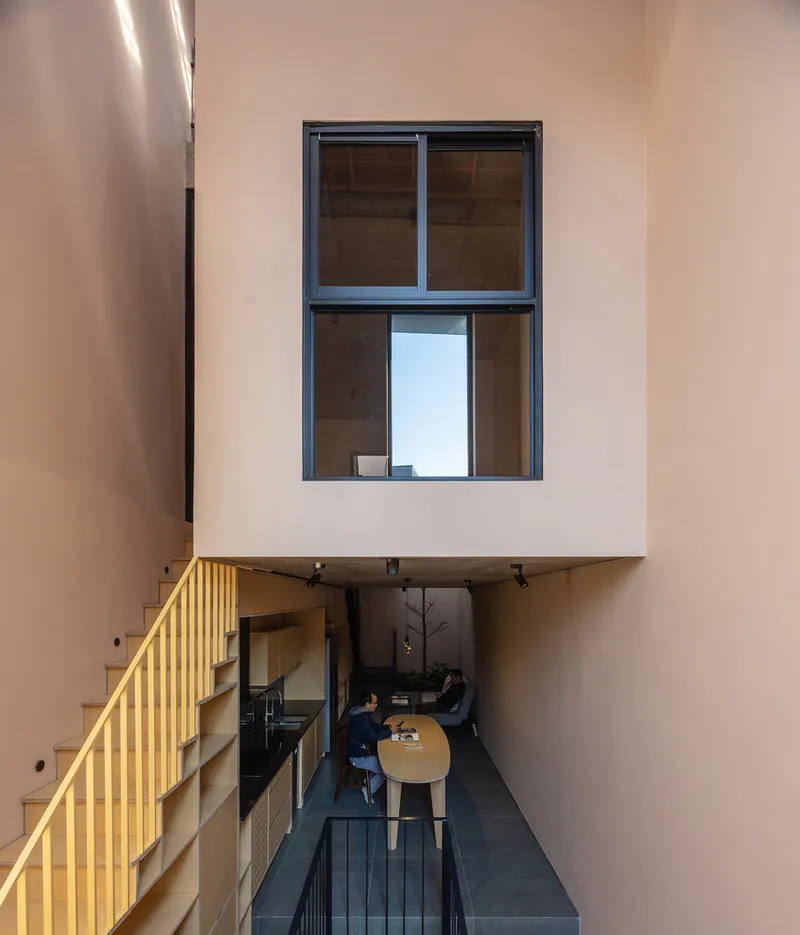
The galley kitchen captures the spatial economy of the whole project. Plywood cabinetry lines one wall beneath a concrete ceiling, and a narrow vertical window at the far end provides both task light and a sense of orientation. There is no wasted surface. Every element, from the depth of the countertop to the position of the window, has been calibrated to the lot's constraints.
Elevating the living areas above the commercial ground floor does more than separate noise from rest. It places the domestic life of the house in the zone where the light wells are most effective, where breezes can cross from void to terrace, and where the occupants are removed from the dust and exhaust of the street. The stacking is simple, but the environmental payoff is real.
Why This Project Matters
Quan Nhân House is not a manifesto building. It does not announce itself on the street or propose a radical typological shift. Its achievement is quieter and arguably more useful: it demonstrates that a 45-square-meter lot on a congested Hanoi lane can produce a home with genuine spatial quality, adequate daylight, cross-ventilation, and a material identity rooted in the village fabric it occupies. That is a design problem millions of Vietnamese homeowners face, and TOOB Studio's solution is replicable without being generic.
The project also makes a case for keeping traditional materials in the contemporary toolkit, not as decoration but as climate-appropriate, locally sourced construction that performs well and connects new buildings to their neighborhoods. In a city where the default is tiled facades and aluminum window frames, the presence of fired brick and clay tile is both an aesthetic and an ethical choice. It says that density and heritage are not opposites, that a house can earn income on the ground floor and still feel like home above.
Quan Nhân House, Cầu Giấy, Hanoi, Vietnam. Architect: TOOB Studio. Area: 45 m². Completed: 2024. Photography: Triệu Chiến.
About the Studio
Share Your Own Work on uni.xyz
If projects like this are the kind of work you want to make, uni.xyz is a place to publish your own, find collaborators, and enter design competitions.




Popular Articles
Popular articles from the community


The Musturak Paradise: Senior Living Architecture for a Connected Future in Temara, Morocco
The Musturak Paradise reimagines senior living architecture in Temara via private homes, social spaces, culture, community, and shared care.

Play: Fragments of Their World
Familiar architecture becomes modular playground design, creating safe spaces where displaced children can learn, connect, imagine and play.

Lunar Spiral: Space Architecture Shaped by the Mathematics of the Universe
Lunar Spiral reimagines space architecture through Fibonacci geometry, lunar regolith, levitating habitats, and self-sustaining Moon living.

The Earth Pod: 3D Printed Homes for Resilient Refugee Communities
The Earth Pod reimagines refugee housing through 3D printed homes made from clay, combining resilience, self-sufficiency, and rapid shelter.
Similar Reads
You might also enjoy these articles


Hodi-Mandai Geram
Project Function: Preservation and revitalization of the Intangible heritage and socio-spatial identity of the Hodi by Housing, Cultural Memory Center, Sacred Grove, landscape, local tourism economy


Olio Towers: A Mid-Rise for Performers That Fuses Housing, Rehearsal, and Stage
Located blocks from Houston's Theater District, this modular tower stacks living units around a central performance atrium.

Oasis: Modular Green Housing Carved into Dhaka's Urban Fabric
A shortlisted Plugin Housing entry reclaims unauthorized settlements in Dhaka with stepped concrete volumes, green roofs, and ventilation-driven design.

Black Hole: A Floating Megastructure for the Post-Physical Era
Emiliano Mazzarotto envisions a spherical, self-scaling arena where e-sports, digital hotels, and holographic stadiums replace traditional public space.

Explore Housing Competitions
Discover active competitions in this discipline



Challenge to reimagine the Iron Throne


Photograph architecture without architects


Illustrate the lost glory of Angkor Wat - Render Challenge


Design challenge to reuse E-waste
Comments (0)
Please login or sign up to add comments
No comments yet. Be the first to comment!