

Serie Architects Stacks Thirteen Rooms into a Crystalline Jain Discourse Hall in Gujarat
Raj Sabhagruh rises 40 meters above a hilltop ashram in Dharampur, clad in 800,000 hand-chiseled Makrana marble bricks salvaged from quarry waste.


Most buildings that aspire to spiritual resonance fall back on scale alone: taller domes, wider naves, more gilding. Raj Sabhagruh, the discourse hall Serie Architects completed in 2024 for the Shrimad Rajchandra Ashram in Dharampur, Gujarat, takes a different route. It stacks thirteen interlocking rooms, each rotated 45 degrees from the one below, so that the building rises less like a tower and more like a slow, spiraling argument. The resulting geometry is unmistakably contemporary, yet it carries the DNA of the Jain Samavasaran, a mythical temple of ascending platforms where each tier represents a step toward enlightenment.
What makes the project genuinely interesting is how it collapses program, structure, and ornament into one system. The gently curving concrete shear walls are simultaneously load-bearing structure, facade, and light filter. Deep circular perforations puncture the building's 36 faces, casting streams of sunlight that shift through the day. The cladding, over 800,000 hand-chiseled bricks of Makrana white marble salvaged from quarry off-cuts, turns each surface into a diffuse reflector whose crystalline grain refracts light differently every hour. Serie Architects won the competition in 2012 and spent more than a decade refining this synthesis. The finished building, sitting at the apex of a crescent-shaped 60-meter hillock within a 100-hectare masterplan, is both the ashram's functional heart and its most potent symbol.
A Lantern on a Hill

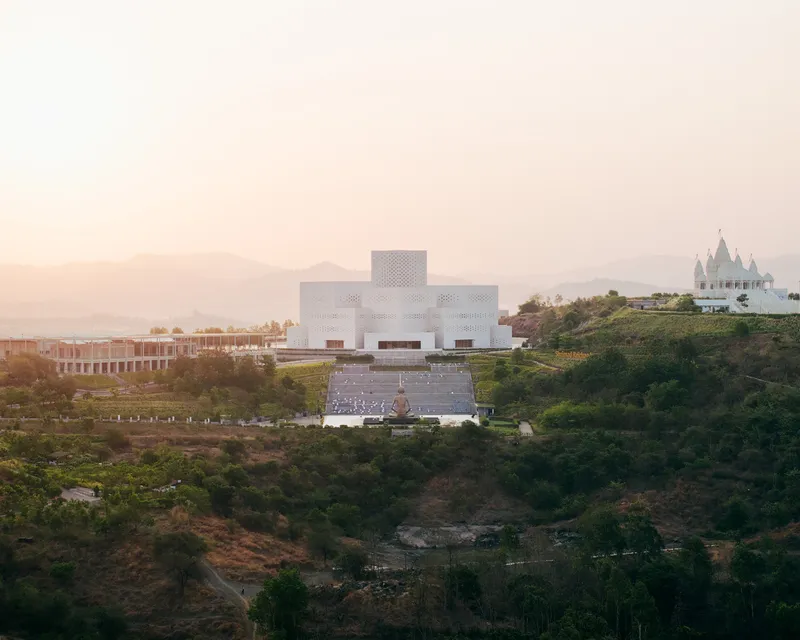
From the ground, Raj Sabhagruh reads as a cluster of pale, perforated volumes stepping upward, its silhouette recalling the shikaras that cap traditional Jain sanctums. From a distance at dusk, the building becomes something else entirely: a luminous cube hovering above the Western Ghats, backlit from within. The siting is deliberate. Placed at the highest point of the hillock, the hall commands views toward a large dining hall to the north, a 5,000-seat open-air amphitheater to the west, and a Jain temple to the south, whose monolithic trabeated marble structure was completed a few years earlier and shares Raj Sabhagruh's material palette.
The plaza surrounding the building is paved in concentric rings of white marble slabs, a ground plane designed not just for procession but for thermal performance. The pale stone reflects the fierce Gujarat sun rather than absorbing it, and ficus trees planted in the rings provide intermittent shade. Landscape architects Ficus Design extended this logic down the slopes with a sacred grove of 108 ancient tree species, linking the building's geometry to the broader ecology of the site.
The Column-Free Drum
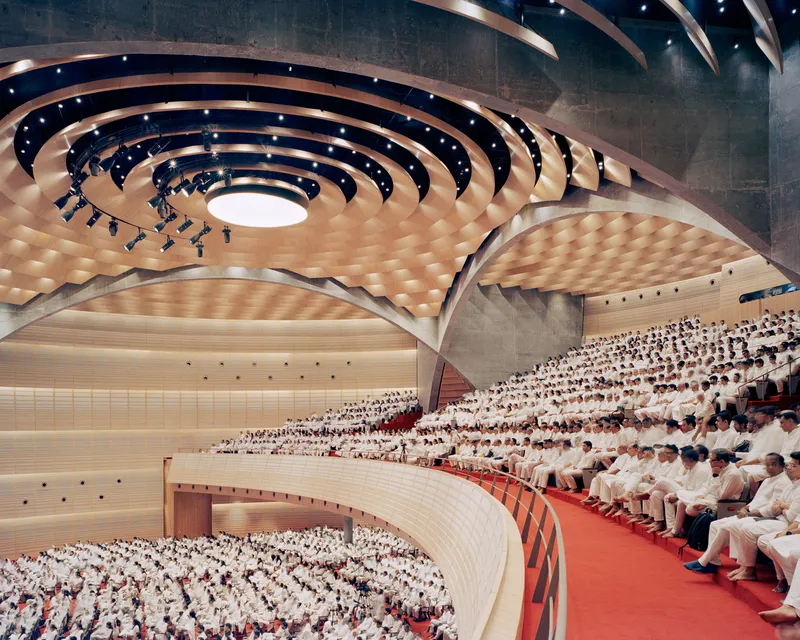

The main auditorium sits at ground level: a circular, column-free drum roughly 54 meters in diameter and 20 meters tall. Four gently curved concrete arches intersect to hold the roof without a single interior column, freeing 5,000 seats to face a central stage with unobstructed sightlines. The ceiling overhead spirals in concentric rings of timber acoustic baffles, a motif that echoes the radial patterns of traditional Jain Maha-mandapas while doing serious acoustic work. The result is a room that can host thousands of attendees for discourse yet still feel intimate enough for a single speaker's voice to carry.
Eight entrances, placed at cardinal and intermediate compass points, open into a circumambulating foyer that wraps the drum. The foyer is generous enough to function as a gathering space in its own right, distributing crowds radially rather than funneling them through a single bottleneck. It is a small planning move with outsized consequences for how the building feels during large events.
From Speech to Silence

Serie Architects describes the sectional journey as moving from "speech to silence." The discourse hall at the base is the noisiest, most public room. Above it, a 1,000-square-meter museum occupies the second tier, followed by classrooms for study and a library of rare Jain texts on the third. At the apex, a 300-seat meditation hall sits in near-total quiet, its ribbed white ceiling and blue carpet creating a room stripped of distraction. Over 1,000 pinpoints of light are etched into its marble surfaces, so the room glows softly rather than relying on artificial fixtures. The program literally ascends through decreasing volumes and decreasing noise, making the architecture an embodiment of inward contemplation.
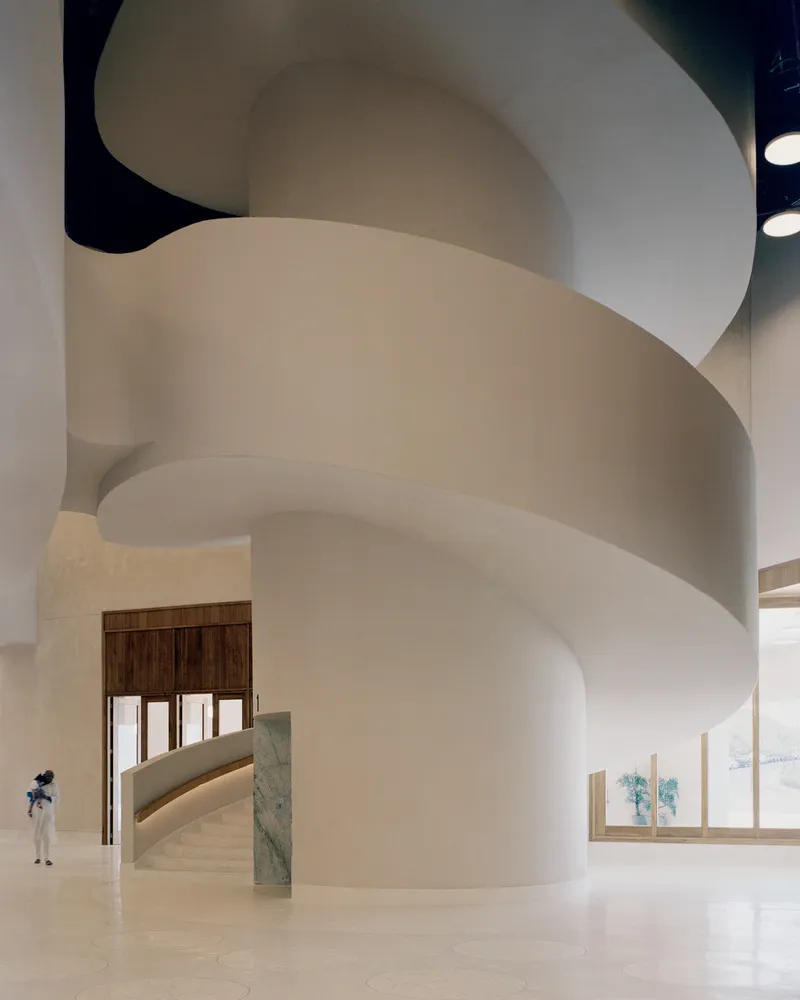
The spiraling staircase that connects these levels reinforces the idea of a ritual climb. Its polished terrazzo floors and curving marble walls feel deliberate without being precious, guiding visitors upward with a sense of inevitability. Each rotation reveals a new perforation pattern, a new angle of daylight, a new framed view of the landscape below.
Marble as Structure, Surface, and Light
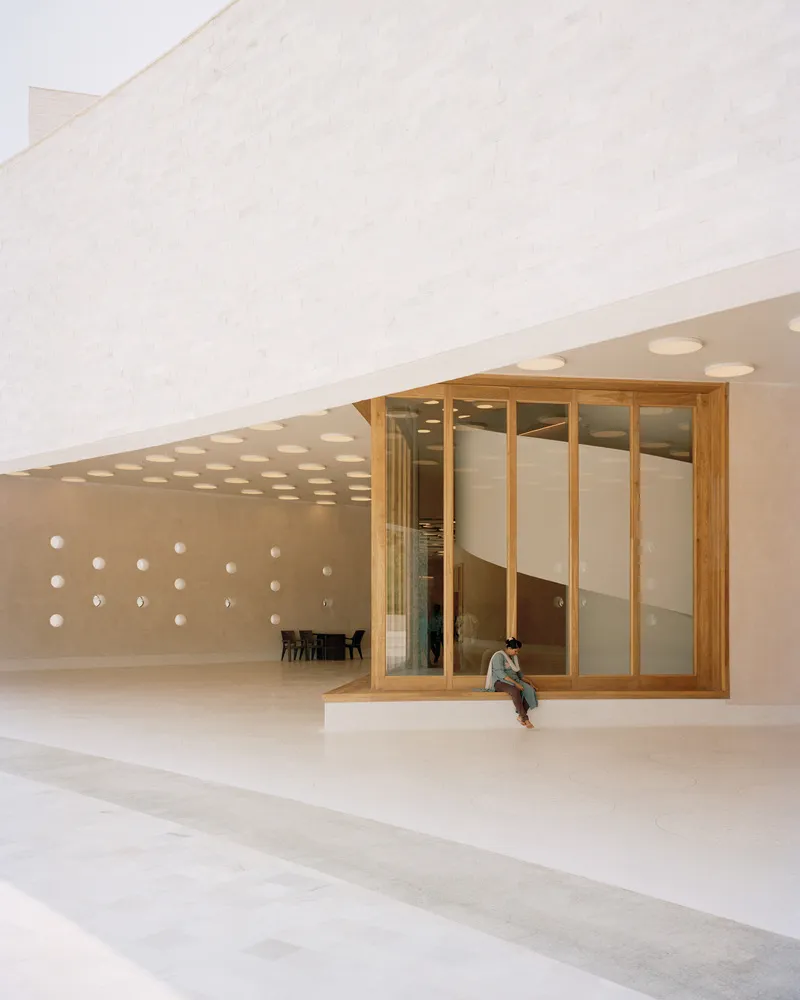
The cladding deserves close attention because it is not decorative veneer. The 50mm-thick, hand-chiseled Makrana marble bricks are deliberately small so they can follow the compound curvature of the shear walls without cracking or requiring excessive mortar joints. Over two years, masons hand-laid these bricks across all 36 faces of the building's stacked volumes. The rough cuts expose the crystalline grain of the marble, which refracts and disperses light rather than reflecting it in a single plane. At different times of day, the same wall can appear warm, cool, matte, or sparkling.
Sourcing matters here. The marble comes from Makrana in Rajasthan, the same quarries that supplied the Taj Mahal, but Serie used discarded off-cuts rather than newly quarried blocks. Repurposing 800,000 bricks' worth of waste marble is both an environmental gesture and a cost-efficiency measure that allowed an extraordinary material to stay within a realistic budget. Combined with the lean structural strategy, where the 500mm-thick shear walls serve simultaneously as structure, facade, and spatial dividers, the project achieves material intensity without material excess.
Threshold and Transition
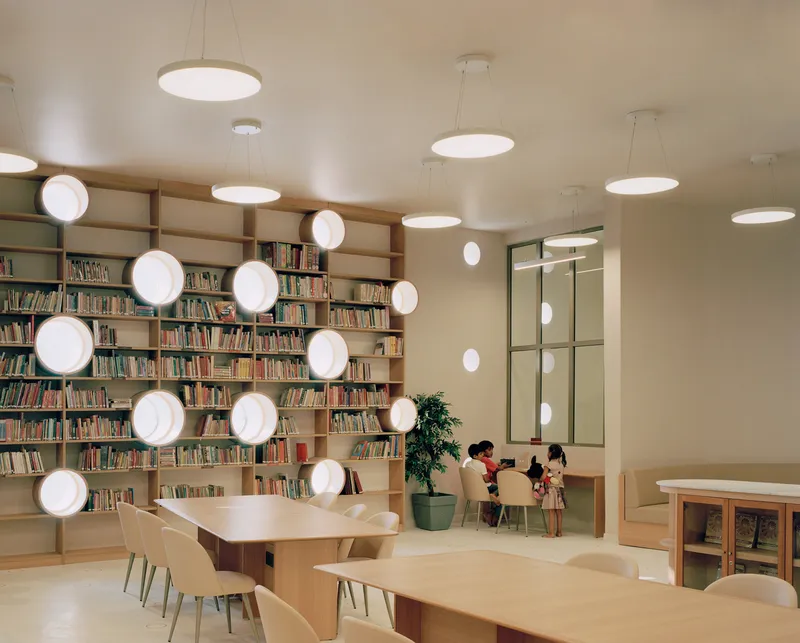
The timber-framed pavilions and openings at ground level deserve a note. Against the austerity of marble and concrete, the warm tone of the timber frames marks points of entry and pause. A reading room on one level, outfitted with timber shelving and circular pendant lights, gives children and scholars a domestic-scaled space within a monumental building. A glazed pavilion at ground level opens onto the courtyard, offering a threshold between the ashram's landscape and the building's interior world. These moments of human-scaled warmth prevent the building from feeling like a monument you merely look at.
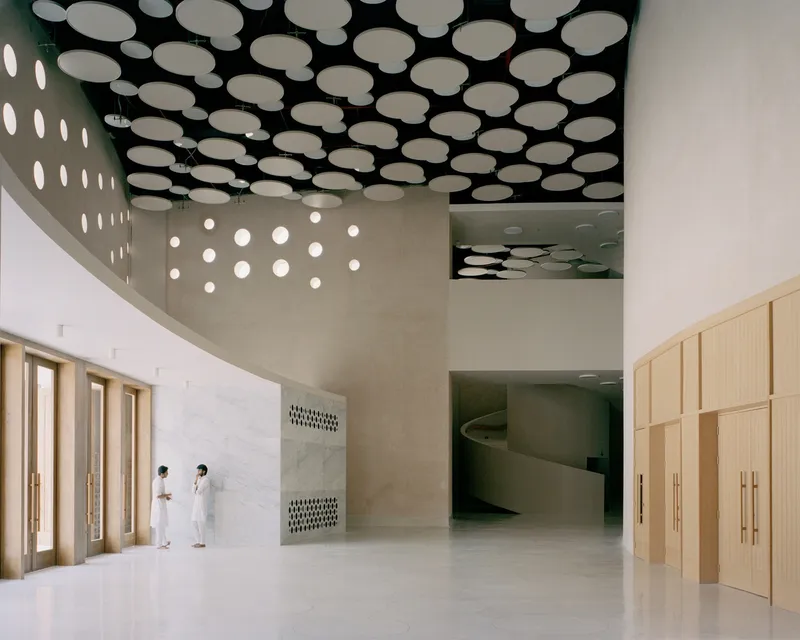
The perforated ceiling panels in the lobby, visible in the interior shots, continue the circular-perforation language of the exterior but in white acoustic panels. The consistency is welcome: the building speaks the same geometric language at every scale, from the macro silhouette down to the smallest ceiling detail.
Why This Project Matters
Religious architecture in India often oscillates between two poles: historicist replicas that reproduce temple forms in modern materials, or sleek contemporary boxes that could belong to any program in any country. Raj Sabhagruh refuses both extremes. It takes a specific cosmological idea, the Samavasaran's ascending platforms as a metaphor for spiritual ascent, and translates it into a structural and spatial logic that could not exist without contemporary engineering. The interlocking, rotated volumes are not ornamental quotations of tradition; they are the structure itself. That is a meaningful distinction.
The project also offers a quiet lesson in material ethics. By rescuing 800,000 marble bricks from quarry waste and deploying a lean shear-wall system that eliminates redundant columns and secondary facades, Serie Architects demonstrates that resourcefulness and sensory richness are not opposites. The building glows, refracts, and shifts with light all day, yet it was built with less material than a conventional structure of comparable size. For a discourse hall dedicated to a philosophy of non-attachment and mindful living, that alignment between means and meaning is the strongest argument the architecture makes.
Raj Sabhagruh Discourse Hall, designed by Serie Architects. Shrimad Rajchandra Ashram, Dharampur, Gujarat, India. 16,000 square meters. Completed 2024. Photography by Rory Gardiner.
About the Studio
Share Your Own Work on uni.xyz
If projects like this are the kind of work you want to make, uni.xyz is a place to publish your own, find collaborators, and enter design competitions.




Popular Articles
Popular articles from the community


Riyadh For All: Intergenerational Urban Design for Active Aging in Rabat
Riyadh For All reimagines urban design in Rabat with intergenerational co-living, adaptive courtyards, and Moroccan cultural exchange today.

Hill & Cross Opera: Sculptural Opera House Architecture Shaped by Tallinn’s Landscape and Identity
Hill & Cross Opera reimagines opera house architecture in Tallinn through its sculptural hill, civic plaza, glass wave and a luminous cross.

The Musturak Paradise: Senior Living Architecture for a Connected Future in Temara, Morocco
The Musturak Paradise reimagines senior living architecture in Temara via private homes, social spaces, culture, community, and shared care.
EW PARK: Sustainable Architecture Reimagines the Future of Urban Parking
EW PARK reimagines city parking as a modular wooden tower combining automation, solar energy, electric mobility, and adaptable urban design.


Similar Reads
You might also enjoy these articles


Hodi-Mandai Geram
Project Function: Preservation and revitalization of the Intangible heritage and socio-spatial identity of the Hodi by Housing, Cultural Memory Center, Sacred Grove, landscape, local tourism economy


Olio Towers: A Mid-Rise for Performers That Fuses Housing, Rehearsal, and Stage
Located blocks from Houston's Theater District, this modular tower stacks living units around a central performance atrium.

Oasis: Modular Green Housing Carved into Dhaka's Urban Fabric
A shortlisted Plugin Housing entry reclaims unauthorized settlements in Dhaka with stepped concrete volumes, green roofs, and ventilation-driven design.

Black Hole: A Floating Megastructure for the Post-Physical Era
Emiliano Mazzarotto envisions a spherical, self-scaling arena where e-sports, digital hotels, and holographic stadiums replace traditional public space.


Explore Religious Building Competitions
Discover active competitions in this discipline



Design Challenge - Contemporary interpretation of a religious complex


Challenge to reimagine the Iron Throne


Photograph architecture without architects


Illustrate the lost glory of Angkor Wat - Render Challenge
Comments (0)
Please login or sign up to add comments
No comments yet. Be the first to comment!