
Ramón Esteve Wraps a Valencian Home Around an Atrium of Stone, Water, and Light
In La Cañada near Valencia, a single-storey courtyard house balances tectonic masonry walls against weightless planes of glass and water.


The suburban periphery of Valencia is not the first place you'd expect to find a house that channels the organizational logic of a Roman domus. But Ramón Esteve Estudio's House in La Cañada does exactly that, using a central courtyard as the generative nucleus from which every room, view, and microclimate radiates. From the street, the 1,053 m² plot reads as a fortified composition of stacked stone and vertical timber screens. Step inside and the house dissolves into glass, reflections, and garden depth.
What makes this project genuinely interesting is the way it operationalizes duality as a design method rather than a stylistic gesture. Every material pairing, every spatial transition, works a specific contrast: horizontal concrete canopy against vertical masonry piers, heavy stone walls against near-invisible sliding glass, solid tectonic volumes against reflective water planes that seem to erase the ground. The house is simultaneously enclosed and porous, a trick that requires disciplined detailing to pull off.
The Street Face: Fortress Logic
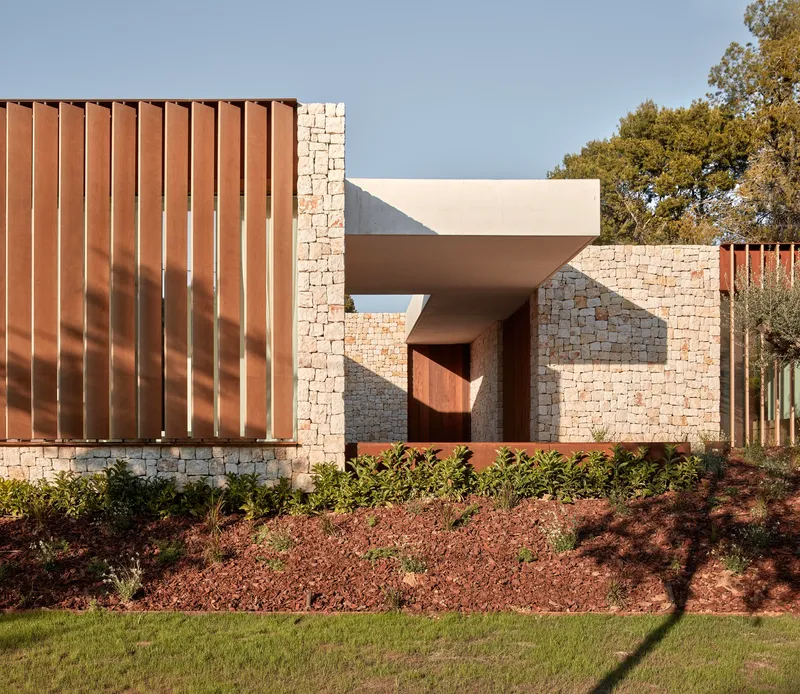
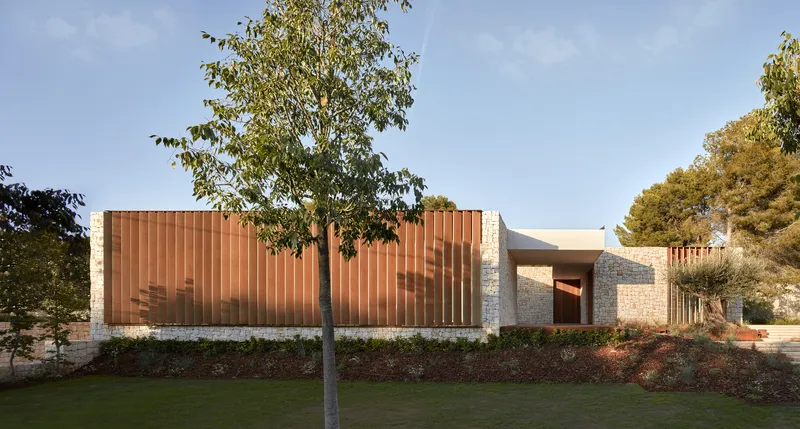
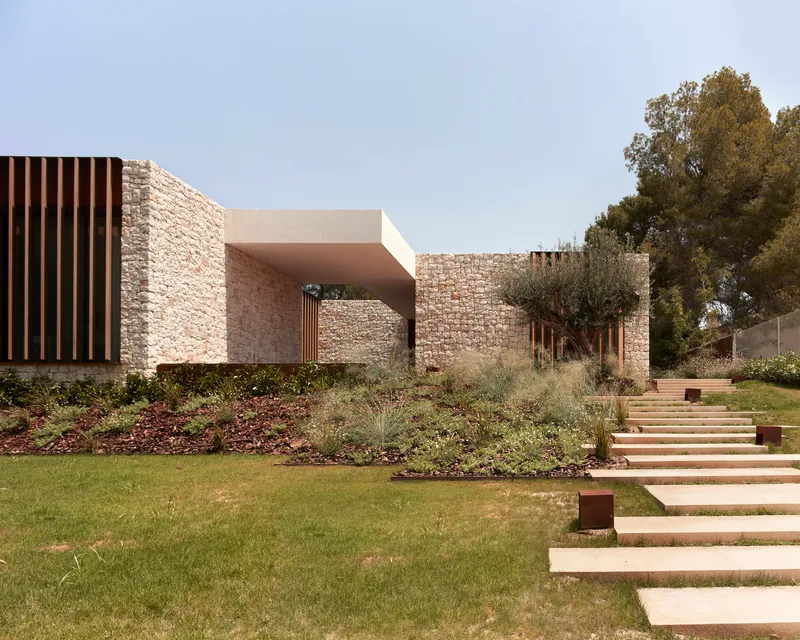
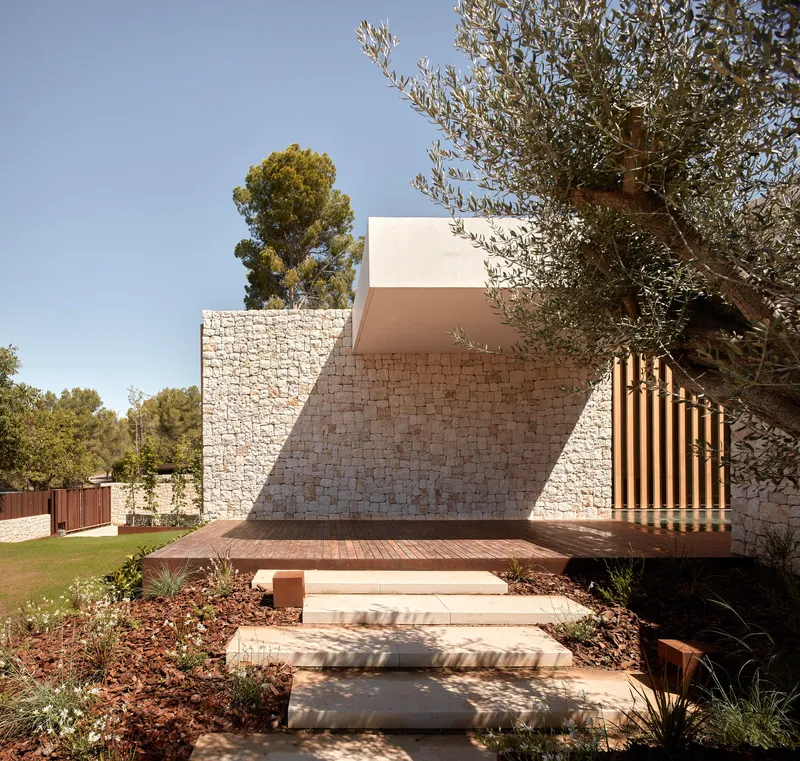
The street elevation is deliberately reticent. Dry-stacked stone masonry, corten-finished metal fins, and white stucco panels compose a layered wall that tells you almost nothing about the life behind it. Existing pine and palm trees emerge from planted beds at the base, softening what would otherwise be an uncompromising barrier. The effect is more compound wall than residential facade, and the choice is programmatic as much as aesthetic: privacy from the surrounding residential area is total.
The entry sequence moves through a terraced landscape of stone steps and angled masonry walls before arriving at a portal framed by vertical metal fins. It's a slow compression, the kind of controlled spatial narrowing that makes the eventual release into the courtyard all the more effective.
The Courtyard as Engine
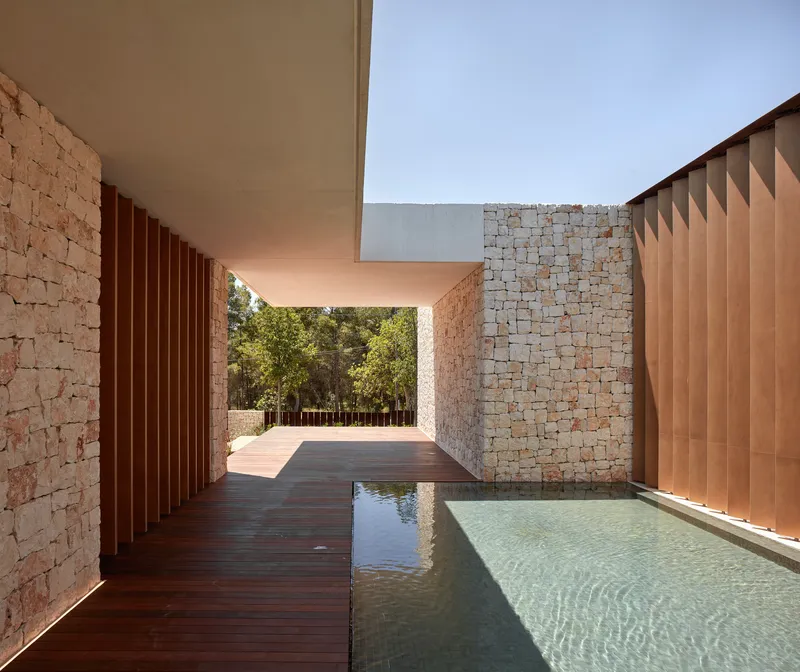
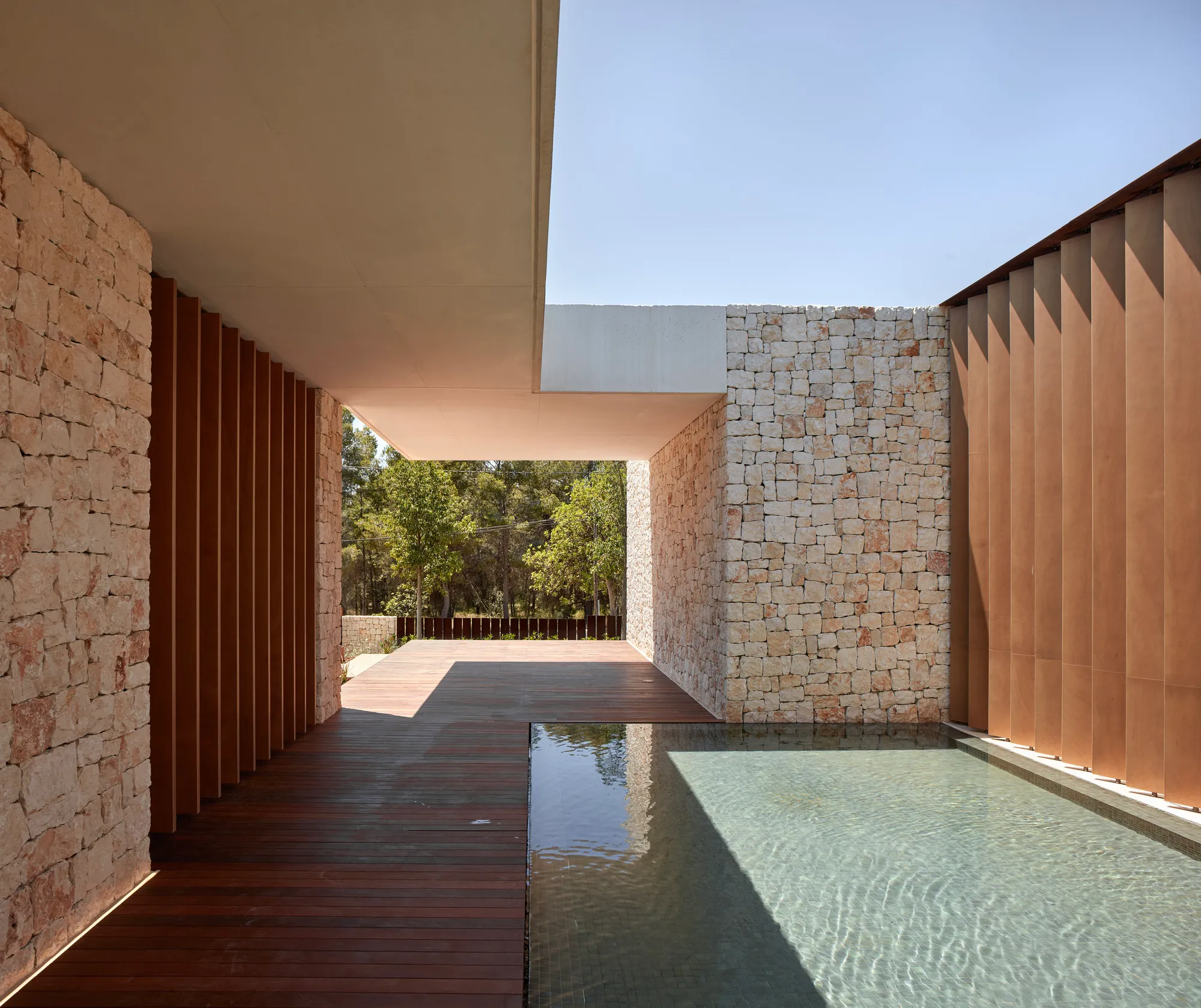
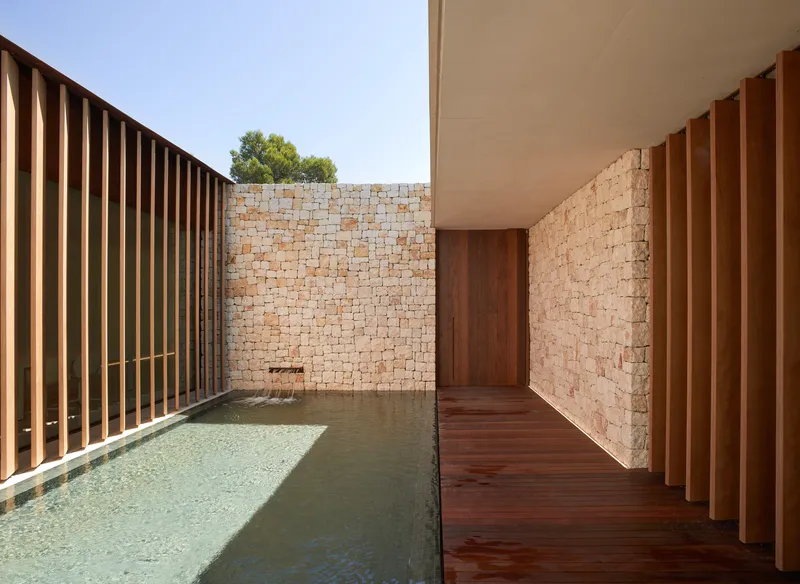
The central courtyard is not decorative; it is the organizational engine of the entire house. Functioning like a Roman atrium, it generates access, separates day rooms from night rooms, and creates the primary visual axis. A large sheet of water occupies much of its floor, reflecting the internal facade and the sky above, which effectively doubles the perceived volume of the space. Two perforations in the white concrete canopy overhead let sunlight enter at controlled angles, tracking across the stone and water throughout the day.
A covered walkway with timber decking runs alongside the reflecting pool, flanked by stone walls and vertical metal screens. The combination of shadow, water reflection, and filtered light gives this passage the quality of an outdoor room rather than a corridor. It is the most photographed moment of the house, and it earns the attention: the detailing of stone meeting water meeting timber is precise without looking fussy.
The Garden Side Opens Up
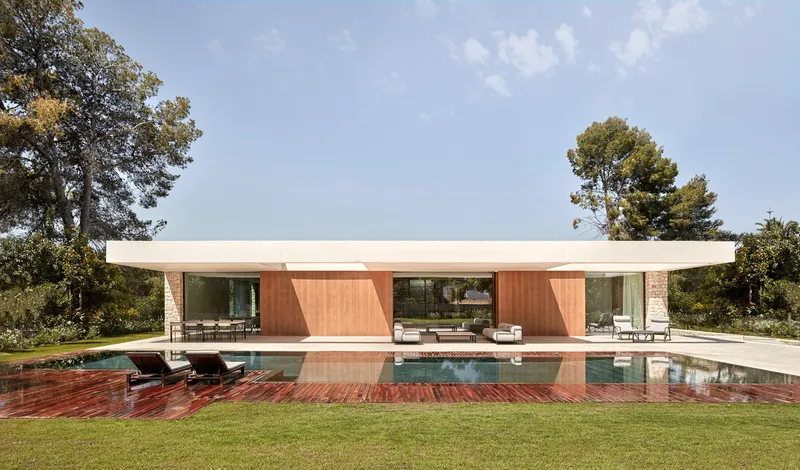
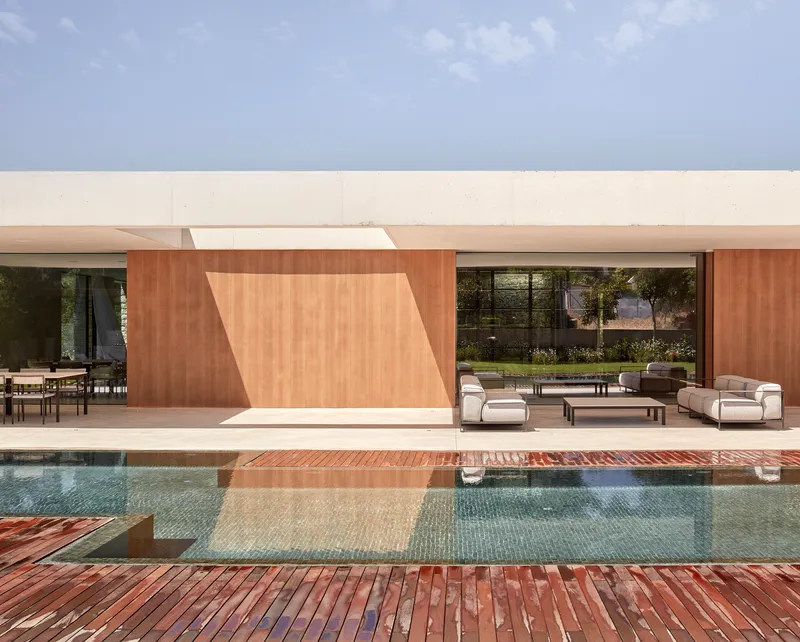
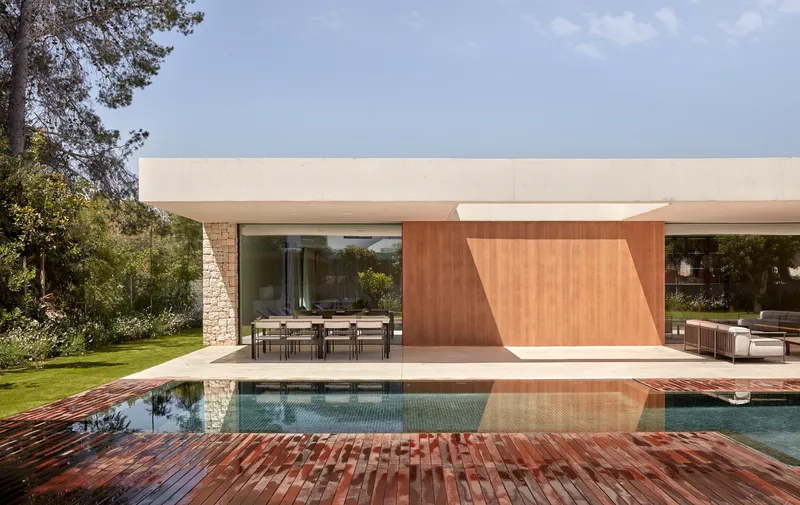
If the street facade is a fortress, the garden elevation is its opposite: a long, transparent plane sheltered by a thick-edged white concrete roof slab that cantilevers dramatically over the pool terrace. Wood-clad volumes flank a covered outdoor zone, and angled timber panels provide adjustable sun protection. The swimming pool extends lengthwise, reinforcing the horizontal emphasis and pulling the landscape into the house's spatial field.
The cantilever is the structural move that makes the garden facade work. It creates a deep veranda with different living zones calibrated for summer or winter use according to sun exposure. In a Mediterranean climate where outdoor life is not optional but fundamental, this veranda is arguably the most important room in the house.
Interior Continuity: Stone, Wood, Concrete
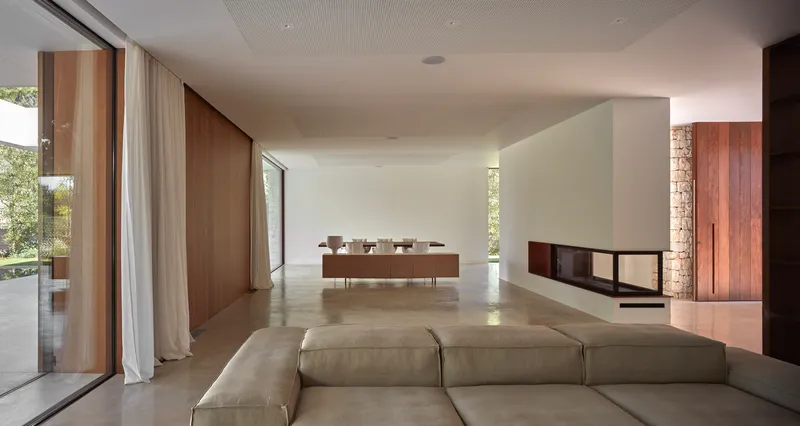
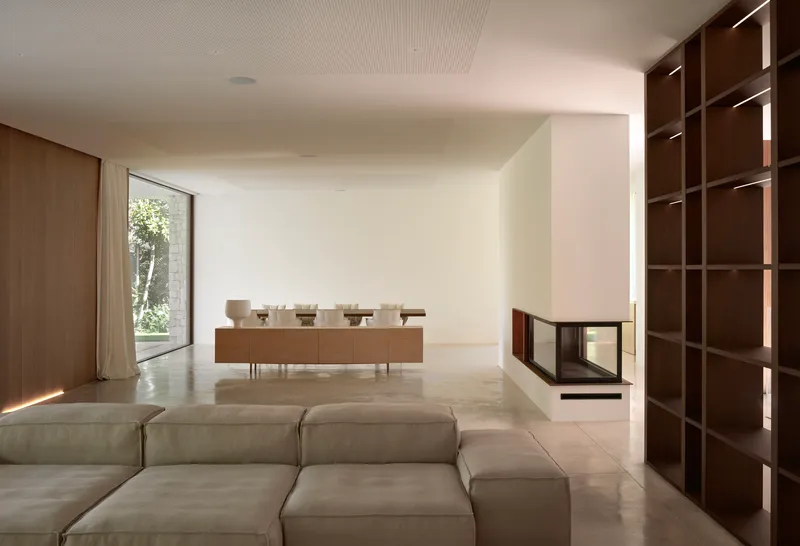
Inside, the material palette stays tight: polished trowelled concrete floors, walnut paneling and shelving, white walls, and occasional stone accents that continue directly from exterior walls into interior spaces. A pass-through fireplace and low cabinets allow visual connections between living and dining areas without breaking the fluid, continuous plan. All furniture was designed by Ramón Esteve Estudio, which means the interior reads as a single authored environment rather than a shell waiting for decoration.
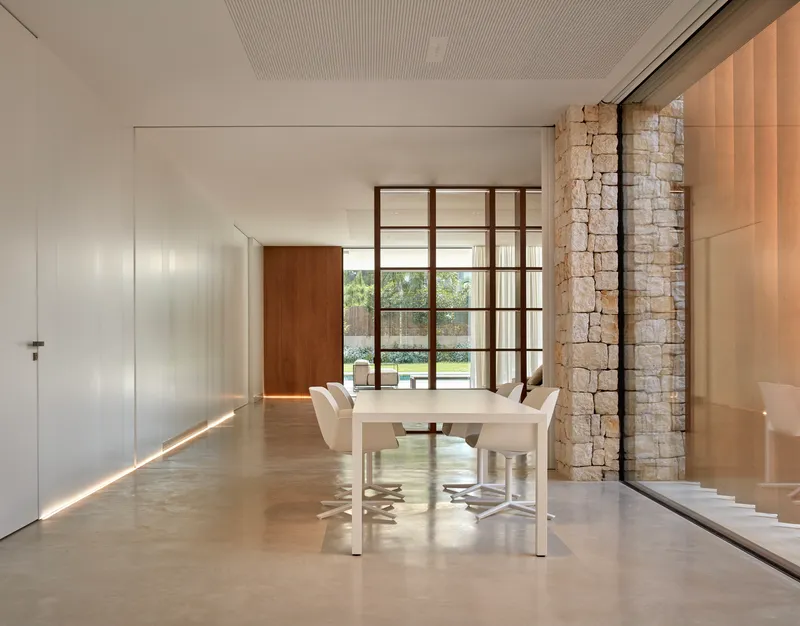
The open-plan living space is anchored by a sectional sofa and dining island, with floor-to-ceiling glazing opening directly onto the garden. A dry-stacked stone column beside the dining table serves as both structural element and material counterpoint to the surrounding smoothness. It's a blunt, almost archaeological gesture in an otherwise refined interior, and it works precisely because it refuses to be polished.
Kitchen and Domestic Craft
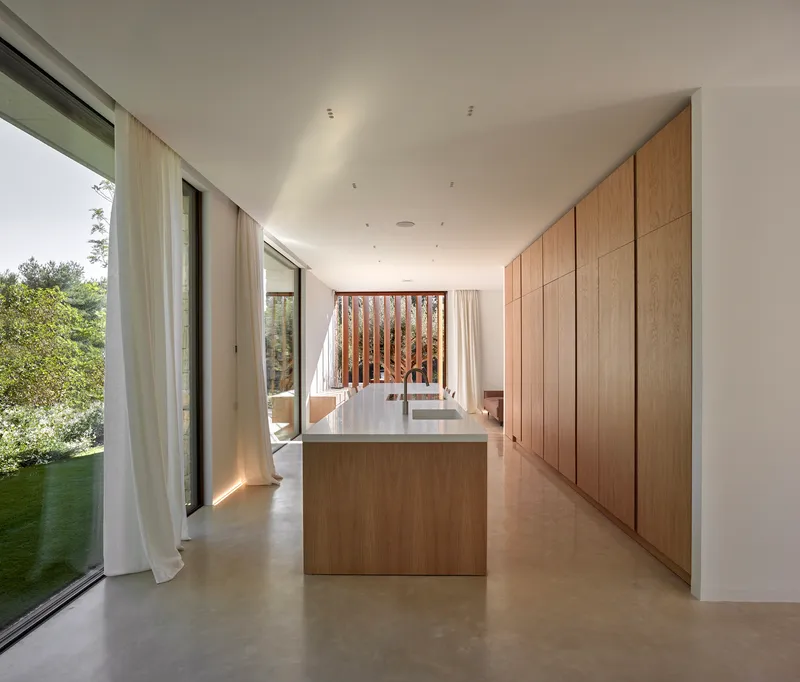
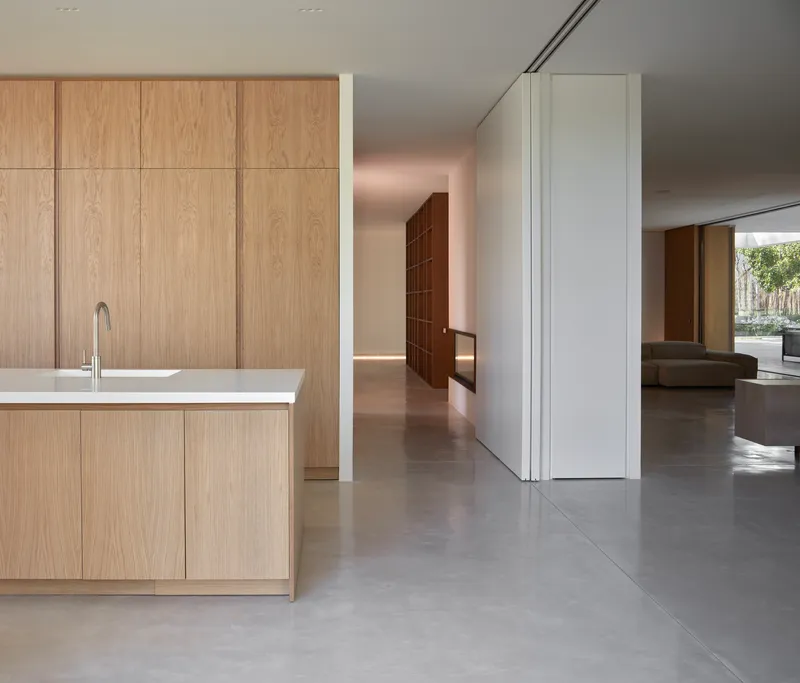
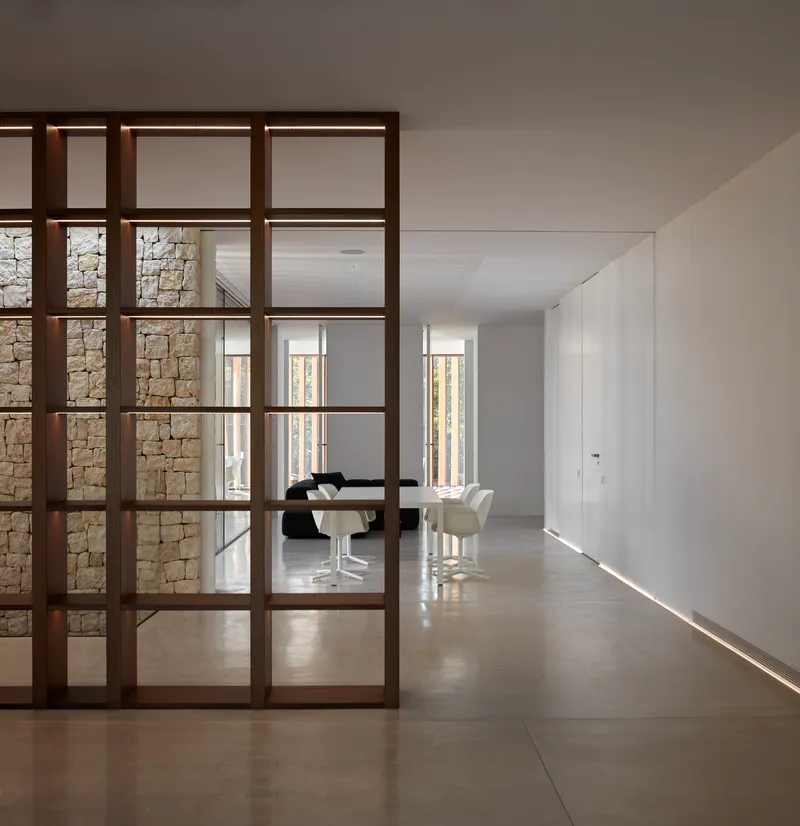
The kitchen occupies a position of equal importance in the plan, with an oak island and full-height cabinetry that opens toward a vertical timber screen beyond. The oak reads warm against the cooler tones of concrete and lacquered surfaces elsewhere. A dark timber-framed glass partition divides the corridor from the dining room, with concealed floor lighting that gives the threshold a lantern-like glow at night.
Detailing here is characteristically restrained. Minimalistic window frames are embedded flush into walls; sliding panes disappear entirely into wall cavities. The effect is that apertures seem to have no hardware at all, just openings that shift between solid and void.
Light, Slats, and the Private Rooms
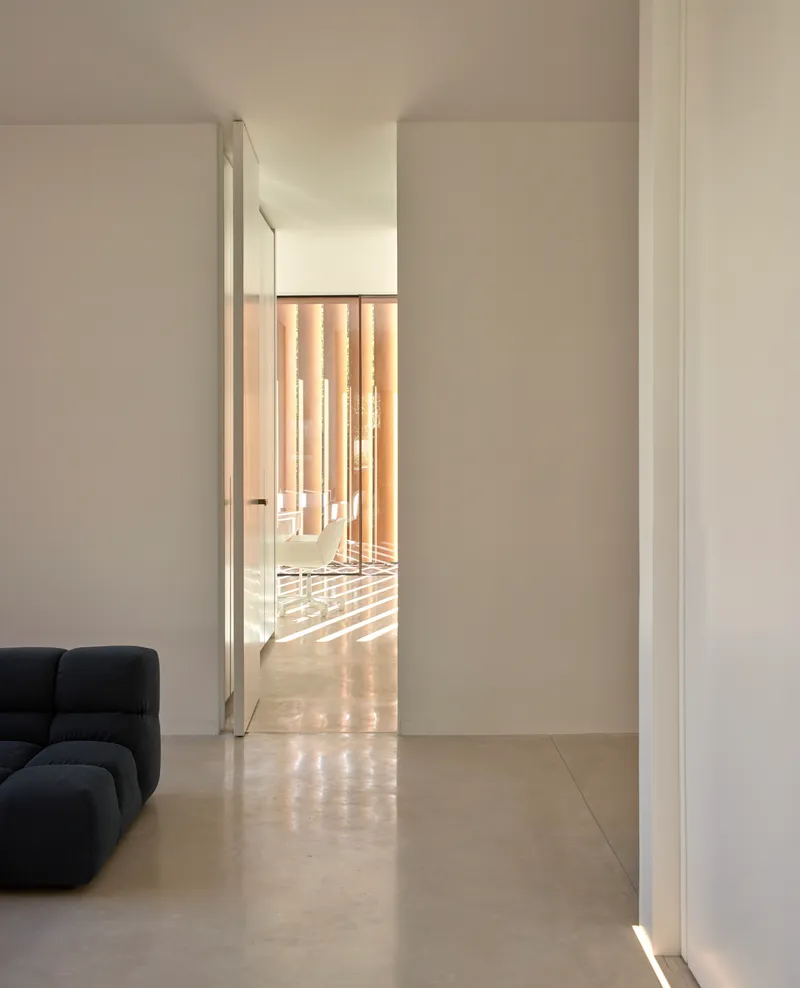
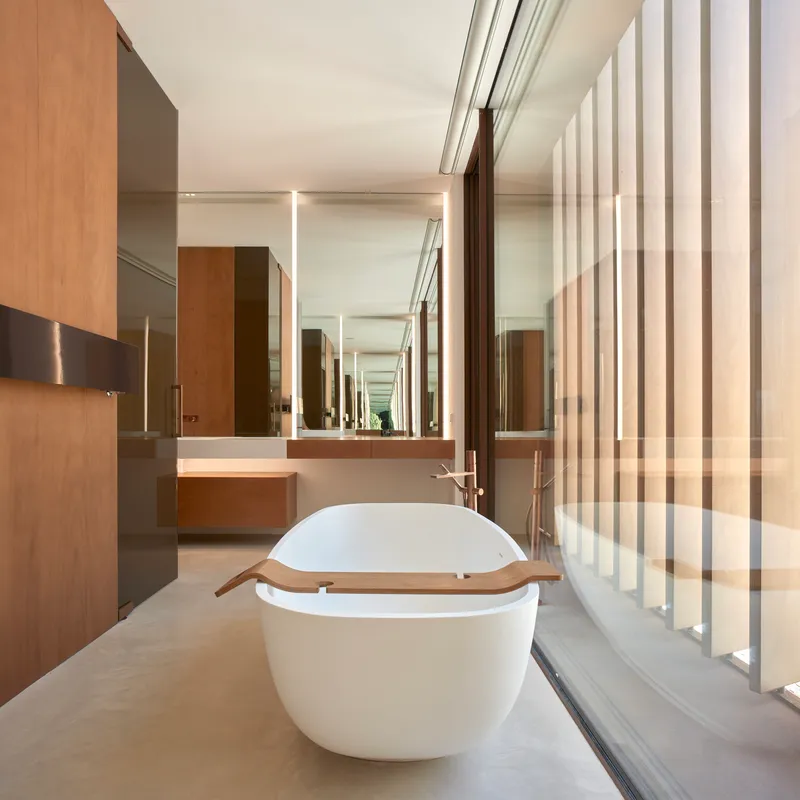
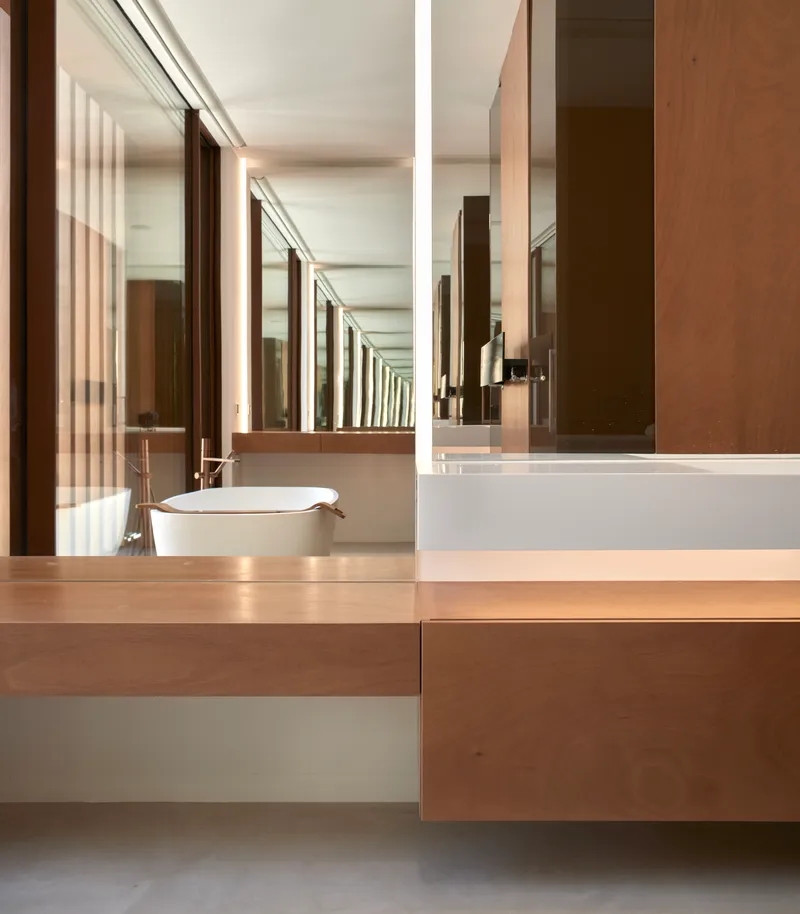
The night side of the house, separated from the day rooms by the central courtyard axis, uses vertical wood slat screens as its primary light-control device. These slats slide into the walls or adjust in angle, giving occupants fine-grained control over privacy, solar gain, and the quality of shadow in each room. The bathroom is perhaps the best expression of this system: a freestanding tub sits beside a full-height slat screen that filters daylight into a pattern of parallel lines across white walls and tile.
The floating timber vanity and vessel sink are reflected in a mirrored wall that doubles the depth of the slat screen beyond. It's a small room doing a lot of perceptual work, and the restraint of the material palette keeps it from feeling overwrought.
Corridors and Hidden Infrastructure
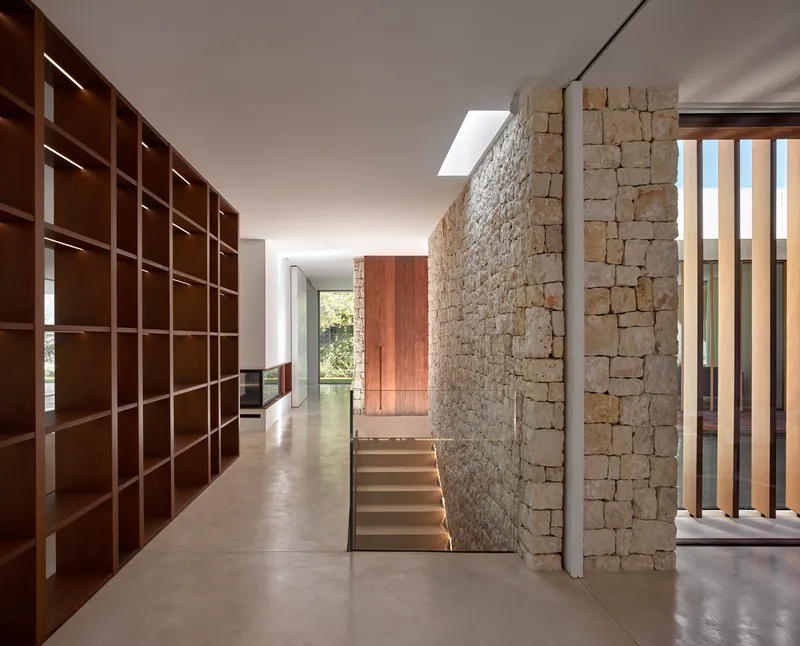
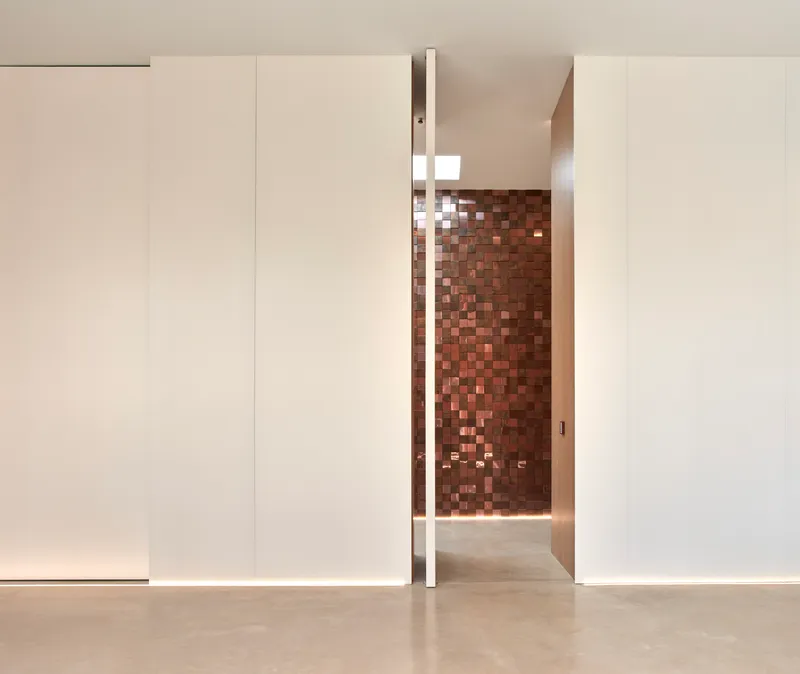
The circulation spaces deserve attention because they carry as much design intention as the principal rooms. A stone-walled stairwell with walnut shelving receives light from a skylight above, connecting the single storey above ground to a basement level that houses service rooms. The basement gets natural light and ventilation through a sunken courtyard on the north facade, an intelligent passive strategy that avoids relegating the lower level to a windowless box.
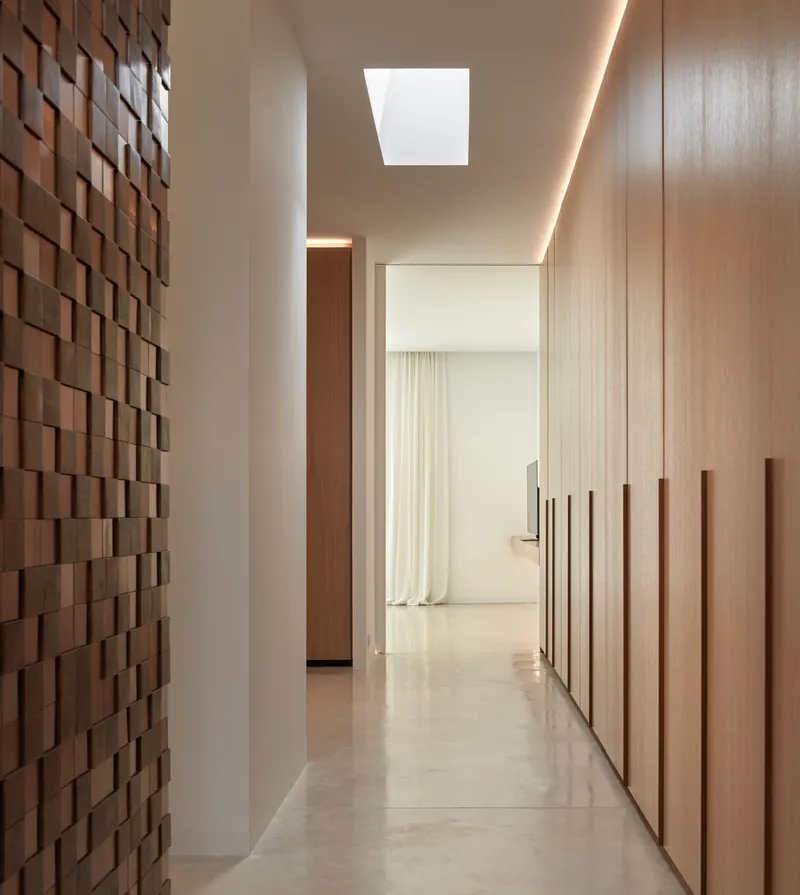
Elsewhere, a corridor features a terracotta tile wall with a wood-clad storage zone and overhead skylight, introducing a warmer, earthier palette that contrasts with the cooler stone and concrete of the main rooms. Pivoting doors with concealed lighting reveal these material shifts in a cinematic, sequential way.
The Outdoor Room
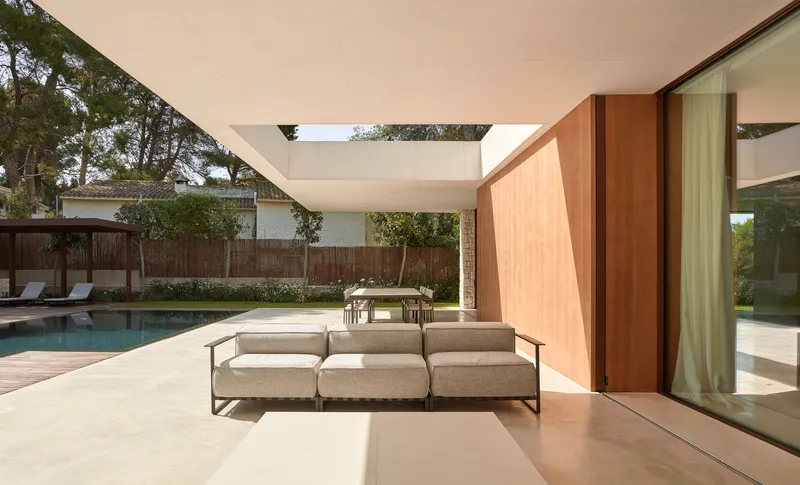
A covered outdoor terrace on the garden side, furnished with a low sofa and framed by a wood-paneled pivot door, functions as the house's most explicit indoor-outdoor space. The pool and timber fence beyond create a layered backdrop. The timber deck surround and stone block walls along the pool edge maintain the material discipline of the interior, so the transition from inside to outside registers as a shift in exposure rather than a change in architectural language.
Plans and Drawings
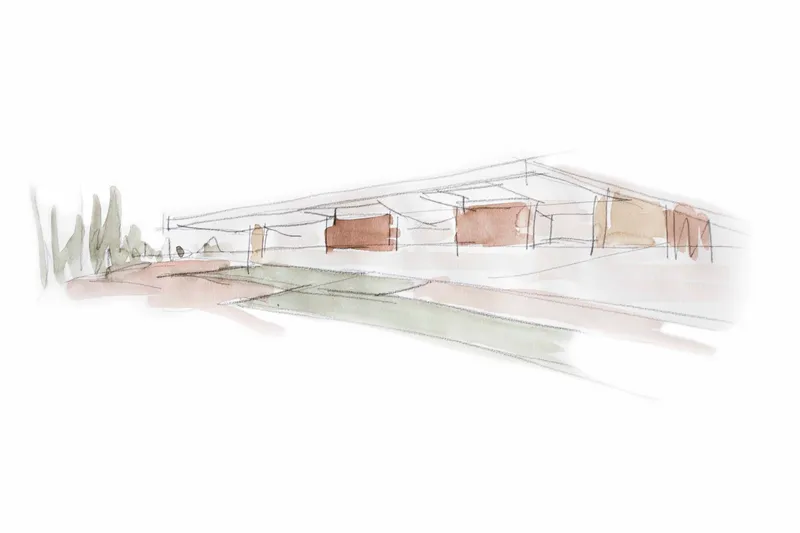
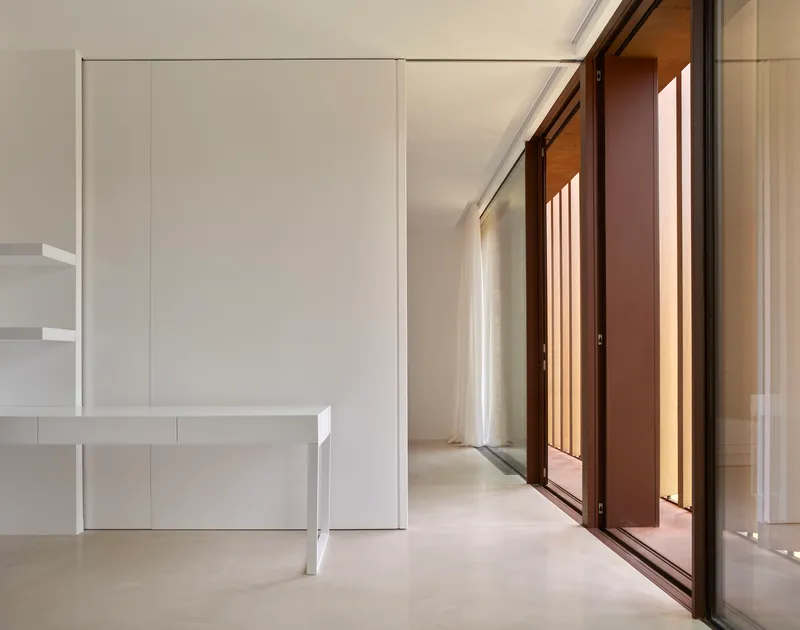
The watercolor sketch reveals the conceptual kernel: a low-slung pavilion roof sheltering glazed volumes beside a reflecting pool. The square plan, pierced by its courtyard void, is already legible in this early drawing. What the sketch captures, and the photographs confirm, is that the relationship between roof plane, water plane, and ground plane was the project's foundational idea from the outset. The sliding wood-framed glazed doors and built-in desk visible in the interior view show how fully the architecture absorbs its furniture into the wall system.
Why This Project Matters
The House in La Cañada is a reminder that the courtyard house, one of architecture's oldest typologies, still has things to teach contemporary practice. Ramón Esteve does not treat the atrium as a nostalgic reference but as a functional instrument: it organizes circulation, mediates climate, generates privacy, and produces the spatial drama that makes this house feel significantly larger and more varied than its footprint suggests. The use of water as a building material, not just a pool but a reflective, cooling, space-expanding device, is particularly well executed.
More broadly, the project demonstrates that material duality can be a rigorous design strategy rather than an aesthetic affectation. Stone against glass, mass against void, shelter against exposure: these contrasts are not decorative but operative, each one solving a specific environmental or spatial problem. In a residential market that too often confuses complexity with quality, Esteve's house makes a convincing case that disciplined reduction, paired with obsessive detailing, produces the richer result.
House in La Cañada, by Ramón Esteve Estudio. La Cañada, València, Spain. 1,053 m². Completed 2016. Photography by Mariela Apollonio.
About the Studio
Share Your Own Work on uni.xyz
If projects like this are the kind of work you want to make, uni.xyz is a place to publish your own, find collaborators, and enter design competitions.



Popular Articles
Popular articles from the community


Lunar Spiral: Space Architecture Shaped by the Mathematics of the Universe
Lunar Spiral reimagines space architecture through Fibonacci geometry, lunar regolith, levitating habitats, and self-sustaining Moon living.

Co-Life: Senior Housing Design That Reconnects Older Adults With the City
Co-Life reimagines senior housing design through healing gardens, shared streets, workshops, and a sustainable community across generations.

The Earth Pod: 3D Printed Homes for Resilient Refugee Communities
The Earth Pod reimagines refugee housing through 3D printed homes made from clay, combining resilience, self-sufficiency, and rapid shelter.

The Musturak Paradise: Senior Living Architecture for a Connected Future in Temara, Morocco
The Musturak Paradise reimagines senior living architecture in Temara via private homes, social spaces, culture, community, and shared care.


Similar Reads
You might also enjoy these articles

Bao Huynh Watercolor Atelier: A Serene Art Retreat in Hội An
Bao Huynh Watercolor Atelier in Hội An blends multifunctional art spaces, sustainable design, local materials, and family-friendly living in a serene environment.

Atelier Macri Concept Store Interior Design by CASE-REAL
Atelier Macri store features a "ko" counter, walnut wood details, cork displays, blending retail, gallery, and seamless customer experiences.

Manuel Vargas Izquierdo Stadium and High-Performance Sports Center: Architectural Excellence in Jalpa de Méndez
The Manuel Vargas Izquierdo Stadium blends sustainable design, inclusive sports facilities, and cultural-inspired architecture, revitalizing Jalpa de Méndez’s public spaces.

KAKR Buluh Awar Hall: Revitalizing Community and Ecology Through Bamboo Architecture
Community built bamboo hall revitalizes Buluh Awar village, empowering youth, restoring ecology, celebrating vernacular craftsmanship through sustainable architecture and culture.


Explore Residential Building Competitions
Discover active competitions in this discipline



Challenge to design a barrier free sports center


Challenge to design an outdoor ice-rink and park


Challenge to design mud housing for contemporary communities
Comments (0)
Please login or sign up to add comments
No comments yet. Be the first to comment!