

(RE) Envisioning: Turning a Madrid Office Tower into a Hybrid E-Sports Arena by 2050
A speculative adaptive reuse proposal transforms Sáenz de Oiza's Castellana 81 tower into co-living pods, immersive simulators, and a rooftop gaming stadiu


What happens when remote work empties the corporate towers that once defined a city's skyline? One answer: you fill them with e-sports arenas, zen housing pods, and immersive gaming simulators wrapped in a phosphorescent skin. (RE) Envisioning takes Sáenz de Oiza's Castellana 81 tower in Madrid's business district and proposes its wholesale reinvention as a vertical cultural machine, one that treats architecture not as a static shell but as a responsive framework calibrated to the rituals of a digital society projected forward to 2050.
The project is the work of Belén Garrido and Pelayo López Suárez-Valdivieso, and it earned the People's Choice Award in The Digital Colosseum 2020 competition. Rather than drafting a new building from scratch, the designers chose to confront the harder question: how do you inject meaning, function, and spectacle into infrastructure the market has already discarded?
An Atrium Rebuilt Around Biophilia and Compact Living
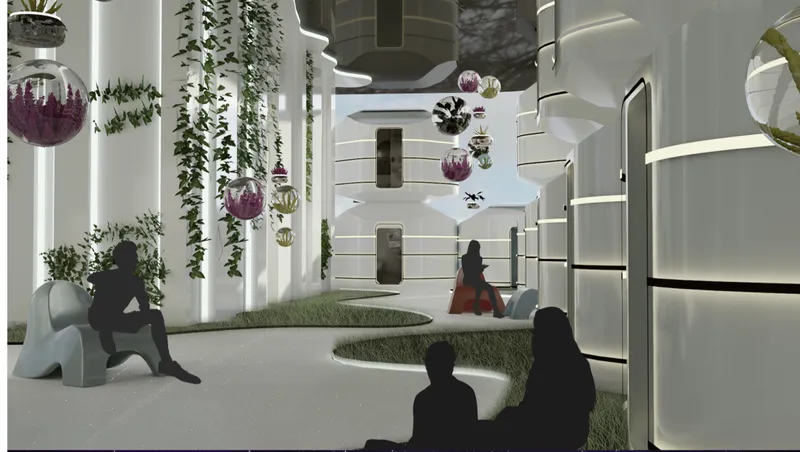
The tower's interior is reorganized around an atrium that reads like a vertical garden crossed with a capsule hotel. Curved white pods, stacked and offset along the atrium walls, house minimalist living units designed for mental well-being over square footage. Between them, hanging planters and grass patches soften the geometry, while translucent purple glass spheres punctuate the section with color. Silhouetted figures move across the green patches at ground level, suggesting a pace of life closer to a park than a lobby. Shared facilities, including lounges, gyms, and leisure zones, orbit these pods, prioritizing communal life and digital lifestyles over the privatized floor plates of the original office program.
A Glowing Crown: The Rooftop E-Sports Stadium
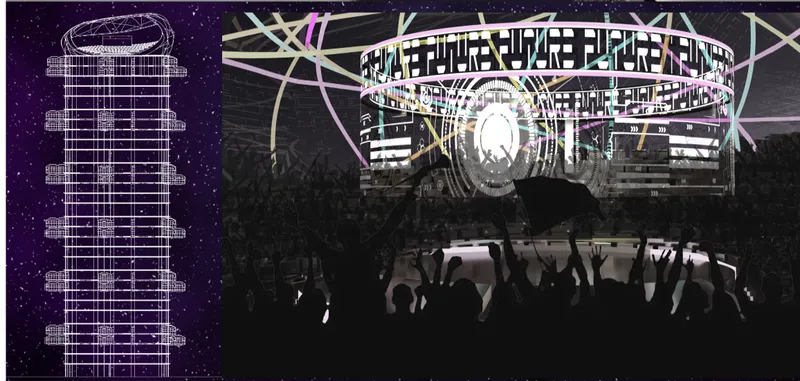
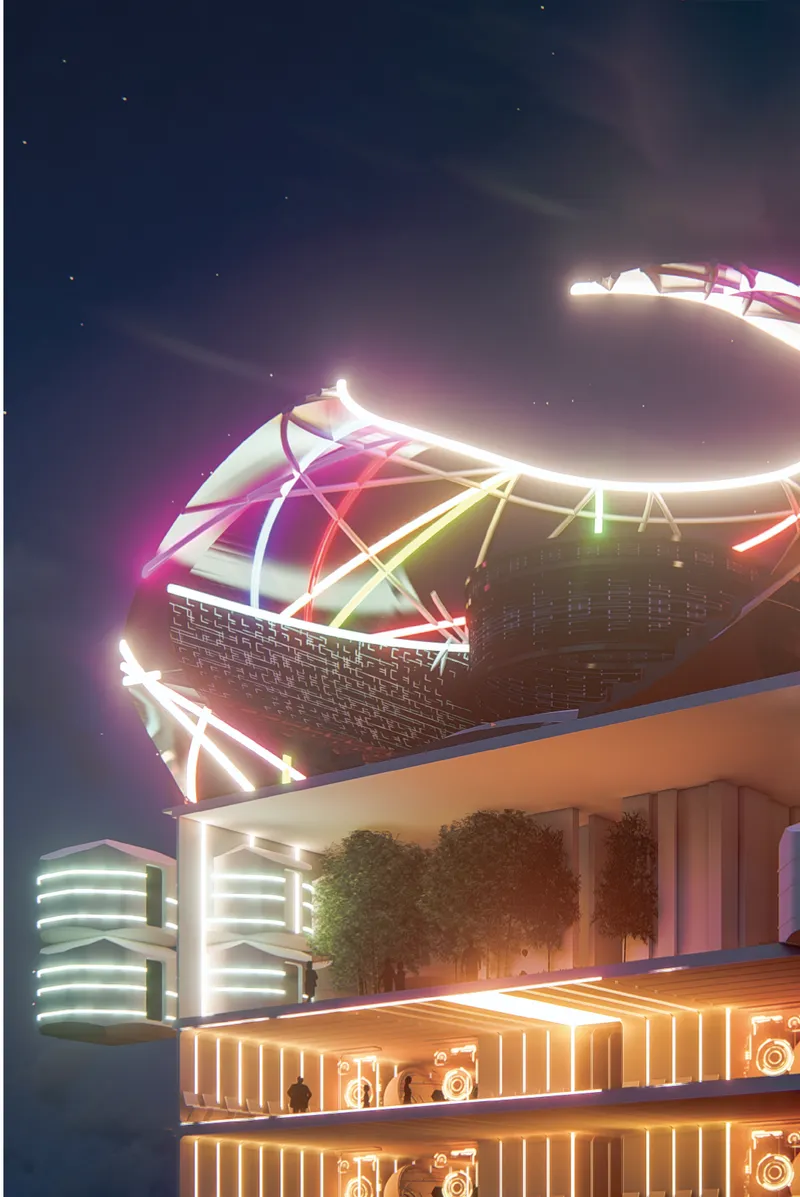
The most dramatic intervention sits at the tower's summit. A circular e-sports arena hovers above the existing structure, enclosed in a dynamic envelope of phosphorescent tubes and glass that turns the building into a glowing landmark on Madrid's skyline after dark. The wireframe elevation drawing reveals the relationship between the arena's hovering disc and the tower below: a crowd gathers at the base, drawn to the spectacle overhead. At night, the structure reads as a multicolored beacon, its terraced lower levels illuminated in warm gradients while the roof assembly shifts between hues. It is digital culture made architectural, a stadium that performs for the city even when no match is underway.
Circular Portals and Neon Corridors: Designing for Immersion
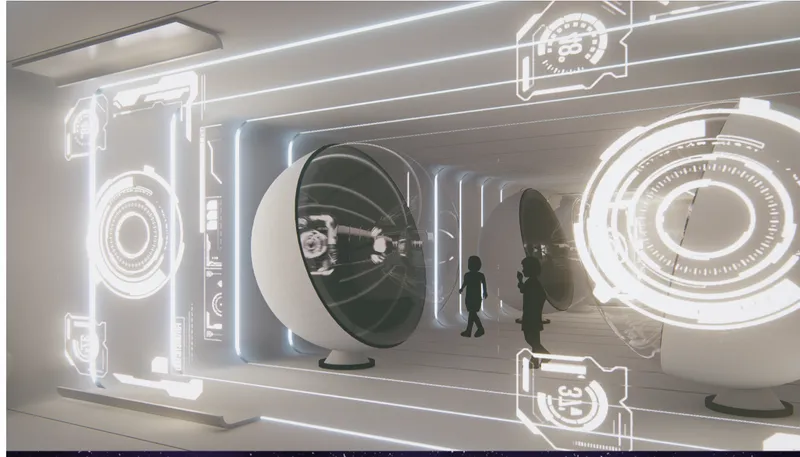

Inside the tower, the simulator and MUGA (Multi-Use Gaming Area) levels abandon right angles entirely. Corridors are lined with circular portals outlined in neon, their reflective flooring doubling the light into infinity. Two figures walk through these curved openings, scaled to feel like thresholds between realities rather than simple doorways. Elsewhere, a curving interior space with pink illuminated screen alcoves and concentric ceiling lights suggests a room that can toggle between individual use and collective gathering. These advanced immersive environments are designed so users can enter alternate realities for gaming or learning, with the architecture itself performing the role of interface.
The flexibility matters. The MUGA concept allows spaces to adapt to both individuals and communities, compressing and expanding their function as demand shifts. It is a direct architectural response to the unpredictability of digital culture, where a room might host a solo VR session at noon and a 200-person tournament by evening.
Why This Project Matters
Cities are already grappling with the fallout of remote work: empty office towers, declining commercial tax bases, stranded infrastructure. (RE) Envisioning argues that demolition is not the only, or even the best, answer. By treating a specific building with a specific structural history as the starting point for speculation, Garrido and López Suárez-Valdivieso ground their futurism in something real. The proposal is more credible for it.
What makes the project resonate beyond its competition context is its willingness to take e-sports and gamification seriously as architectural programs. These are not novelty additions bolted onto a conventional mixed-use scheme. They are the organizing logic of the entire building, from the portal corridors to the rooftop stadium. As virtual spaces become normalized parts of daily life, architecture will need new typologies to house them. (RE) Envisioning offers an early, vivid sketch of what those typologies might look like.
View the Full Project
About the Designers
Designers: Belén Garrido, Pelayo López Suárez-Valdivieso
Enter a Design Competition on uni.xyz
uni.xyz runs architecture and design competitions year-round that reward proposals with spatial conviction and real site intelligence.
Project credits: (RE) Envisioning by Belén Garrido, Pelayo López Suárez-Valdivieso The Digital Colosseum 2020 (uni.xyz).


Popular Articles
Popular articles from the community


The Amber Palace Opera: A Geological Fiction Surfaces on Tallinn's Baltic Waterfront
Pierre Brillard reimagines a Baltic legend as a public landscape, opera house, and waterfront promenade rooted in Tallinn's coastal identity.

Tsunami Convergenics: Turning Catastrophic Ocean Forces into Underwater Housing Infrastructure
A speculative underwater settlement off the coast of Onagawa, Japan, treats tsunamis and typhoons as energy sources rather than threats.
Opera on the Sea: Driftwood Logic Shapes a Timber Opera House on Estonia's Coast
Trevor Orgill's opera house translates the entangled drift of floating timber into a civic building where wood, water, and music converge.
Opera by the Sea Estonia: Three Shells Dissolving Architecture into Tallinn's Coastline
A winning opera house proposal replaces monumental form with interconnected shells that blur the boundary between building, park and Baltic Sea.

Similar Reads
You might also enjoy these articles

Shakur's House: Exposed Brick as an Interior Organiser in a 168 m² Mashhad Residence
Brick moves indoors in this Mashhad residence, where masonry walls, glass partitions and teal planes sequence a compact home without closing it off.

Day and Night Park: A Time-Based Urban Newsstand in Beijing
A temporary urban newsstand in Beijing blending travel, light, and reading through poetic colors, compact form, and community-focused design.

Modernist Patio Renovation in El Masnou, Barcelona by Oliver Segura Arquitectura + Cebrià Arquitectura
Modernist patio renovation blending tradition and innovation with a movable pool, leveled floors, and Catalan materials in El Masnou.

Alto Residencial Coop: Cooperative Housing Development in Santiago de Compostela by Carbajo Barrios Arquitectos
A linear cooperative housing complex blending white volumes and perforated metal façades, enhancing community living, natural light, privacy, and urban integration.

Explore Adaptive Reuse Competitions
Discover active competitions in this discipline

Challenge to visualize a collision of the future and past

Challenge to visualize future spaces of waste

Challenge to visualize slums of 2080

Challenge to illustrate the ruins of Petra
Comments (0)
Please login or sign up to add comments
No comments yet. Be the first to comment!