
Re-Evolving Transit, Revolutionizing Cities
Proposing a new vision for Mumbai, 2030 by rethinking its locals


Context
Mumbai, the City of Dreams, the land of the visionaries. With so many metaphors of fame and success alluding to this small coastal land, it has become one of the most densely populated cities in the world. Despite progress in infrastructural development, Mumbai city still sees a stark contrast in the way people live and travel. The city plays host to one of the most widely used public transport in the world- the suburban railway system, or in indigenous terms, the ‘Mumbai Local’. The existing system is a prized possession of the residents; though with an increasing population, there are a growing number of problems as well.
With India on the path to becoming a superpower, many transportation and infrastructure systems need a major upheaval to represent the country as a technological powerhouse and provide more comfort and ease to the commuters. The best ideas usually come from the users themselves, and to tap into these suggestions, COMMUN presented the design community with a competition called “Hyperlocal — Rebuilding Mumbai Within”. The challenge here was to propose a new system ‘Hyper-Local’ for the commuters and express the vision of how the city of Mumbai might appear in 2030. It would be a network that caters to existing and upcoming issues in Mumbai.
The Winners
The ideas that came up were wide and varied, simple yet well-thought-out. A few of them stood out with their design concept, implementation process and all-around holistic and sustainable approach, giving food for thought to development authorities.
1. “The Green Link” — designed by Alan Abraham, Arancha Alvear, Vineet Hingorani, Natasha Joseph, Aishwarya Singh and Vatsal Mistry
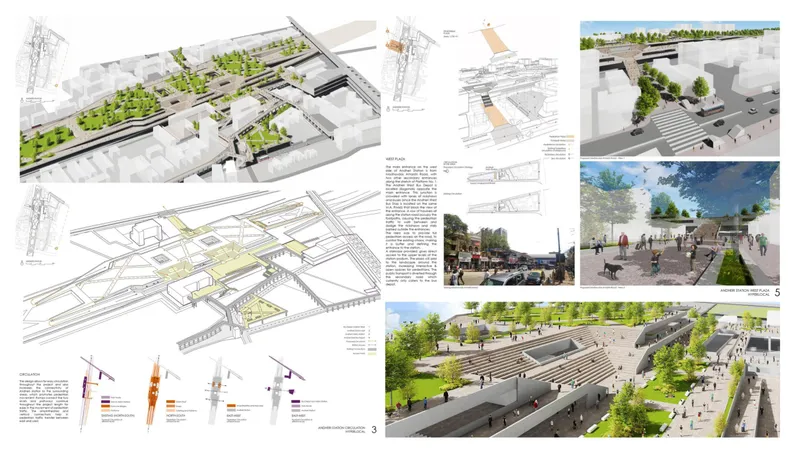
The Winning entry, conceptualizes the development of an urban park above railway lines, creating accessible, green public spaces providing an enhanced experience for daily commuters and casual visitors. The design suggests a renewed system of transport, allowing one to walk, cycle & use the train, generating a balance between private & public modes reducing congestion and overcrowding. The designers write, “On the city scale, the design provides a solution not only for an organized transport system but also creates an opportunity for the public to experience great stretches of open and green spaces which the city currently lacks. The design aims at promoting pedestrian and public interactive spaces for the city.” The design proposes a green space for pedestrian traffic where they can sit, wait and even just relax, effectively dealing with overcrowding at the stations. The project also links different modes of transport together, and the open spaces are enhanced by public plazas at different junctions.
2. “Urban Embroidery”, designed by Lohita Turlapati and Prera Vaishnav
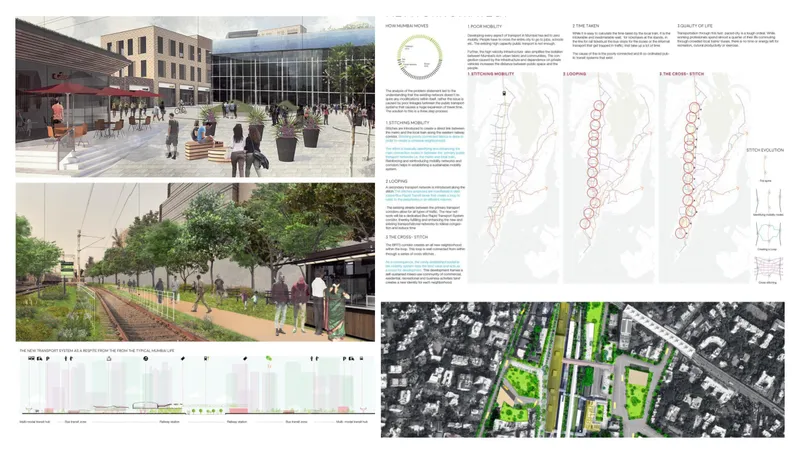
Discussing the theme of “Railways becoming the new green lung”, this project realizes that modifications in the existing system are enough to stitch the gaps and make it a more efficient and comfortable ride for commuters. Their proposed solution, which won the Runners up category, revolves around increasing transit development through interconnecting public modes of transport, making the commute easier through technological interventions, and introducing pedestrian heavy green “lungs” in between the integration of transport modes acting as public plazas.
3. “Kripya Dhyaan Dijiye”, designed by Alankrita Sarkar, Sahil Kanekar, Rahul Dewan and Sumanth S Rao
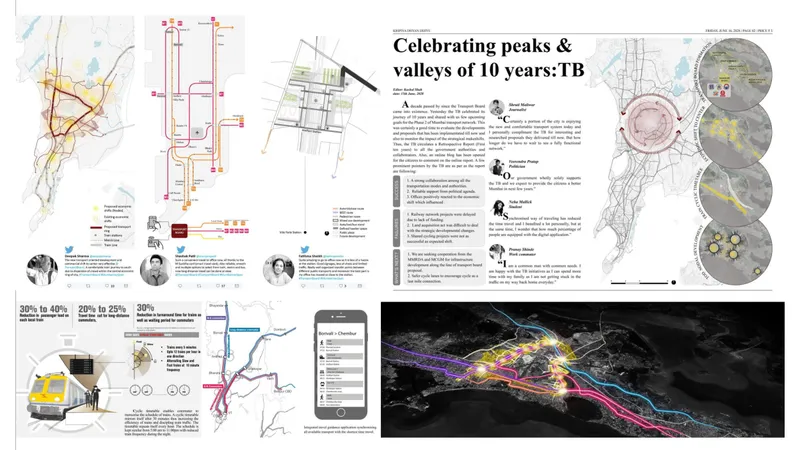
“One transport, one network!” Based on a citizen-driven approach and presented in a very quirky format of newspaper clippings, this project entry won an honourable mention by the jurors. The designers describe it as a “holistic and rational approach in rethinking integrated, transit-oriented development for Mumbai. The whole strategy, they say, is to channelize the traffic with daily feedbacks from the commuters. As one of the stakeholders, the transport board thus becomes responsible to direct the system accordingly with a thorough assessment. Ideas and policies like a new cyclic and organized timetable, an interconnected system of public transport modes, and easy to use mobile and web applications propose a rational route of action for the city, rather than just being a design concept.
4. “Alawabbad”, designed by Sibin Sabu, Radhika Suresh, Aravind S, Aswin S Kumar and Aparna Lakshmy Krishnan
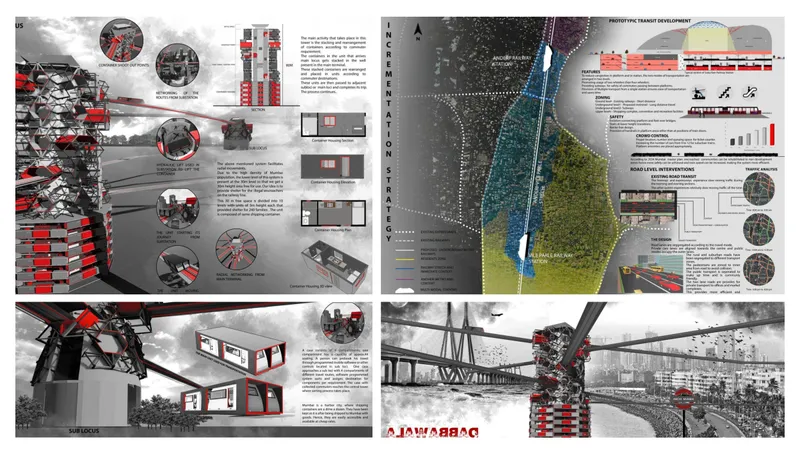
Deriving inspiration from the lunchbox delivery and return service called the “Dabbawalla” system, this project proposal depicts a new system altogether — that of a radial network, revolving around main loci which get networked into tributaries to reach the masses. The commuter starts from a sub-node, and travels to the main node from where they are redirected to their location at a sub-node. The significance of the proposed name is in their concept inspiration itself, spelt backwards; as “in a dabbawalla system man carries box and in the new system the box(container) carries the man, thus the dabbawalla got mirrored to Alawabbad.” The originality of the design approach won the proposal for the People’s Choice category.
All the mentioned project proposals, as well as other entries, are available for viewing at: https://uni.xyz/competitions/hyperlocal-rebuilding-mumbai-within/entries
Discover the design brief here: https://uni.xyz/competitions/hyperlocal-rebuilding-mumbai-within/info/about

Follow us on social media: Facebook | Instagram | LinkedIn | Twitter | Youtube
Discover other design competitions to participate here: https://uni.xyz/competitions


Popular Articles
Popular articles from the community


graciastudio Turns a Viewless Tijuana Lot Inward Around a Courtyard of Concrete, Timber and Trees
In Tijuana, Jorge Gracia's GA2 House stacks a timber-clad private floor over exposed concrete and replaces a missing view with a planted interior patio.

ETEH Reworks the Shared Spaces of São Domingos School in Brazil Around Timber, Color and Hanging Plants
At São Domingos School in Brazil, 436 m² of hall, refectory and library are recast with timber joinery, a yellow and blue code and trailing greenery.


Singing Woman: An Opera House That Performs Before the Curtain Rises
Ovidiu Cristian Pavel's conceptual opera house translates Estonia's choral identity into a sculpted waterfront landmark facing the Baltic Sea.

LT2A and OPEN Architectes Thread a Brick and Glass High School Through a Wooded Belgian Campus
In Braine-l'Alleud, a 3,000 m² wing for Collège Cardinal Mercier pairs pale brick with a glazed colonnade, deferring to a small chapel and a dense wood.

Similar Reads
You might also enjoy these articles

Aquadapt: An Underwater Habitat That Rewrites Its Rooms by the Hour
Curved modules ring the seabed while one shell shifts from breakfast room to cinema, farm and football pitch as residents' needs change.

Play: Fragments of Their World: Remembered Architecture Rebuilt as a Modular Playground for Refugee Camps
Tom Gardner abstracts domes, arches and towers from the homelands of displaced families into a kit of child-scaled play parts for camp settlements.
REBIRTH: A Circular Settlement Where Afghan Widows and Their Children Rebuild Life Together
A shortlisted Resile entry turns the circle into a protective ring of timber and brick, gathering homes, classrooms and gardens around a shared landscape.
The Main Dream: A Recycled Plastic Kit That Lets Refugee Children Build Their Own Playground
Thirty-centimetre interlocking cubes that connect on three axes turn play into construction, letting children author the spaces they occupy.

Comments (0)
Please login or sign up to add comments
No comments yet. Be the first to comment!