
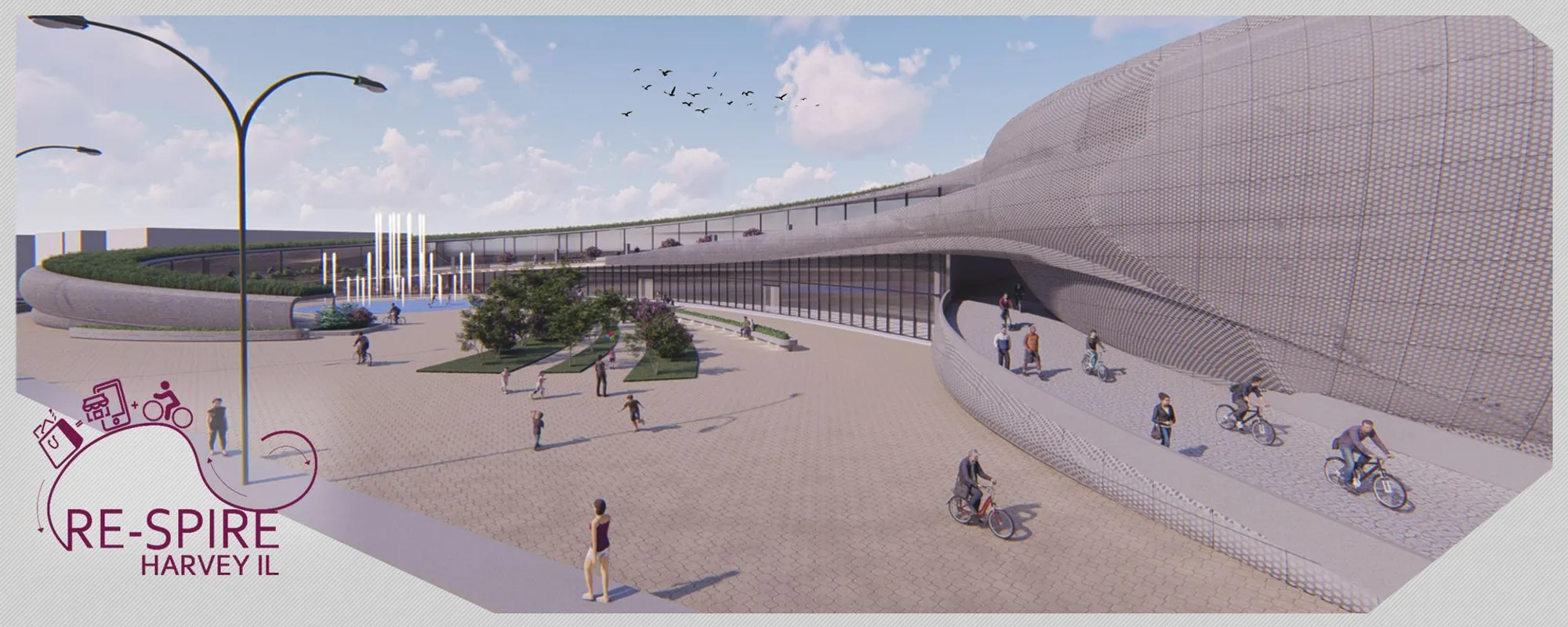
Re-Spire: A Breathing Retail Hub That Spirals Between Landscape and Commerce
Transforming a defunct retail building into a cycling-friendly cultural hub where green roofs, spiraling ramps, and local business converge.


What if a dead shopping center could literally respire, exchanging stale commercial air for something greener, slower, and more public? Re-Spire takes a defunct retail structure and reimagines it as a cultural hub organized around a figure-eight circulation loop, where cyclists glide up interior ramps, green roofs absorb rainwater overhead, and the boundary between plaza and building dissolves into a continuous social surface. The name is apt: the project breathes new program into old bones.
Designed by Ali Alhamad, Faris Turkistani, and BA Z, Re-Spire was entered as a People's Choice Award submission in the Upcycling Retail 2019 competition. The brief asked designers to repurpose commercial spaces for the future, and the team responded by converting the Harvey building into a community-oriented destination that celebrates local businesses rather than big-box retail. The result is equal parts landscape, marketplace, and urban park.
A Landscaped Plaza That Replaces the Parking Lot
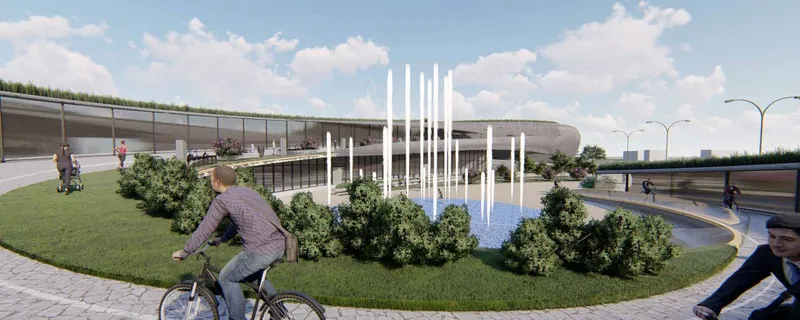

The aerial rendering immediately signals the project's priorities: where asphalt once dominated, a generous landscaped plaza now occupies the ground plane, complete with fountain jets and a dedicated cycling path ringing the perimeter. Cars are not banished entirely, but they are demoted. Parking is tucked beneath a cantilevered roof structure, visible in the underside view where vehicles sit in shadow while the public realm above enjoys full sun. The inversion is deliberate: infrastructure serves the pedestrian experience rather than commanding it.
An Oval Volume Wrapped in Colonnade and Green Roof
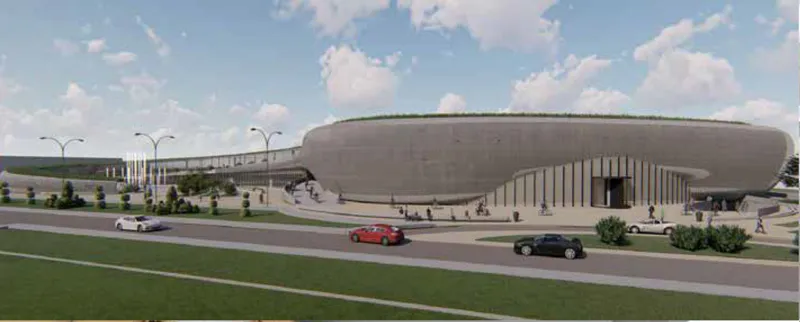
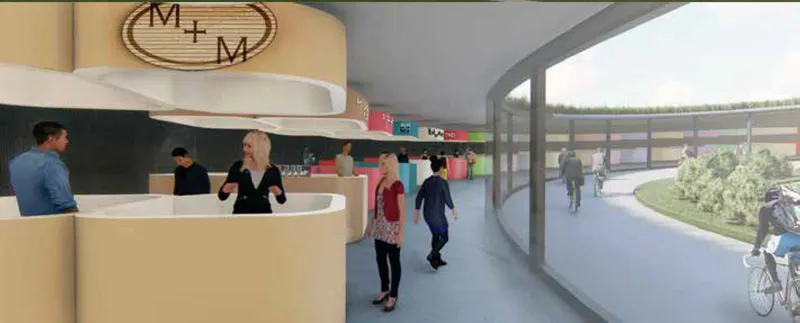
The building's primary volume reads as a soft oval, its perimeter articulated by a vertical colonnade that gives the facade rhythm and porosity. A green roof caps the form, its planted surface visible against the cloudy sky, reinforcing the project's commitment to environmental performance. At ground level the architecture blurs interior and exterior: the reception area features a curved counter alongside a fully glazed corridor that looks directly onto the exterior bike path. You are always aware of movement outside, whether it is a cyclist passing or light shifting across planted surfaces.
The intertwining of indoor and outdoor space is not ornamental. It is a circulation strategy. By making the boundary transparent and porous, the designers encourage visitors to drift between retail, gathering areas, and the plaza without the hard thresholds typical of conventional malls. Entering the building feels less like crossing a property line and more like moving deeper into a landscape.
A Figure-Eight Loop That Keeps People Moving
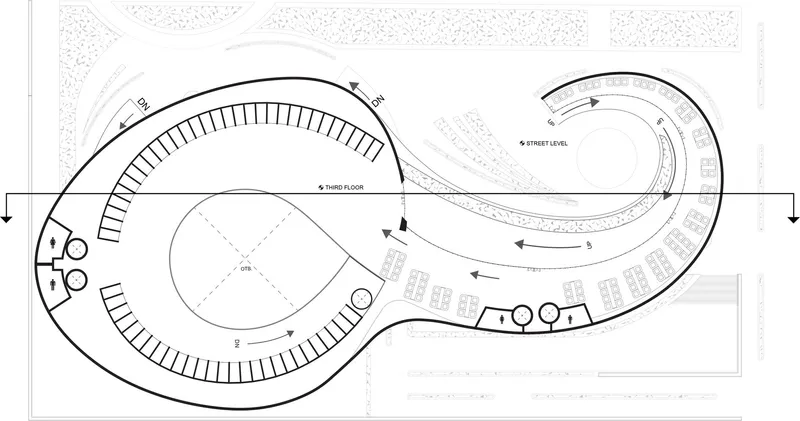
The floor plan reveals the project's organizational engine: a figure-eight circulation loop that threads through parking zones, central community spaces, and retail areas in a single continuous path. There are no dead ends, no corridors that terminate at an anchor store. Instead, every route reconnects, keeping foot traffic distributed and giving smaller local businesses equal exposure. It is an effortless, streamlined layout that makes movement feel intuitive rather than choreographed.
Spiraling Ramps for Bikes and Bodies
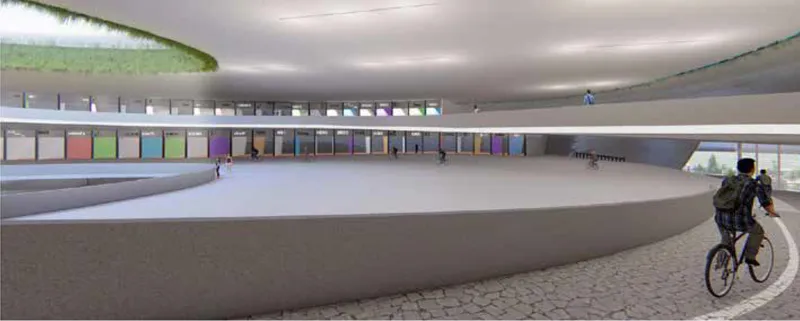
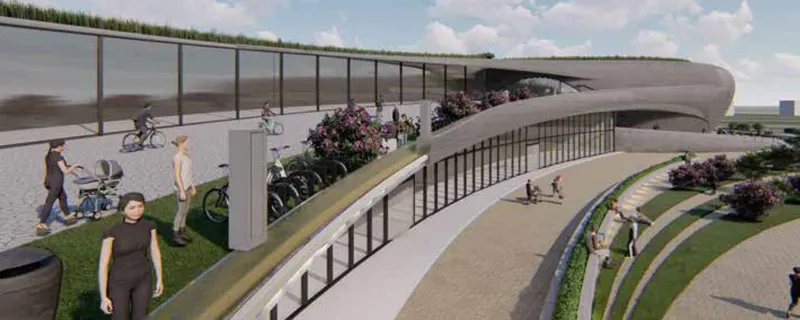
Perhaps the most striking spatial moment in the project is the interior ramp that spirals upward past colorful display panels. A cyclist appears mid-ascent, confirming that the ramp is not merely a stair alternative but a genuine bike-friendly pathway woven into the building's vertical circulation. The exterior counterpart is a curved ramp flanked by planted terraces, where pedestrians move between levels surrounded by greenery. Together these elements make the act of changing floors feel like a promenade rather than a chore.
The planted terraces along the ramp serve double duty. They soften the building's mass when viewed from outside, and they extend the green roof strategy down through the section, so that landscape is not just a cap on the building but something threaded vertically through it. The result is an architecture that breathes at every level.
Why This Project Matters
Re-Spire makes a compelling case that upcycling retail does not mean cosmetic renovation. The designers rethought the fundamental relationship between car, cyclist, and pedestrian, between landscape and building, and between anchor tenant and local vendor. The figure-eight plan, the bike ramps, and the porous facade are all working parts of a single argument: that the next life of a shopping center should be measured by public life, not square footage of leasable space.
What stands out in the work of Ali Alhamad, Faris Turkistani, and BA Z is a willingness to treat sustainability not as an add-on (a green roof here, a bike rack there) but as the organizing logic of the entire project. Circulation, structure, landscape, and program all align around the same principle: that a building can respire, exchanging the obsolete for the vital, if the design team is brave enough to rethink what a retail space is for.
View the Full Project
About the Designers
Designers: Ali Alhamad, Faris Turkistani, BA Z
Enter a Design Competition on uni.xyz
uni.xyz runs architecture and design competitions year-round that reward proposals with spatial conviction and real site intelligence.
Project credits: Re-Spire by Ali Alhamad, Faris Turkistani, BA Z Upcycling Retail 2019 (uni.xyz).




Popular Articles
Popular articles from the community


AL-JANNAH: Sustainable Architecture and Permaculture for Afghan Widows
AL-JANNAH uses sustainable architecture and permaculture to create resilient oasis of housing, learning, work and renewal for Afghan widows.

Co-Life: Senior Housing Design That Reconnects Older Adults With the City
Co-Life reimagines senior housing design through healing gardens, shared streets, workshops, and a sustainable community across generations.
EW PARK: Sustainable Architecture Reimagines the Future of Urban Parking
EW PARK reimagines city parking as a modular wooden tower combining automation, solar energy, electric mobility, and adaptable urban design.

Riyadh For All: Intergenerational Urban Design for Active Aging in Rabat
Riyadh For All reimagines urban design in Rabat with intergenerational co-living, adaptive courtyards, and Moroccan cultural exchange today.
Similar Reads
You might also enjoy these articles

Day and Night Park: A Time-Based Urban Newsstand in Beijing
A temporary urban newsstand in Beijing blending travel, light, and reading through poetic colors, compact form, and community-focused design.

Modernist Patio Renovation in El Masnou, Barcelona by Oliver Segura Arquitectura + Cebrià Arquitectura
Modernist patio renovation blending tradition and innovation with a movable pool, leveled floors, and Catalan materials in El Masnou.

Alto Residencial Coop: Cooperative Housing Development in Santiago de Compostela by Carbajo Barrios Arquitectos
A linear cooperative housing complex blending white volumes and perforated metal façades, enhancing community living, natural light, privacy, and urban integration.

Vil Genis School by BPA ARCHITECTURE – Massy, France
Vil Genis School in Massy, France, features sustainable design, south-facing classrooms, community integration, accessible spaces, and modern educational architecture.

Explore Streetscape Competitions
Discover active competitions in this discipline



Challenge to design locus for the upliftment of human rights


Design challenge to reuse E-waste
Comments (0)
Please login or sign up to add comments
No comments yet. Be the first to comment!