
RE-UTILITY
Grain bins for housing

CONCEPT
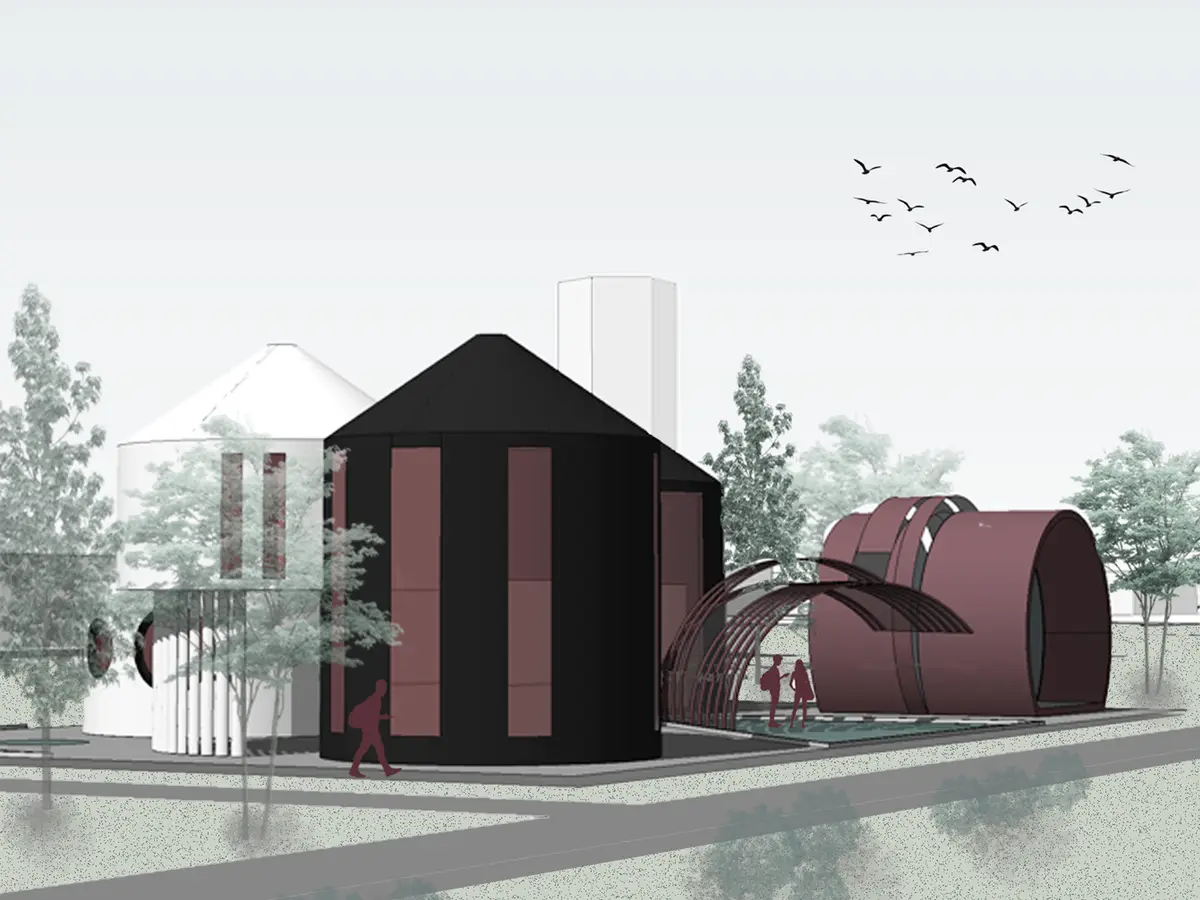
In my project I use 7 silos, one of which I place in a horizontal plane and put the administration in it. Steel cuttings from this silo are saved and used to make a canopy that frames the recreational area. 4 more bins remain intact, and 2 bins are cut in half, forming single-level blocks. The main idea of recycling is to use all the waste when transforming bins. For example, scraps can become a facade decoration, small architectural forms, etc.
The residential blocks consist of 1, 1.5 and 2 grain bins. The concept is to connect multiple bins to form one living space. The project has 1 residential block for two residents, 2 residential blocks for three residents and 1 residential block for four residents.
FORM
The laconic black-and-white color scheme of the facades of the residential blocks is diluted with pink administrative and recreational blocks. The administrative block is inspired by a lot of wind in Kansas. The cut sections of the silo are raised and form a spiral that resembles the trajectory of the wind. The same technique is repeated in the canopy over the recreation area.
MASTER PLAN
All residential blocks are placed on the site by stringing them onto a conventional axis, creating a logical pictorial composition. Residential blocks for 2-3 people are united by one entrance platform. The entrance to the residential block for 4 people is slightly removed. The administration block is a separate volume, forming an entrance group to the territory. The recreation area is landscaped and covered with a canopy that protects from hot sunlight or rain.
PLANS
The project contains 3 types of planning solutions for residential blocks in accordance with the number of residents in the block.
Block number 1 consists of two levels. The first floor includes an entrance with a spiral staircase leading to the second floor and a lift. There are also bathroom and a kitchen-living room. On the second level, there are two bedrooms, united by horizontal communication, and an atrium overlooking the entrance group.
Block number 2 also consists of two levels. The first floor includes an entrance with a spiral staircase leading to the second floor and a lift. There is also a bathroom, a kitchen, and a separate living room. On the second level, there are three bedrooms, united by horizontal communication, and an atrium overlooking the entrance group.
Block number 3 consists of two levels. The first floor includes an entrance with a spiral staircase leading to the second floor and a lift. There is also a bathroom, a kitchen, and a separate living room. On the second level there are two bedrooms in one silo and two bedrooms in a half of the other, raised by a cantilever. The bedrooms are connected by horizontal communication and an atrium overlooking the entrance group.
The project provides comfortable living for all groups of the population.
MATERIALS AND CONSTRUCTIONS
The design is based on a steel grain bin. Four bins are covered with black enamel on the outside, two bins are white and one pink. White plaster is used for interior wall decoration. And for the cladding of partitions and decorative elements, wooden panels are used. Floor - filler, black. For windows is used glass with a pink tint, framed by a burgundy profile.
The construction of the wall was chosen taking into account the climatic conditions of the area. It consists of 5 layers: an outer layer of steel silo, a layer of wind protection, a layer with a wooden frame and thermal protection, a layer of vapor barrier and an inner layer of drywall cladding covered with plaster. The partitions are also made of drywall, covered with wooden panels.
To ensure unhindered movement in front of the entrance group, a concrete ramp is provided.

Popular Articles
Popular articles from the community


Opera on the Sea: Driftwood Logic Shapes a Timber Opera House on Estonia's Coast
Trevor Orgill's opera house translates the entangled drift of floating timber into a civic building where wood, water, and music converge.

Opera by the Sea Estonia: Three Shells Dissolving Architecture into Tallinn's Coastline
A winning opera house proposal replaces monumental form with interconnected shells that blur the boundary between building, park and Baltic Sea.

Manzana Morphosis: Stretching Barcelona's Grid into a Living Landscape for 2050
A radical reworking of the Eixample manzana turns density into a tool for generous public space, vertical ecology, and environmental performance.

The Amber Palace Opera: A Geological Fiction Surfaces on Tallinn's Baltic Waterfront
Pierre Brillard reimagines a Baltic legend as a public landscape, opera house, and waterfront promenade rooted in Tallinn's coastal identity.

Similar Reads
You might also enjoy these articles

Shakur's House: Exposed Brick as an Interior Organiser in a 168 m² Mashhad Residence
Brick moves indoors in this Mashhad residence, where masonry walls, glass partitions and teal planes sequence a compact home without closing it off.

Day and Night Park: A Time-Based Urban Newsstand in Beijing
A temporary urban newsstand in Beijing blending travel, light, and reading through poetic colors, compact form, and community-focused design.

Modernist Patio Renovation in El Masnou, Barcelona by Oliver Segura Arquitectura + Cebrià Arquitectura
Modernist patio renovation blending tradition and innovation with a movable pool, leveled floors, and Catalan materials in El Masnou.

Alto Residencial Coop: Cooperative Housing Development in Santiago de Compostela by Carbajo Barrios Arquitectos
A linear cooperative housing complex blending white volumes and perforated metal façades, enhancing community living, natural light, privacy, and urban integration.


Comments (0)
Please login or sign up to add comments
No comments yet. Be the first to comment!