
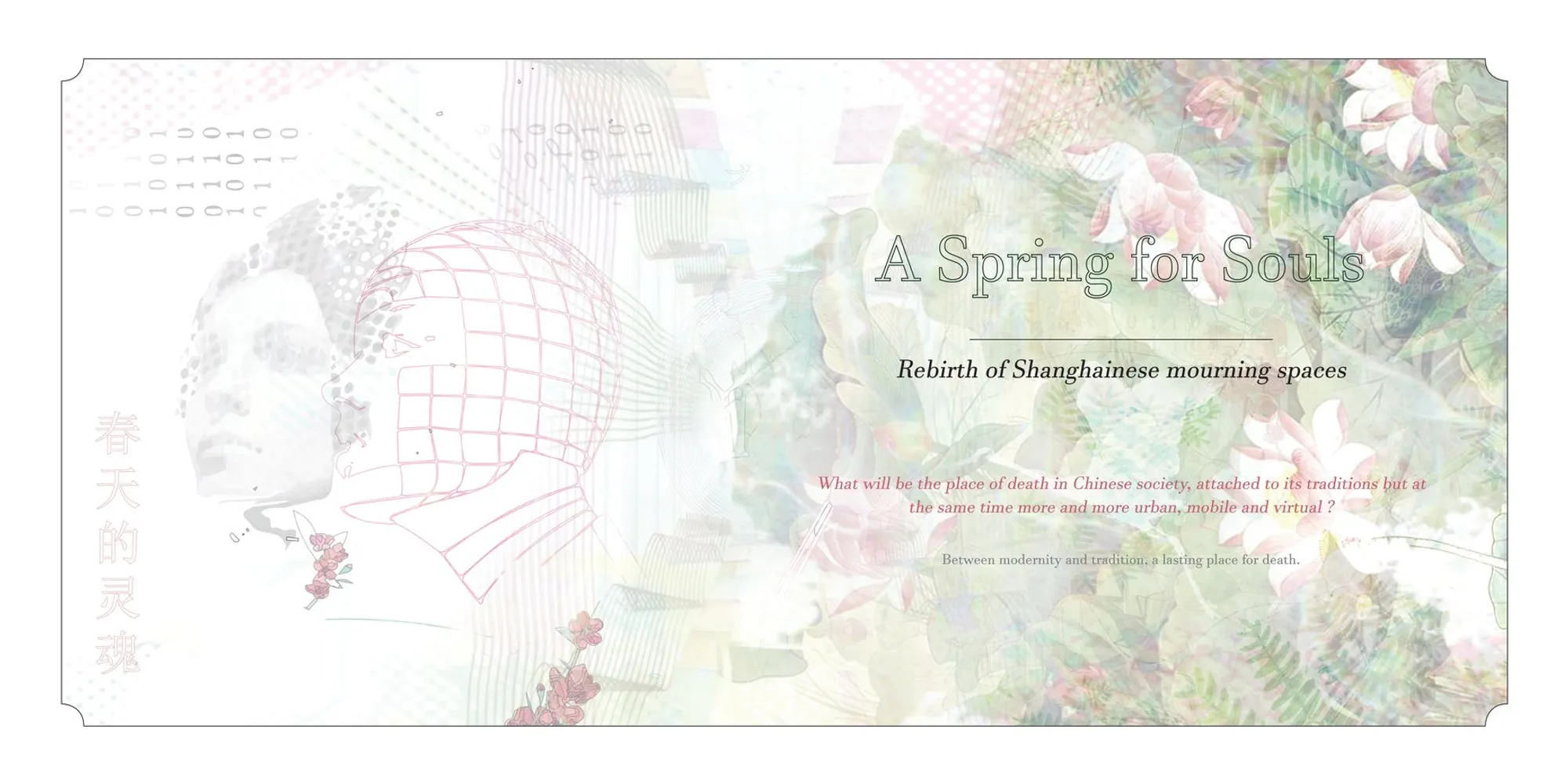
A Spring for Souls: Ecological Burial Architecture in Shanghai's Overstretched Funerary Landscape
A memorial park and remembrance pavilion merge biodegradable burial practices with Feng Shui principles in a city running out of room for the dead.


Shanghai is running out of space for the dead. Decades of rapid urbanization, communist-era funeral policies, and colonial-period cemetery perimeters have left the city's burial infrastructure saturated, pushing planners to rethink how a metropolis of 26 million people honors its departed. The question is no longer where to bury, but how to fold death back into the fabric of a living city without consuming the land the living still need.
Marie Fruiquière's A Spring for Souls answers that question by proposing a new funerary typology for Shanghai: one that replaces rigid cemetery grids with biodiversity sanctuaries, swaps marble headstones for biodegradable urns, and integrates digital memorials alongside ancestral temple traditions. Rooted in the Shanghai 2035 Master Plan's ambitions to decentralize burial sites and expand the city's ecological matrix, the project positions mourning not as something sequestered at the urban edge but as a contemplative experience woven into daily life.
Timber, Concrete, and Filtered Light: A Pavilion for Meditative Retreat


The Remembrance Pavilion draws from ancestral temple traditions but speaks a distinctly contemporary material language. Inside, a concrete bench sits against a warm timber wall, its surface dappled by light filtering through overhead screens. Two figures occupy the space in silence, and the composition reads less like a funerary building than a place for slow, quiet inhabitation. Outside, timber-clad volumes frame a courtyard planted with low beds and anchored by a shallow water basin, reflecting the winter sky above. The courtyard acts as a threshold between urban life and the more intimate rituals of remembrance that take place within.
The relationship between inside and outside here is deliberate: the pavilion does not wall off grief but calibrates it, using natural light, water, and planting to guide visitors through an emotional sequence. It is a space designed for both communal gathering and solitary reflection, with dedicated provisions for digital memorials that allow families to maintain remembrance practices without demanding additional physical land.
Split Levels and Sectional Depth: Grounding Memory in the Landscape
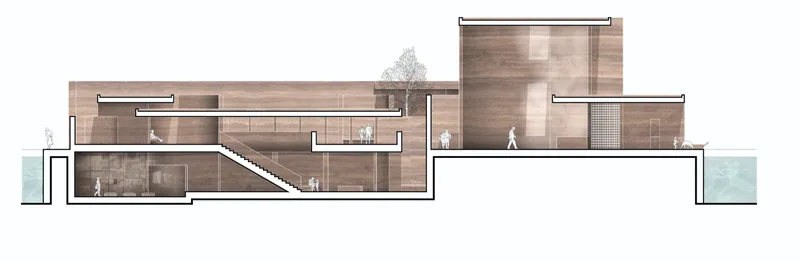
A section drawing reveals the pavilion's split-level organization, where timber-clad interiors step down into the ground, embedding the building in the landscape rather than sitting on top of it. A staircase connects the levels, and silhouetted figures move through spaces that shift in height and enclosure. The sectional logic is key: by partially submerging the programme, Fruiquière creates a sense of descent and intimacy that mirrors the psychological movement from public life toward private remembrance. The timber cladding maintains warmth and tactility throughout, avoiding the institutional coldness that often plagues memorial architecture.
A Funerary Park as Biodiversity Sanctuary


At the landscape scale, the Funerary Park operates as both memorial ground and ecological infrastructure. A watercolor site plan maps garden zones, pathways, and illustrated plant specimens, revealing a design strategy that prioritizes biodiversity over monumental geometry. The park is conceived as a natural burial forest where biodegradable urns and coffins decompose into the soil, reducing the environmental footprint of conventional cemeteries while reinforcing a cyclical understanding of life and death.
A more detailed plan drawing shows the memorial gardens organized around a circular structure, a water feature, and three distinct burial zones marked by tree canopies. The arrangement reflects Feng Shui principles, aligning burial sites with natural elements to establish a balance between spiritual practice and ecological function. Commemorative gardens, water features, and planted walkways replace the rows of identical headstones typical of Shanghai's existing cemeteries, offering a fluid, adaptable landscape that residents can inhabit as public green space even as it serves its funerary purpose. The protected ecological zones where ashes may be dispersed further dissolve the boundary between cemetery and park.
Why This Project Matters
The spatial crisis in Shanghai's funerary landscape is not unique. Cities across East Asia, from Hong Kong to Tokyo, face similar pressures as populations grow and burial land dwindles. What makes A Spring for Souls compelling is its refusal to treat the problem as purely logistical. Fruiquière does not simply propose more efficient burial storage; she reimagines the cultural contract between a city and its dead, arguing that mourning deserves designed space within the urban ecological framework, not just a plot at the periphery.
By linking biodegradable burial methods, digital memorials, ancestral Feng Shui principles, and biodiversity-driven landscape design into a single architectural proposition, the project demonstrates that sustainability and cultural heritage need not compete. It offers a model in which the dead nourish the landscape, the landscape serves the living, and memory persists through both physical gardens and virtual platforms. In a city hurtling toward 2035, that integration of past, present, and ecological future feels not just desirable but necessary.
View the Full Project
About the Designers
Designer: Marie Fruiquière
Enter a Design Competition on uni.xyz
uni.xyz runs architecture and design competitions year-round that reward proposals with spatial conviction and real site intelligence.
Project credits: "A Spring by souls by Marie Fruiquière.




Popular Articles
Popular articles from the community


Hill & Cross Opera: Sculptural Opera House Architecture Shaped by Tallinn’s Landscape and Identity
Hill & Cross Opera reimagines opera house architecture in Tallinn through its sculptural hill, civic plaza, glass wave and a luminous cross.
EW PARK: Sustainable Architecture Reimagines the Future of Urban Parking
EW PARK reimagines city parking as a modular wooden tower combining automation, solar energy, electric mobility, and adaptable urban design.

Co-Life: Senior Housing Design That Reconnects Older Adults With the City
Co-Life reimagines senior housing design through healing gardens, shared streets, workshops, and a sustainable community across generations.

Co-life: Sustainable Architecture for Age-Friendly Community Living
Co-life reimagines sustainable architecture for seniors through courtyards, rammed earth, shared gardens, and spaces designed for belonging.


Similar Reads
You might also enjoy these articles

Day and Night Park: A Time-Based Urban Newsstand in Beijing
A temporary urban newsstand in Beijing blending travel, light, and reading through poetic colors, compact form, and community-focused design.

Modernist Patio Renovation in El Masnou, Barcelona by Oliver Segura Arquitectura + Cebrià Arquitectura
Modernist patio renovation blending tradition and innovation with a movable pool, leveled floors, and Catalan materials in El Masnou.

Alto Residencial Coop: Cooperative Housing Development in Santiago de Compostela by Carbajo Barrios Arquitectos
A linear cooperative housing complex blending white volumes and perforated metal façades, enhancing community living, natural light, privacy, and urban integration.
Vil Genis School by BPA ARCHITECTURE – Massy, France
Vil Genis School in Massy, France, features sustainable design, south-facing classrooms, community integration, accessible spaces, and modern educational architecture.


Comments (0)
Please login or sign up to add comments
No comments yet. Be the first to comment!