
NFO Weaves Twelve Micro-Squares into One Civic Tapestry in Koprivnica, Croatia
A 15,000 m² reconstruction of three central squares turns a transit corridor into a mosaic of programmed public life.


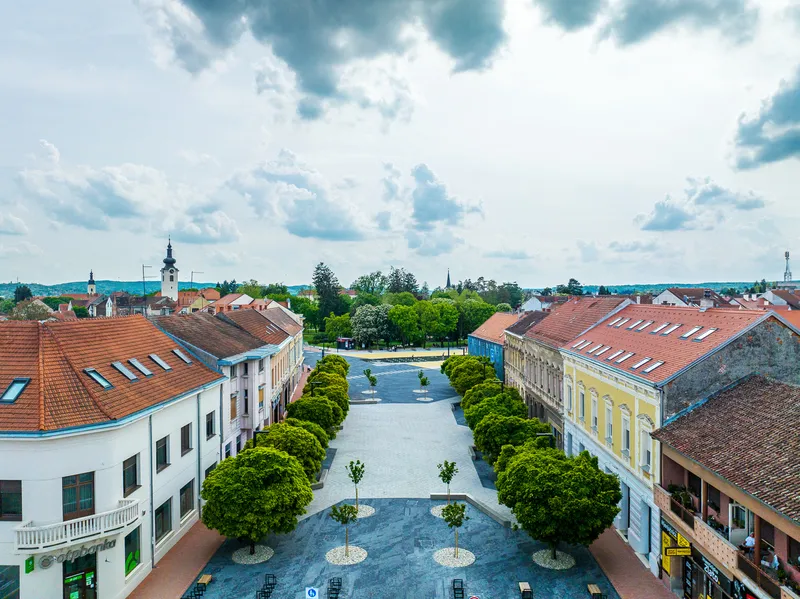
Public squares that function primarily as shortcuts are a familiar urban problem. In Koprivnica, a small city in northern Croatia's Podravina region, three central squares had drifted into exactly that condition: Ban Jelačić Square was a tree-lined boulevard used mainly for seasonal markets, the Market Square channeled pedestrians and cyclists through its center, and Zrinski Square, the largest of the three, was an oversized void people crossed diagonally without ever pausing. NFO, the Zagreb-based office that won the design competition in 2019, completed a 15,000 m² reconstruction in 2023 that refuses to treat these three spaces as a single grand gesture. Instead, it subdivides them into twelve distinct micro-zones, each calibrated to its immediate edge condition, and stitches the whole ensemble together with bicycle paths, material codes, and a carefully regional color palette.
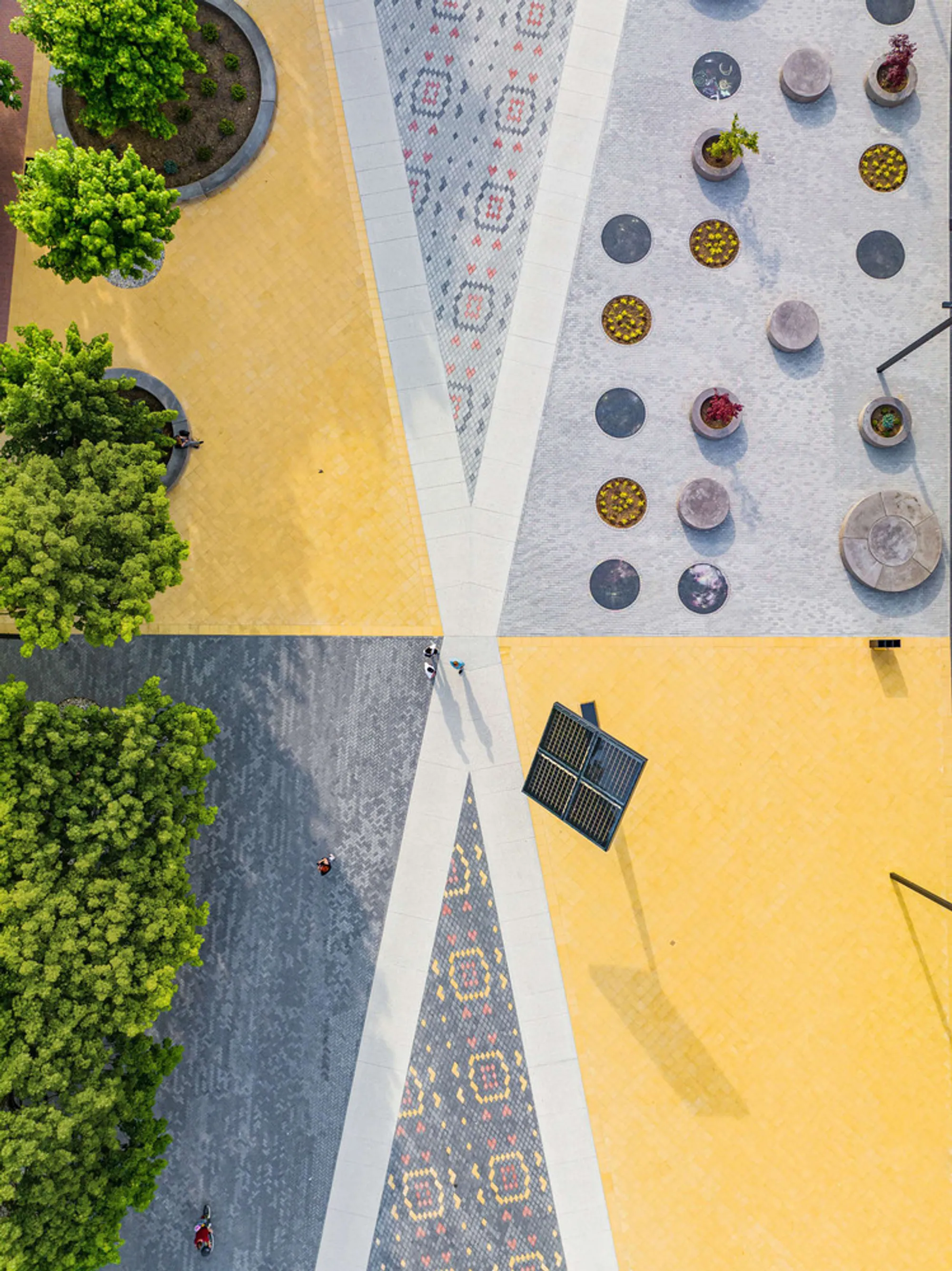
The most interesting move here is conceptual honesty about how people actually use the square. Rather than fighting the diagonal bicycle desire lines, NFO adopted them as the coordinate system for the entire layout. An X-shaped network of bike lanes carves Zrinski Square into a constellation of smaller territories: an art zone with exhibition pedestals, a pop-up zone under maples for summer events, café terraces with designated parasol footprints, and quiet seating clusters around existing mature trees. The neighboring squares function as "green vestibules," giving Zrinski a visual border it never had. It is a project about accepting chaos and giving it just enough structure to become a community.
The X-Shaped Logic
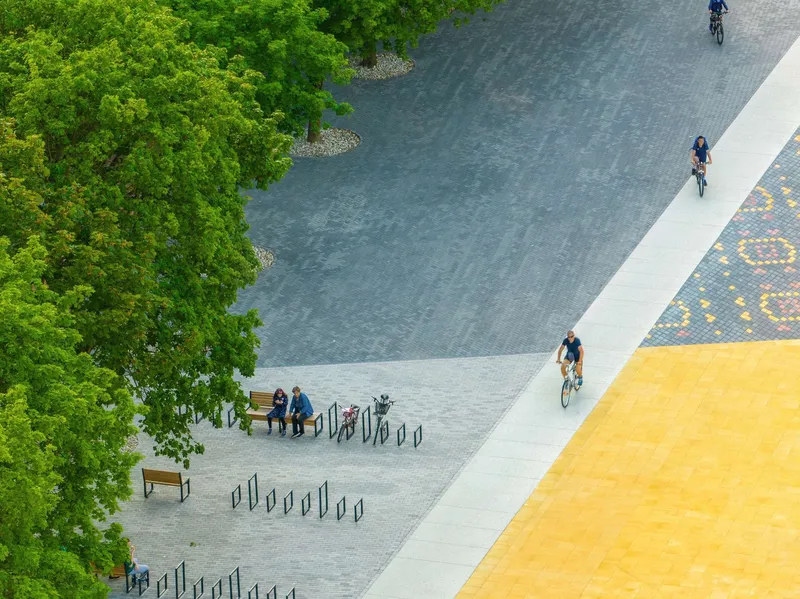
The decision to let cyclists dictate the plan is counterintuitive for a project meant to encourage lingering, but it works precisely because it converts a liability into an armature. The bike lanes cut across the square in an X pattern, and the residual wedges between those paths and the perimeter become the twelve programmed zones. Each wedge acquires its own paving tone, furniture set, and planting. The effect, visible from above, is less like a single square and more like a quilted field of distinct rooms open to the sky.
Bicycle infrastructure here is not an afterthought bolted onto a pedestrian scheme. Rough-hewn concrete distinguishes the lanes from surrounding surfaces, and combined bench-and-bike-rack elements mark the transition points where cyclists dismount and enter the slower-paced zones. The integration is tight enough that the square never reads as a conflict between modes of movement.
Color as Regional Code
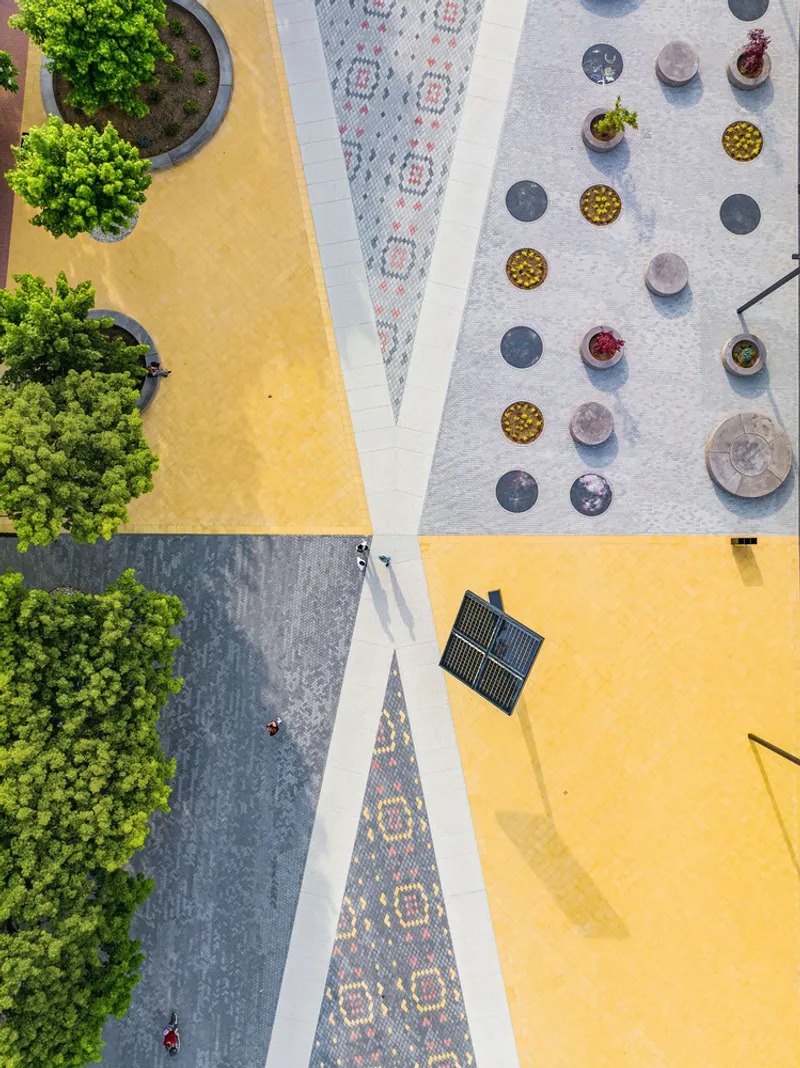
NFO derived the paver palette from an analysis of surrounding facades, local heritage, and the broader Podravina ambience. Reddish stones recall the old brick roads that once surfaced Croatian town centers. Ocher-yellow marks the multifunctional gathering zones, acting as a warm beacon amid gray-toned circulation areas. The result avoids the generic neutrality of most European square refurbishments. It looks rooted, as if the ground surface grew out of the same geology and craft tradition as the buildings around it.
Embedded mosaic panels take the cultural reference further, interpreting traditional Podravina embroidery in stone. These are not decorative afterthoughts tucked into corners; they occupy prominent positions along circulation paths where foot traffic is highest. For a regional city competing with larger Croatian destinations for identity, the mosaics offer visitors something genuinely site-specific to discover underfoot.
Water Mirror and Play
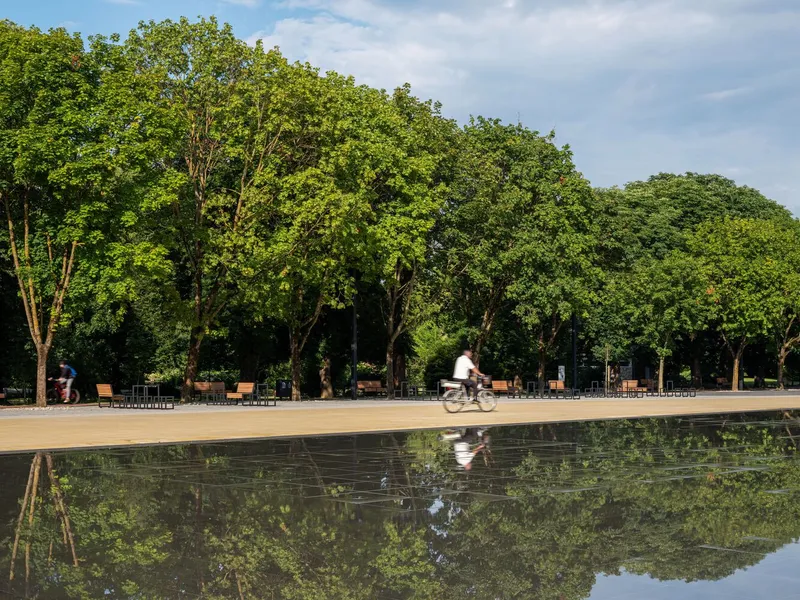
The fountain on Zrinski Square replicates the outline of a historic flower garden, a circular feature known locally as the "rundele." Paved in gray flamato sandstone and lowered just two centimeters below the surrounding grade, it becomes a reflective water mirror in calm conditions, doubling the park tree line and the Town Hall façade in its surface. In summer, the jets activate and the basin turns into a water playground for children. The transformation is seamless because the section change is so slight: there is no curb, no step, no gate separating civic formality from play.
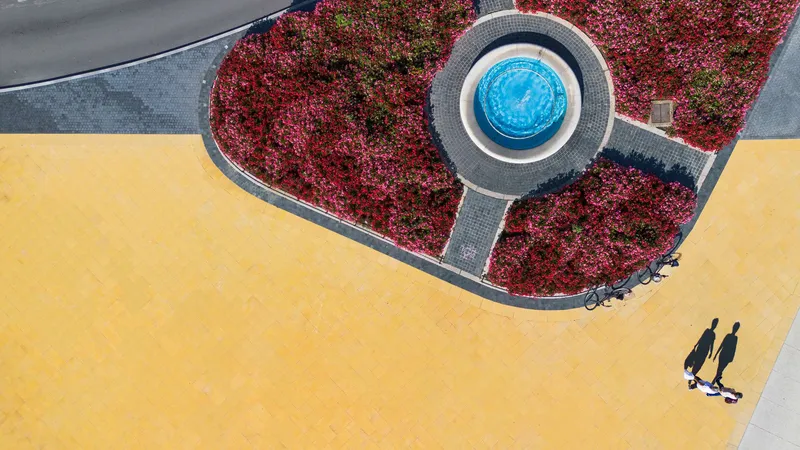
The blue basin visible in the circular fountain element offers a more contained water feature, ringed by red groundcover plantings and yellow paving that frame it like a jewel within the broader composition. Together, the two water elements give the square year-round visual anchors that shift in character with the seasons.
Circular Planters and Urban Canopy
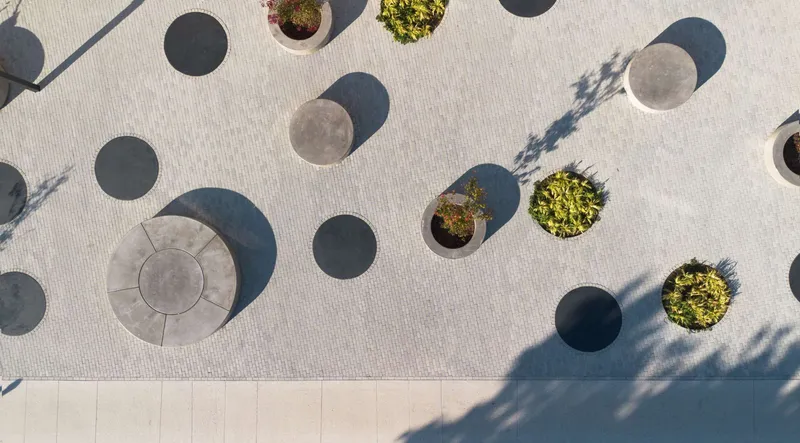
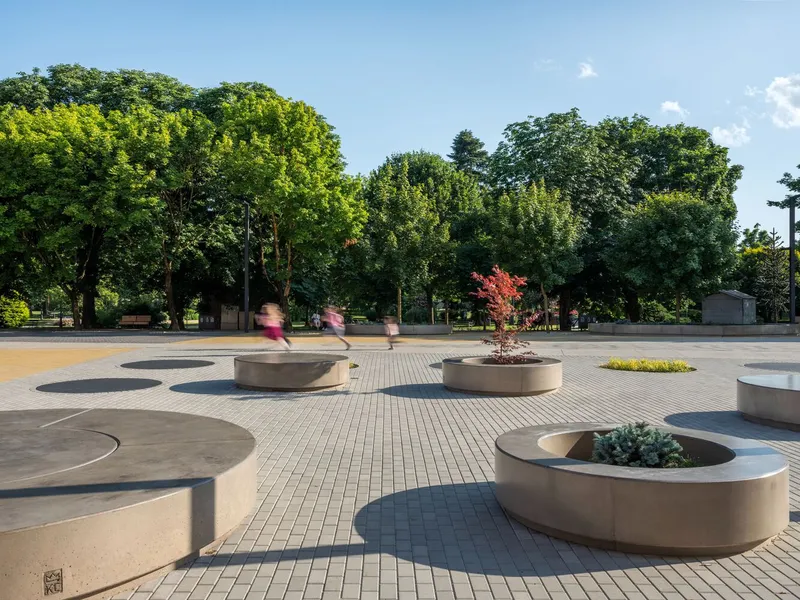
NFO's planting strategy layers existing mature trees with new species chosen for both ecological resilience and spatial purpose. Rows of Acer platanoides globosum maples now line Ban Jelačić and Market squares, their dense globular canopies forming a legible green ceiling. On Zrinski Square, Japanese maples sit inside circular concrete bench-planters underplanted with Ophiopogon, creating intimate enclosures within the open field. Sophoras and spruce bushes fill in the existing tree line, thickening the park edge that had previously felt porous and undefined.
Irrigation relies on a Root Water System and drip lines paired with ACO rainwater management, a practical but often overlooked detail that keeps 15,000 m² of hardscape from overwhelming the city's storm drainage. The green vestibule concept on the neighboring squares provides Zrinski with clear visual borders while also acting as ecological buffer zones, softening the transition between pavement and park.
Smart Furniture, Quiet Integration
A solar tree installed near the library and cinema provides Wi-Fi, power outlets, and a screen displaying live meteorological data. It could easily read as a gimmick, but NFO places it where students and readers already congregate, turning a tech object into a functional node rather than an isolated spectacle. Elsewhere, the furniture vocabulary stays deliberately quiet: wooden benches along the park edge, concrete circular seating under large trees, and steel wastebaskets and bike racks finished to weather alongside the stonework.
The range of seating typologies is worth noting. Benches double as exhibition pedestals in the art zone, merge with bike racks at entry points, and wrap into circular planters around trunk bases. Each serves a specific micro-zone, reinforcing the twelve-part spatial logic without requiring signage or barriers.
Plans and Drawings
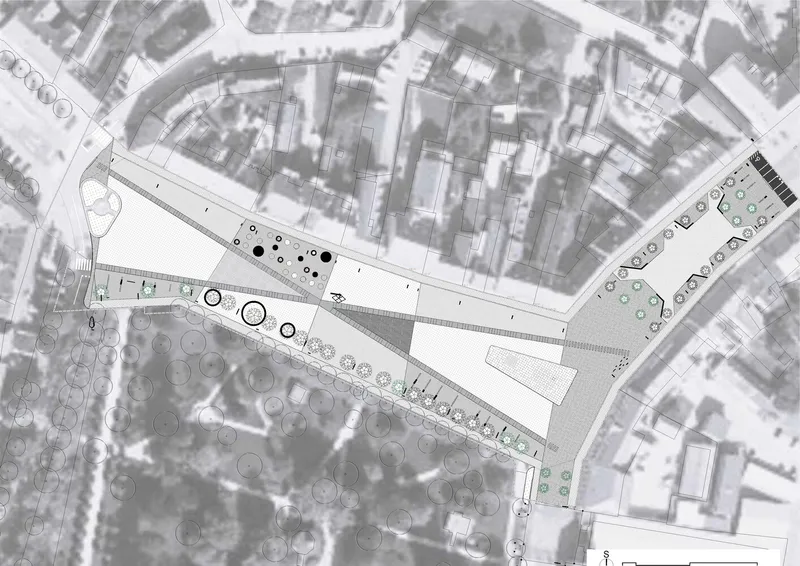
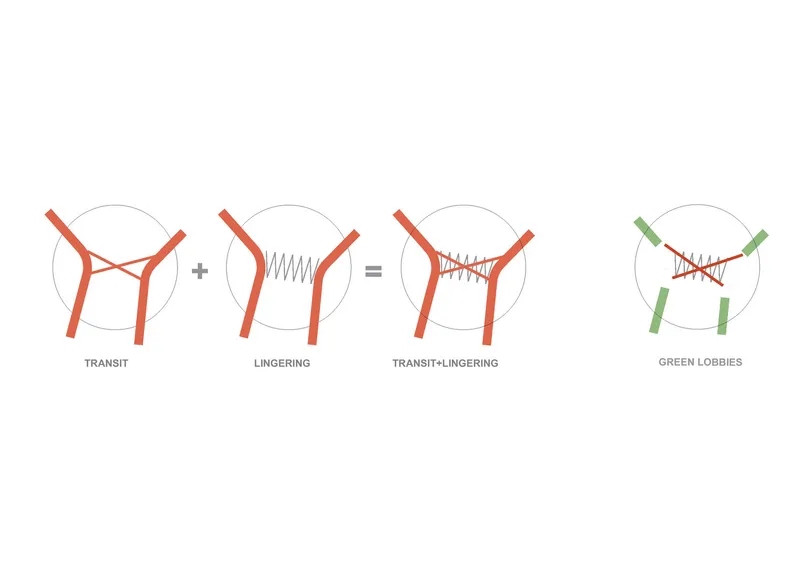
The site plan, overlaid on an aerial photograph, reveals the angular geometries that give Zrinski Square its fractured paving pattern. What might look organic at eye level is actually a tightly coordinated set of vectors generated by the bicycle desire lines and the irregular perimeter of surrounding buildings. The circulation diagram clarifies the "green vestibule" concept: four circular configurations show overlapping transit paths and buffer planting zones that define the edges of each square. Together, the drawings make legible a project whose success depends on looking unplanned.
Why This Project Matters
Koprivnica's reconstructed squares demonstrate that mid-sized European cities do not need monumental gestures to reclaim their public centers. By accepting existing movement patterns and subdividing an oversized void into a network of purpose-built micro-zones, NFO avoids the two most common failures of square design: the empty plaza that looks great in aerial photographs but repels daily use, and the over-programmed theme park that ages badly. The twelve-zone approach is inherently adaptable; as businesses change and demographics shift, individual zones can be reprogrammed without redesigning the whole.
Equally significant is the project's refusal to flatten regional identity into generic contemporary urbanism. The paver colors, the embroidery mosaics, the rundele-shaped fountain: these are specific references to Podravina's material and craft traditions, deployed without nostalgia. They give Koprivnica a ground plane that belongs to it and nowhere else. For a city of roughly 30,000 people, that specificity is not a luxury. It is the difference between a place people pass through and one they choose to stay in.
Reconstruction of Central Squares in Koprivnica by NFO. Koprivnica, Croatia. 15,000 m². Completed 2023. Photography by Zoran Bakić and bosnić+dorotić.
About the Studio
Share Your Own Work on uni.xyz
If projects like this are the kind of work you want to make, uni.xyz is a place to publish your own, find collaborators, and enter design competitions.




Popular Articles
Popular articles from the community


The Earth Pod: 3D Printed Homes for Resilient Refugee Communities
The Earth Pod reimagines refugee housing through 3D printed homes made from clay, combining resilience, self-sufficiency, and rapid shelter.

Co-life: Sustainable Architecture for Age-Friendly Community Living
Co-life reimagines sustainable architecture for seniors through courtyards, rammed earth, shared gardens, and spaces designed for belonging.

The Musturak Paradise: Senior Living Architecture for a Connected Future in Temara, Morocco
The Musturak Paradise reimagines senior living architecture in Temara via private homes, social spaces, culture, community, and shared care.

Riyadh For All: Intergenerational Urban Design for Active Aging in Rabat
Riyadh For All reimagines urban design in Rabat with intergenerational co-living, adaptive courtyards, and Moroccan cultural exchange today.

Similar Reads
You might also enjoy these articles


Hodi-Mandai Geram
Project Function: Preservation and revitalization of the Intangible heritage and socio-spatial identity of the Hodi by Housing, Cultural Memory Center, Sacred Grove, landscape, local tourism economy


Olio Towers: A Mid-Rise for Performers That Fuses Housing, Rehearsal, and Stage
Located blocks from Houston's Theater District, this modular tower stacks living units around a central performance atrium.

Oasis: Modular Green Housing Carved into Dhaka's Urban Fabric
A shortlisted Plugin Housing entry reclaims unauthorized settlements in Dhaka with stepped concrete volumes, green roofs, and ventilation-driven design.

Black Hole: A Floating Megastructure for the Post-Physical Era
Emiliano Mazzarotto envisions a spherical, self-scaling arena where e-sports, digital hotels, and holographic stadiums replace traditional public space.


Explore Public Building Competitions
Discover active competitions in this discipline



Challenge to design locus for the upliftment of human rights


Challenge to reimagine the Iron Throne


Photograph architecture without architects


Illustrate the lost glory of Angkor Wat - Render Challenge
Comments (0)
Please login or sign up to add comments
No comments yet. Be the first to comment!