

Redefining the Urban Fabric of Manek Chowk, Ahmedabad, Gujarat
Reimagining one of India’s oldest market precincts through heritage-led urban regeneration architecture that balances commerce, culture, and community life.


Manek Chowk, located at the historic heart of Ahmedabad, Gujarat, is one of India’s most vibrant and complex urban marketplaces. Active for over six centuries, the precinct functions simultaneously as a trading hub, a cultural landmark, and a living urban fabric shaped by layered histories. The project “Redefining the Urban Fabric of Manek Chowk” explores how urban regeneration architecture can respond to extreme density, informal growth, and heritage preservation within an organically evolved Indian market.
Designed as an academic thesis project by Nilay Desai, the proposal investigates the relationship between built form and public space, aiming to revive the spatial, social, and cultural qualities of Manek Chowk while addressing present-day urban challenges.


Understanding the Urban Context
Manek Chowk is characterized by narrow streets, intense pedestrian movement, informal vending, heritage structures, and a constantly shifting temporal identity, from jewelry markets by day to food streets by night. Over time, unplanned additions, illegal settlements, traffic congestion, and inadequate public amenities have compromised spatial legibility and heritage visibility.
The project begins with a detailed mapping of existing conditions, identifying:
- Heritage structures embedded within dense commercial blocks
- High traffic and pedestrian congestion zones
- Temporary and permanent stall typologies
- Residential units layered above ground-floor shops
- Lack of breathing spaces and public plazas
This analysis forms the basis for a regenerative architectural strategy that works with the existing fabric rather than replacing it.
Urban Regeneration Strategy
The core objective of the proposal is to create a heritage-sensitive urban regeneration architecture framework that reorganizes market activity while retaining the intangible cultural identity of Manek Chowk.
Key interventions include:
- Retaining and restoring significant heritage structures
- Introducing controlled open plazas around monuments
- Improving permeability and visual access from surrounding streets
- Reorganizing shop typologies for better circulation
- Integrating housing units on upper floors to support existing communities
By carefully subtracting, re-layering, and inserting new architectural elements, the project transforms congestion into structured density.
Open Space as Cultural Infrastructure
One of the most critical moves in the design is the introduction of open breathing spaces around heritage monuments. These plazas act as buffers between commercial activity and historic structures, offering places for pause, gathering, and cultural interaction.
Rather than functioning as empty voids, these open spaces are conceived as active urban rooms: used by locals while shopping, resting, or participating in cultural events. This approach reinforces tourism while maintaining everyday usability for residents and vendors.
Programmatic Interventions
To strengthen Manek Chowk’s role as a cultural anchor, the project introduces new public programs that complement existing market activities:
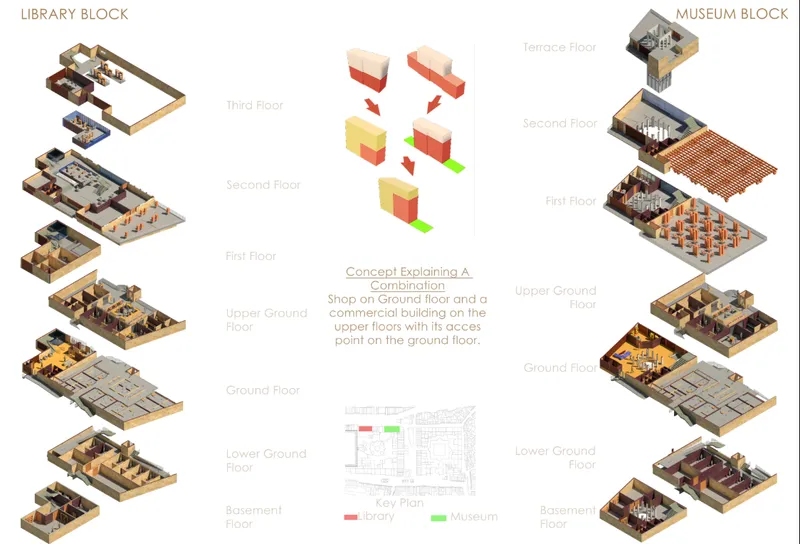
- Library Block: Designed as a quiet civic space embedded within the market fabric, offering knowledge access in an otherwise commercial environment.
- Museum and Exhibition Spaces: Showcasing the history of Manek Chowk, local crafts, and the evolution of Ahmedabad’s trading culture.
- Refurbished Old Stock Exchange Building: Adaptive reuse of a historic structure into a workshop and exhibition space for local women artisans, enabling economic empowerment through craft production and public engagement.
These interventions position architecture as a tool for social and cultural regeneration, not merely spatial reorganization.
Housing and Shop Typologies
The project rethinks traditional market typologies by clearly separating yet vertically integrating functions:
- Ground floors remain dedicated to shops and commercial activity
- Upper floors accommodate refurbished housing units for existing residents
- New shop modules are designed based on eye-level perception and street engagement
By relocating informal ground-level settlements into upgraded upper-floor housing, the proposal improves living conditions without displacing communities.
Architectural Language and Materiality
The architectural expression draws from Ahmedabad’s historic streetscape: solid masonry walls, shaded corridors, balconies, and rhythmic openings, reinterpreted through contemporary construction techniques. The aim is continuity rather than contrast, allowing new interventions to blend seamlessly into the old city fabric.
Sections and elevations emphasize human scale, climatic responsiveness, and visual continuity across the market precinct.
Impact and Conclusion
“Redefining the Urban Fabric of Manek Chowk” demonstrates how urban regeneration architecture can address the complexities of heritage markets in Indian cities. By balancing conservation with strategic intervention, the project proposes a sustainable model for revitalizing historic urban centers without erasing their identity.
Through integrated public spaces, adaptive reuse, and community-oriented design, the proposal transforms Manek Chowk into a more legible, inclusive, and culturally vibrant urban environment, one that respects its past while adapting to contemporary urban life.
Project Title: Redefining the Urban Fabric of Manek Chowk, Ahmedabad
Project Type: Academic Thesis
Designer: Nilay Desai
Location: Ahmedabad, Gujarat, India




Popular Articles
Popular articles from the community


The Musturak Paradise: Senior Living Architecture for a Connected Future in Temara, Morocco
The Musturak Paradise reimagines senior living architecture in Temara via private homes, social spaces, culture, community, and shared care.

Riyadh For All: Intergenerational Urban Design for Active Aging in Rabat
Riyadh For All reimagines urban design in Rabat with intergenerational co-living, adaptive courtyards, and Moroccan cultural exchange today.
AL-JANNAH: Sustainable Architecture and Permaculture for Afghan Widows
AL-JANNAH uses sustainable architecture and permaculture to create resilient oasis of housing, learning, work and renewal for Afghan widows.
EW PARK: Sustainable Architecture Reimagines the Future of Urban Parking
EW PARK reimagines city parking as a modular wooden tower combining automation, solar energy, electric mobility, and adaptable urban design.

Similar Reads
You might also enjoy these articles

Maya Harvest: A Cacao Resort Village Rooted in Mayan Tradition and Local Craft
Situated within a Tabasco cacao plantation, this shortlisted resort proposal merges vernacular materials with hands-on cultural immersion.
Harmonia: A River-Shaped Community That Grows Over Decades in Boa Vista
Curved pathways and modular grid structures along the Branco River create a phased settlement designed to evolve from 2030 to 2050.
The Architecture of Bathing: A Mughal Hammam Reimagined Across the Yamuna
Charlotte May's honorable mention entry for The Black Taj reinterprets Agra's bathing rituals through red sandstone, water, and framed views of the Taj Mah
Om-1: A Wall-Hung System That Moves Your Workspace Off the Desk
Modular plywood boards, magnetic pegs, and utility elements migrate clutter from the horizontal surface to the vertical plane.


Comments (0)
Please login or sign up to add comments
No comments yet. Be the first to comment!