

Reed Maze: Architecture That Vanishes into the Landscape It Heals
A regenerative workshop and research centre in the Tame Valley uses Miscanthus grass to conceal and reveal its timber pavilions with the seasons.


What if a building could disappear? Not demolished, not abandoned, but absorbed back into the land it occupies, only to re-emerge months later when the grasses are cut. That is the provocation at the heart of Reed Maze, a workshop and research centre designed to rise and retreat with the growth cycle of Miscanthus × giganteus, a sterile bioenergy grass planted across a former industrial wasteland in England's Tame Valley. The architecture does not sit on the landscape so much as it participates in it, concealed behind dense reeds in summer and revealed again after harvest, turning seasonal visibility into a design strategy rather than a problem to solve.
Designed by Ana Markovic, this winning entry in the WIC Competition confronts one of the most polluted river corridors in the UK and proposes architecture as an act of ecological repair. The River Tame, degraded by centuries of coal mining, chemical dumping, and gravel extraction, has begun to recover through purification lakes and community conservation. Reed Maze accelerates that recovery by embedding education, craft revival, and ecological stewardship into a cluster of timber pavilions scattered across reclaimed wetlands. The project is simultaneously a memorial to environmental damage and a working blueprint for regeneration.
Pavilions Scattered Like Seeds Across the Wetland
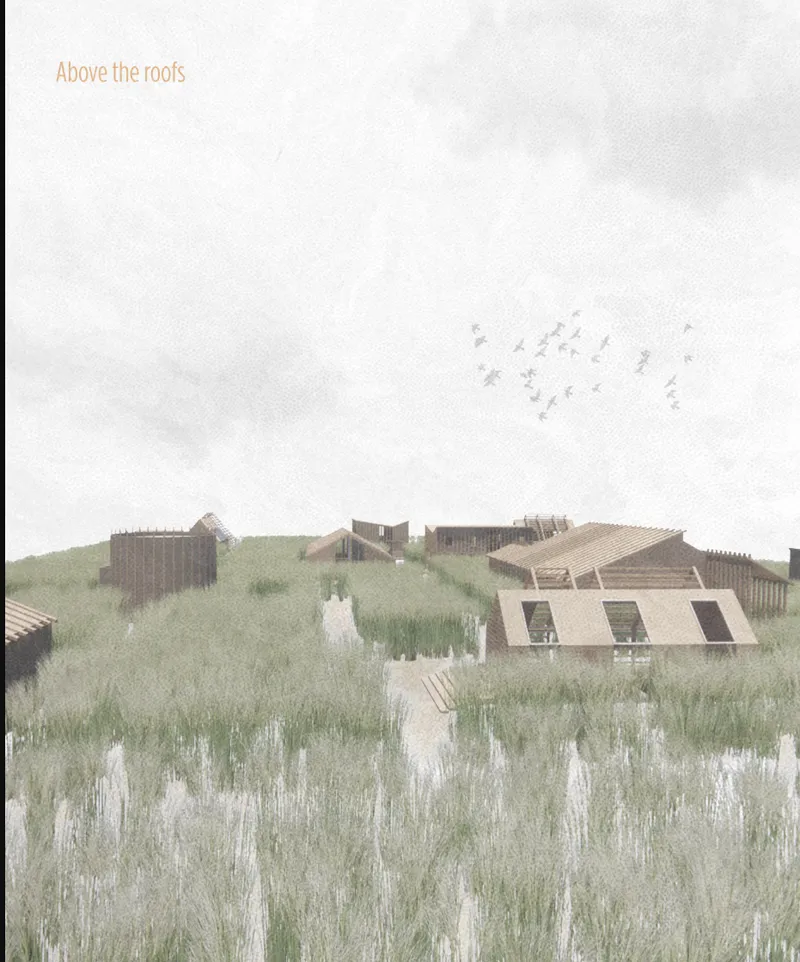
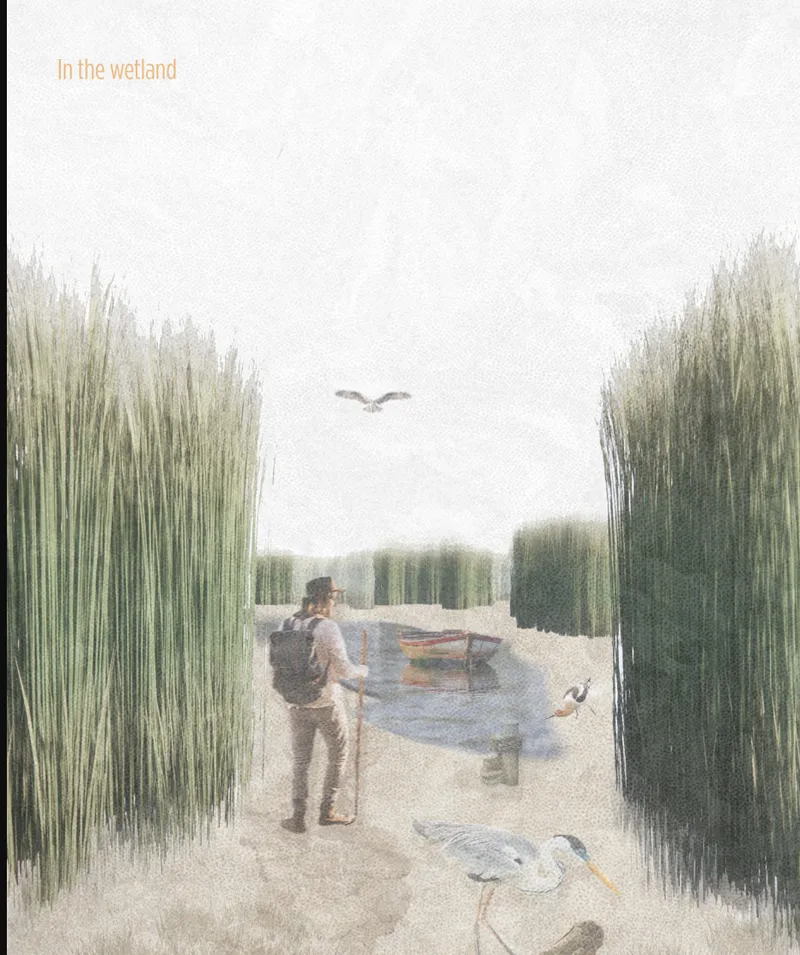
Seen from above, the complex reads less as a campus and more as a constellation. Timber-framed pavilions are distributed across the site without the rigidity of a masterplan grid, their placement responding to existing reed beds, water bodies, and topography. The aerial view captures this dispersal strategy clearly: buildings appear almost incidental among the tall Miscanthus grasses, with flocks of birds moving overhead as if the architecture were simply another element of the habitat. This is not a nature centre dropped onto a greenfield site. It is infrastructure woven into the fabric of a recovering ecosystem.
At ground level, the experience shifts dramatically. Visitors walk through dense corridors of reeds, the architecture hidden until a boardwalk or gabled roof edge breaks the vegetative wall. Wading birds share the pathways under misty skies, reinforcing the sense that human presence here is negotiated, not imposed. The spatial sequence encourages slowness and attention, turning the journey between buildings into an educational experience in itself.
Disappearing Architecture: Sloped Roofs and Seasonal Concealment
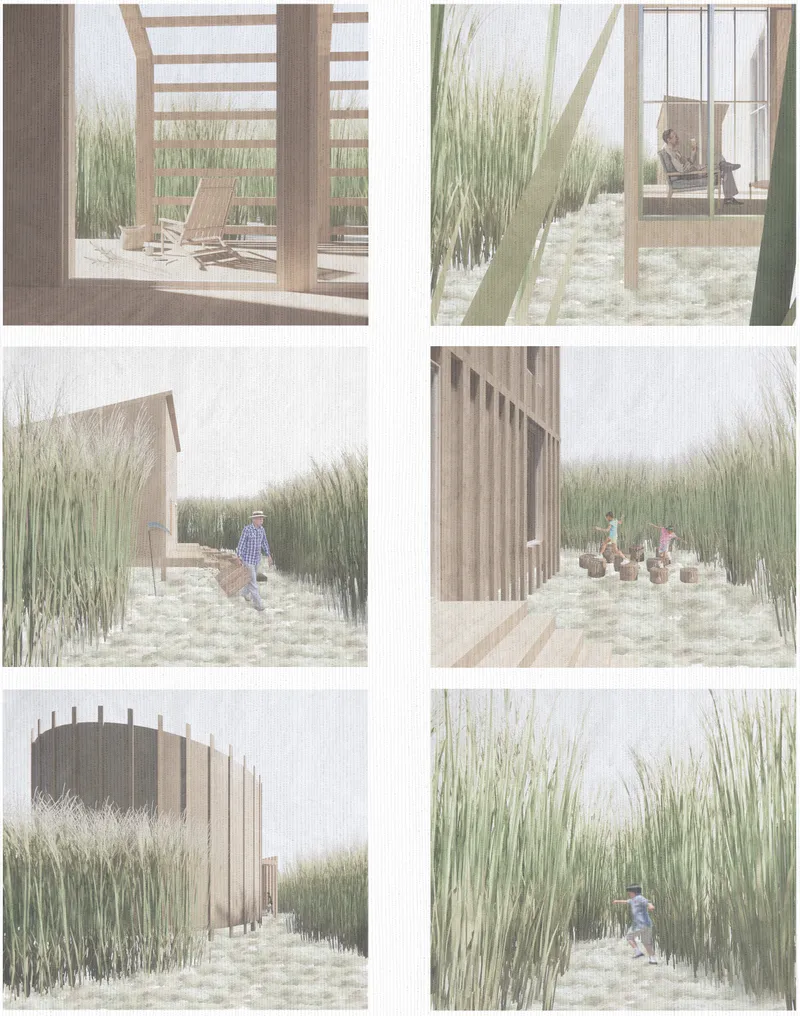
Markovic's concept of "disappearing architecture" gives the project its most distinctive quality. Every building except the cylindrical technology centre adopts a sloped roof profile designed to blend with the surrounding topography and vegetation. During summer, when Miscanthus reaches full height, only these angled rooflines remain visible, serving as subtle wayfinding markers above the sea of grass. The rendered vignettes show how boardwalks and pavilions sit within the planting matrix, their timber frames echoing the vertical rhythm of the reed stems. The visual language is consistent: warm, natural materials, low profiles, and an insistence on porosity between interior and exterior.
The duality of presence and absence does more than minimize visual impact. It transforms the visitor's relationship to architecture itself. A building you cannot always see becomes something you must actively seek, heightening sensory awareness of sound, texture, and the changing quality of light filtered through grass. The design treats concealment not as a limitation but as a spatial event, one that recurs annually and makes each visit to the centre a fundamentally different experience.
Timber Frames Through Rain, Sun, and Frost
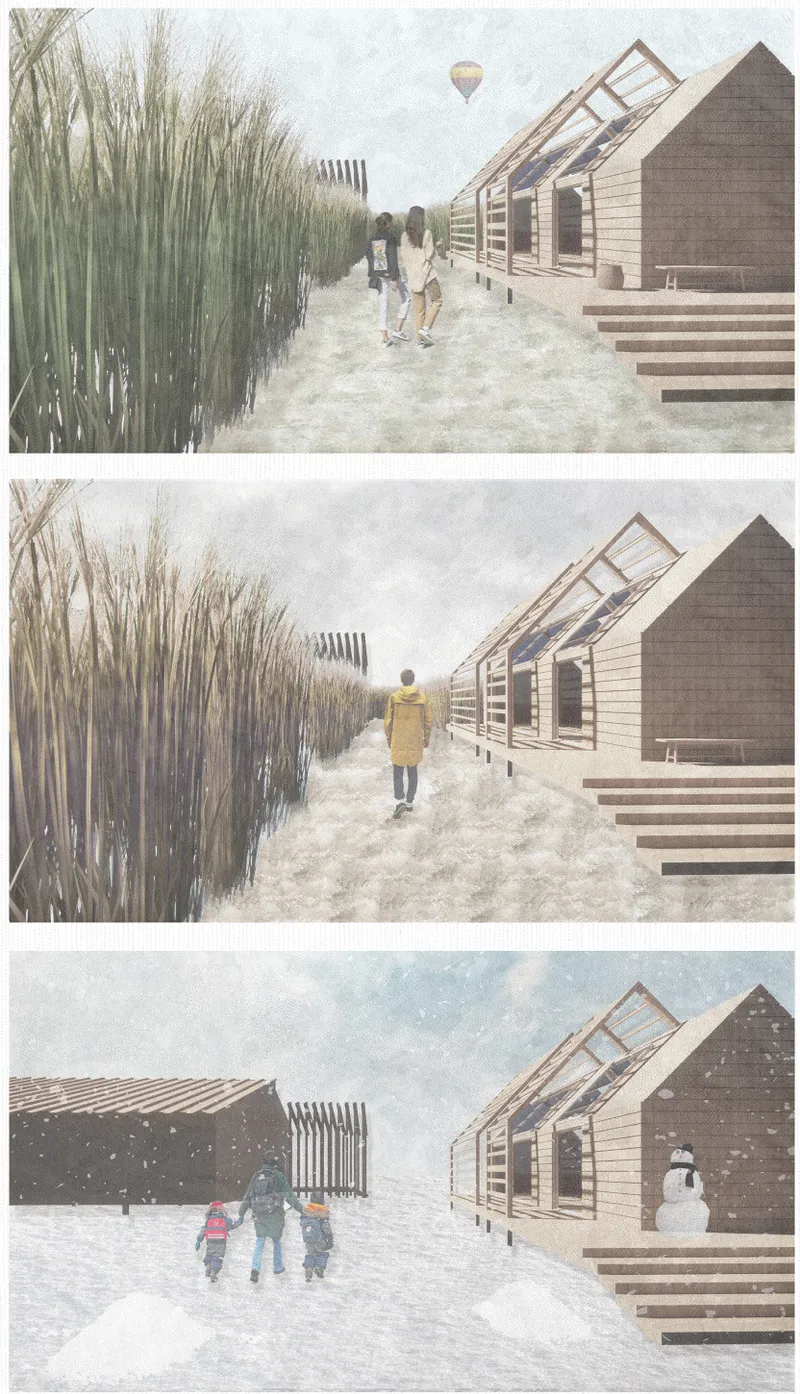
A sequence of three seasonal views along a timber-framed walkway between gabled structures reveals how the architecture performs across the year. In warmer months, the tall grasses press close and visitors move through dappled shade. In autumn and winter, the harvested landscape opens up, exposing the structural skeleton of the buildings and the full extent of the boardwalk network. Figures appear in varying weather conditions, from bright sun to overcast grey, grounding the project in the reality of the English Midlands climate rather than presenting an idealized sunny-day render.
This seasonal documentation is a deliberate design argument. It insists that the project is not a single image but a process. The architecture ages, weathers, and cycles alongside the Miscanthus crop. Internal layouts are designed for flexibility, adapting to educational workshops, recreational use, and residential accommodation as the programme demands. The buildings serve multiple roles across time, mirroring the cyclical productivity embedded in the landscape strategy.
Programme Rooted in Craft, Ecology, and Memory
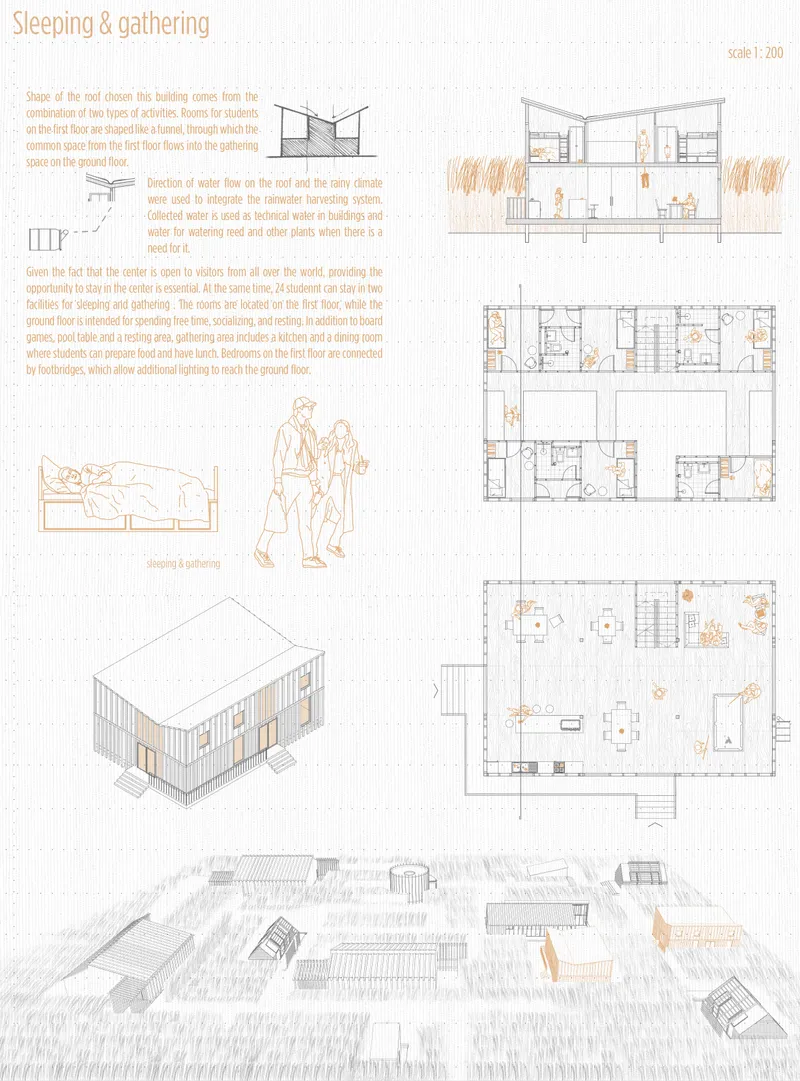
The presentation board lays out the full spatial programme with clarity: floor plans, sections, axonometric projections, and a site plan that maps the residential building layouts within the broader wetland context. The centre houses three thematic museums, the first addressing the industrial history of the River Tame, the second celebrating current wetland biodiversity, and the third dedicated to reedcraft and its cultural lineage. Workshops range from botanical sessions on the lifecycle of reeds and Miscanthus to hands-on craft training in basket weaving, tool-making, and thatching masterclasses aimed at preserving nearly-lost vernacular skills.
Eco-friendly accommodation allows extended stays for researchers, craftspeople, and visitors, turning the centre into a living campus rather than a day-trip destination. The programme is ambitious but coherent: every element connects back to the site's history of exploitation and its ongoing recovery. Education is not an add-on but the engine of the project, with the architecture itself serving as teaching material. Visitors learn about regenerative systems not from display panels alone but from the building fabric, the planting strategy, and the seasonal rhythms they inhabit.
Why This Project Matters
Reed Maze refuses the common trap of "green architecture" that grafts ecological signifiers onto conventional building logic. Here, the ecology is the architecture. The Miscanthus crop is not decoration; it is structure, screen, educational subject, bioenergy source, and cultural symbol in a single organism. By designing buildings that literally vanish into their context, Markovic challenges the assumption that architecture must assert its presence to have value. Sometimes the most powerful statement a building can make is to step back.
The project also demonstrates something increasingly rare in competition culture: genuine site specificity. Every decision, from the choice of Miscanthus over ornamental grasses to the placement of museums tracing the River Tame's industrial scars, is rooted in a deep reading of place. The result is not a prototype that could land anywhere but a building that could only exist in this valley, on this reclaimed land, for this community. That kind of conviction, backed by rigorous ecological and programmatic logic, is what separates a provocative concept from a credible model for regenerative practice.
View the Full Project
About the Designers
Designer: Ana Markovic
Enter a Design Competition on uni.xyz
uni.xyz runs architecture and design competitions year-round that reward proposals with spatial conviction and real site intelligence.
Project credits: REED MAZE – Workshop and Research Centre by Ana Markovic WIC (uni.xyz).


Popular Articles
Popular articles from the community


Opera by the Sea Estonia: Three Shells Dissolving Architecture into Tallinn's Coastline
A winning opera house proposal replaces monumental form with interconnected shells that blur the boundary between building, park and Baltic Sea.

Manzana Morphosis: Stretching Barcelona's Grid into a Living Landscape for 2050
A radical reworking of the Eixample manzana turns density into a tool for generous public space, vertical ecology, and environmental performance.
Opera on the Sea: Driftwood Logic Shapes a Timber Opera House on Estonia's Coast
Trevor Orgill's opera house translates the entangled drift of floating timber into a civic building where wood, water, and music converge.
Tsunami Convergenics: Turning Catastrophic Ocean Forces into Underwater Housing Infrastructure
A speculative underwater settlement off the coast of Onagawa, Japan, treats tsunamis and typhoons as energy sources rather than threats.

Similar Reads
You might also enjoy these articles

Shakur's House: Exposed Brick as an Interior Organiser in a 168 m² Mashhad Residence
Brick moves indoors in this Mashhad residence, where masonry walls, glass partitions and teal planes sequence a compact home without closing it off.

Day and Night Park: A Time-Based Urban Newsstand in Beijing
A temporary urban newsstand in Beijing blending travel, light, and reading through poetic colors, compact form, and community-focused design.

Modernist Patio Renovation in El Masnou, Barcelona by Oliver Segura Arquitectura + Cebrià Arquitectura
Modernist patio renovation blending tradition and innovation with a movable pool, leveled floors, and Catalan materials in El Masnou.

Alto Residencial Coop: Cooperative Housing Development in Santiago de Compostela by Carbajo Barrios Arquitectos
A linear cooperative housing complex blending white volumes and perforated metal façades, enhancing community living, natural light, privacy, and urban integration.

Explore Recreative Competitions
Discover active competitions in this discipline

Challenge to design public laboratory

Design challenge to reuse E-waste
Comments (0)
Please login or sign up to add comments
No comments yet. Be the first to comment!