
Onion Turns a Bangkok School Building into an All-Day Social Engine with Color, Copper, and Graph Paper Ceilings
A refectory, lounge, and library at King's College International School Bangkok replace walls with material palettes to keep students engaged all day.


Most school buildings treat the canteen, the library, and the common room as separate boxes with separate schedules. Onion refused that premise when designing the new senior building at King's College International School Bangkok. Instead of distinct rooms sealed off by partitions, the firm produced a single interconnected environment where dining, studying, socializing, and lounging bleed into one another through shifts in color, materiality, and ceiling treatment. The result is a building that students actually want to occupy between classes, not just during lunch.
What makes the project genuinely interesting is its rejection of the partition as a spatial tool. Where a conventional school architect would reach for drywall, Onion reaches for a change in hue. Light blue metal laminates define the refectory zone. Orange brick and copper mark the library. A gridded ceiling pattern, deliberately scaled to resemble a giant sheet of graph paper, runs across multiple areas as a unifying motif that also winks at the student experience. It is a school building that reads its own context and turns it into architecture.
The Refectory: 246 Seats, Zero Dead Hours

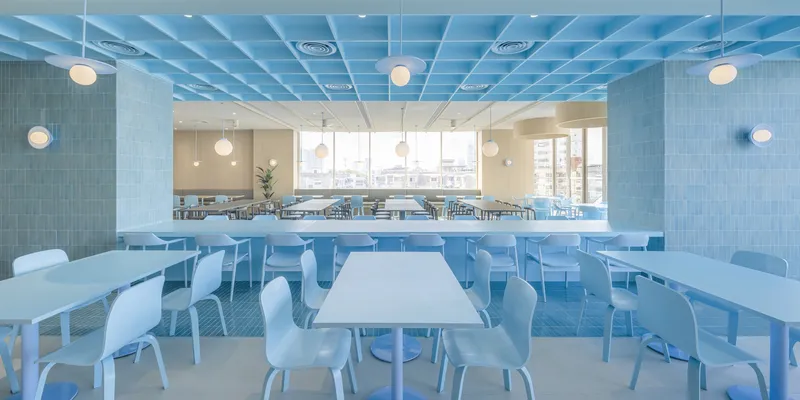
The refectory seats 246 people across two climate zones: 156 in an air-conditioned interior and 90 in a naturally ventilated space that opens into the school's main atrium. Seating types range from bar stools to 20-seat communal tables, acknowledging that eating in a school is fundamentally a social act, not a transactional one. The variety isn't decorative. It calibrates group size, posture, and duration of stay, so students who want a quick snack aren't forced into the same furniture as those settling in for a study session.
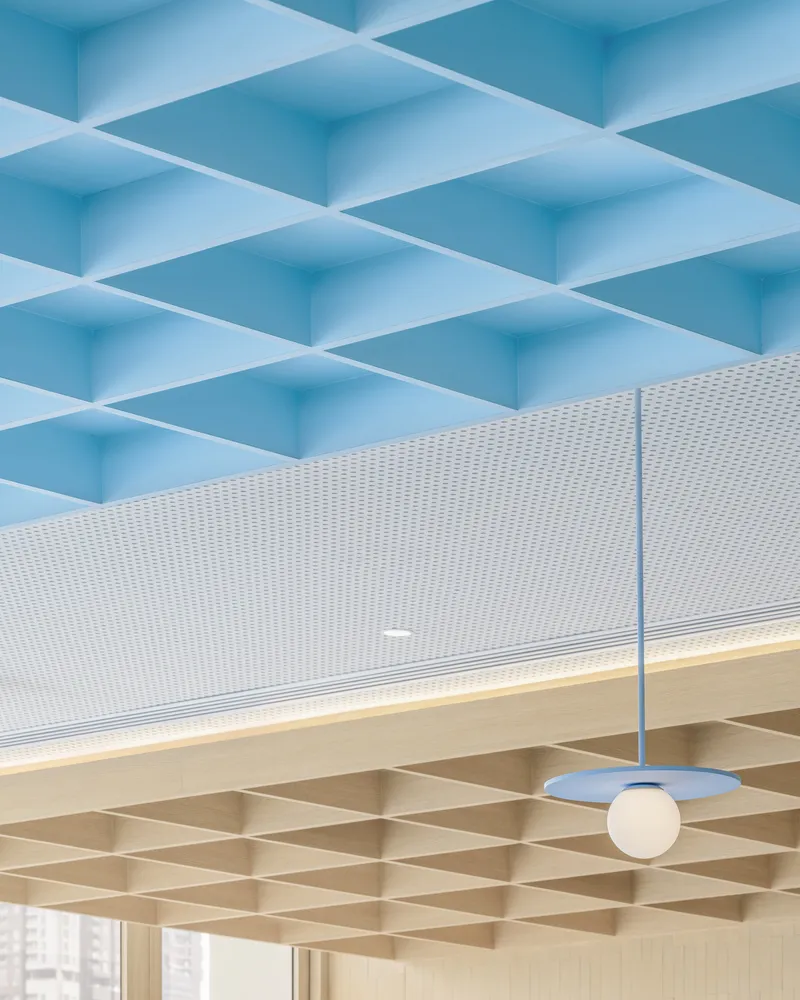
Light blue dominates the palette here, a deliberate reference to the senior year school color. Onion chose a lighter, cooler shade than the official blue, aiming for calm rather than institutional pride. The coffered ceiling panels in blue sit above a timber waffle grid, with globe pendant lights dropping through at regular intervals. Against the warm orange brick walls that wrap the building's exterior, the blue reads as intentional contrast rather than arbitrary theming.
A Staircase That Performs Double Duty
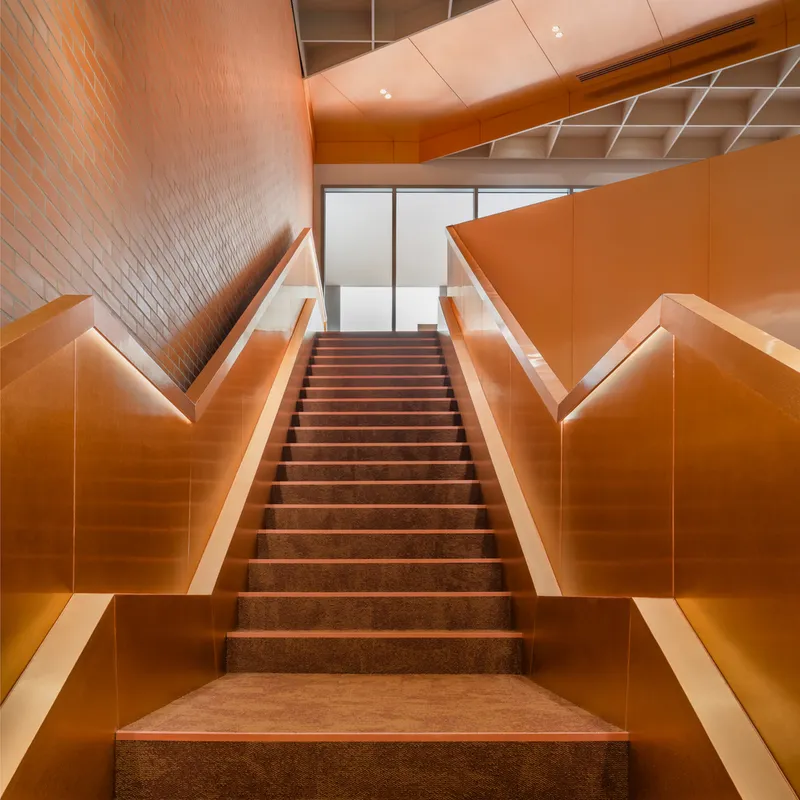
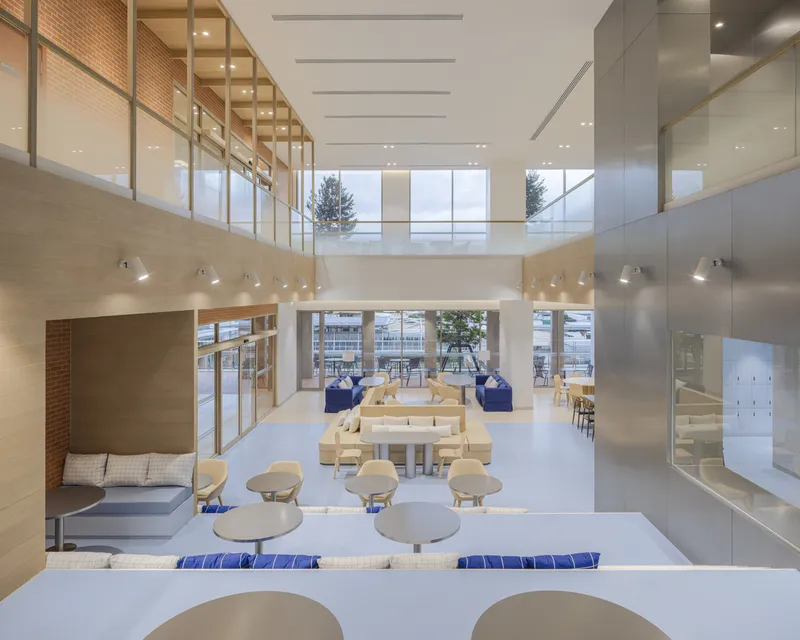
A central staircase connecting the fourth and fifth floors is one of the building's key architectural moves. Faced in orange metal panels with dark terrazzo treads, it functions as both circulation and seating. Students can perch on its steps to watch activity in the atrium below or the football courtyard beyond. Onion designed it for visibility in both directions: you see and are seen. In a school context, that legibility doubles as a passive safety strategy, keeping sightlines open without resorting to surveillance infrastructure.
The mezzanine level that wraps around the staircase offers views down into communal workspaces, reinforcing the vertical connectivity. Glass balustrades keep the edges transparent. Daylight filters in from above, diffused but generous, so the stair well never feels like a back-of-house corridor.
The Sixth Form Centre: Lockers, Lounges, and Transparent Playrooms
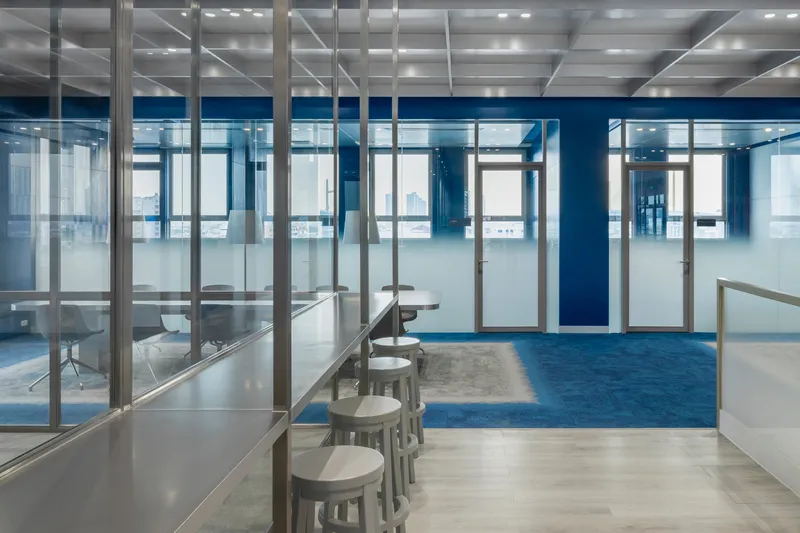
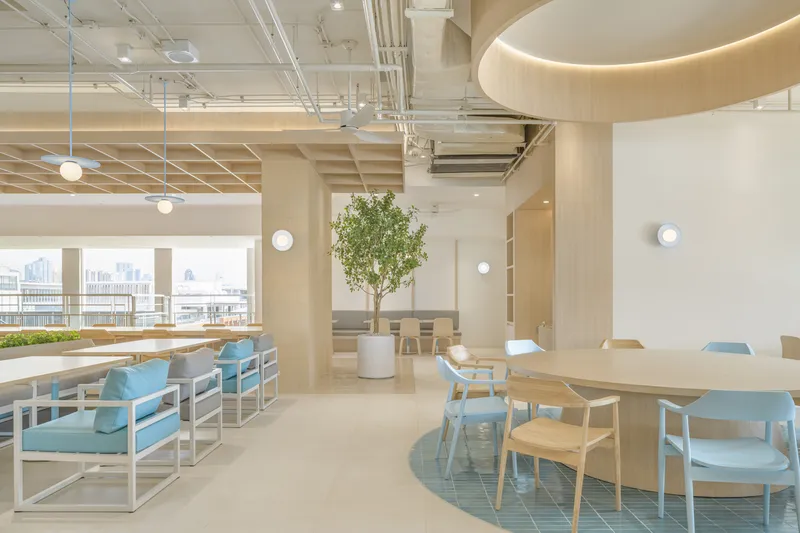
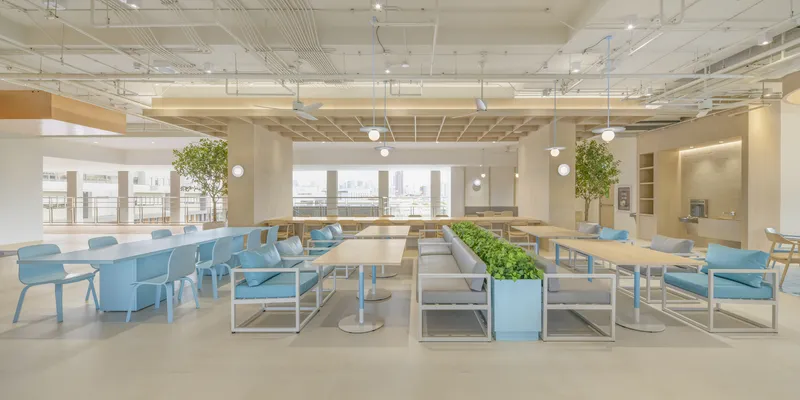
The Sixth Form Centre spreads across two floors and packs in an almost domestic range of programs: lockers, living areas, study zones, playrooms, teacher consultation rooms, and vending machines for snacks and water. It reads less like a school facility and more like a coworking lounge calibrated for teenagers. Blue upholstered seating, light wood tables, potted trees used as room dividers, and floor-to-ceiling windows that pull in views of the city all contribute to an atmosphere that respects students as semi-autonomous adults.
The playrooms deserve specific attention. Enclosed in transparent glass, they maintain acoustic separation without visual isolation. You can see who is inside, what they are doing, and whether a room is free, all without opening a door. The blue metal laminate panels on surrounding walls carry the same grid pattern found in the ceilings elsewhere, a detail that ties the building together at the scale of surface texture.
The Library: 864 Square Meters of Copper and Brick
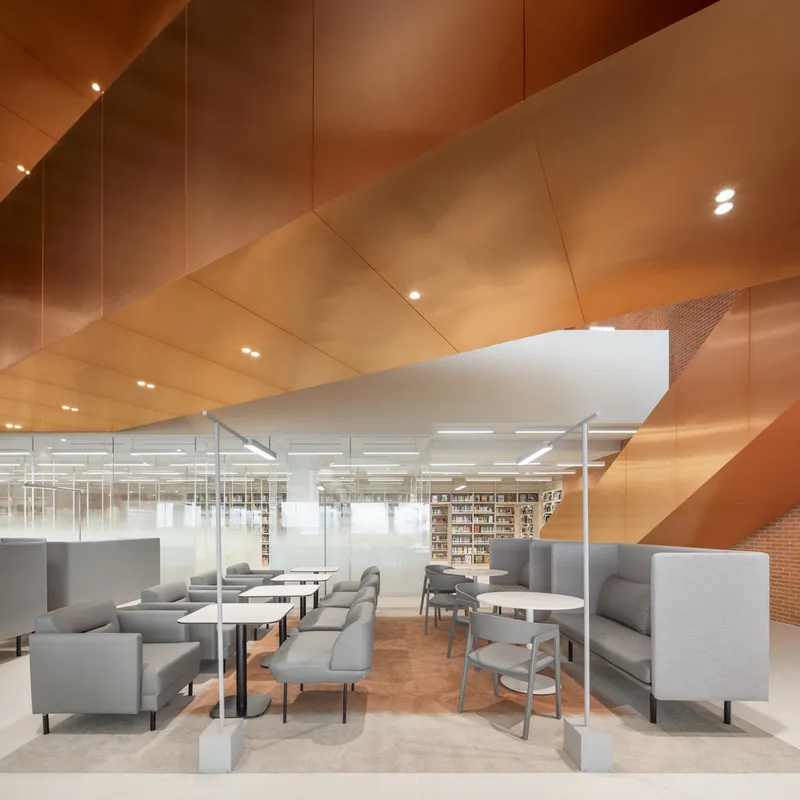
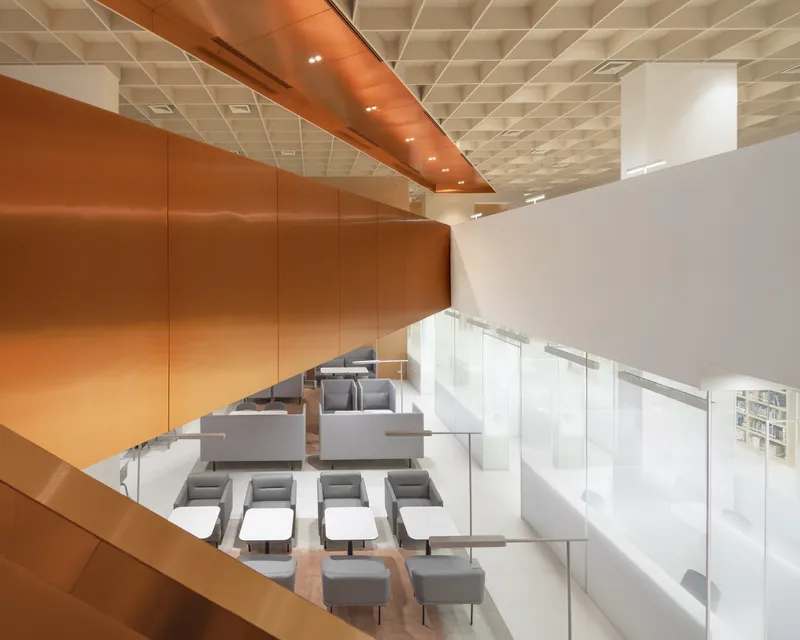
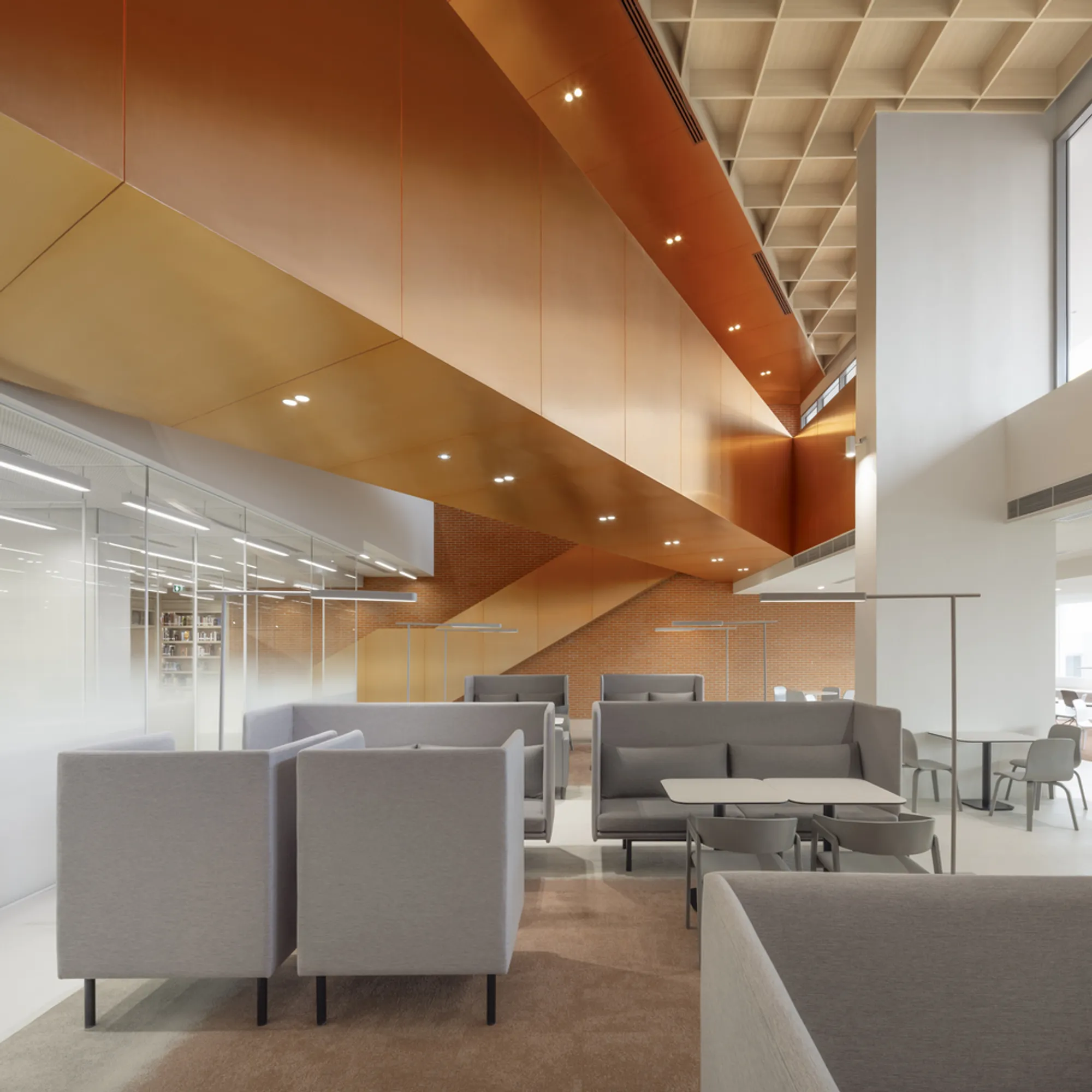
At 864 square meters, the two-story library is the building's intellectual anchor. A copper-laminated staircase and bridge cut diagonally across the double-height reading space, connecting the floors in a single dramatic gesture. The copper surface is shiny and reflective, catching light and movement in ways that make the bridge feel alive even when empty. It hovers above a reading lounge furnished with low seating, creating a layered section where quiet individual work happens below and collaborative spaces occupy the upper level.
Orange brick from the exterior is pulled inward, meeting the copper in a warm, tactile palette that contrasts sharply with the cooler blues of the refectory and lounge. Bookshelves hold up to 11,200 volumes. Five enclosed study rooms serve group discussions. The 175 seats mix tables, chairs, and sofas, and the reading desks along glazed walls feature a gradient privacy film that fades from opaque at the bottom to transparent at the top. The effect is clever: from outside, you see only silhouettes of readers, preserving focus while maintaining the building's commitment to visual openness.
The Grid: Graph Paper as Architectural Language
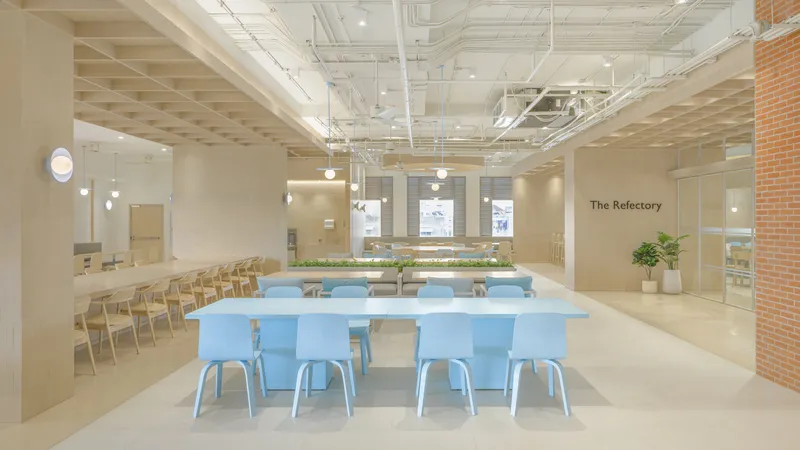

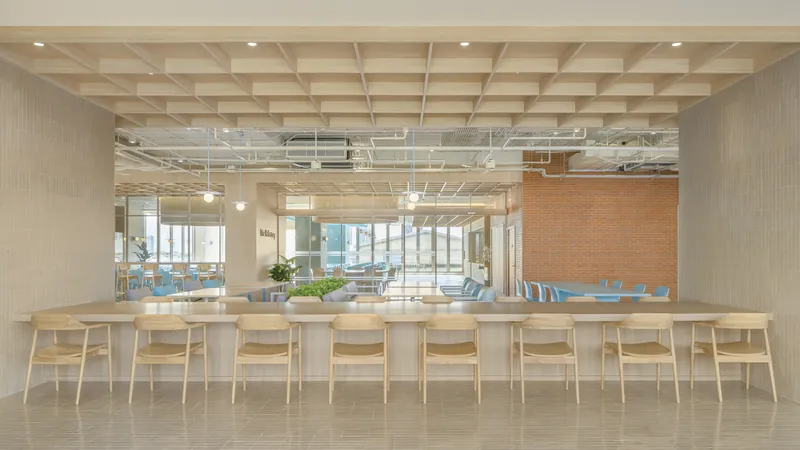
One of the most consistent details across the building is the exposed gridded structure that covers walls and ceilings. Onion scaled it to resemble a page from a student's graph paper notebook, a reference that could easily tip into kitsch but here stays on the right side of the line. The grid works because it does real architectural work. It organizes lighting, conceals mechanical systems, and provides a visual datum that unifies spaces with very different material characters. Under the blue panels of the refectory, above the communal work tables with their exposed conduit and brick walls, and across the copper-clad library ceiling, the grid quietly repeats.
It also solves a practical problem. In a building where color and material replace partitions as spatial dividers, you need something to hold the whole composition together. The grid is that something. It is the connective tissue between blue and orange, copper and brick, air-conditioned and naturally ventilated. Without it, the building might feel like a collection of themed rooms. With it, the building reads as one continuous environment with deliberate atmospheric shifts.
Why This Project Matters
School architecture too often defaults to a utilitarian logic where each room serves exactly one function and shuts down the moment that function is complete. Onion's building at King's College Bangkok rejects that model entirely. By designing the refectory for all-day occupation, making the staircase a gathering spot, and wrapping the library in materials warm enough to linger in, the firm has produced a building where the boundary between learning and living is deliberately blurred. For senior students on the cusp of university life, that blurring is not just a design gesture. It is a rehearsal for the kind of self-directed environments they are about to enter.
The deeper lesson here is about how materials can do the work of walls. Onion's strategy of dividing space through color, texture, and ceiling treatment rather than partitions keeps the building legible, flexible, and socially alive. It is a model worth studying for any architect designing educational environments, particularly in dense urban contexts like Bangkok where interior square meters are expensive and every room needs to earn its keep across the full length of the day.
Refectory, Lounge, and Library at King's College International School Bangkok by Onion. Located in Bangkok, Thailand. Photography by W Workspace.
About the Studio
Share Your Own Work on uni.xyz
If projects like this are the kind of work you want to make, uni.xyz is a place to publish your own, find collaborators, and enter design competitions.




Popular Articles
Popular articles from the community


Conexión: Biophilic Design Reimagines High-Rise Living in Hong Kong
Conexión reimagines high-rise living in Hong Kong through biophilic design, green facades, shared spaces, daylight, water and nature within.

Riyadh For All: Intergenerational Urban Design for Active Aging in Rabat
Riyadh For All reimagines urban design in Rabat with intergenerational co-living, adaptive courtyards, and Moroccan cultural exchange today.

The Musturak Paradise: Senior Living Architecture for a Connected Future in Temara, Morocco
The Musturak Paradise reimagines senior living architecture in Temara via private homes, social spaces, culture, community, and shared care.

Co-Life: Senior Housing Design That Reconnects Older Adults With the City
Co-Life reimagines senior housing design through healing gardens, shared streets, workshops, and a sustainable community across generations.

Similar Reads
You might also enjoy these articles


Hodi-Mandai Geram
Project Function: Preservation and revitalization of the Intangible heritage and socio-spatial identity of the Hodi by Housing, Cultural Memory Center, Sacred Grove, landscape, local tourism economy


Olio Towers: A Mid-Rise for Performers That Fuses Housing, Rehearsal, and Stage
Located blocks from Houston's Theater District, this modular tower stacks living units around a central performance atrium.

Oasis: Modular Green Housing Carved into Dhaka's Urban Fabric
A shortlisted Plugin Housing entry reclaims unauthorized settlements in Dhaka with stepped concrete volumes, green roofs, and ventilation-driven design.

Black Hole: A Floating Megastructure for the Post-Physical Era
Emiliano Mazzarotto envisions a spherical, self-scaling arena where e-sports, digital hotels, and holographic stadiums replace traditional public space.


Explore Educational Building Competitions
Discover active competitions in this discipline



Challenge to design public laboratory


Challenge to reimagine the Iron Throne


Photograph architecture without architects


Illustrate the lost glory of Angkor Wat - Render Challenge
Comments (0)
Please login or sign up to add comments
No comments yet. Be the first to comment!