

Re.greeneration: Turning Aleppo's Explosion Craters into Biotopes, Gardens and Places of Healing
A shortlisted Memory entry that treats Aleppo's demolished buildings as part of an evolving ecosystem, turning craters into biotopes and gardens.


What does a city do with a crater? Most reconstruction plans treat war damage as something to erase: clear the rubble, level the ground, rebuild as quickly as possible. Re.greeneration argues otherwise. It reads Aleppo's demolished buildings not as ruins but as parts of an evolving ecosystem, and it proposes that the scars of destruction can become the city's most fertile ground. Explosion craters become biotopes, and broken plots become fruit gardens, crop fields and greenhouses. Memory is not paved over. It is planted.
The project was developed by Claudia de Sas Trujillo and Juanita Leal Ochoa and was shortlisted in the Memory competition on uni.xyz. Its site is Aleppo, a city whose layered heritage has been badly damaged by conflict. The designers frame their response around five pillars: community engagement, ecological restoration, cultural revival, green integration, and empathy and healing. Together they describe a reconstruction strategy that is as much social and emotional as it is spatial.
Reading the Ruin as an Ecosystem
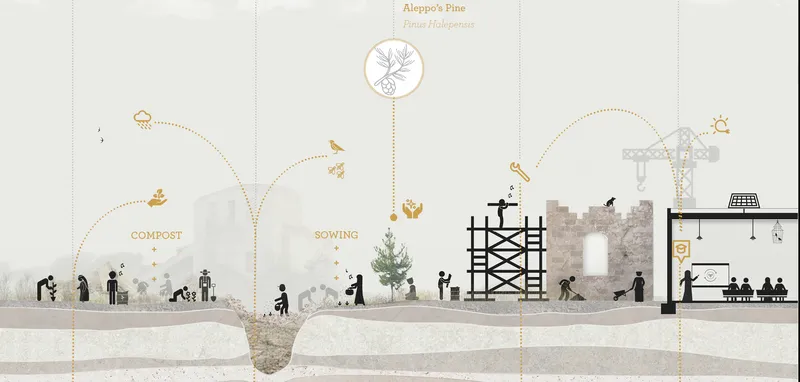
The conceptual move at the heart of the proposal is a change of category. A demolished building is usually counted as a loss to be cleared away. Here it becomes a starting condition: a remnant that can host growth, healing and reconnection. The shift matters because it keeps the physical evidence of what happened inside the city's fabric instead of removing it. The designers' stated aim is to preserve Aleppo's history and celebrate it, and their way of doing so is to let new life take hold in the same places the old life was interrupted.
That decision also answers the competition's theme directly. Memory here is not held in a plaque or a sealed monument. It sits in the ground itself, in landscapes that will keep changing as plants mature and residents return. The past stays legible because the future is literally growing out of it.
From Craters to Biotopes, Gardens and Greenhouses
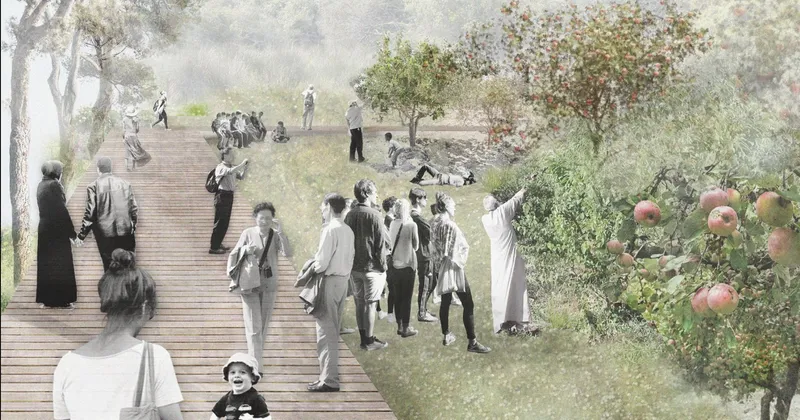
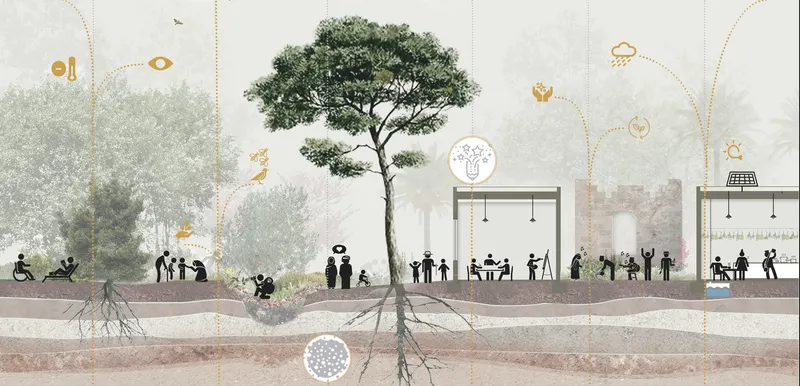
The ecological programme gives the concept its working parts. Former explosion craters are turned into biotopes intended to foster biodiversity and restore natural cycles, and the voids left by blasts become habitats. Around them, the proposal sets out fruit gardens, crop gardens and greenhouses meant to bring greenery back into the city and to support a degree of self-sufficiency. In a city where supply chains and livelihoods have been disrupted, growing food close to home is a practical tool for recovery as well as an aesthetic choice.
The Aleppo's Pine Initiative adds a symbolic layer. By planting native pines, the designers tie landscape restoration to the city's own name and identity, making each tree a small marker of resilience. Construction follows the same logic: solar energy, rainwater harvesting and vernacular materials keep the new interventions grounded in local climate and building tradition rather than imported formulas.
Gardens as Social Infrastructure
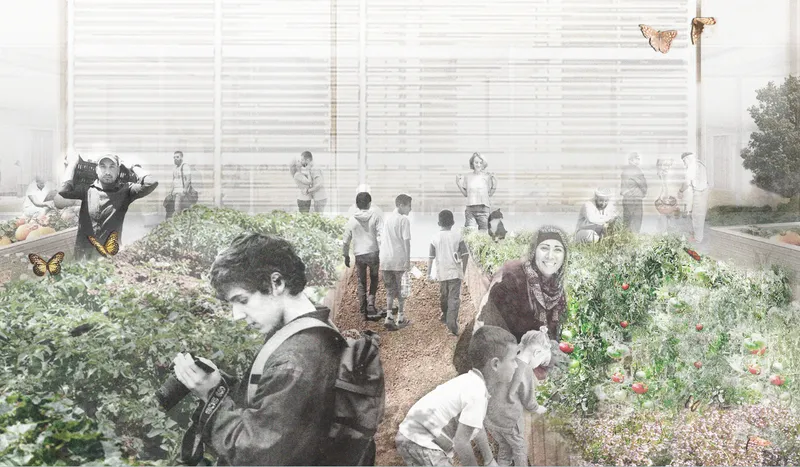
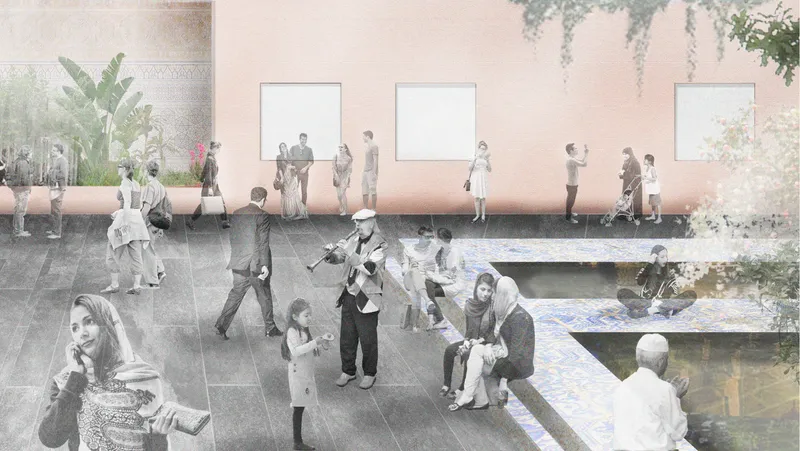
The strongest idea in Re.greeneration is that its gardens are not only landscapes. The fruit and crop gardens are designed as social hubs where residents can meet, learn sustainable practices and share experiences. Collaborative workshops and activities invite citizens to take part in rebuilding their own neighbourhoods, which turns reconstruction from something done to a community into something done by it. Alongside these productive spaces, the proposal sets aside areas for communal healing, self-discovery and emotional growth, and places for cultural exchange and artistic expression that reflect Aleppo's heritage.
This pairing of cultivation and care is well judged. Tending a garden is slow, repetitive and shared work, exactly the kind of rhythm that can help a traumatised community rebuild trust. The landscape becomes a place where grief and recovery can happen side by side without forcing a single, official narrative onto what the city has lived through.
Why This Project Matters
Post-conflict reconstruction often swings between two extremes: nostalgic replication of what was lost, or tabula rasa redevelopment that erases it. Re.greeneration offers a third path. By treating destruction as part of an ongoing ecological and social process, it lets the city remember without freezing it, and rebuild without forgetting. The craters stay, but they now hold water, plants and people.
The proposal leaves open questions of scale, phasing and governance that a built version would need to resolve. Its value lies in the framework it sets out: heritage conservation, ecological restoration and community healing treated as one design problem rather than three separate briefs. That framework reaches beyond Aleppo, to any city looking for ways to let its wounds become places of growth.
View the Full Project
About the Designers
Designers: Claudia de Sas Trujillo, Juanita Leal Ochoa
Enter a Design Competition on uni.xyz
uni.xyz runs architecture and design competitions year-round that reward proposals with spatial conviction and real site intelligence.
Project credits: Re.greeneration by Claudia de Sas Trujillo, Juanita Leal Ochoa Memory (uni.xyz).


Popular Articles
Popular articles from the community


Juan García Correa, John González and Claudia Rueda Sink a Circular Amphitheater into a Manizales Engineering Building
On the La Nubia campus in Manizales, Colombia, the S1 Building folds labs and offices into a hillside of ramped lawns that double as a campus route.

Cube Design Draws an Ecological Corridor Between Two Shenzhen Hills with the Nankai Building
Beside Shenzhen's container docks, the Nankai Building pairs stacked balconies with a climbing green screen to connect two hillsides across its height.

U.GA Architects Wraps an Oval Rooftop Pool in Curved Board-Formed Concrete on Busan's Jeollidan-gil
In Busan's Jeonpo-dong, a 454 m² mixed-use block stacks a neighborhood facility, guest rooms and an oval rooftop pool inside spiraling concrete walls.

David Macias Steps a Doorless Stone and Plaster House Down a Tropical Colombian Hillside
In the humid hills of Colombia, Threshold House replaces the front door with an open void and terraces its 850 m² down the slope instead of fighting it.

Similar Reads
You might also enjoy these articles


Hodi-Mandai Geram
Project Function: Preservation and revitalization of the Intangible heritage and socio-spatial identity of the Hodi by Housing, Cultural Memory Center, Sacred Grove, landscape, local tourism economy


Olio Towers: A Mid-Rise for Performers That Fuses Housing, Rehearsal, and Stage
Located blocks from Houston's Theater District, this modular tower stacks living units around a central performance atrium.

Oasis: Modular Green Housing Carved into Dhaka's Urban Fabric
A shortlisted Plugin Housing entry reclaims unauthorized settlements in Dhaka with stepped concrete volumes, green roofs, and ventilation-driven design.

Black Hole: A Floating Megastructure for the Post-Physical Era
Emiliano Mazzarotto envisions a spherical, self-scaling arena where e-sports, digital hotels, and holographic stadiums replace traditional public space.

Comments (0)
Please login or sign up to add comments
No comments yet. Be the first to comment!