
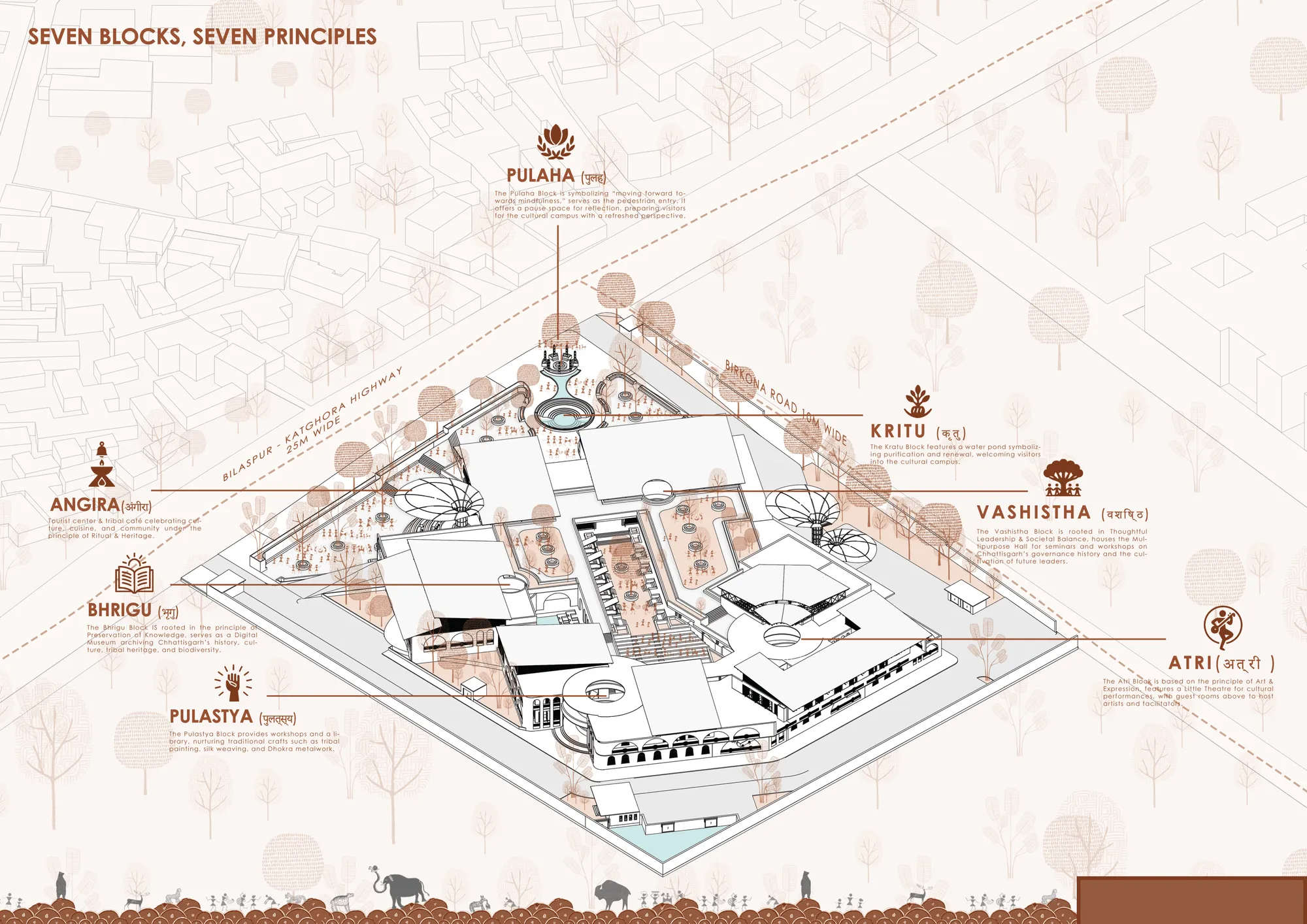
Reinforcing the Identity of Chhattisgarh
Architecture is not just about buildings; it is also about people, memories, and the identity of a place.

This project focuses on Chhattisgarh, a state formed in 2000, which today faces a challenge of identity. On one hand, it is known across India as a land rich in coal, steel, and minerals. On the other hand, it has a much older legacy of history, culture, traditions, and spiritual depth that often goes unnoticed. Over time, the image of Chhattisgarh has become more industrial than cultural, creating a gap between how the state is seen and what it truly represents.
The Concern:

Chhattisgarh was created to make administration easier and to preserve its unique cultural roots. But in the last two decades, the state’s cultural and historical richness has been overshadowed by industries and mining activities. Added to this, issues like Naxalite conflict have shaped how outsiders perceive the region, often in negative ways.
This has led to a situation where the people of Chhattisgarh themselves do not always feel connected to their deep cultural legacy. Many of the stories, traditions, and art forms remain hidden, with very few spaces to showcase or celebrate them. As a result, the state is seen mostly as a resource-based economy rather than as a culturally rich region.
Chhattisgarh’s heritage goes back to ancient times, when it was known as Dakshin Kaushalya. It is closely linked to the Ramayana and Mahabharata, with references to sages, sacred rivers, and historic sites. The city of Bilaspur, today the judicial capital, is surrounded by places of cultural and historical importance. Yet its potential to become a cultural hub has never been fully explored.This project aims to change that by using Bilaspur as the focal point for reviving and promoting Chhattisgarh’s cultural identity.A political state must establish and reinforce its identity to reflect its unique culture, history, and values. This identity not only distinguishes the state nationally and globally but also preserves its heritage for future generations.
In a diverse country like India, where each state adds to a mosaic of traditions, languages, and lifestyles, protecting and promoting identity becomes especially important. Without deliberate efforts, these elements risk being diluted in the face of globalization.
Reinforcing cultural identity also fosters pride and connection among citizens, particularly the youth, who become active custodians of their heritage. A strong identity brings economic benefits as well, by showcasing festivals, cuisine, art, and heritage. It can strengthen tourism, attract investment, and support local industries. Ultimately, a well defined identity provides both cultural continuity and economic growth, making the region more appealing for engagement and collaboration.
Architectural Intent:

The proposed design creates spaces where history and culture can be experienced, not just displayed. The goal is to make architecture a living medium through which people connect with their heritage. The project works on three main ideas:
Preserve - Protect traditions, art forms, and historic knowledge by weaving them into built spaces.
Celebrate - Provide places for festivals, performances, exhibitions, and craft markets where culture is shared openly.
Reframe Identity - Shift the perception of Chhattisgarh from being only an industrial state to being equally recognized for its heritage and culture.
The design includes open cultural plazas, performance spaces, galleries, and learning areas that invite participation from both locals and visitors. These are not imagined as static monuments, but as dynamic, everyday spaces where cultural life continues to grow.
Design Concept:
Chhattisgarh is home to a wide variety of cultures and belief systems that make it very different from other parts of India. Like every Indian state, its identity has been shaped by its climate, geography, lifestyle, and traditions. This unique identity can be understood through four key aspects: History, Culture, Tribal Heritage, and Wildlife.
When we look deeper, we see that while cultures across India are very diverse, they are also connected by common values and shared beliefs. This raises an important question: How do such different cultures across India still share a sense of unity?
The answer lies in traditions at the grassroots level. Across regions, we find repeating patterns of values and moral principles passed down through generations. These values trace back to the ancient concept of the Saptarishi - the Seven Sages of India. They are seen as carriers of wisdom and guidance for society. Their teachings created the foundation of many Indian traditions and still influence cultural unity today, including in Chhattisgarh.
So, while local traditions may differ, the Saptarishi principles act as a common thread that ties them together.
The Saptarishi Concept:
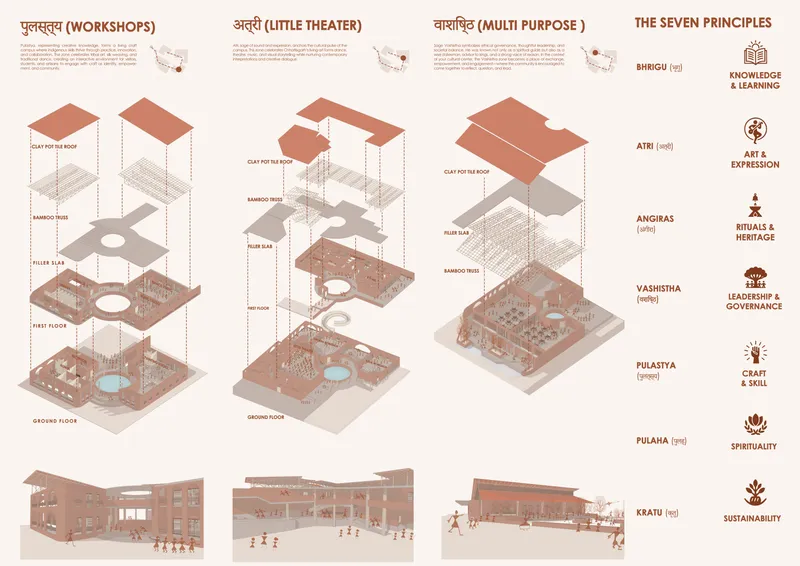
The Saptarishi are the seven revered sages of ancient India, seen as pillars of civilization. Each sage represents an essential principle of life such as knowledge, expression, spirituality, leadership, and sustainability. These timeless values have shaped India’s moral and cultural fabric for centuries.

In architecture, they can be imagined as anchors, symbolic guides that influence how we design spaces and define collective identity.
This thesis is built on that idea: that India’s cultural diversity is deeply connected through these shared values. Using Chhattisgarh as the focus, the project explores how architecture can reflect these principles while also celebrating the region’s unique identity.
The larger vision is to create a universal architectural framework, one that adapts to different regions across India but always stays rooted in the wisdom of the Saptarishi.
A Universal System of Design:
The Saptarishi framework is not just an inspiration, it works as a design system, a philosophical toolkit rather than a style. The seven guiding principles stay constant everywhere, but the way they are expressed changes depending on climate, culture, geography, and traditions of each region.
Think of the Saptarishi principles as a constant light. The regional context like Chhattisgarh acts as a lens through which this light passes. As it filters through, the light takes on different colors and forms, creating context-specific architectural expressions. The values remain universal, but their manifestation adapts to each place.
This flexibility is the strength of the system. It provides a strong conceptual base while allowing architecture to grow naturally from local culture and environment.
In this thesis, Chhattisgarh is the main focus, but the framework can easily extend to other regions of India, helping them preserve their identity while staying rooted in timeless wisdom.
Architectural Language:
The architectural language of the project is a careful synthesis of Chhattisgarh’s traditional practices, materials, and craft techniques, creating a built environment that resonates deeply with the local culture. One of the most symbolic elements incorporated is the practice of smearing cow dung on floors, a method traditionally used in Chhattisgarhi homes not only for hygiene and insulation but also as a ritual act that signifies purity and connection with nature. Similarly, the clay pot tile roofing system draws directly from the vernacular architecture of the region, responding effectively to the local climate while providing a visual identity that is immediately recognizable to the local community. Structural elements, such as bamboo trusses, reflect indigenous construction methods that are lightweight, sustainable, and well understood by local craftsmen, enabling active participation in the construction process and fostering a sense of familiarity and trust in the architecture.

The design also celebrates Chhattisgarh’s tribal artistic heritage in its detailed features. Railings, windows, and screens are adorned with tribal motifs, while walls and surfaces feature traditional tribal paintings that narrate local stories and cultural symbolism. Sculptural elements inspired by regional iconography are integrated into both interior and exterior spaces, providing a tangible link to ancestral knowledge and craft traditions. Even the spatial organization—such as courtyards, verandahs, and open gathering areas is drawn from local customs, reflecting the rhythm of social life, festivals, and communal rituals.
By thoughtfully weaving these elements together, the design transforms everyday spaces into living expressions of culture, where visitors can not only see but also experience the traditions of Chhattisgarh. Each material, technique, and craft detail serves as a bridge between the past and the present, ensuring that the architecture is not merely functional but also culturally meaningful. This integration of local practices and craftsmanship fosters a profound sense of belonging, connecting people to their heritage, reinforcing cultural pride, and making the architecture feel like an organic extension of the community itself.


Popular Articles
Popular articles from the community


Conexión: Biophilic Design Reimagines High-Rise Living in Hong Kong
Conexión reimagines high-rise living in Hong Kong through biophilic design, green facades, shared spaces, daylight, water and nature within.

Co-life: Sustainable Architecture for Age-Friendly Community Living
Co-life reimagines sustainable architecture for seniors through courtyards, rammed earth, shared gardens, and spaces designed for belonging.

Riyadh For All: Intergenerational Urban Design for Active Aging in Rabat
Riyadh For All reimagines urban design in Rabat with intergenerational co-living, adaptive courtyards, and Moroccan cultural exchange today.

Hill & Cross Opera: Sculptural Opera House Architecture Shaped by Tallinn’s Landscape and Identity
Hill & Cross Opera reimagines opera house architecture in Tallinn through its sculptural hill, civic plaza, glass wave and a luminous cross.


Similar Reads
You might also enjoy these articles

The Rhythm of Seasons
A Farmers' Market Connecting Nature and the City

More Than a Building-Designing a Living System
More Than a Building-Designing a Living System
Base Beyond
DESERT COMPOUND ARID: TOURISM OF ABSENCE AND ABUNDANCE






Comments (0)
Please login or sign up to add comments
No comments yet. Be the first to comment!