
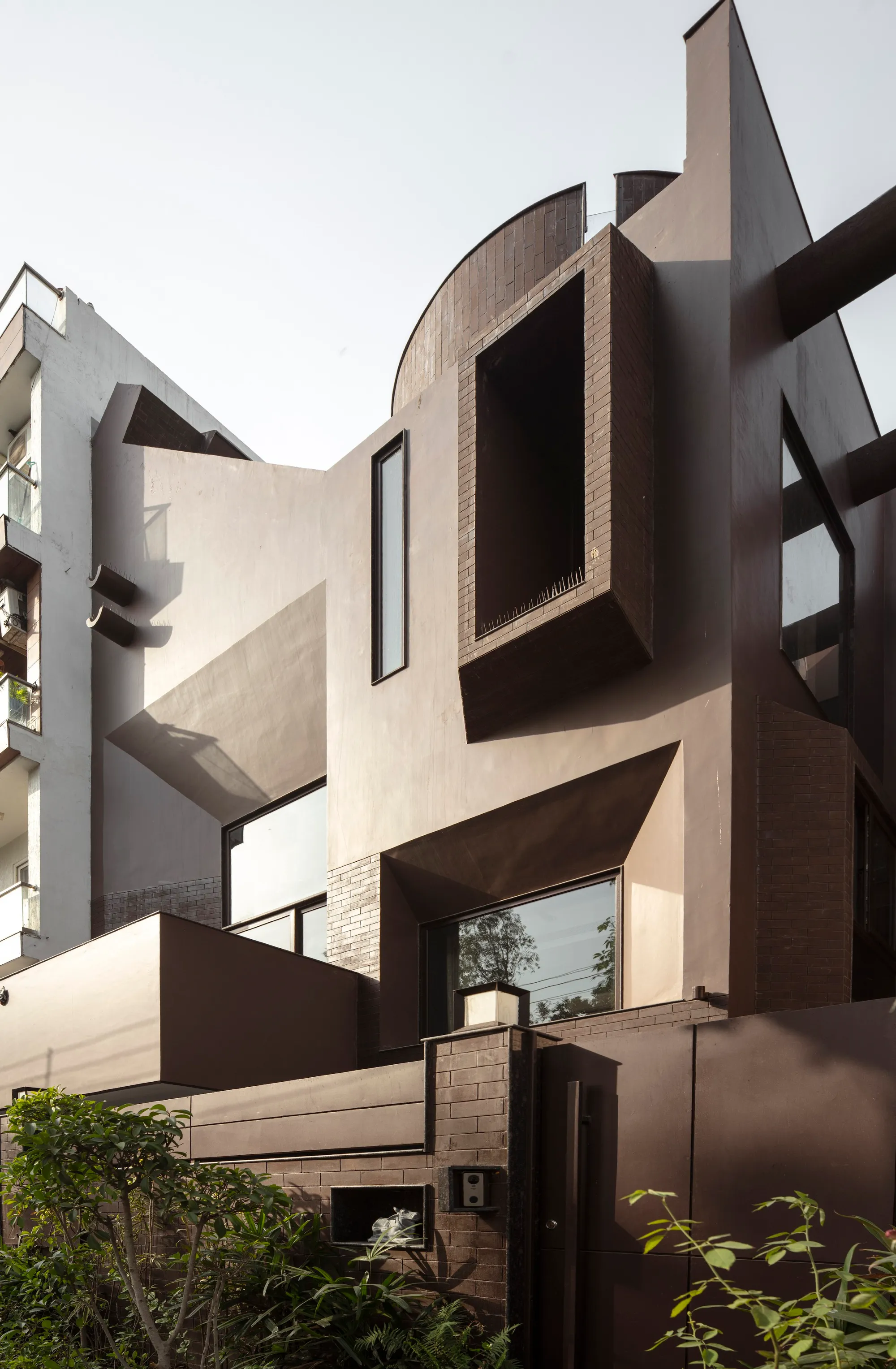
RENESA Channels Corbusian Brutalism into a Four-Story New Delhi Home Clad in Burnt Sienna Brick
Casa Brut fuses raw concrete and indigenous brick into a private residence that reinterprets brutalism through an unmistakably Indian lens.


Brutalism in residential architecture has always been a gamble. The movement's monumental scale and unforgiving surfaces tend to feel more at home in civic buildings than in private dwellings, and attempts to domesticate it often end in a kind of aesthetic cosplay: concrete walls and nothing else to say. Casa Brut, designed by RENESA Architecture Design Interiors Studio for a nuclear family in a quiet New Delhi neighborhood, avoids that trap by rooting its Corbusian ambitions in a material palette that is specific to place. Burnt sienna brick, molded granite, terrazzo, and timber do the heavy lifting here, producing a house that reads as brutalist without ever resorting to bare concrete as a default finish.
The four-level house stacks single, double, and triple-height volumes to create a sectional drama that belies a relatively compact urban footprint. Five bedrooms sit alongside a sequence of communal spaces that form the organizational nucleus of the plan. RENESA's strategy is not to shock with rawness but to layer material warmth into a rigorous volumetric framework, letting extruded facade segments and deeply recessed glazing do the expressive work on the street, while the interiors settle into a quieter register of polished floors, linen curtains, and wood furniture.
A Street Presence Built on Restraint
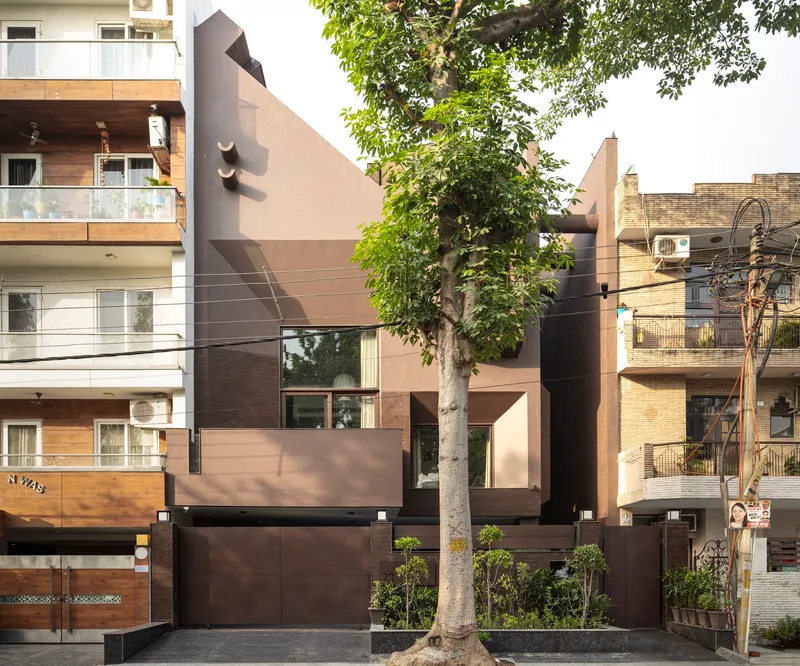
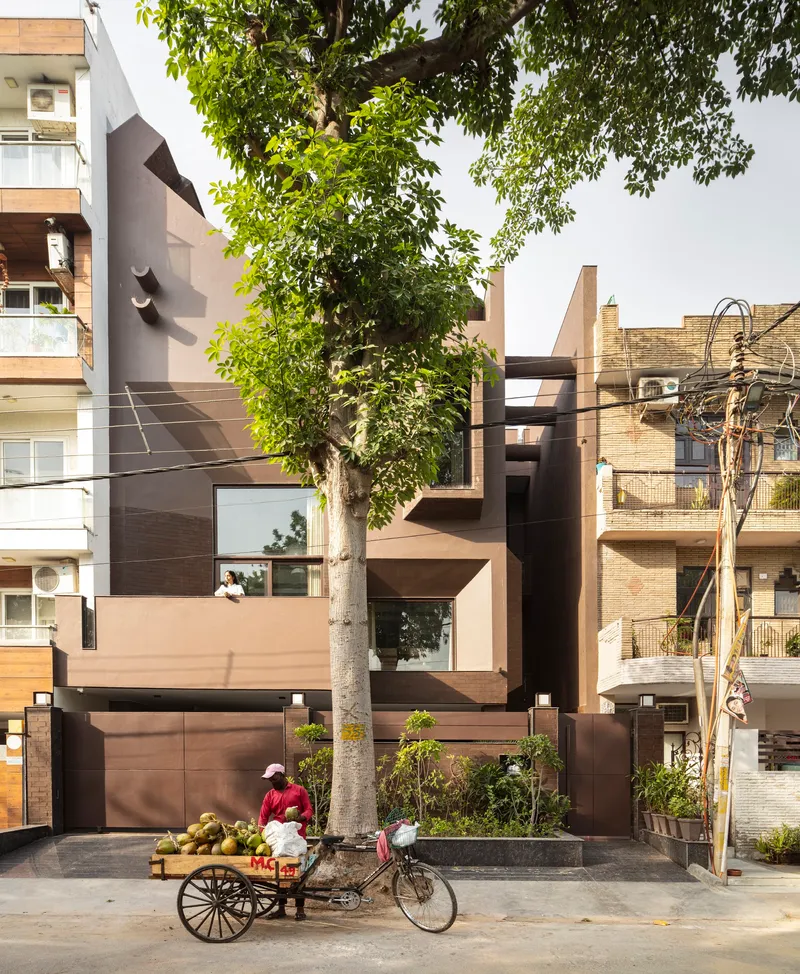
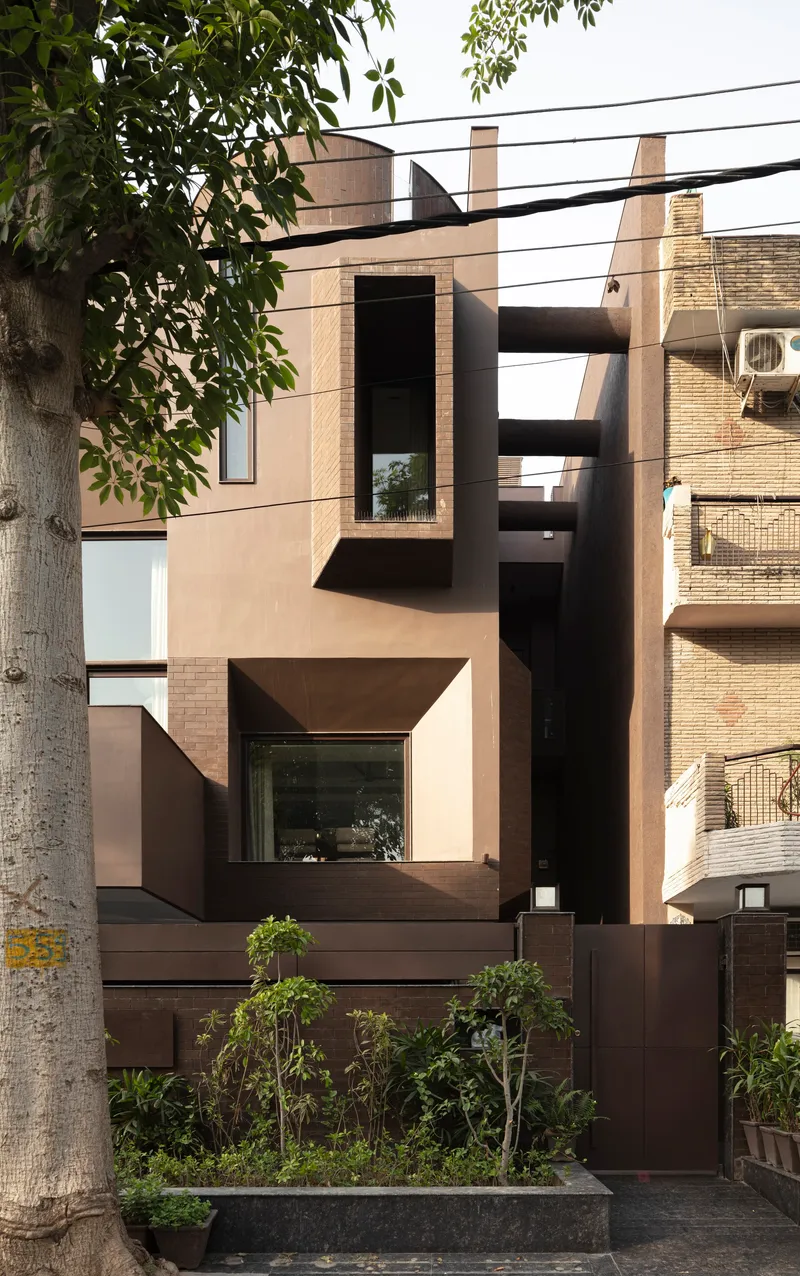
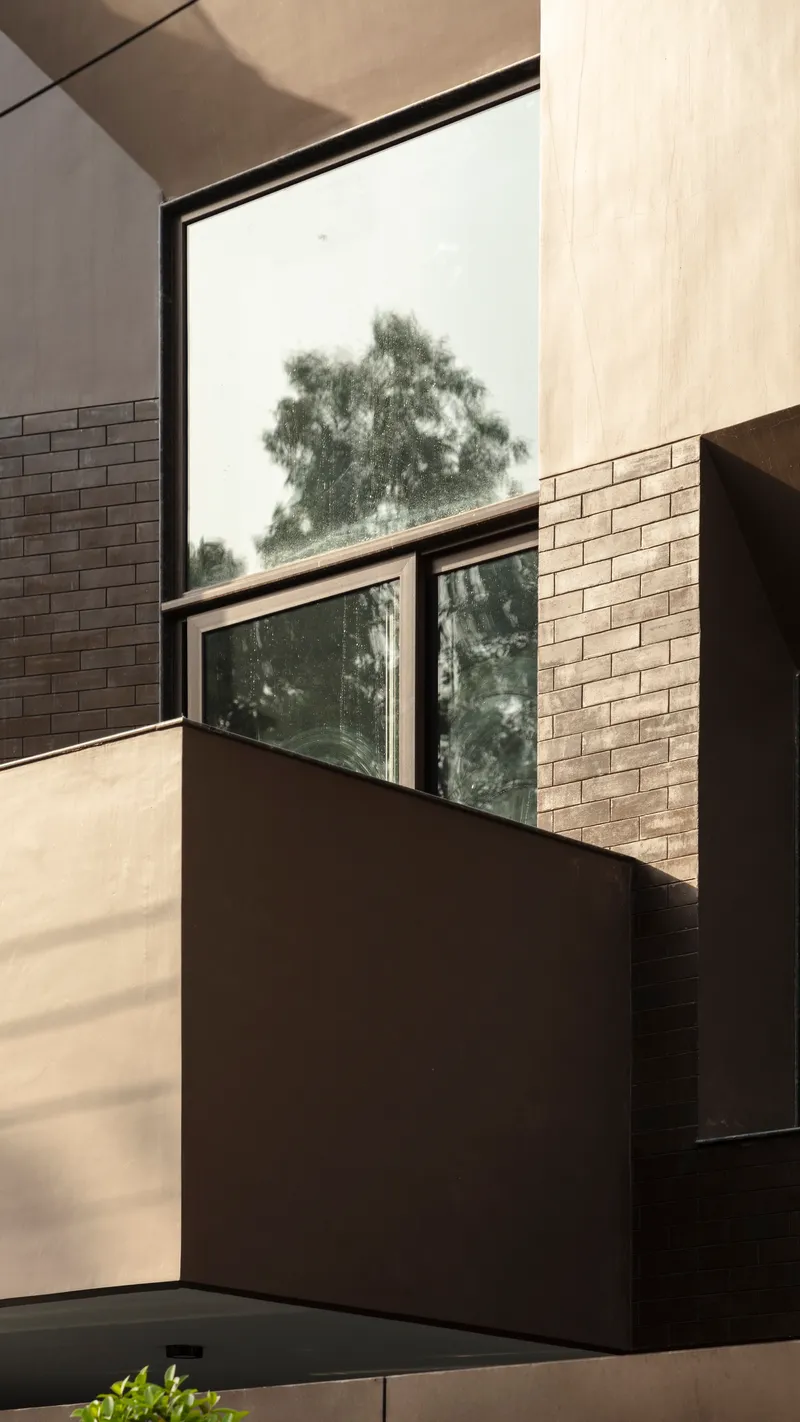
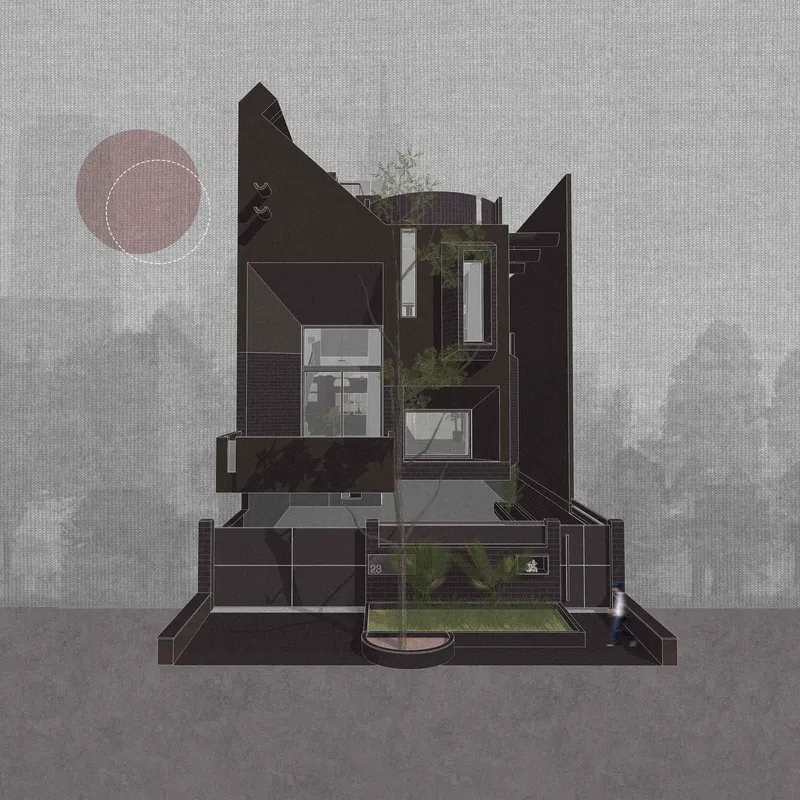
From the street, Casa Brut is an exercise in controlled asymmetry. Layered volumes in plaster and deep brown brick push and pull against each other, creating pockets of shadow that shift throughout the day. Geometric bronze-framed windows punctuate the facade at irregular intervals, giving the composition a syncopated rhythm that rewards a second look. A planted bed and a mature street tree soften the base, anchoring the house to the sidewalk life of its neighborhood rather than walling it off.
The image of a fruit vendor parking his bicycle cart at the entrance gate is telling. This is not a house that retreats behind a blank perimeter wall, the default move for upscale Delhi residences. Instead, it engages the streetscape through its sculptural massing, treating the public face as a composition worth looking at rather than a security barrier.
Angular Volumes and Courtyard Breaks
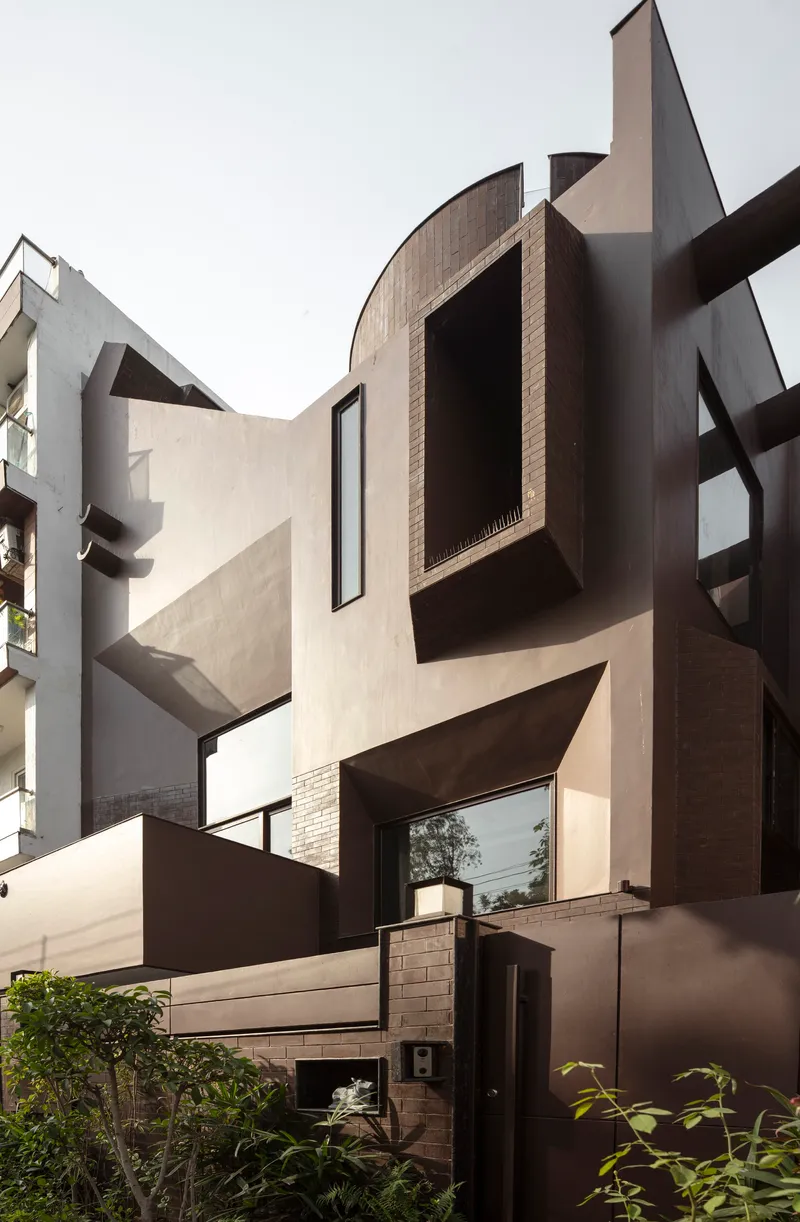

Seen from the courtyard, the house reveals its volumetric logic more fully. Angular facade segments jut outward in staggered planes, and protruding window boxes introduce a third dimension to what could have been flat walls. The interplay between plaster surfaces and brick cladding creates a tonal gradient: warm brown at the base transitioning to lighter tones above, pulling the eye upward through the full height of the building.
These courtyard voids are not decorative. In New Delhi's extreme climate, where summer temperatures routinely exceed 45 degrees Celsius, they function as thermal buffers and light wells. Tactically positioned fenestrations channel cross-ventilation through the interior, reducing reliance on mechanical cooling. Combined with rooftop solar panels, the house operates with a degree of energy self-sufficiency that is rare in Delhi's residential construction.
The Staircase as Spine
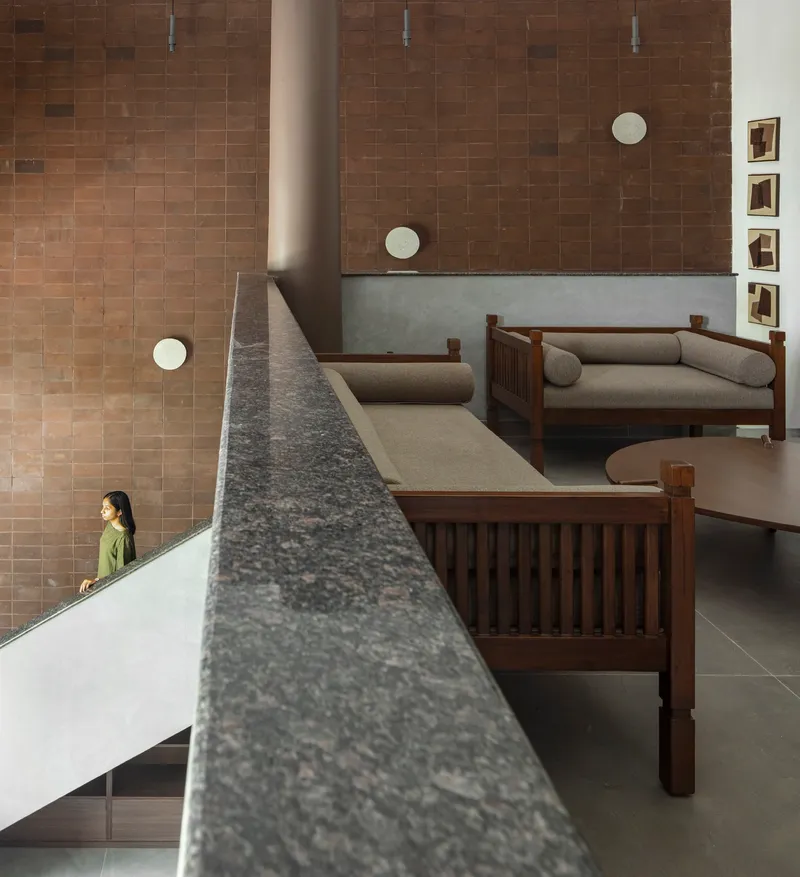
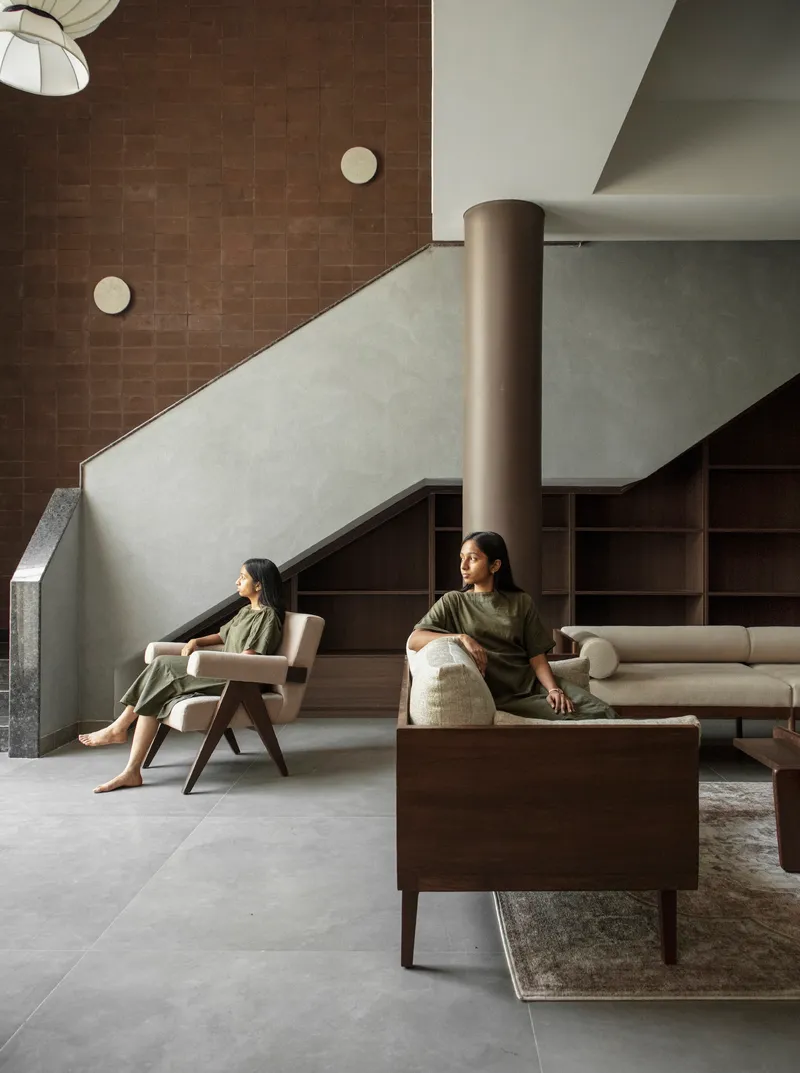
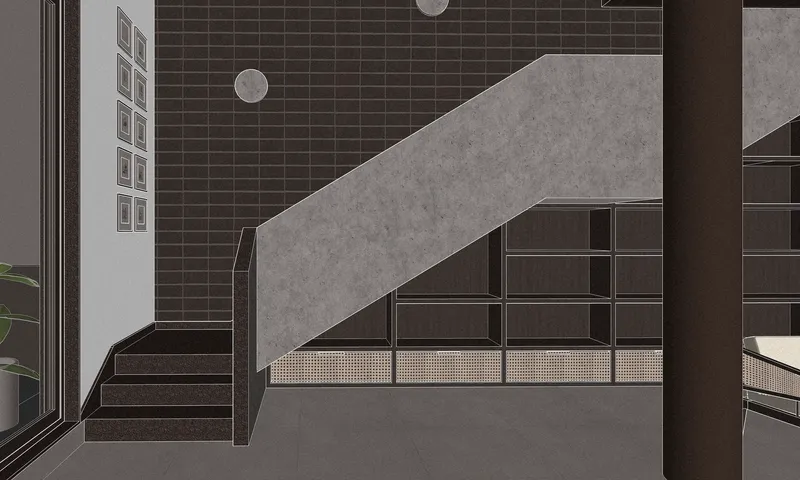
The concrete staircase is the structural and spatial spine of the house, rising through all four levels with a molded granite handrail that gives the fingers something warm to grip in a house otherwise dominated by hard surfaces. The stairwell walls are clad in a grid of deep brown bricks that traverses the full height of the building, establishing a vertical datum line that ties the floors together visually.
RENESA frames views through and around the staircase with care. From the ground floor lounge, you look up past the plaster balustrade to catch a slice of sky through a window at the landing. From within the stairwell itself, a tree visible through a slot window reintroduces the outside world at a moment when you might otherwise feel enclosed. The staircase is not just circulation; it is the connective tissue that makes the sectional ambition legible.
Living Below the Skylight
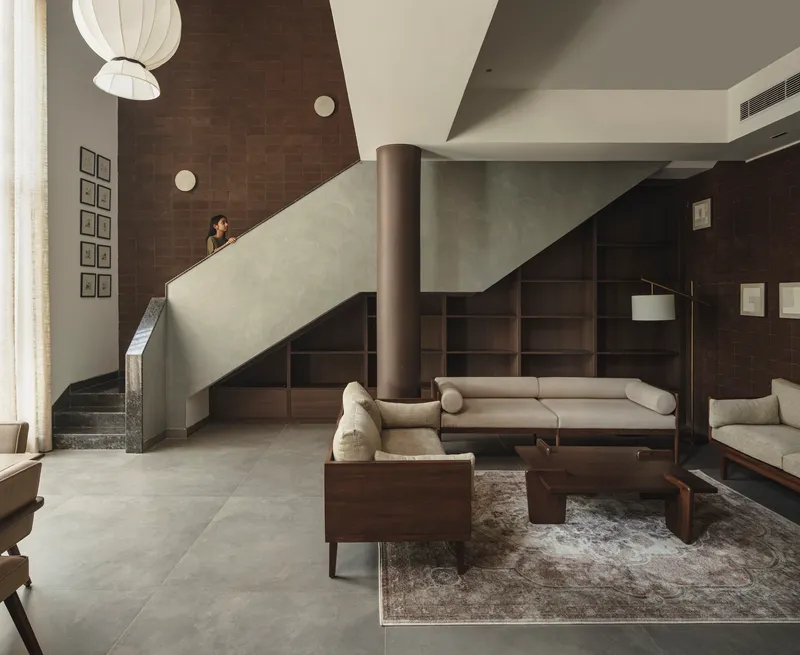

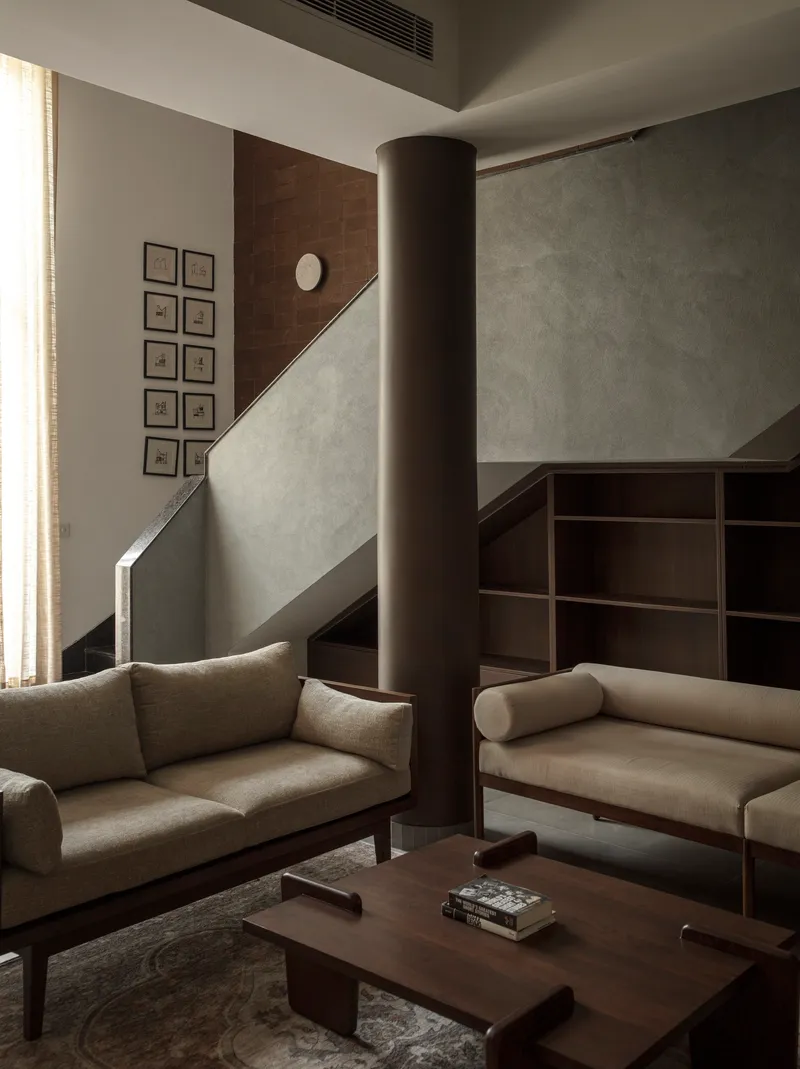
The double-height living room is the communal heart of the house, and it earns its drama through a single bold move: an angled skylight that slices across the ceiling, pouring natural light down onto a cylindrical concrete column and dark wood shelving below. The column recurs throughout the plan, a deliberately raw structural element left exposed as a sculptural object rather than concealed behind drywall.
Framed artworks hung along the brown-tiled staircase wall bring a domestic scale to a volume that might otherwise feel institutional. Timber seating and pendant lights pull the space down to human proportions, while the shelving unit, with its small brass objects and books, personalizes a room that could easily have defaulted to austerity. The balance is precise: monumental enough to feel ambitious, furnished enough to feel lived in.
Material Detail at Close Range


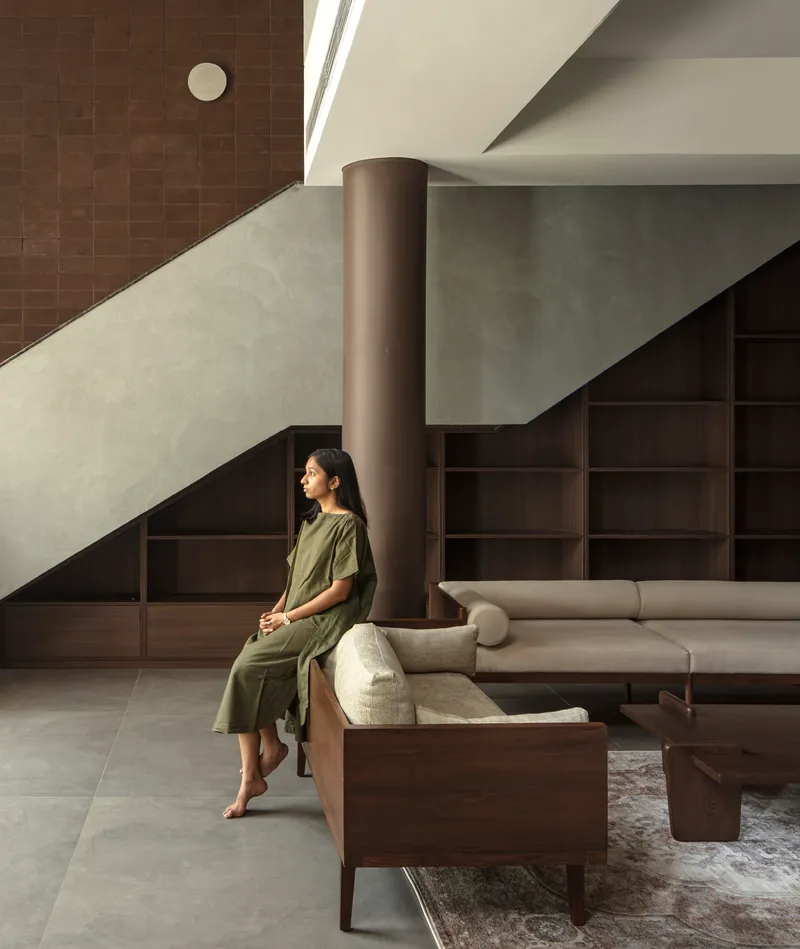
Close-up, the material choices reveal their craft. The cylindrical column meets the polished concrete floor with a clean, unfussy joint. Timber-framed furniture sits against brown tile with a tonal harmony that suggests a carefully controlled palette rather than a grab bag of textures. Circular concrete wall sconces, a small but considered detail, reinforce the brutalist idiom without overwhelming the domestic register.
These are indigenous materials handled with precision. The brick is local, the granite is local, and the terrazzo on the staircase treads references a finishing tradition common across Indian construction. RENESA's contribution is not the invention of a new material language but the curation of an existing one, elevating familiar elements through careful proportion and placement.
Soft Light and Domestic Calm
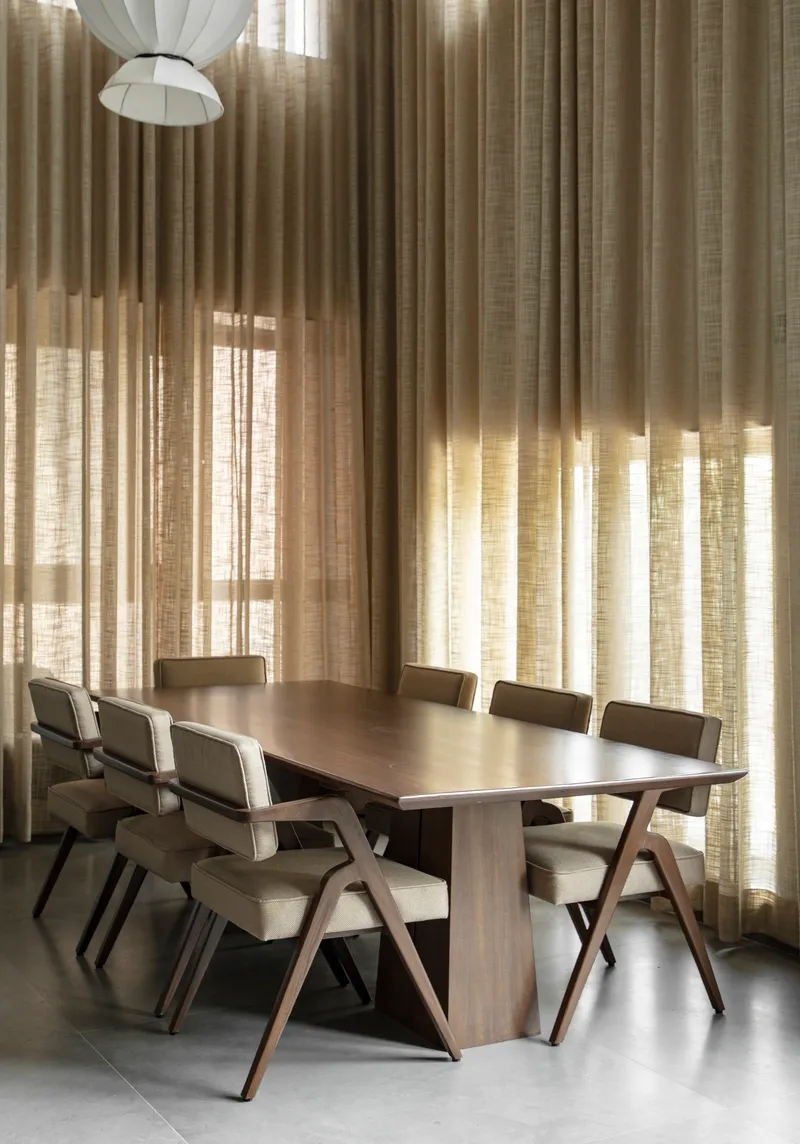
The dining area offers the quietest moment in the house. Layered linen curtains filter daylight into a soft wash that falls across a timber table and chairs, stripping the brutalist intensity back to something almost contemplative. Here, the material palette shifts from exposed brick and concrete to fabric and wood, signaling a transition from public spectacle to private comfort.
It is a necessary counterpoint. A house that maintained the facade's sculptural aggression in every room would be exhausting to live in. RENESA understands that brutalism, when it works domestically, needs moments of release, rooms where the architecture lowers its voice and lets the occupants breathe.
Plans and Drawings
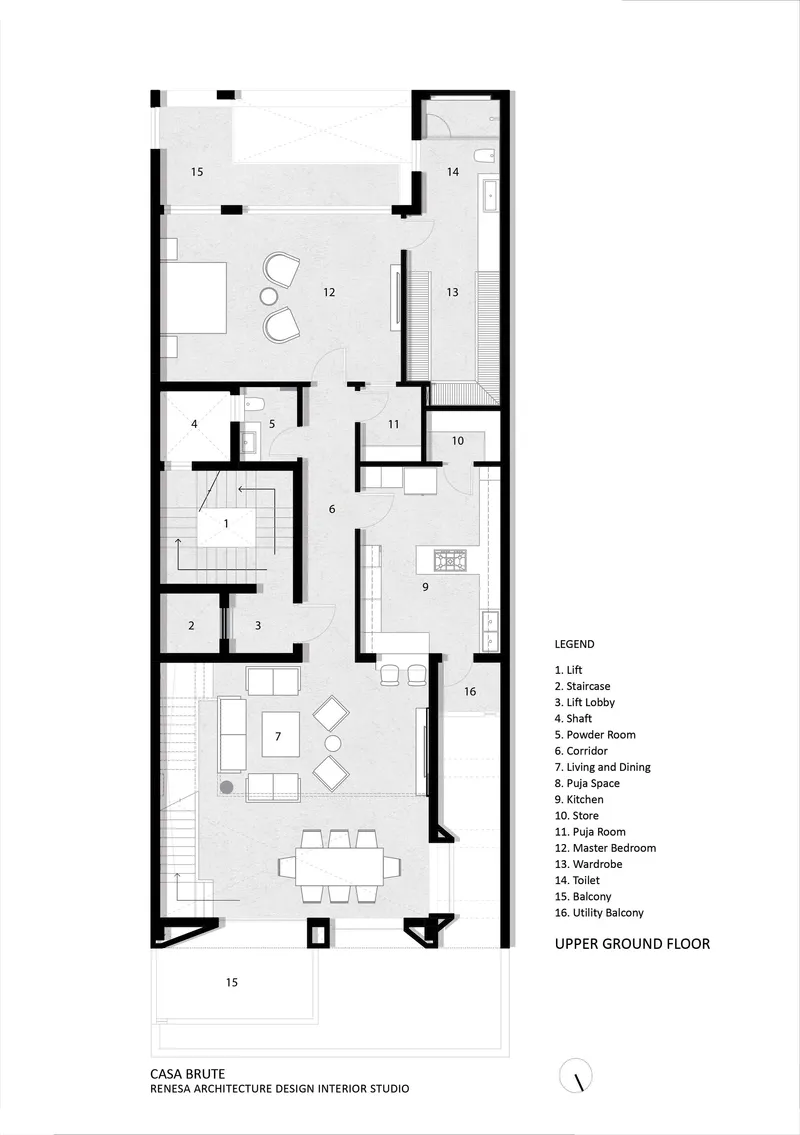
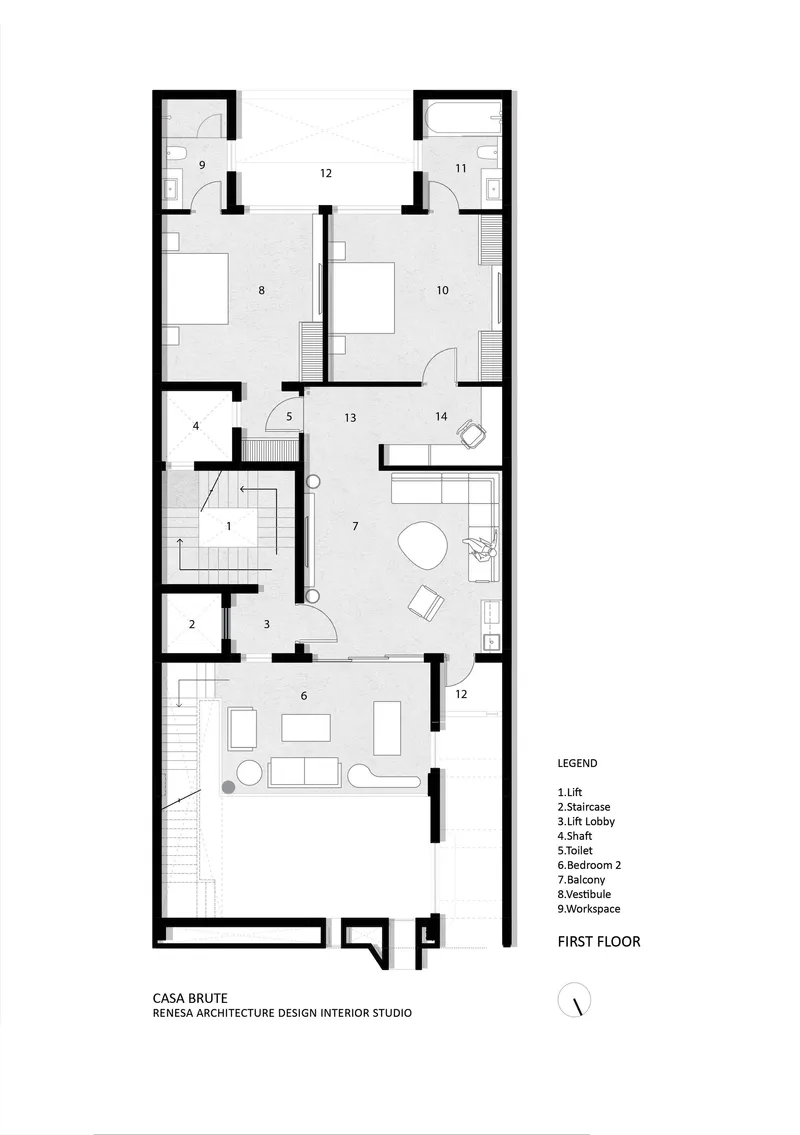

The floor plans confirm what the photographs suggest: communal spaces occupy the center of the plan, with bedrooms pushed to the periphery. On the upper ground floor, the living and dining areas flow around a central corridor, while the kitchen tucks to one side. The first floor dedicates itself to two bedrooms with ensuite bathrooms flanking a central balcony, a simple and effective layout that prioritizes privacy without isolating the rooms from each other.
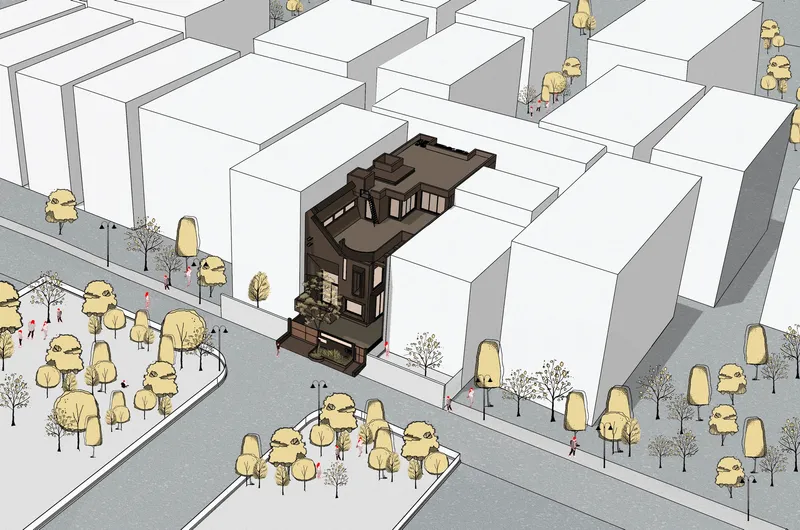
The axonometric drawings are where the project's sectional ambition becomes fully legible. Stacked rooms with dark brick walls and vertical windows read as a series of interlocking boxes, and the perspective section reveals how the concrete staircase threads through the composition, connecting levels that operate at different heights. The axonometric site drawing places the house in its urban context: a dark, sculpted volume inserted among white surrounding blocks, unmistakable in its intent to stand apart.
Why This Project Matters
Casa Brut matters because it demonstrates that brutalism does not have to be imported wholesale. The movement originated in Europe, found its most celebrated expression in Chandigarh through Le Corbusier's hand, and has since been adopted globally, often without the site-specific intelligence that made Corbusier's Indian work so powerful. RENESA's contribution here is to fold brutalist principles, exposed structure, material honesty, volumetric ambition, into a material palette and a climatic strategy that are genuinely rooted in New Delhi. The brick, the granite, the passive ventilation strategy: these are not stylistic choices but responses to place.
The house also offers a useful corrective to the prevailing minimalism in high-end Indian residential design, which tends toward marble, glass, and an erasure of texture. Casa Brut goes the other direction, embracing surface, weight, and grain. It is not a comfortable house in the showroom sense. It is a house with convictions, and that alone makes it worth studying.
Casa Brut by RENESA Architecture Design Interiors Studio, New Delhi, India, completed 2022. Photography by Niveditaa Gupta.
About the Studio
Share Your Own Work on uni.xyz
If projects like this are the kind of work you want to make, uni.xyz is a place to publish your own, find collaborators, and enter design competitions.




Popular Articles
Popular articles from the community


Hill & Cross Opera: Sculptural Opera House Architecture Shaped by Tallinn’s Landscape and Identity
Hill & Cross Opera reimagines opera house architecture in Tallinn through its sculptural hill, civic plaza, glass wave and a luminous cross.

The Musturak Paradise: Senior Living Architecture for a Connected Future in Temara, Morocco
The Musturak Paradise reimagines senior living architecture in Temara via private homes, social spaces, culture, community, and shared care.

The Earth Pod: 3D Printed Homes for Resilient Refugee Communities
The Earth Pod reimagines refugee housing through 3D printed homes made from clay, combining resilience, self-sufficiency, and rapid shelter.

Conexión: Biophilic Design Reimagines High-Rise Living in Hong Kong
Conexión reimagines high-rise living in Hong Kong through biophilic design, green facades, shared spaces, daylight, water and nature within.


Similar Reads
You might also enjoy these articles

Bao Huynh Watercolor Atelier: A Serene Art Retreat in Hội An
Bao Huynh Watercolor Atelier in Hội An blends multifunctional art spaces, sustainable design, local materials, and family-friendly living in a serene environment.

Atelier Macri Concept Store Interior Design by CASE-REAL
Atelier Macri store features a "ko" counter, walnut wood details, cork displays, blending retail, gallery, and seamless customer experiences.

Manuel Vargas Izquierdo Stadium and High-Performance Sports Center: Architectural Excellence in Jalpa de Méndez
The Manuel Vargas Izquierdo Stadium blends sustainable design, inclusive sports facilities, and cultural-inspired architecture, revitalizing Jalpa de Méndez’s public spaces.

KAKR Buluh Awar Hall: Revitalizing Community and Ecology Through Bamboo Architecture
Community built bamboo hall revitalizes Buluh Awar village, empowering youth, restoring ecology, celebrating vernacular craftsmanship through sustainable architecture and culture.


Explore Architecture Competitions
Discover active competitions in this discipline



Challenge to reimagine the Iron Throne


Photograph architecture without architects


Illustrate the lost glory of Angkor Wat - Render Challenge


Design challenge to reuse E-waste
Comments (0)
Please login or sign up to add comments
No comments yet. Be the first to comment!