

Renovation of Shanghai Relay Factory by HCCH Studio: Adaptive Reuse Shaping a Green Urban Media Park
Former Relay Factory transformed into a green media park, blending preserved industrial structures with contemporary offices, commerce, and public spaces.


The Renovation of Shanghai Relay Factory by HCCH Studio exemplifies a thoughtful approach to industrial heritage renovation, transforming a former manufacturing campus into the Shanghai Electric Media Park, a low-density, high-green-ratio office and commercial complex in central Shanghai. Located in the former Zhabei District, the project demonstrates how adaptive reuse architecture can balance preservation, innovation, and economic restraint within a rapidly urbanizing context.
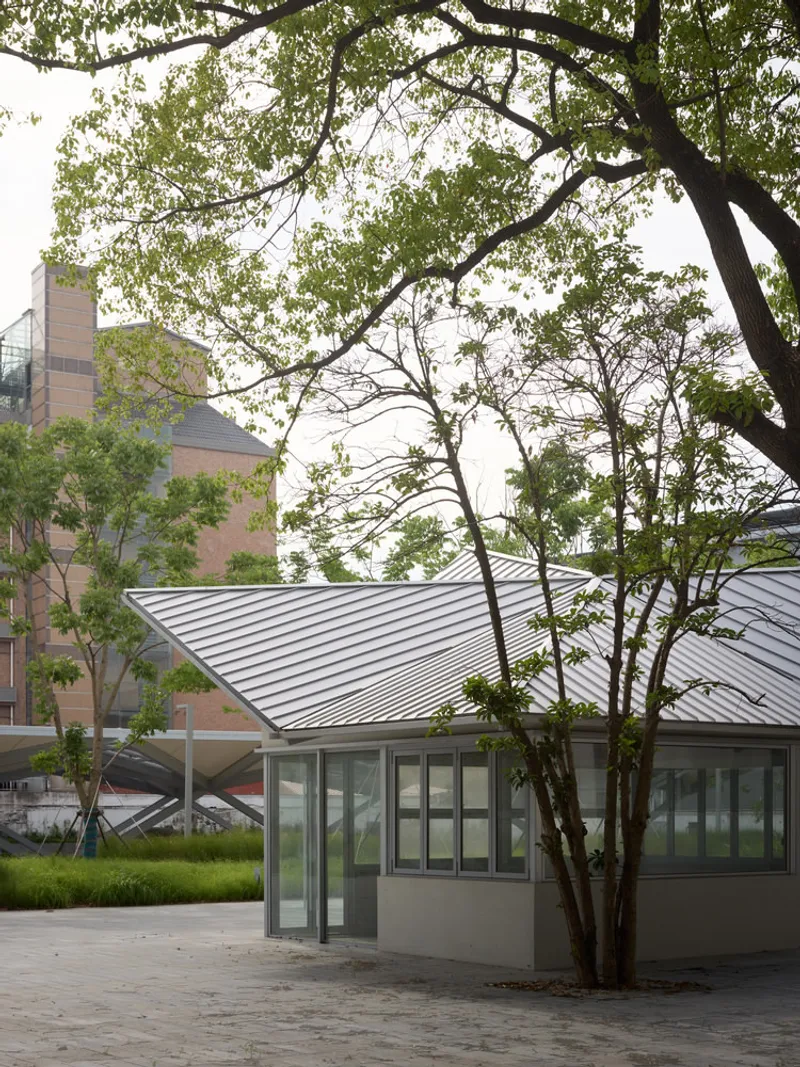
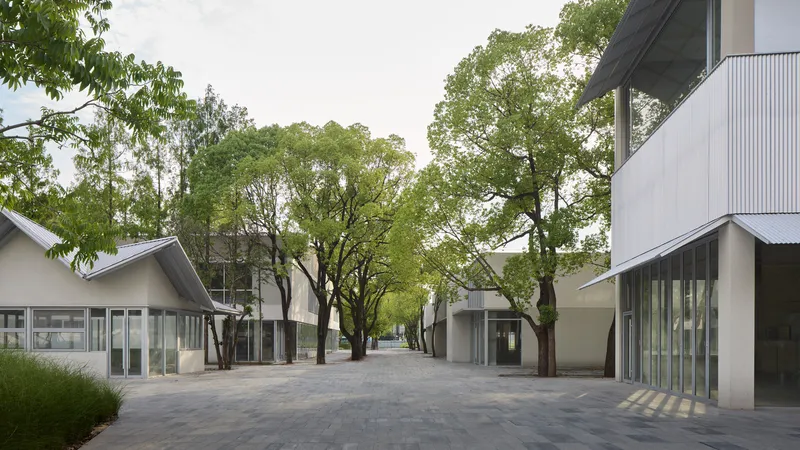
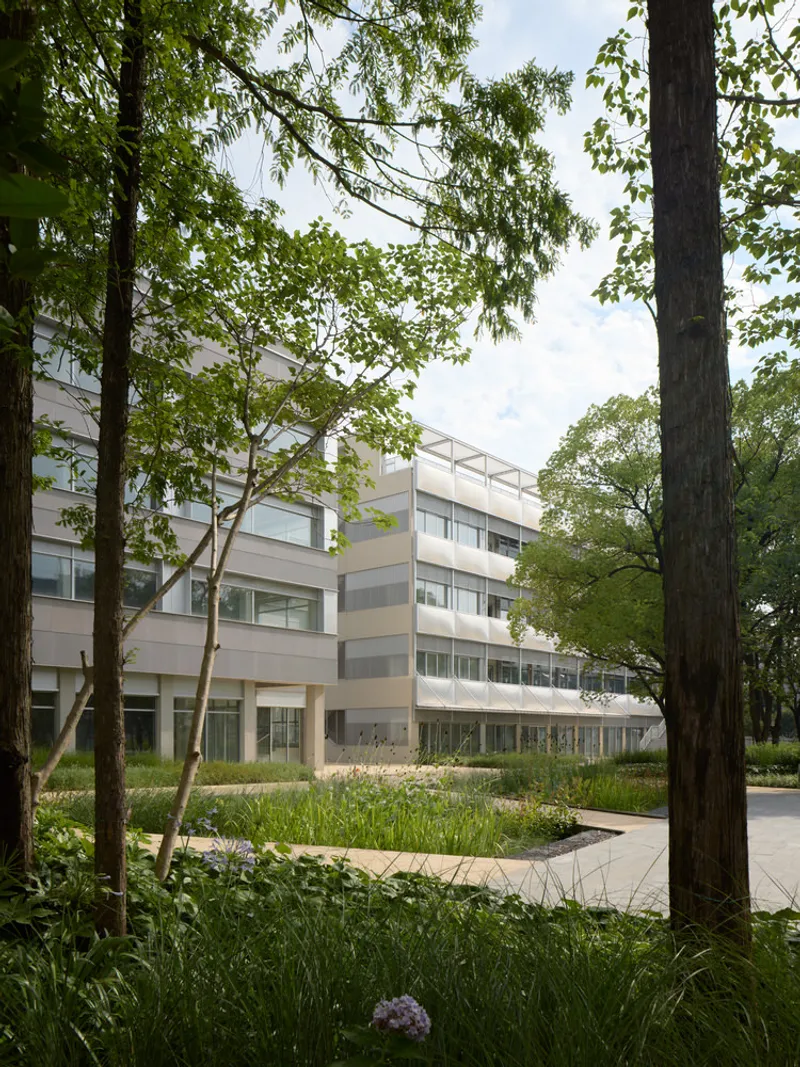
Covering a total area of 9,000 square meters, the renovation preserves six existing industrial buildings, including two four-story workshops and four one- or two-story auxiliary structures, all originally embedded within a dense landscape of mature trees. Rather than imposing a new masterplan, HCCH Studio retained the original campus layout and greenery, aligning with urban planning guidelines while creating a rare garden-like commercial environment in downtown Shanghai.
Preserving Industrial Memory Through Material Expression
A key architectural strategy of the project lies in maintaining a cohesive industrial atmosphere while allowing each building to develop its own identity. This is achieved through a careful mix-and-match of raw industrial materials, resulting in an architectural cluster that is visually unified yet spatially diverse.
The renovation avoids nostalgic reconstruction. Instead, it embraces material contrast, proportion shifts, and façade layering to reinterpret the site’s industrial past in a contemporary language. Cement fiberboard, aluminum panels, perforated metal, expanded mesh, ETFE membranes, and galvanized steel are deployed with precision, reinforcing the industrial DNA while introducing new textures and rhythms.

Office Buildings: Concealing Structure, Revealing Composition
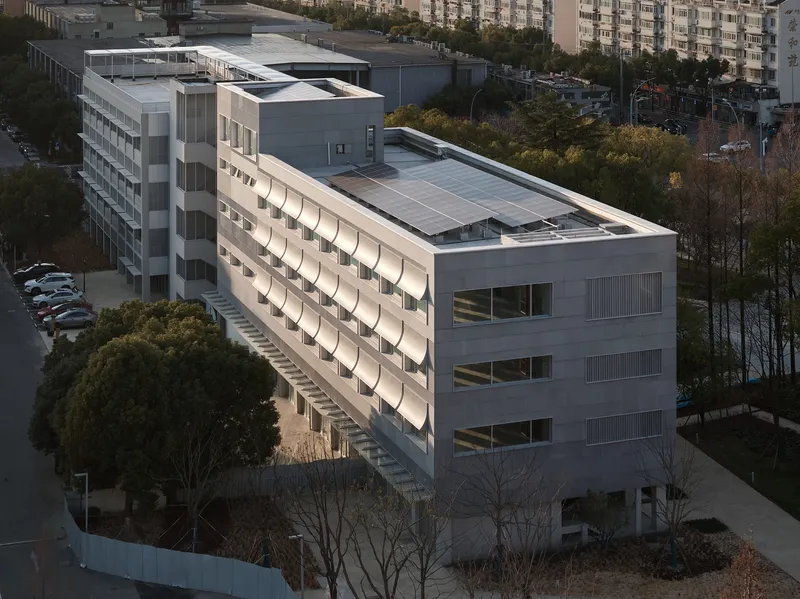
The two four-story workshops have been converted into modern office buildings with distinct architectural expressions.
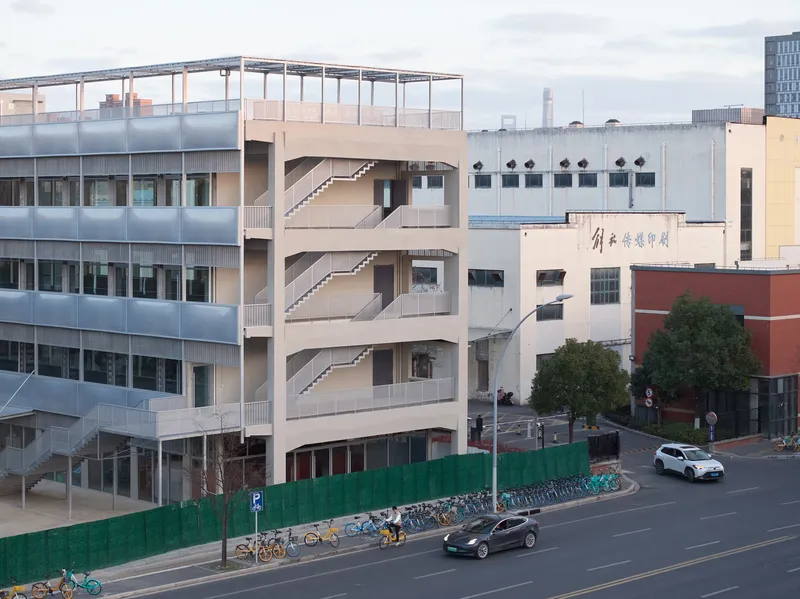
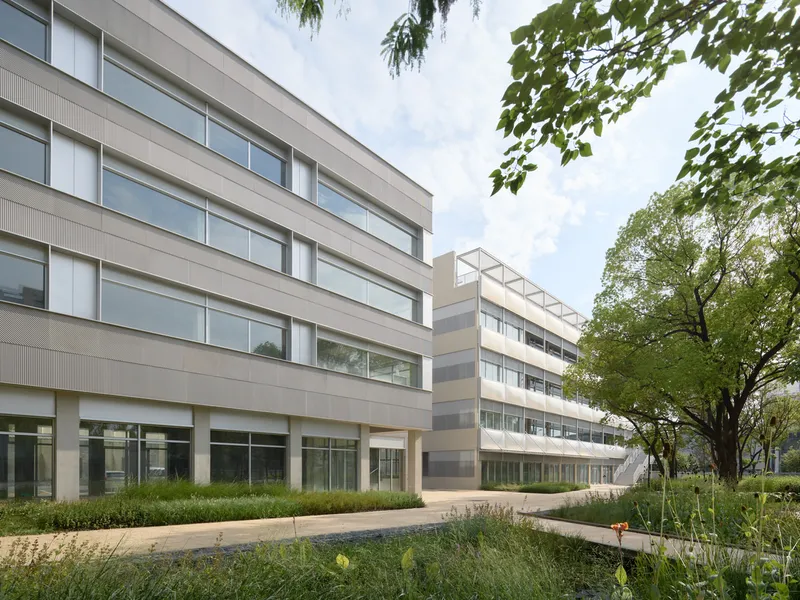
The eastern office building emphasizes horizontality through a meticulously composed façade of grooved cement fiberboard, silver perforated long panels, and aluminum panels arranged in varied orientations. Large glass openings on the north façade frame views of the garden, while solid aluminum window panels discreetly conceal the original structural columns. The rigid industrial framework is intentionally hidden behind a refined patchwork composition, softening the building’s scale and enhancing its relationship with the landscape.
In contrast, the western office building retains a more explicit industrial character. A steel staircase is inserted into the existing structural frame along the west façade, creating a bold urban frontage. This staircase extends northward to form a public circulation route that touches the ground floor, reinforcing permeability and pedestrian engagement. The use of inflatable ETFE membranes for railings and roof corridors introduces a futuristic, almost sci-fi quality. At night, the illuminated air cushions become a striking urban landmark facing the city.
Commercial Strip: From Industrial Utility to Urban Interface
Along the street edge, a linear strip of single-story commercial buildings maintains the original building height through a sequence of undulating pitched roofs, preserving the historical scale of the industrial walkway. Toward the internal pedestrian street, these volumes transition into flat roofs, creating a subtle spatial gradient between public and semi-public zones.
The façades are clad in silver perforated panels and expanded metal mesh, reinforcing visual continuity with the office buildings. At the eastern end of the strip, the former power distribution room is transformed into a tall metal-clad volume. Retaining its oversized height and exposed concrete beams, the structure is wrapped in corrugated galvanized steel panels that rise toward the plaza, forming a sculptural element reminiscent of an opened industrial gift box.

Café and Dining Spaces: Lightness Within an Industrial Park
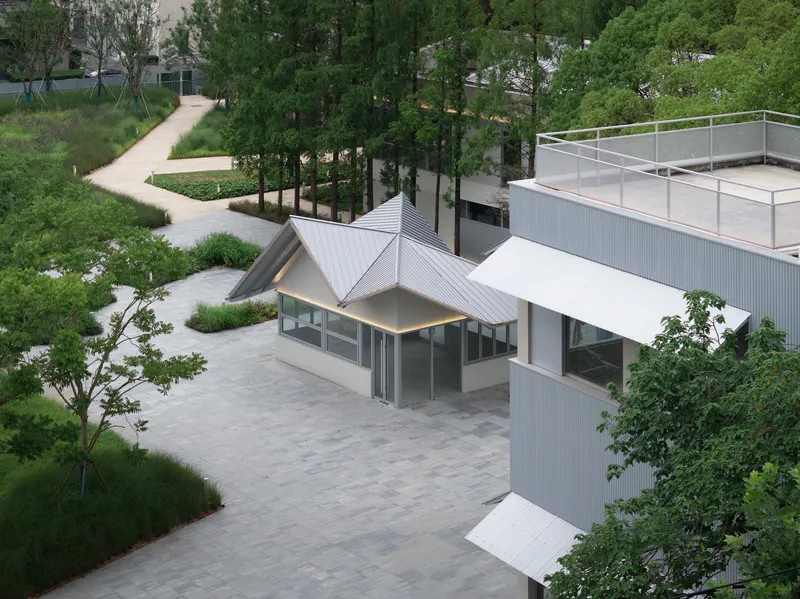
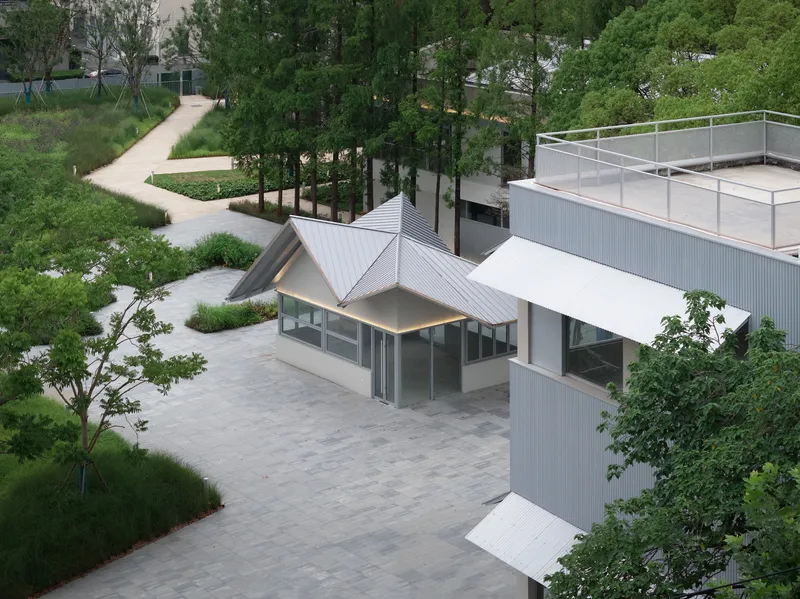
Facing the central plaza, a café constructed with a light steel structure introduces a more playful architectural language. Its irregular, folded, paper-like roof extends outward and lifts at the edges, inviting people to gather beneath it. Fully operable façades dissolve the boundary between interior and exterior, encouraging social interaction and flexible use.
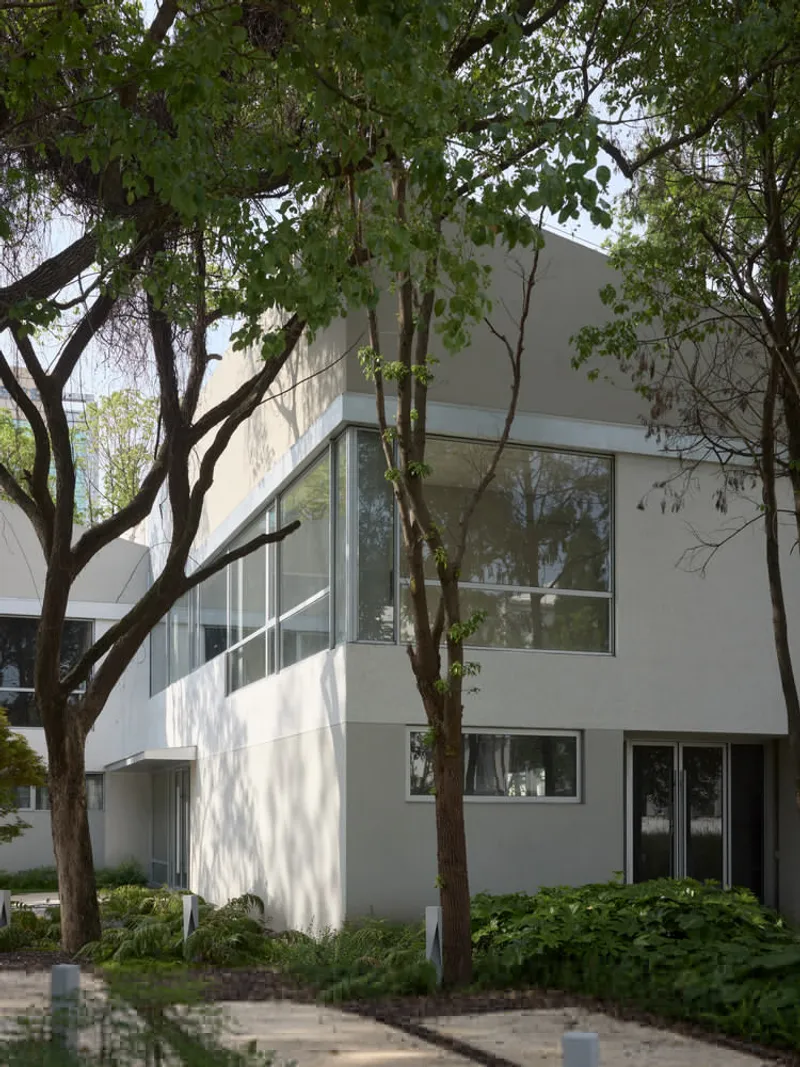
Nearby, the renovated two-story dormitory building is repurposed into a high-end dining destination. The existing L-shaped layout encloses a tranquil garden shaded by dawn redwoods, offering a calm retreat within the media park. Each private dining room is topped with a sawtooth roof, allowing natural light to filter through high clerestory windows, casting dynamic tree shadows across the interiors.
A Cost-Conscious Model for Urban Renewal
Rather than pursuing excessive commercialization or superficial repositioning, the Shanghai Relay Factory renovation explores a cost-cautious and design-driven model of urban renewal. Spatial richness and visual complexity emerge not from spectacle, but from the careful transformation of proportions, materials, and circulation. The project demonstrates how existing industrial buildings can be reactivated to support new cultural and commercial programs while preserving ecological value and collective memory.

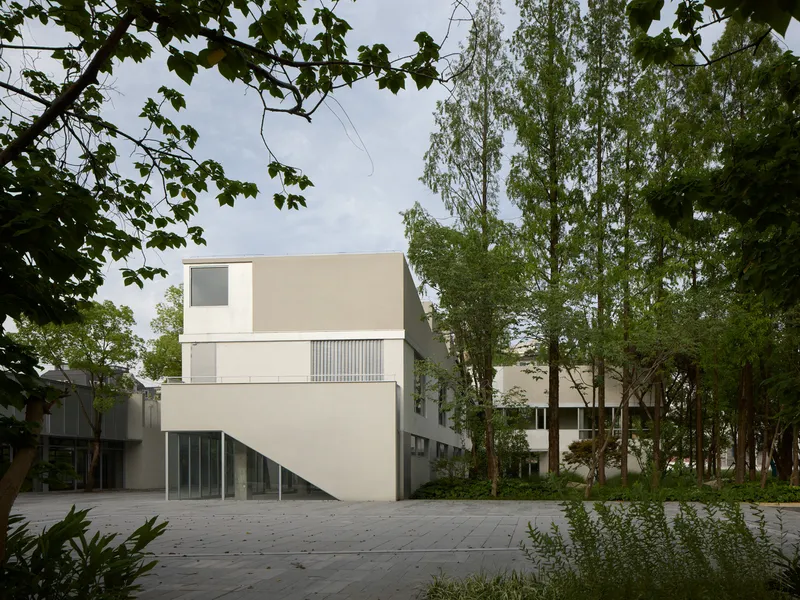
All photographs are works of Qingyan Zhu




Popular Articles
Popular articles from the community


Co-Life: Senior Housing Design That Reconnects Older Adults With the City
Co-Life reimagines senior housing design through healing gardens, shared streets, workshops, and a sustainable community across generations.

EW PARK: Sustainable Architecture Reimagines the Future of Urban Parking
EW PARK reimagines city parking as a modular wooden tower combining automation, solar energy, electric mobility, and adaptable urban design.

AL-JANNAH: Sustainable Architecture and Permaculture for Afghan Widows
AL-JANNAH uses sustainable architecture and permaculture to create resilient oasis of housing, learning, work and renewal for Afghan widows.

The Earth Pod: 3D Printed Homes for Resilient Refugee Communities
The Earth Pod reimagines refugee housing through 3D printed homes made from clay, combining resilience, self-sufficiency, and rapid shelter.

Similar Reads
You might also enjoy these articles


Hodi-Mandai Geram
Project Function: Preservation and revitalization of the Intangible heritage and socio-spatial identity of the Hodi by Housing, Cultural Memory Center, Sacred Grove, landscape, local tourism economy


Olio Towers: A Mid-Rise for Performers That Fuses Housing, Rehearsal, and Stage
Located blocks from Houston's Theater District, this modular tower stacks living units around a central performance atrium.

Oasis: Modular Green Housing Carved into Dhaka's Urban Fabric
A shortlisted Plugin Housing entry reclaims unauthorized settlements in Dhaka with stepped concrete volumes, green roofs, and ventilation-driven design.

Black Hole: A Floating Megastructure for the Post-Physical Era
Emiliano Mazzarotto envisions a spherical, self-scaling arena where e-sports, digital hotels, and holographic stadiums replace traditional public space.

Explore Sustainable Design Competitions
Discover active competitions in this discipline



Challenge to reimagine the Iron Throne


Photograph architecture without architects


Illustrate the lost glory of Angkor Wat - Render Challenge


Design challenge to reuse E-waste
Comments (0)
Please login or sign up to add comments
No comments yet. Be the first to comment!