
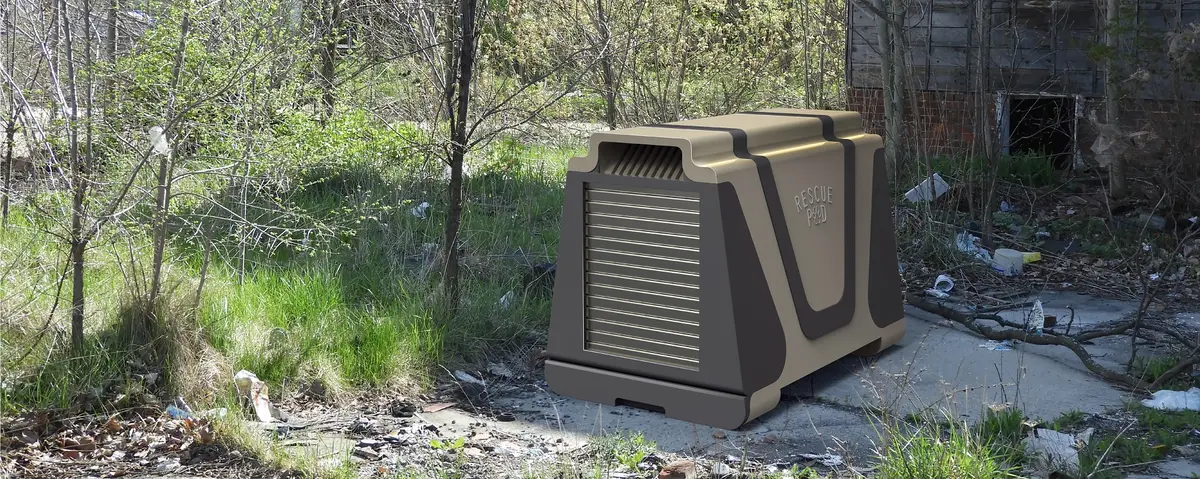
Rescue Pod: A Street-Scale Shelter That Lets Stray Animals Trigger Their Own Rescue
A compact sensor-equipped pod gives stray cats and dogs shelter, food and a secure door, then alerts local rescue groups through a live-mapped app.


Cities are planned almost entirely around human movement, and the animals that share those streets end up in whatever space is left over: alleys, abandoned lots, sidewalks, construction debris. The Rescue Pod answers this with a small, pointed idea. Instead of waiting for people to find strays, it places a shelter on the street and lets the animal begin its own rescue by walking inside. Architecture here works as a first responder, holding an animal safely until a shelter can collect it.
Designed by Elizabeth Aboona and published as a project on uni.xyz, the Rescue Pod is a compact, deployable shelter system meant for the places strays already gather. It brings together three things that rarely share a footprint this small: refuge from weather and traffic, a steady supply of food and water, and a digital link to local rescue organizations. The scale is micro, but the premise is urban. Aboona treats animals as part of the city's ecosystem rather than an afterthought, and the pod is how that position becomes a physical object on the street.
Carving Approachability by Hand: Foam, Tape and a Slatted Door
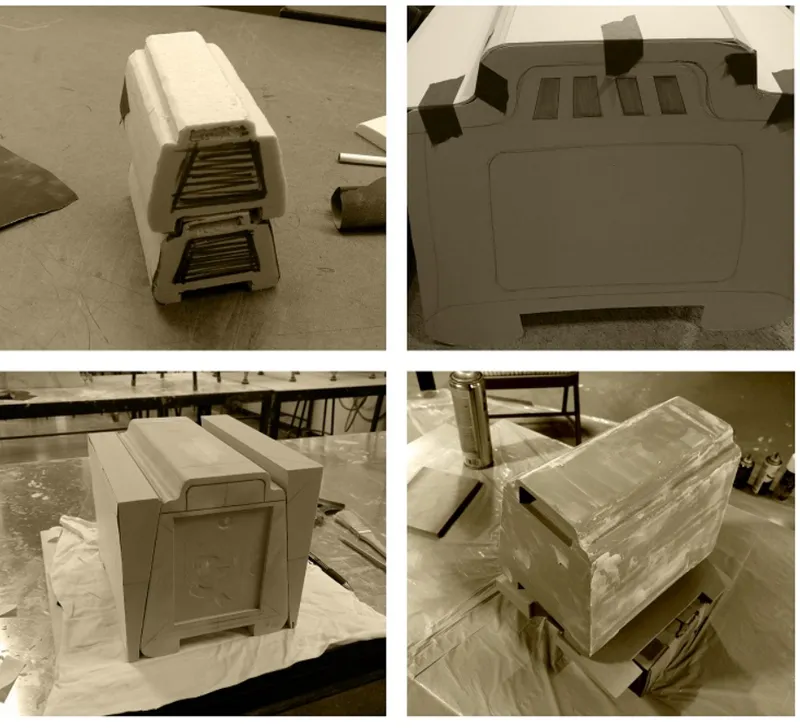
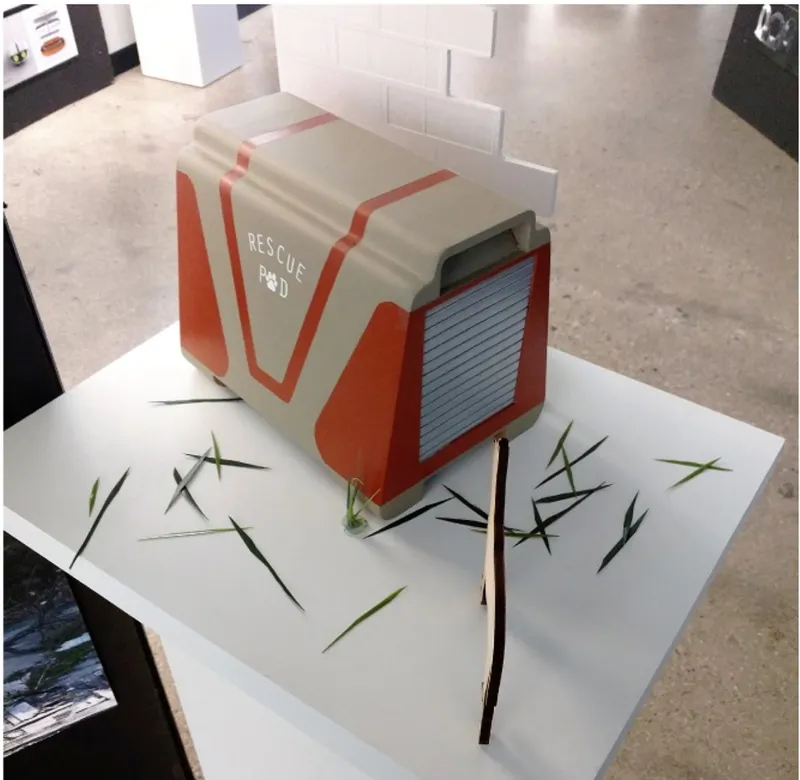
The process images show a design worked out with the hands before it was drawn. Foam and cardboard blocks are carved, taped and sanded on a workshop table, with spray cans waiting nearby, until the massing settles into a rounded, low form. The finished scale model, painted in rust and tan and set on a plinth scattered with paper grass, reads as something closer to a kennel or a garden object than a piece of street infrastructure. That softness is intentional. The brief calls for a form that is deliberately non-threatening, and a frightened animal will judge a structure on silhouette alone.
The slatted door on the model is the important detail. It keeps the interior visible from outside, so an animal can see into the space before committing to it. Approachability and visibility on the way in, security once inside: the whole project depends on resolving that tension, and the model shows Aboona testing it at a scale she can hold.
Three Zones in One Box: Resting, Feeding and Waste Pulled Apart
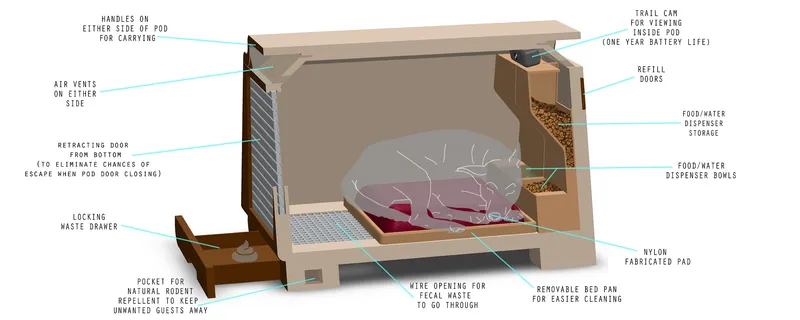
The cutaway is where the pod turns from sculpture into a working plan. A cat curls on a padded bed, a food dispenser sits within reach, and a waste drawer runs beneath the floor. The callouts make the spatial logic clear: resting, feeding and waste each get their own territory, even inside a volume this tight. A wire-based floor lets waste fall through into a removable, lockable drawer, so the animal never lies in its own mess and staff can clean the pod without reaching into the interior.
Food and water dispensers are built into the structure and refilled from outside, which is the right call for a unit that may hold an animal for up to two days. The designer describes the interior as a calm, controlled micro-environment, a pause from the street, and that ambition depends on these unglamorous details: ventilation and thermal comfort for year-round use, durable materials for outdoor exposure, and a maintenance routine that never asks anyone to open the animal's space.
One Form, Three Sizes: Designing for a Cat and a Large Dog Alike
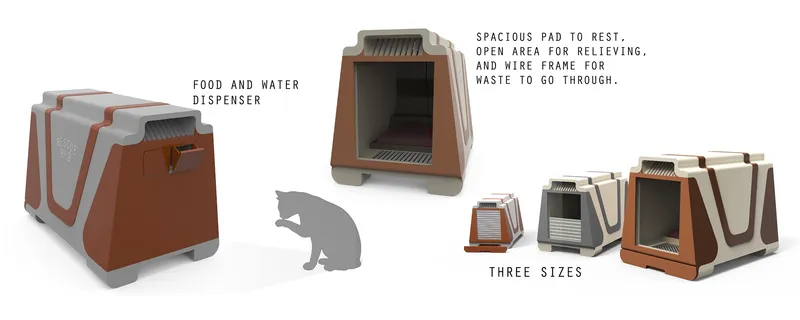
The rendering series runs through the pod's components (the food dispenser, the open-fronted interior, a seated cat silhouette for scale) and then sets out three size versions in different colours. That last move matters more than it first appears. A single standard unit would quietly favour one body type; offering several sizes keeps the shared form while making room across species and builds. The colour coding also gives each size a clear identity, which would help rescue teams and residents read a row of pods at a glance.
The minimal footprint is the other strategic decision on show. Because the pod fits into tight or overlooked corners, it can occupy exactly the residual spaces where strays already shelter. Rather than drawing animals somewhere new, the project upgrades the places they already use.
From Sidewalk to Shelter Van: A Rescue Sequence Told in Frames
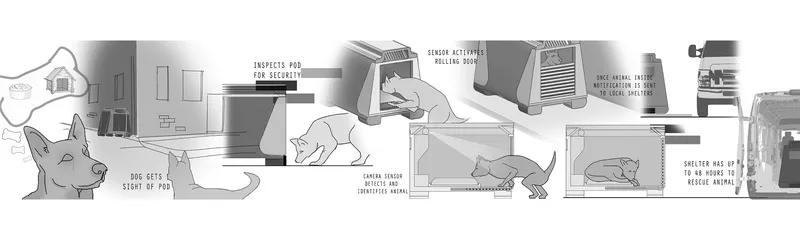
The storyboard is the clearest explanation of what the Rescue Pod actually does. A stray dog approaches, steps inside, trips the sensor door, rests, and is later collected by a shelter van. Motion and camera sensors detect the arrival, and an automated door closes from the bottom, a detail chosen to prevent both escape and injury. Closing from below rather than swinging shut means the mechanism works with an animal's body rather than against it.
Once the pod is occupied, a dedicated app notifies connected rescue organizations with the pod's location, its occupancy status and live visual confirmation. Shelters then have up to 48 hours to respond. A colour-coded map separates vacant pods from occupied ones, turning a scattered field of shelters into a network that can be dispatched. This is where the project moves from object to system: the architecture captures the moment of need, and the software routes it to people who can act.
Making the Invisible Visible: Problem, Facts and Solution on One Board
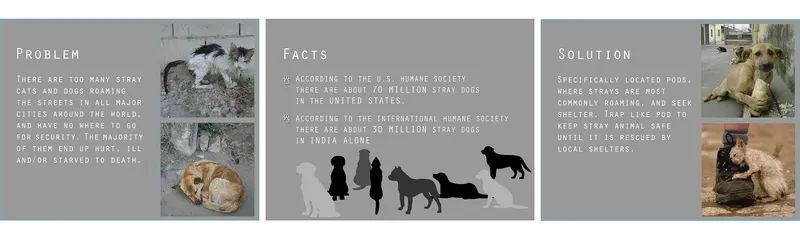
The presentation board places the problem, the facts and the proposed solution beside photographs of stray cats and dogs and a row of dog silhouettes. It argues for the project's relevance rather than its form. Tens of millions of stray dogs and cats live in cities worldwide, concentrated in dense metropolitan regions and exposed to weather, traffic, hunger and disease. Planning frameworks barely register them. By setting real animals next to the design, the board insists that the pod responds to a measurable condition rather than a sentimental one.
Why This Project Matters
The Rescue Pod is valuable because it changes who acts first. Most animal welfare infrastructure is reactive, relying on volunteers to spot, chase and catch a distressed animal. Aboona's proposal makes the street itself responsive: a shelter that invites entry, secures the occupant gently, feeds it, keeps it clean, and calls for help on its own. The ambition is modest in scale and serious in intent, and the project is at its strongest where architecture and automation hand off to each other at the closing door.
The proposal also stretches the definition of urban design. If cities can build bus shelters, bike racks and parcel lockers into the public realm, a network of care for non-human residents should not feel far-fetched. Questions remain for a built version, from vandalism and siting permissions to how quickly rescue groups can realistically answer within the 48-hour window. Still, the Rescue Pod gives designers a concrete starting point for treating empathy as a design requirement at the scale of a single sidewalk corner.
View the Full Project
About the Designers
Designer: Elizabeth Aboona
Enter a Design Competition on uni.xyz
uni.xyz runs architecture and design competitions year-round that reward proposals with spatial conviction and real site intelligence.
Project credits: Rescue Pod by Elizabeth Aboona.


Popular Articles
Popular articles from the community


ETEH Reworks the Shared Spaces of São Domingos School in Brazil Around Timber, Color and Hanging Plants
At São Domingos School in Brazil, 436 m² of hall, refectory and library are recast with timber joinery, a yellow and blue code and trailing greenery.


Singing Woman: An Opera House That Performs Before the Curtain Rises
Ovidiu Cristian Pavel's conceptual opera house translates Estonia's choral identity into a sculpted waterfront landmark facing the Baltic Sea.

Opera on the Sea: Driftwood Logic Shapes a Timber Opera House on Estonia's Coast
Trevor Orgill's opera house translates the entangled drift of floating timber into a civic building where wood, water, and music converge.

The Amber Palace Opera: A Geological Fiction Surfaces on Tallinn's Baltic Waterfront
Pierre Brillard reimagines a Baltic legend as a public landscape, opera house, and waterfront promenade rooted in Tallinn's coastal identity.

Similar Reads
You might also enjoy these articles
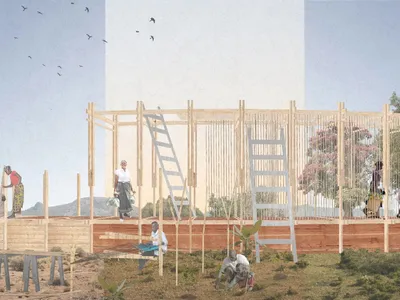
Healing Façade: A Modular Chapel System That Restores Ethiopia's Sacred Forests
Winner of the Eco-Chapel competition, this circular timber façade collects water from air to rebuild soil and reforest degraded Ethiopian landscapes.
Kaffeebühnen: Where Coffee Shop Architecture Becomes a Civic Stage in Vienna
A linear sequence of timber boxes, transparent shells, and open yards turns the Viennese café tradition into a public performance space.
Eco Chapel: A Modular Forest Pavilion That Grows Like the Landscape It Protects
Hexagonal timber modules weave through existing trees, turning a chapel into a living system for prayer, education, and reforestation.


Urban Forest: A Vertical Ecosystem for 5,000 Workers in Singapore's Changi Business Park
Radially stacked pods and layered green decks turn a 7-acre plot into 47 acres of ecological workspace projected for 2040.

Explore Dog Shelter Competitions
Discover active competitions in this discipline

Design challenge to equip cities with modern furniture

Packaging challenge - Design meets sustainability
Comments (0)
Please login or sign up to add comments
No comments yet. Be the first to comment!