
Researches Part One: Biophilic Interiors Shaped by Light Simulation and Natural Form
A digital study in daylight, material warmth, and organic geometry that reimagines residential interiors through biophilic design principles.


A teardrop pendant glows like ripe fruit against a dusky sky, its diamond lattice throwing shadow patterns across a still reflecting pool. It is the kind of image that could pass for a photograph of a built space, but it is entirely simulated, every photon path calculated. "Researches: Part One" uses high-resolution 3D modeling and lighting simulation not as a rendering exercise but as a genuine design instrument, testing how daylight, material reflections, and organic geometry can shape the atmosphere of domestic interiors before a single wall is built.
The project is the debut research output from Walls Can Be More, a practice grounded in the founder's academic trajectory through a BA (Hons) in Interior Design, a PGCert in Low-Carbon Building Design, and an MSc in Energy and Sustainable Design. That layered expertise is legible in every frame: these interiors are not styled vignettes but spatial hypotheses, each one probing how solar movement, thermal comfort, and biophilic form interact within everyday living environments. The series marks the studio's first significant step into digital environmental simulation as a vehicle for independent research.
A Latticed Lantern and a Reflecting Pool
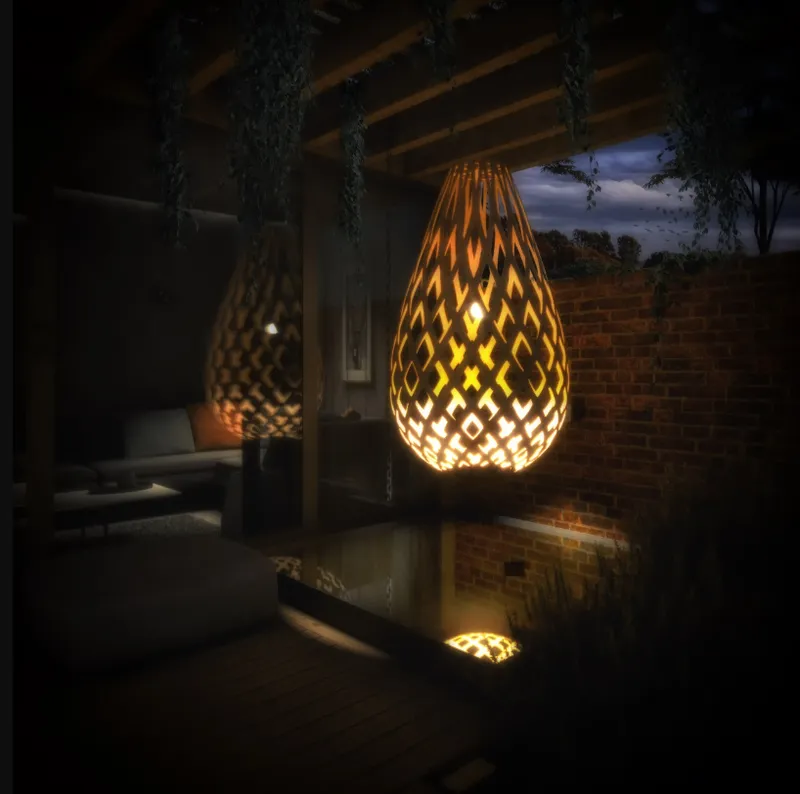
The opening image is the project's thesis compressed into a single object. A teardrop-shaped pendant light, its surface articulated with a diamond lattice pattern, hangs over a shallow reflecting pool at dusk. The geometry is unmistakably organic, recalling seed pods or woven nests, yet the precision of the lattice reveals a digital craft sensibility. Light passes through the perforations and multiplies on the water below, producing a field of patterned illumination that shifts with viewing angle. It is a demonstration that artificial lighting, when shaped by biophilic logic, can behave more like sunlight through a canopy than a bulb on a wire.
Warmth Without Waste: The Living Room as Thermal Landscape

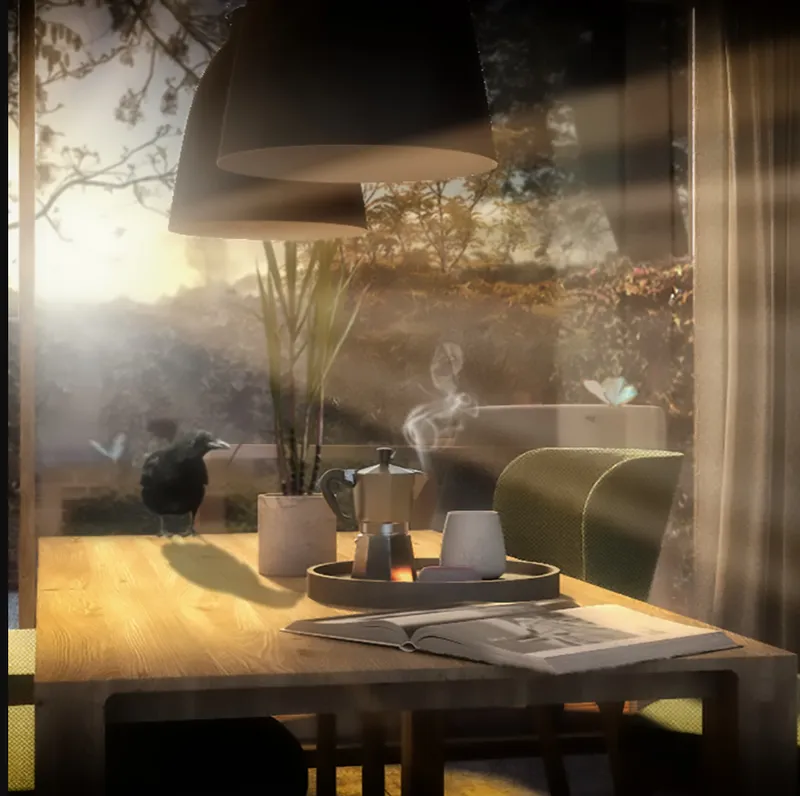
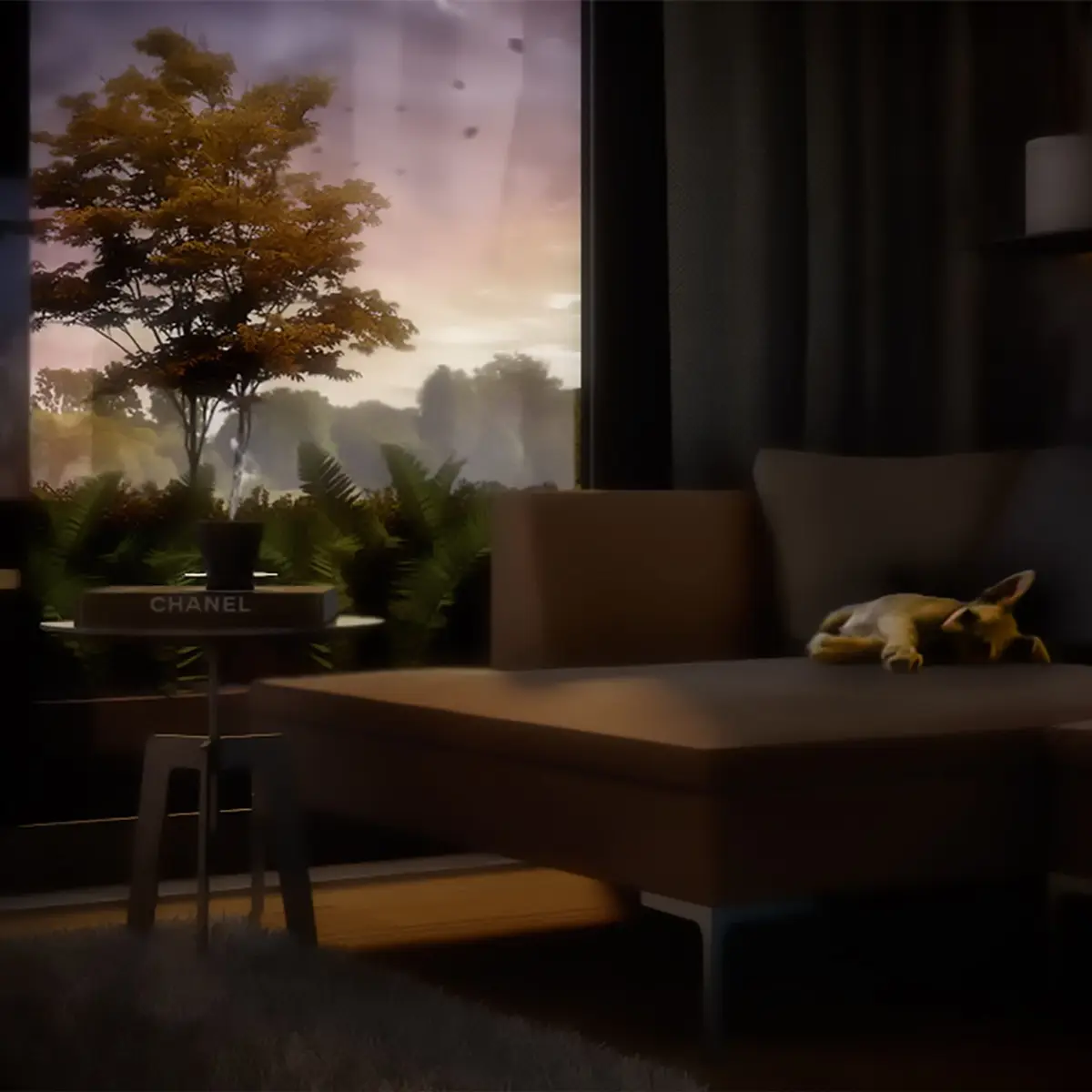
Two interior scenes establish the project's position on domestic comfort. In the first, an orange lounge chair and a spherical suspended fireplace anchor a living room where warm tones radiate outward from the hearth. A dog rests on a dark carpet, and the stillness reads as thermal contentment, not decorative staging. The material palette leans on natural textiles and deep color to hold heat visually as much as physically. In the second frame, a wooden dining table sits in a pool of morning sunlight streaming through a window, illuminating a coffee service and a magazine. No artificial light source is visible; the room runs on solar gain alone.
What connects these two moments is a disciplined restraint. Rather than relying on layered artificial lighting schemes, the interiors use daylight patterns and material reflections to create atmosphere. The simulation work behind each image evaluates not just visual appearance but environmental factors like thermal comfort and daylight quality, translating academic research in low-carbon building design into tangible spatial propositions.
Framing Nature: Kitchen and Bedroom as Solar Instruments
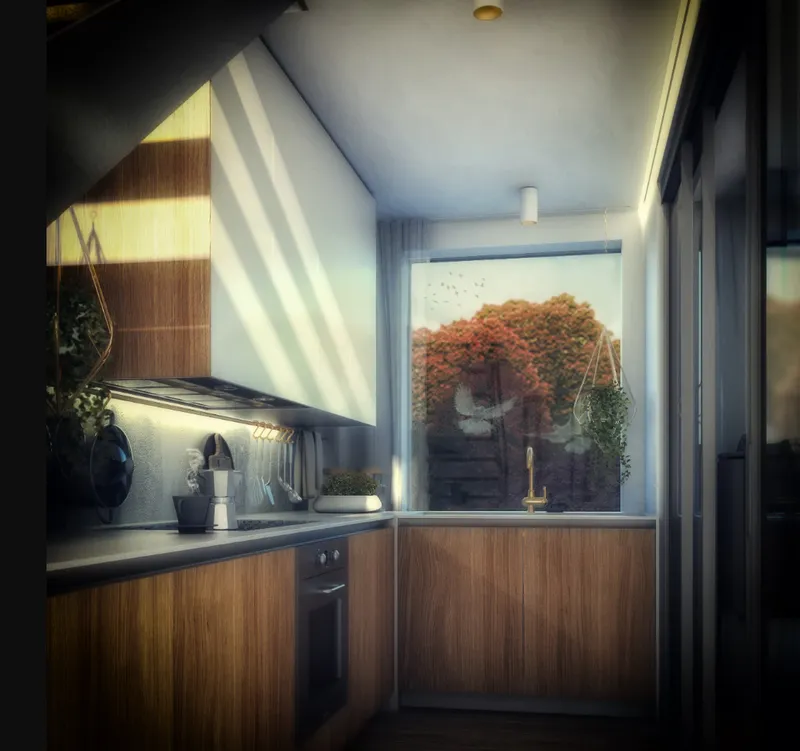

The galley kitchen is a study in simplicity. Timber cabinetry lines a narrow plan while a window at the end frames an exterior of foliage, afternoon light, and deep shadow. The composition is intentionally directional: the eye is pulled through the workspace toward the garden view, reinforcing the biophilic principle that connection to the outdoors reduces cognitive fatigue. The material choices are warm but muted, allowing the quality of incoming light to do the expressive work.
The bedroom takes the solar relationship further. A platform bed sits low against a floor-to-ceiling window at sunset, and the silhouette of a cat on the sill completes a scene that feels inhabited rather than composed. The window operates as a light instrument: at this hour, it bathes the room in long, amber wavelengths that cue circadian rest. It is an elegant illustration of how orientation and aperture size, informed by solar movement research, can replace mechanical dimming systems with the planet's own schedule.
The Pendant Returns: Light, Texture, and Living Greenery
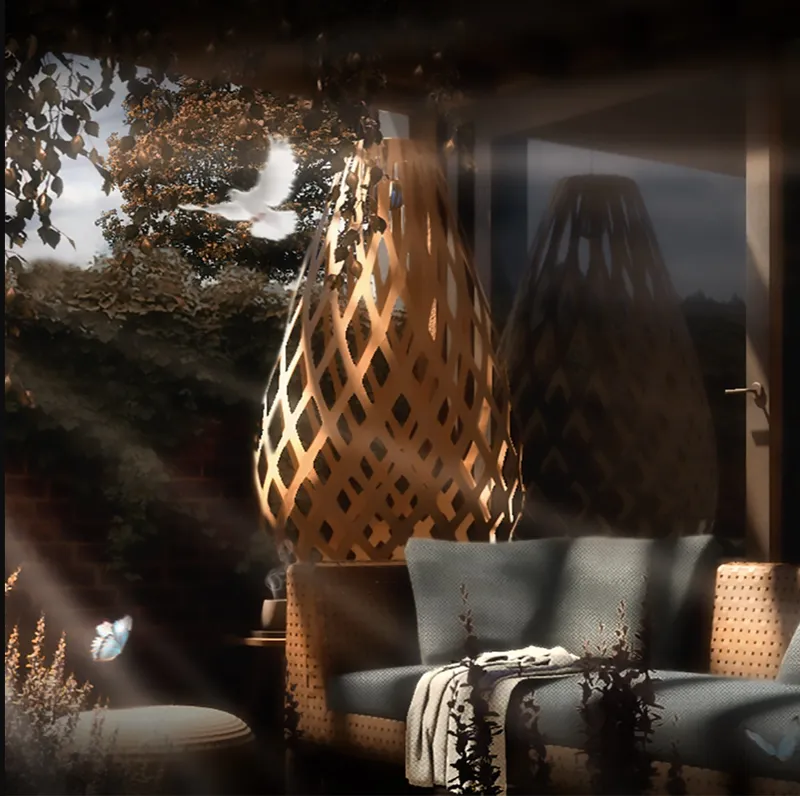
The final image brings the latticed teardrop pendant back, this time placed beside a sofa dressed in textured cushions with hanging plants trailing nearby. Where the first appearance tested the lamp against water and open air, this scene nests it within a layered domestic interior. The lattice casts softer, more diffuse shadows here, filtered by the surrounding foliage and fabric surfaces. It is a closing argument for the project's central claim: that bespoke latticework, organic form, and living greenery can produce a quality of filtered light that feels genuinely natural, even when the entire environment exists only as simulation data.
Why This Project Matters
"Researches: Part One" is framed as the beginning of an ongoing series, and that framing is important. It positions digital environmental simulation not as a deliverable at the end of a design process but as the process itself, a space where hypotheses about daylight, material, and biophilic form can be tested iteratively without the cost and carbon of physical prototyping. For a practice built on low-carbon design credentials, that alignment between method and message is credible.
More broadly, the project addresses a gap in how biophilic design is typically communicated. Too often it is reduced to plant walls and timber cladding, surface gestures that signal nature without engaging its systems. By grounding each interior in solar movement analysis, thermal comfort evaluation, and carefully simulated daylight quality, Walls Can Be More demonstrates that biophilic architecture is a performance standard, not an aesthetic trend. If the subsequent parts of this research series maintain this rigor, they could become a meaningful reference for designers working to make residential spaces genuinely responsive to the natural forces around them.
View the Full Project
About the Designers
Designer: Walls Can Be More
Enter a Design Competition on uni.xyz
uni.xyz runs architecture and design competitions year-round that reward proposals with spatial conviction and real site intelligence.
Project credits: Researches: Part One by Walls Can Be More.


Popular Articles
Popular articles from the community


ETEH Reworks the Shared Spaces of São Domingos School in Brazil Around Timber, Color and Hanging Plants
At São Domingos School in Brazil, 436 m² of hall, refectory and library are recast with timber joinery, a yellow and blue code and trailing greenery.


Singing Woman: An Opera House That Performs Before the Curtain Rises
Ovidiu Cristian Pavel's conceptual opera house translates Estonia's choral identity into a sculpted waterfront landmark facing the Baltic Sea.

Opera on the Sea: Driftwood Logic Shapes a Timber Opera House on Estonia's Coast
Trevor Orgill's opera house translates the entangled drift of floating timber into a civic building where wood, water, and music converge.

Aquadapt: An Underwater Habitat That Rewrites Its Rooms by the Hour
Curved modules ring the seabed while one shell shifts from breakfast room to cinema, farm and football pitch as residents' needs change.

Similar Reads
You might also enjoy these articles

Vereda Arquitetos Renovates a 40-Square-Meter Apartment Inside Niemeyer's Copan Building
A compact unit in São Paulo's most iconic residential tower gets a material overhaul that pairs exposed concrete with bold blue Formica.

Shakur's House: Exposed Brick as an Interior Organiser in a 168 m² Mashhad Residence
Brick moves indoors in this Mashhad residence, where masonry walls, glass partitions and teal planes sequence a compact home without closing it off.

Day and Night Park: A Time-Based Urban Newsstand in Beijing
A temporary urban newsstand in Beijing blending travel, light, and reading through poetic colors, compact form, and community-focused design.

Modernist Patio Renovation in El Masnou, Barcelona by Oliver Segura Arquitectura + Cebrià Arquitectura
Modernist patio renovation blending tradition and innovation with a movable pool, leveled floors, and Catalan materials in El Masnou.

Explore Interior Architecture Competitions
Discover active competitions in this discipline

Challenge to design luxury tourism on rails

Challenge to reimagine the Iron Throne

Photograph architecture without architects

VR headsets Storefront design competition
Comments (0)
Please login or sign up to add comments
No comments yet. Be the first to comment!