
Javier de las Heras Solé Grounds 57 Homes on a Marés Stone Base in Mallorca's Es Molinar
A social housing project in Palma de Mallorca uses local stone, courtyards, and a U-shaped plan to frame the sea and shelter a community day center.


Fourteen years elapsed between the competition win and the building's completion, a timeline that says something about the pace of public housing in Spain but also about the patience required to get a project like this right. Javier de las Heras Solé's Residential and Community Day Center in Palma de Mallorca, finished in 2023, sits on a corner lot in Es Molinar, a former fishing village whose urban fabric remains patchy and unconsolidated. The architect's response to that uncertain context is decisive: a heavy marés stone base locks the building to the ground, while three floors of white housing volumes slide over it, oriented in a U-shape that opens toward the Mediterranean.
What makes the project genuinely interesting is not the formal move alone but how it distributes social life vertically and horizontally. The ground floor is entirely given over to a day center with four rooms and two commercial or social premises, organized around an interior street and three courtyards of graduated size. The 57 residential units above are reached via rectilinear corridors and screened on the north and east by expanded metal panels. Every design decision, from the chestnut wood cladding to the green roof over the day center, works toward a single proposition: that density, community programming, and passive climate strategy can reinforce one another rather than compete.
A Stone Plinth That Belongs to the Terrain
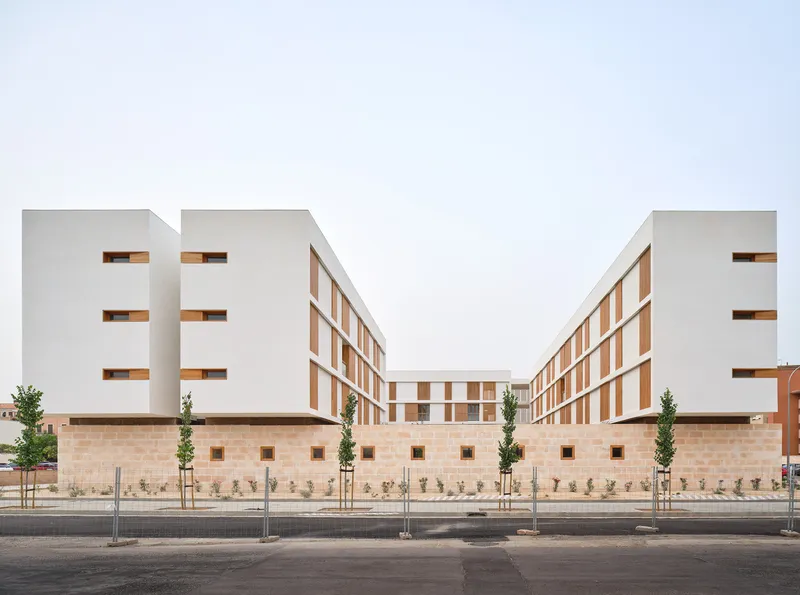
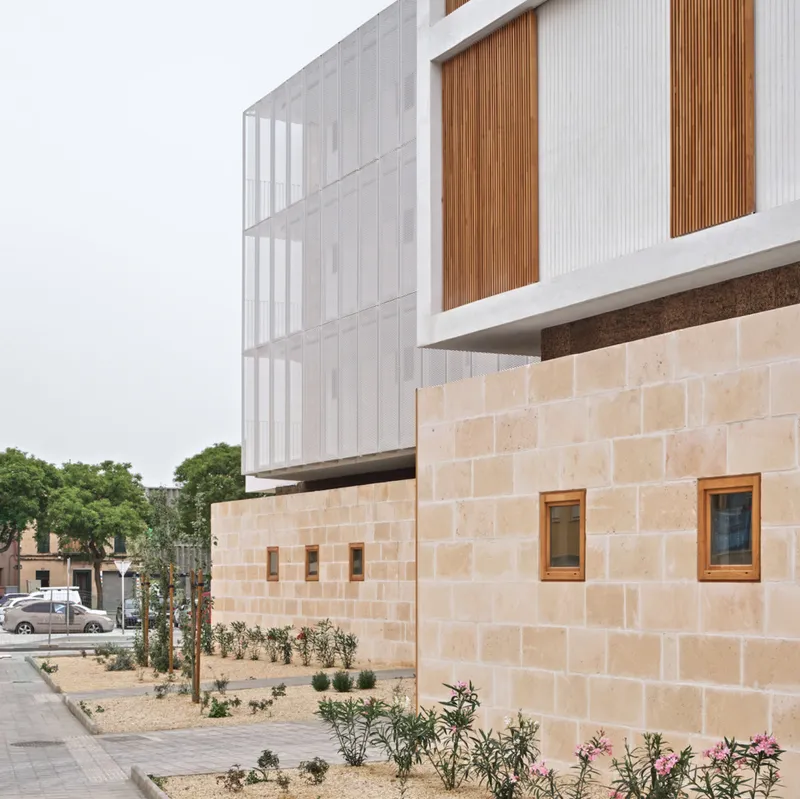
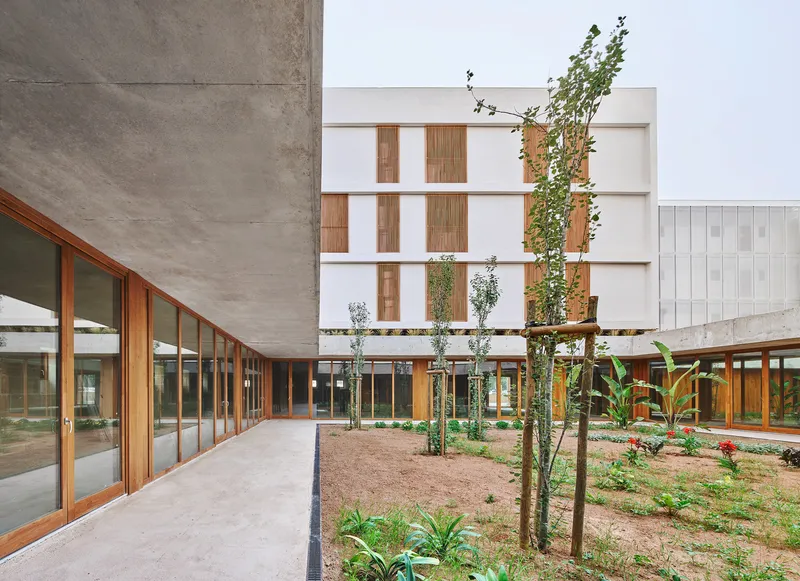
The ground floor reads as geology more than architecture. Marés, the porous limestone quarried across Mallorca for centuries, wraps the base in a material that is both structurally honest and culturally loaded. It signals permanence in a neighborhood still searching for an identity, and its rough texture draws a sharp line against the smooth lime mortar plaster of the floors above. The cantilevered upper volume, visible from the street, reinforces that conceptual split: heavy below, light above, each half doing a different kind of work.
Planted sidewalks and young trees soften the interface between the stone wall and Cuba Street, but the ground floor remains deliberately closed to the outside. Privacy for the day center users is non-negotiable, and the dense enclosure also buffers noise from a streetscape that is still being consolidated. Timber-framed windows and doors puncture the stone only where access is needed, keeping the base legible as a continuous surface.
Three Courtyards, Three Microclimates
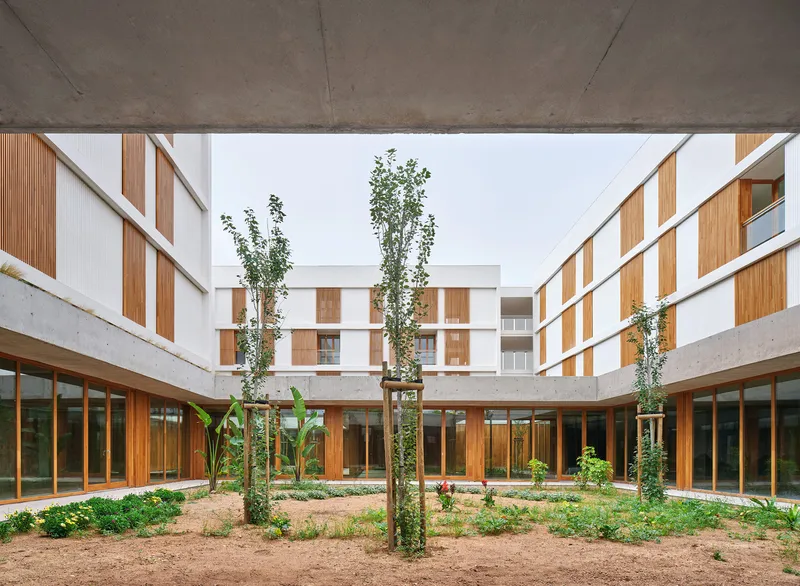
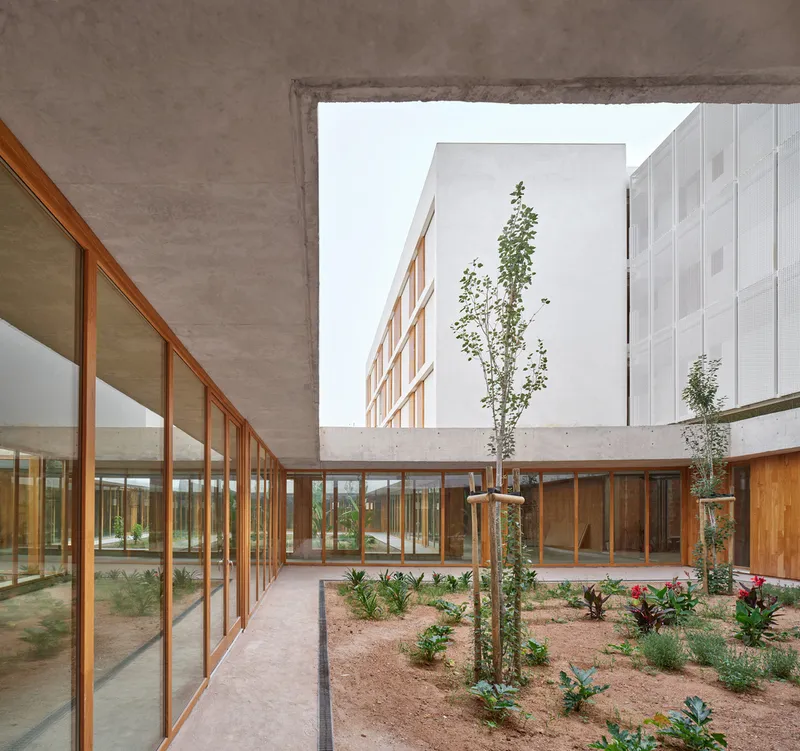
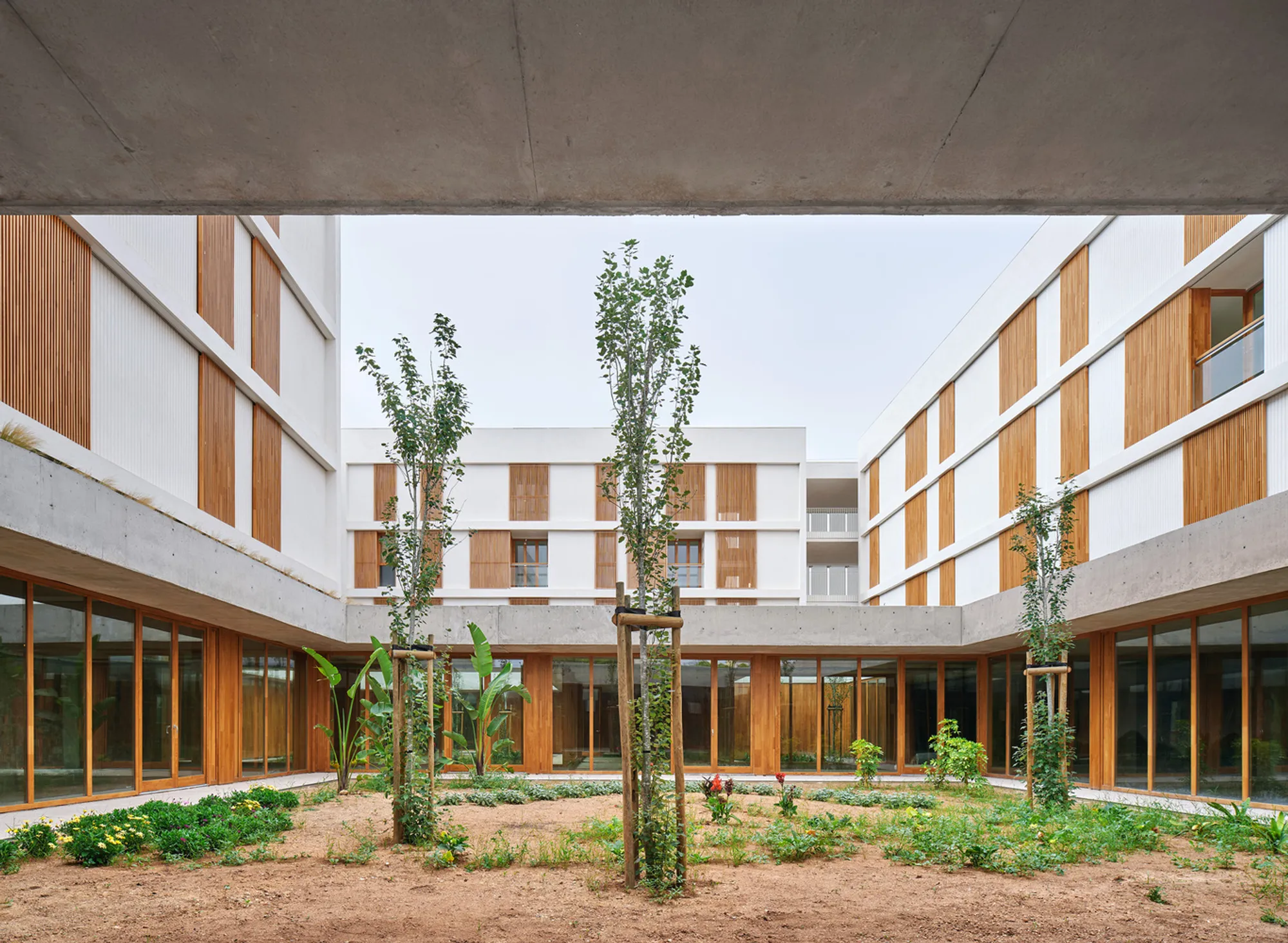
The sequencing of the three courtyards is the project's most considered spatial strategy. Each court is a different size, calibrated to the program it serves: the largest acts as a communal garden visible from the housing corridors above; a mid-sized court mediates between the day center rooms; and the smallest creates a pocket of calm near the social premises. Together, they regulate the embat, the local sea breeze that can turn from pleasant to aggressive, while pulling daylight deep into the plan.
Planting choices are restrained. Banana palms and young deciduous trees appear in bare earth beds, with climbing vines beginning their slow colonization of concrete columns. The aesthetic is deliberately unfinished, an acknowledgment that landscape in Mediterranean housing needs years, not months, to reach maturity. Concrete soffits overhead frame the sky as a fifth elevation, and the timber-clad walls lining each courtyard warm what could otherwise feel institutional.
Screening as Climate and Privacy Device
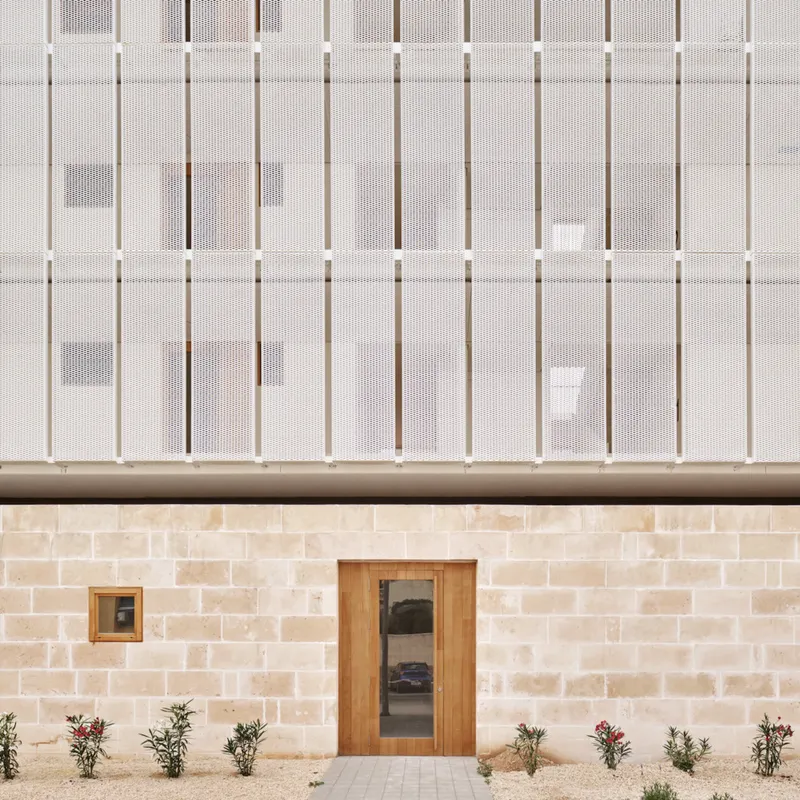
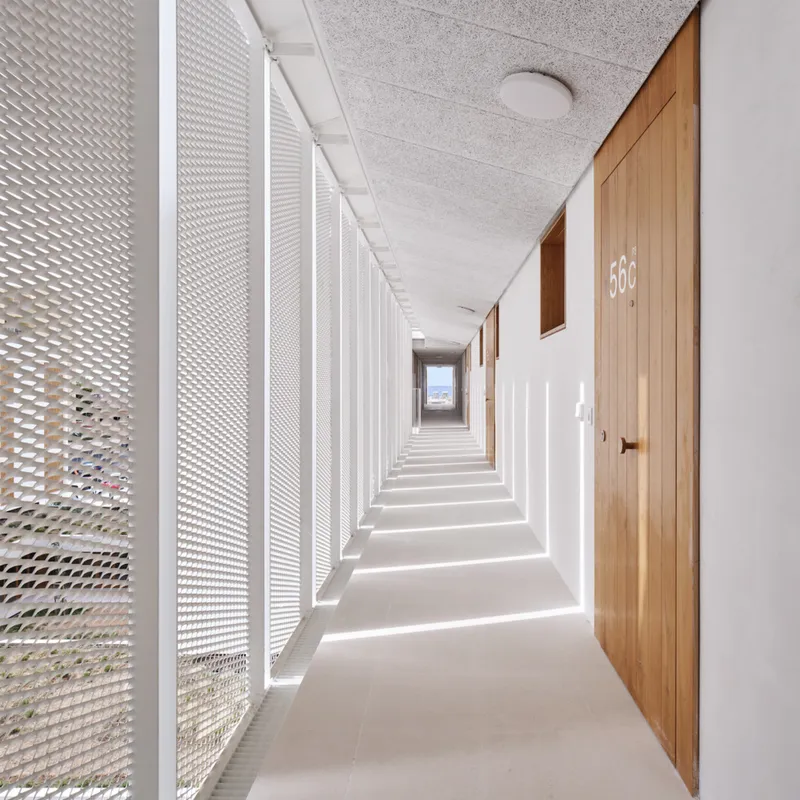
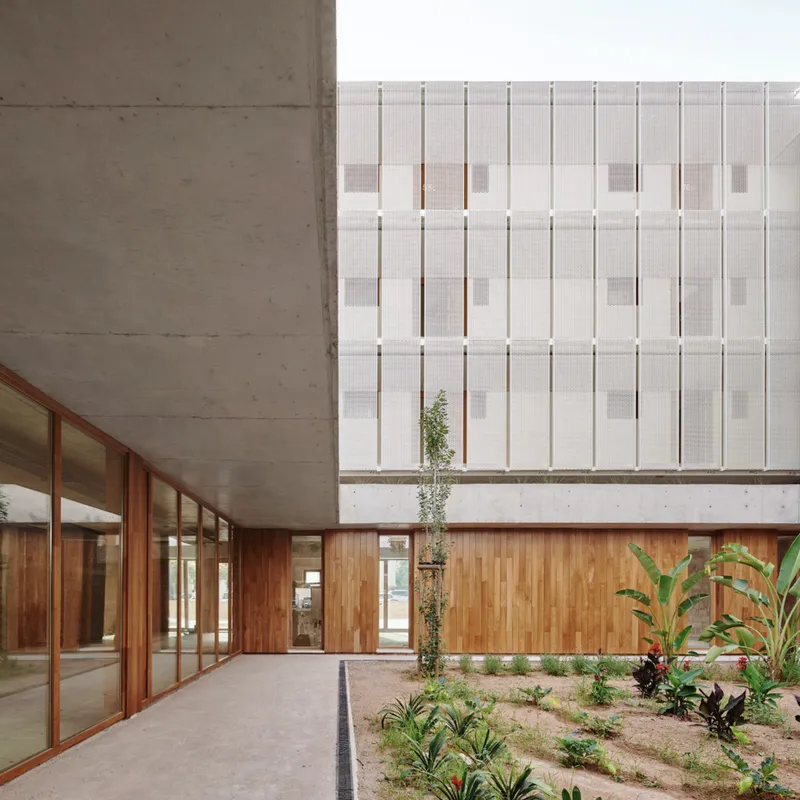
On the north and east facades, expanded metal panels replace conventional balcony railings or curtain walls. The effect in the corridor is striking: rhythmic shadows ripple across white surfaces and timber doors throughout the day, turning a circulation space into something worth lingering in. But the screens are functional before they are photogenic. They cut direct solar gain on the least favorable orientations, filter dust and wind, and give residents a degree of visual privacy without sealing them off from natural ventilation.
The detail at the junction of marés stone, timber, and perforated metal is worth studying. Each material retains its own logic: the stone is load-bearing, the timber is tactile and domestic, and the metal is industrial and sacrificial. There is no attempt to blend them into a unified skin. The honesty of the assembly keeps the building legible as a series of systems rather than a monolithic object.
Living Between Timber and Sky
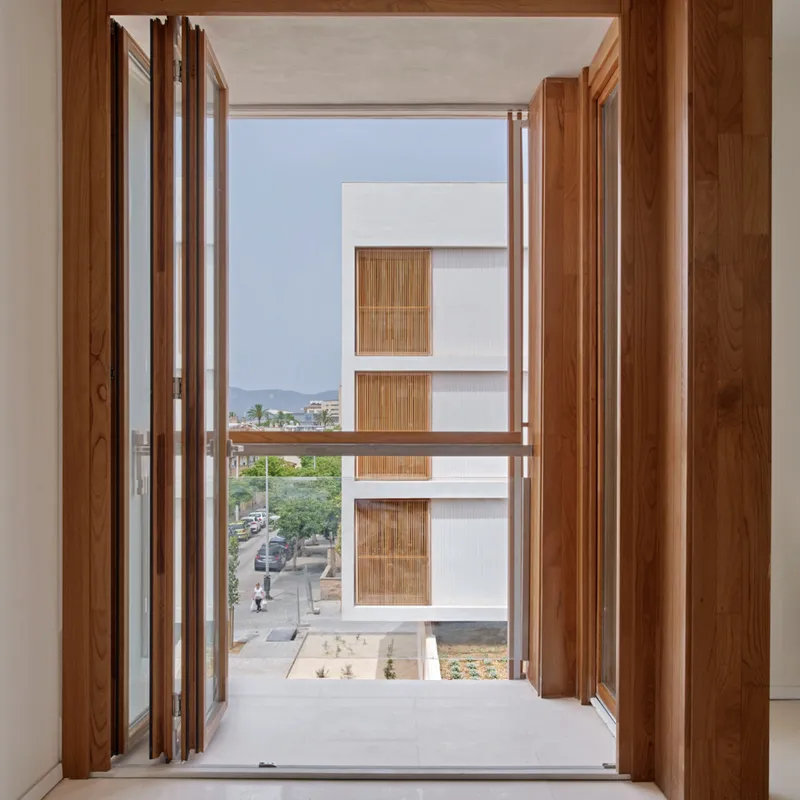
Inside the residential units, chestnut wood folding doors open rooms to views of the opposite facade block and the courtyards below. The apartments are arranged along rectilinear corridors, a layout that prioritizes legibility and cross-ventilation over spatial gymnastics. South and west orientations dominate, putting the Mediterranean in view and ensuring that winter sun penetrates deep into living spaces. The U-shaped plan means that most units enjoy dual exposure, a genuine luxury in a 57-unit block.
Covered walkways along the courtyard edge serve as semi-outdoor living rooms for the upper floors, framed by timber glazing and shaded by the floors above. Climbing vines on support columns will eventually blur the boundary between architecture and garden, a strategy that asks for patience but promises a building that improves with age rather than merely weathers.
The Green Roof as Quiet Infrastructure
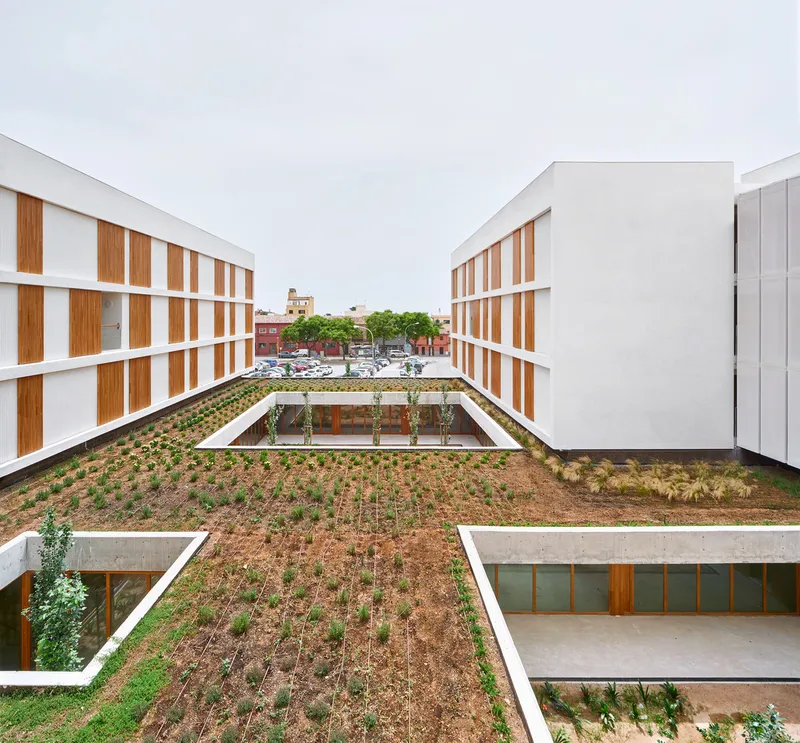
The landscaped roof over the day center is visible from the upper-floor corridors and terraces, turning what would normally be dead space into a visual amenity. Low-maintenance vegetation covers the flat surface, contributing to microclimate mitigation by reducing the urban heat island effect and absorbing rainwater. The nearly 3,000 square meters of garden area across the project, when set against 4,770 square meters of total built area, underscore how much ground the architect reclaimed for planting.
Under overcast skies, which are rarer in Mallorca than the tourism brochures suggest but not uncommon, the green roof and the white volumes create a muted palette that feels distinctly Mediterranean without relying on cliché. There are no terracotta tiles, no bougainvillea cascading over whitewashed walls. The restraint is deliberate and effective.
Why This Project Matters
Social housing in southern Europe rarely gets this level of material attention. The use of marés stone, a material with deep roots in Mallorcan construction, elevates the ground floor from a generic podium to a civic gesture. The expanded metal screens, the chestnut wood, and the courtyard sequence all serve practical ends, yet they also give residents a building with texture, rhythm, and identity. In a neighborhood still defining itself, that matters more than another glass box.
The long gestation from 2009 competition to 2023 completion may have worked in the project's favor. Es Molinar has shifted from forgotten periphery to a district with genuine momentum, and the building now anchors a streetscape that is catching up to it. Javier de las Heras Solé has delivered a proof of concept: strict orthogonal discipline, local materials, and passive environmental strategy can produce housing that is dense, humane, and built to last.
Residential and Community Day Center Building, designed by Javier de las Heras Solé. Es Molinar, Palma de Mallorca, Spain. 4,770 m². Completed 2023. Structural engineering by Eskubi-Turró arquitectes slp. Photographs by José Hevia.
About the Studio
Javier de las Heras Solé exemplifies modern architectural innovation
Share Your Own Work on uni.xyz
If projects like this are the kind of work you want to make, uni.xyz is a place to publish your own, find collaborators, and enter design competitions.




Popular Articles
Popular articles from the community


The Earth Pod: 3D Printed Homes for Resilient Refugee Communities
The Earth Pod reimagines refugee housing through 3D printed homes made from clay, combining resilience, self-sufficiency, and rapid shelter.

The Musturak Paradise: Senior Living Architecture for a Connected Future in Temara, Morocco
The Musturak Paradise reimagines senior living architecture in Temara via private homes, social spaces, culture, community, and shared care.

Hill & Cross Opera: Sculptural Opera House Architecture Shaped by Tallinn’s Landscape and Identity
Hill & Cross Opera reimagines opera house architecture in Tallinn through its sculptural hill, civic plaza, glass wave and a luminous cross.

Co-life: Sustainable Architecture for Age-Friendly Community Living
Co-life reimagines sustainable architecture for seniors through courtyards, rammed earth, shared gardens, and spaces designed for belonging.


Similar Reads
You might also enjoy these articles


Hodi-Mandai Geram
Project Function: Preservation and revitalization of the Intangible heritage and socio-spatial identity of the Hodi by Housing, Cultural Memory Center, Sacred Grove, landscape, local tourism economy


Olio Towers: A Mid-Rise for Performers That Fuses Housing, Rehearsal, and Stage
Located blocks from Houston's Theater District, this modular tower stacks living units around a central performance atrium.

Oasis: Modular Green Housing Carved into Dhaka's Urban Fabric
A shortlisted Plugin Housing entry reclaims unauthorized settlements in Dhaka with stepped concrete volumes, green roofs, and ventilation-driven design.

Black Hole: A Floating Megastructure for the Post-Physical Era
Emiliano Mazzarotto envisions a spherical, self-scaling arena where e-sports, digital hotels, and holographic stadiums replace traditional public space.

Explore Architecture Competitions
Discover active competitions in this discipline



Challenge to reimagine the Iron Throne


Photograph architecture without architects


Illustrate the lost glory of Angkor Wat - Render Challenge


Design challenge to reuse E-waste
Comments (0)
Please login or sign up to add comments
No comments yet. Be the first to comment!