
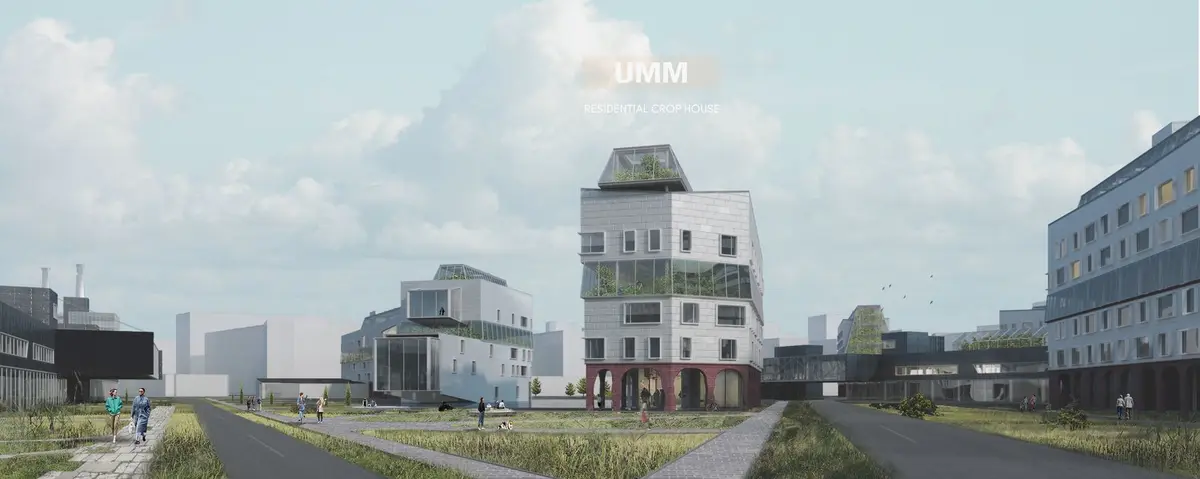
Residential Crop House: Where Homes Grow Food on an Old Market Site
A shortlisted Urban Meal Mine entry transforms a forty-year-old fruit and vegetable market into a closed-loop residential farming district.


What happens when a building is expected to feed its occupants as well as shelter them? The Residential Crop House takes that question literally, stacking greenhouse levels above brick residential floors so that vegetables and fruits grow in the same structure where people sleep, cook, and gather. It is an architecture of dual output: domestic comfort below, food production above, and a closed-loop ecological system binding the two together.
Designed by Мила Молодец and Артур Махмутов, the project was shortlisted in the Urban Meal Mine competition. The site is a forty-year-old market historically known for its trade in fruits and vegetables. Rather than bulldozing that legacy, the designers restructured the market's original 14-block layout into a new residential typology that keeps cultivation alive within the urban fabric.
Brick Bases, Glass Canopies: A Building That Reads in Two Halves
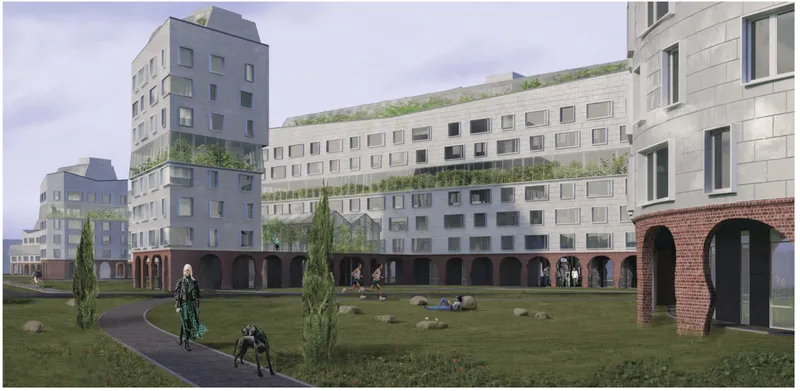
The rendering reveals the project's defining visual contrast. Ground and first floors use brick finishes to create a tactile, human-scaled pedestrian experience, with archways framing pathways into shared courtyards. Above, glass and aluminum envelopes house greenhouse levels dedicated to plant cultivation, allowing maximum light penetration. The effect is immediate: solid, grounded bases anchor the buildings while transparent, plant-filled upper volumes signal openness and growth. People linger on lawns between the blocks, suggesting that the spaces between buildings are as programmed as the interiors themselves.
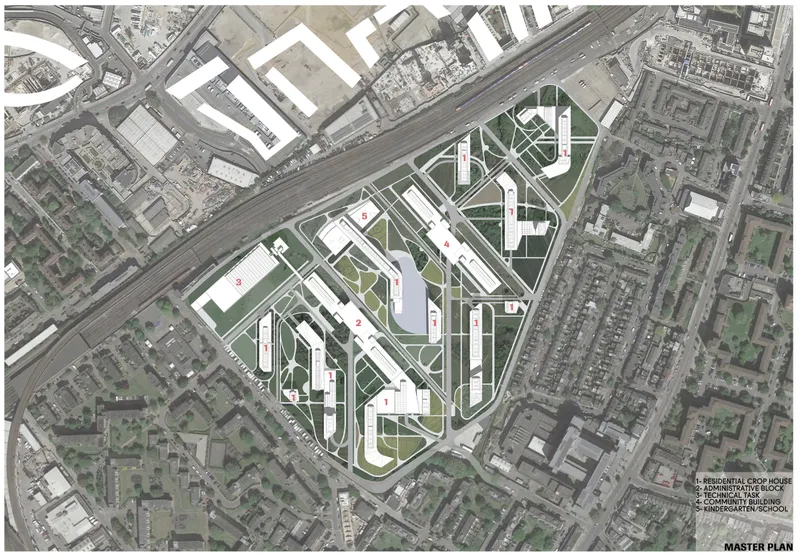
The aerial site plan confirms the project's urban intelligence. Residential blocks are distributed along the existing grid, but the dissolved 14-block market structure gives way to green courtyards threaded between housing volumes. These courtyards are not decorative leftovers; they are extensions of the agricultural program, places where shared gardens and cultivation spaces allow neighbors to exchange harvests and horticultural knowledge. The market's commercial DNA survives, reorganized into a model where residents are simultaneously occupants and farmers.
Beetle-Like Blocks and Interwoven Public Ground
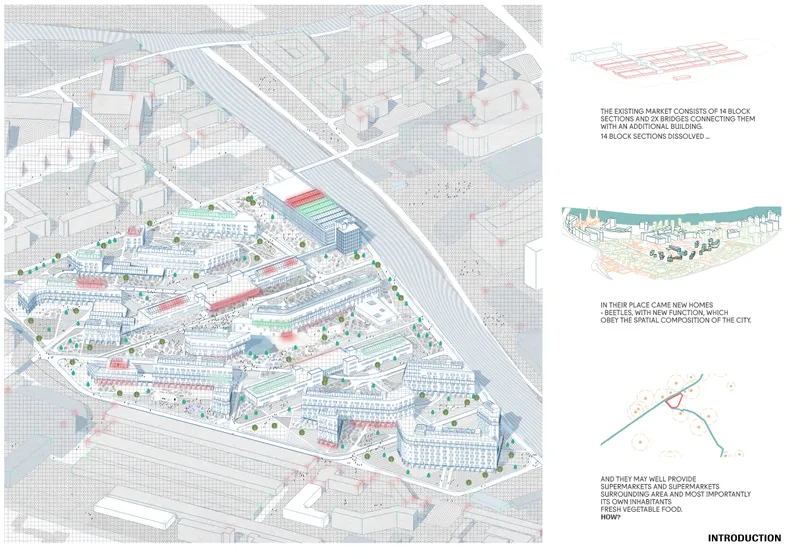
The axonometric drawing pulls apart the neighborhood to show its organizational logic. Housing blocks are described by the designers as "beetle-like structures" that adapt to the city's spatial composition while introducing new functions. Each block slots into a larger network of interwoven public spaces, walkways, and cultivation zones, so the district reads less like a conventional residential compound and more like an inhabited landscape. The drawing makes clear that agriculture is not confined to rooftops or hidden utility floors; it permeates the section, the plan, and the public ground between buildings.
A Closed Loop from Rooftop to Foundation
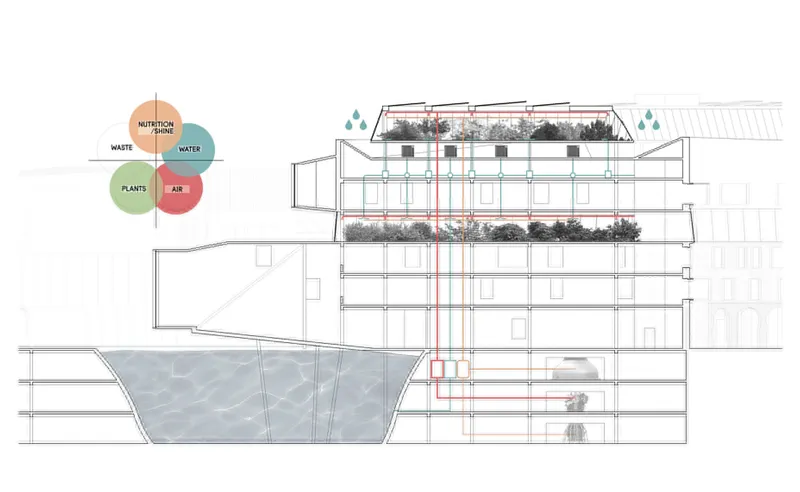
The section drawing is where the project's ecological ambition becomes technical. Vertical plant beds climb the building's upper floors, while rooftop planting beds and a rainwater collection system cap the structure. Water, air, nutrition, and waste are all managed within a closed loop: rainwater is captured, organic waste is recycled back into the growing medium, and the vertical farm operates as an integrated subsystem rather than an add-on. The section reveals how each floor participates in a chain of resource flows, turning the building into a self-sustaining organism that shelters and nourishes simultaneously.
This is the detail that separates the Residential Crop House from projects that simply attach green roofs to standard housing. The ecological system is not cosmetic; it is structural to the building's program. Residents live within the loop, consuming what the building produces and returning organic waste to feed the next growing cycle. The architecture becomes infrastructure.
Solar Geometry as Design Driver
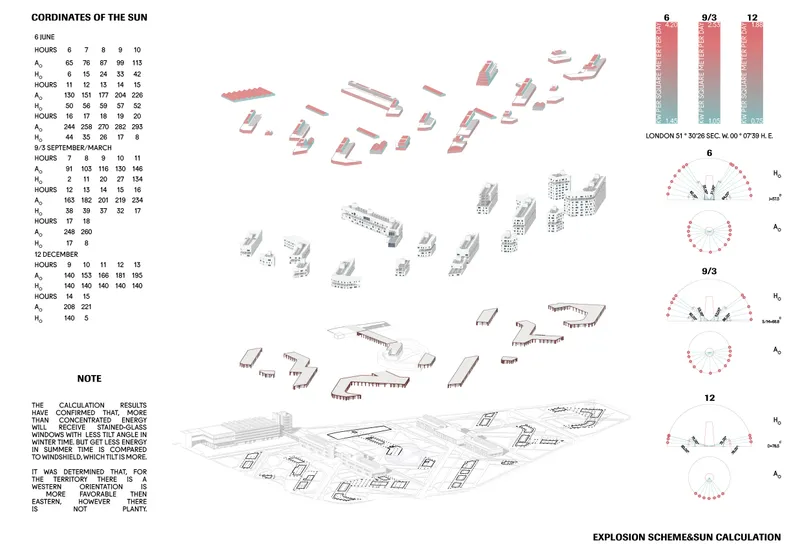
The solar geometry diagram maps seasonal sun paths against building massing, revealing that the block forms are not arbitrary. Building orientation, floor plate depth, and greenhouse placement respond to calculated solar access across seasons. For a project that depends on plant growth within the building envelope, this is not an academic exercise; it is a survival parameter. Without adequate light reaching the upper greenhouse floors, the entire food-productive premise collapses. The diagram shows the designers treated solar access as a first-order design constraint, shaping form before aesthetics.
Why This Project Matters
The Residential Crop House matters because it refuses to treat food production and housing as separate urban programs. By fusing them into a single building typology on a site with a forty-year agricultural history, Молодец and Махмутов propose an architecture that is productive in the most literal sense. The closed-loop ecological system, the solar-driven massing, and the brick-to-glass sectional contrast all serve one argument: cities can feed themselves if the architecture is designed to do so.
As a shortlisted entry in the Urban Meal Mine competition, the project also signals a generational shift in how young designers approach sustainability. It is not enough to reduce energy consumption or add photovoltaic panels. The next step, this project argues, is to make the building itself a source of nourishment, turning residents into participants in their own food cycle and transforming architecture from passive shelter into active sustenance.
View the Full Project
About the Designers
Designers: Мила Молодец, Артур Махмутов
Enter a Design Competition on uni.xyz
uni.xyz runs architecture and design competitions year-round that reward proposals with spatial conviction and real site intelligence.
Project credits: Residential Crop House by Мила Молодец, Артур Махмутов Urban Meal Mine (uni.xyz).


Popular Articles
Popular articles from the community


The Ocean Hive: Sustainable Architecture for a Self-Sufficient Civilization at Sea
The Ocean Hive imagines sustainable architecture at sea, where modular habitats, algae, wave power and ocean waste sustain a growing colony.

Play: Fragments of Their World
Familiar architecture becomes modular playground design, creating safe spaces where displaced children can learn, connect, imagine and play.

Lunar Spiral: Space Architecture Shaped by the Mathematics of the Universe
Lunar Spiral reimagines space architecture through Fibonacci geometry, lunar regolith, levitating habitats, and self-sustaining Moon living.

Co-Life: Senior Housing Design That Reconnects Older Adults With the City
Co-Life reimagines senior housing design through healing gardens, shared streets, workshops, and a sustainable community across generations.

Similar Reads
You might also enjoy these articles

Bao Huynh Watercolor Atelier: A Serene Art Retreat in Hội An
Bao Huynh Watercolor Atelier in Hội An blends multifunctional art spaces, sustainable design, local materials, and family-friendly living in a serene environment.

Atelier Macri Concept Store Interior Design by CASE-REAL
Atelier Macri store features a "ko" counter, walnut wood details, cork displays, blending retail, gallery, and seamless customer experiences.

Manuel Vargas Izquierdo Stadium and High-Performance Sports Center: Architectural Excellence in Jalpa de Méndez
The Manuel Vargas Izquierdo Stadium blends sustainable design, inclusive sports facilities, and cultural-inspired architecture, revitalizing Jalpa de Méndez’s public spaces.

KAKR Buluh Awar Hall: Revitalizing Community and Ecology Through Bamboo Architecture
Community built bamboo hall revitalizes Buluh Awar village, empowering youth, restoring ecology, celebrating vernacular craftsmanship through sustainable architecture and culture.


Comments (0)
Please login or sign up to add comments
No comments yet. Be the first to comment!