

Resurrecting the Past: Salvaged Facades Become Living Monuments in Stockholm
A speculative restoration project reimagines Norrmalm's demolished heritage as freestanding ruins woven into the city's public landscape.


What if the act of demolition could be reversed, not by rebuilding what was lost, but by giving its fragments a second life as public monuments? In Stockholm's Norrmalm district, where mid-century modernization campaigns erased entire blocks of 19th-century architecture, this project proposes a compelling countermove: salvaging ornamental facades and structural remnants from ongoing demolitions across the city and re-erecting them as freestanding ruins in the urban landscape. The result is neither reconstruction nor memorial. It is something stranger and more honest, a new typology that treats architectural salvage as both ecological resource and cultural artifact.
Submitted to the Artificial Decay competition on uni.xyz, the project was developed by NA NA. Set against the specific history of Norrmalm's postwar demolitions, the proposal takes aim at architecture's disposability problem. Rather than consigning demolished buildings to landfill, it imagines a systematic program of disassembly, cataloguing, and recomposition. Stockholm's scars become its gardens.
The Violence of Erasure: Norrmalm's Demolition Legacy
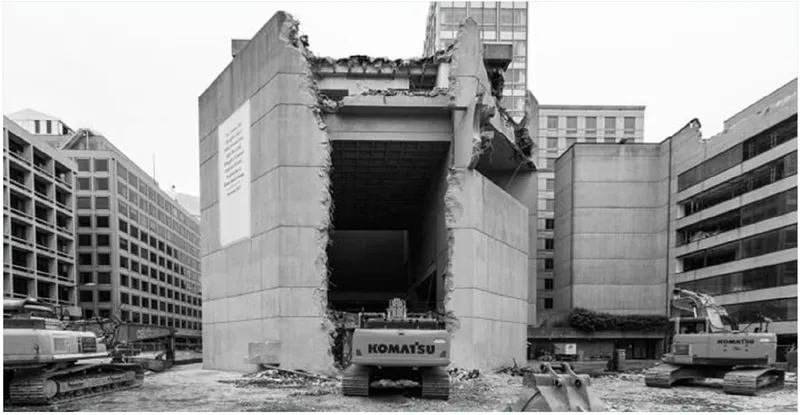
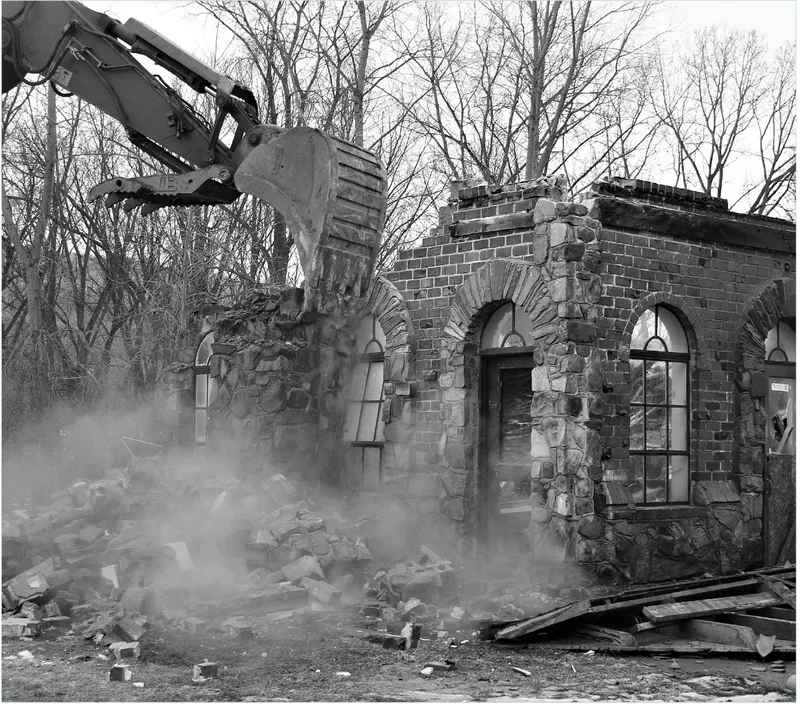
The project opens with an unflinching look at demolition as an urban event. Images of excavators tearing into concrete structures and brick facades capture the brute mechanics of erasure. In Norrmalm, this process played out at an enormous scale during the 1950s and 60s, when hundreds of buildings were razed to make way for modernist commercial blocks. The dust clouds, the exposed interiors, the sudden absence of a building that had been part of a street for a century: these are the conditions the project takes as its starting point.
By documenting the demolition process in such visceral detail, the designers establish a clear moral argument. Every act of demolition produces not just waste but orphaned architectural elements: arches, pediments, keystones, columns. These are not debris. They are potential.
Cataloguing the Remains: An Anatomy of Salvageable Parts
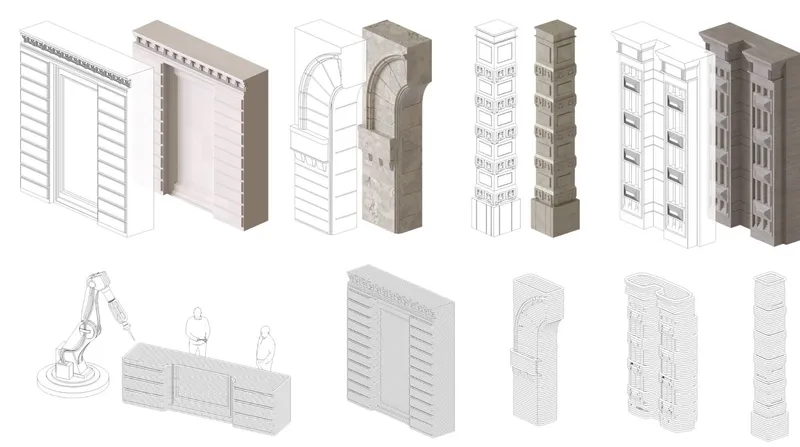
An axonometric drawing lays out the methodology with forensic precision. Salvaged facade fragments, arched window assemblies, ornamental stone pediments, and structural components are arranged in two neat rows like specimens in a naturalist's cabinet. The drawing insists on legibility: each piece is identifiable, measurable, reusable. It transforms the chaos of demolition into an orderly inventory, a parts catalog for a kind of urban archaeology.
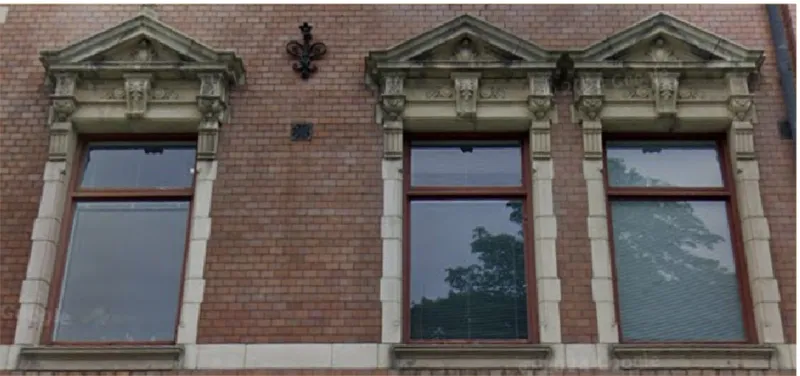
A detail photograph of three windows with stone pediments and decorative keystones set into red brick reinforces what is at stake materially. These are not generic building components. They carry specific craft, specific proportions, specific histories of making. The project argues that to landfill such elements is not just wasteful but culturally illiterate.
Ruin as Architecture: The Freestanding Sandstone Gate
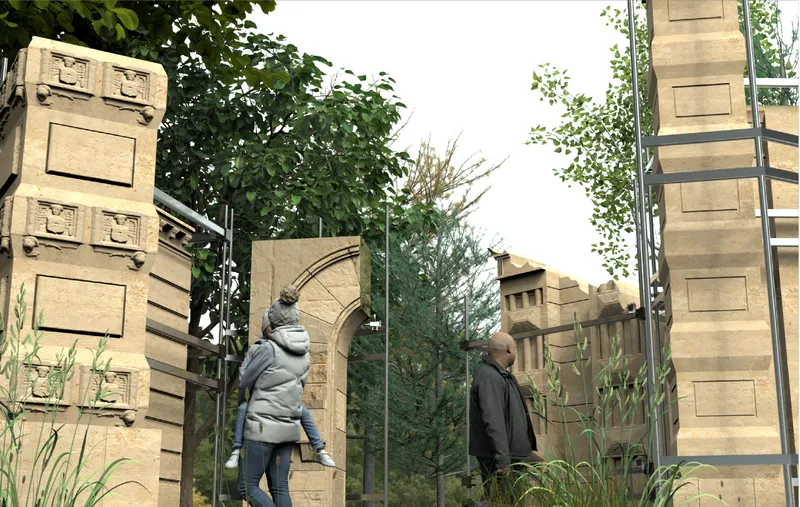

The proposal's most evocative image shows a freestanding sandstone gate with an arched opening, surrounded by planted grasses and sheltered beneath leafy trees. Two visitors stand nearby, their scale establishing the fragment as monumental yet approachable. The gate frames nothing except the landscape beyond it, a threshold without walls, a doorway to a building that no longer exists. It functions simultaneously as sculpture, garden folly, and public space.
Contrast this with the image of an arched masonry facade mid-collapse, its ornamental columns crumbling into rubble beneath a tower crane. The juxtaposition is the project's central argument made visual. On one side, destruction. On the other, resurrection. The same formal language of arches and stone appears in both images, but the freestanding gate has been granted a future. It has been extracted from the timeline of decay and given new ground to stand on.
Why This Project Matters
The construction industry accounts for roughly a third of global waste, and most demolished buildings end up in landfill regardless of the quality of their materials. Projects like this one push back against that norm by proposing a cultural and ecological framework for salvage. The idea is not nostalgic. It does not ask for faithful reconstruction or historical theme parks. Instead, it treats architectural fragments as living things, capable of meaning something new when placed in new contexts.
For Norrmalm specifically, the proposal addresses a wound that has defined Stockholm's relationship with its own modernity for decades. The district's wholesale demolition remains controversial, and this project offers a way to metabolize that loss without pretending it didn't happen. Freestanding ruins scattered through the city would serve as both gardens and ghost stories, reminders that buildings have material afterlives if we choose to grant them one.
View the Full Project
About the Designers
Designer: NA NA
Enter a Design Competition on uni.xyz
uni.xyz runs architecture and design competitions year-round that reward proposals with spatial conviction and real site intelligence.
Project credits: Resurrecting the Past: Sustainable Architectural Restoration by NA NA Artificial Decay (uni.xyz).




Popular Articles
Popular articles from the community


Co-life: Sustainable Architecture for Age-Friendly Community Living
Co-life reimagines sustainable architecture for seniors through courtyards, rammed earth, shared gardens, and spaces designed for belonging.

Hill & Cross Opera: Sculptural Opera House Architecture Shaped by Tallinn’s Landscape and Identity
Hill & Cross Opera reimagines opera house architecture in Tallinn through its sculptural hill, civic plaza, glass wave and a luminous cross.

The Earth Pod: 3D Printed Homes for Resilient Refugee Communities
The Earth Pod reimagines refugee housing through 3D printed homes made from clay, combining resilience, self-sufficiency, and rapid shelter.

Conexión: Biophilic Design Reimagines High-Rise Living in Hong Kong
Conexión reimagines high-rise living in Hong Kong through biophilic design, green facades, shared spaces, daylight, water and nature within.
Similar Reads
You might also enjoy these articles

Day and Night Park: A Time-Based Urban Newsstand in Beijing
A temporary urban newsstand in Beijing blending travel, light, and reading through poetic colors, compact form, and community-focused design.

Modernist Patio Renovation in El Masnou, Barcelona by Oliver Segura Arquitectura + Cebrià Arquitectura
Modernist patio renovation blending tradition and innovation with a movable pool, leveled floors, and Catalan materials in El Masnou.

Alto Residencial Coop: Cooperative Housing Development in Santiago de Compostela by Carbajo Barrios Arquitectos
A linear cooperative housing complex blending white volumes and perforated metal façades, enhancing community living, natural light, privacy, and urban integration.

Vil Genis School by BPA ARCHITECTURE – Massy, France
Vil Genis School in Massy, France, features sustainable design, south-facing classrooms, community integration, accessible spaces, and modern educational architecture.

Explore Nordic Sustainable Architecture Competitions
Discover active competitions in this discipline



Comments (0)
Please login or sign up to add comments
No comments yet. Be the first to comment!