

Reuse the Nature: A 1,300-Meter Mega-Tree That Harvests Its Own Climate
Biomimicry drives a visionary vertical habitat where architecture absorbs water from air, channels wind, and generates solar energy like a living tree.


What if a skyscraper could photosynthesize? Not literally, but functionally: pulling water from the atmosphere, converting sunlight at its crown, filtering air through its core, and sheltering an entire ecosystem within its structure. "Reuse the Nature" takes the operational logic of a tree and scales it to 1,300 meters, producing a speculative megastructure that doesn't just sit in a landscape but performs like one. The result is less a building and more a vertical biome, a provocation aimed squarely at the wastefulness of conventional high-rise development.
Designed by Ecenaz Tütüncü and Selahattin Nacar, the project reimagines the tower typology through biomimicry. The concept begins with the systemic intelligence of trees: organisms that harvest water, capture sunlight, produce shade, support life, and enrich ecosystems without generating waste. From that biological blueprint, the designers derive an architectural prototype shaped like a futuristic mega-tree, complete with a solar-collecting canopy, a wind-channeling trunk, and root-like base clusters that ground the structure both physically and programmatically.
From Triangle to Living Geometry

The design process starts with a deceptively simple move: a triangle. Through diagrammatic studies, that triangle separates into distinct volumes, softens its edges for aerodynamic performance, and recombines into cluster arrangements capable of hosting public, semi-public, and private programs. The diagram above traces this morphological evolution alongside the tower's environmental systems. The expansive canopy at the top operates like a tree's crown, shading the urban ground below while functioning as a renewable energy field that collects solar rays and filters harmful UV radiation. The tapered central core works like a trunk, channeling airflow for natural cooling while reducing wind loads at extreme heights. At the base, triangular cluster formations echo a root system, anchoring the building's program and its structural logic to the ground.
What makes this biomimetic translation compelling is its specificity. The designers don't simply evoke nature aesthetically; they map discrete biological functions onto architectural elements. Atmospheric water generation, inspired by how trees pull moisture from air and soil, uses advanced air-particle technology to produce fresh water that feeds agriculture, green terraces, and internal systems. The wind-diffusion strategy doesn't just stabilize the structure; it creates micro-climate zones within the tower itself. Each system serves double duty, much like the organisms it references.
Stacking an Entire City Vertically

The exploded axonometric reveals how program is distributed across the tower's height in a deliberate gradient. Communal and public levels occupy the upper zones: gardens, urban parks, performance arenas for theatre and concerts, food terraces, cafés, and marketplaces. Below these, semi-public work levels host collective workspaces, co-learning hubs, labs, workshops, and shared office clusters. Private and operational levels sit at the base, containing individual workspaces, residence-styled office modules, and mechanical systems. The logic inverts conventional tower hierarchies, placing the most accessible programs at the top, near the solar canopy, and the most utilitarian ones closest to the ground.
This vertical zoning transforms the structure into what the designers call a "self-sustaining urban organism." The triangular floor plates visible in the axonometric allow for spatial flexibility at every level, accommodating everything from intimate work pods to vast public gathering spaces. The structural framework reads as a lattice of interconnected modules rather than a monolithic core-and-slab system, reinforcing the biological metaphor of branching, interdependent growth.
A Concrete Canopy in the Clouds
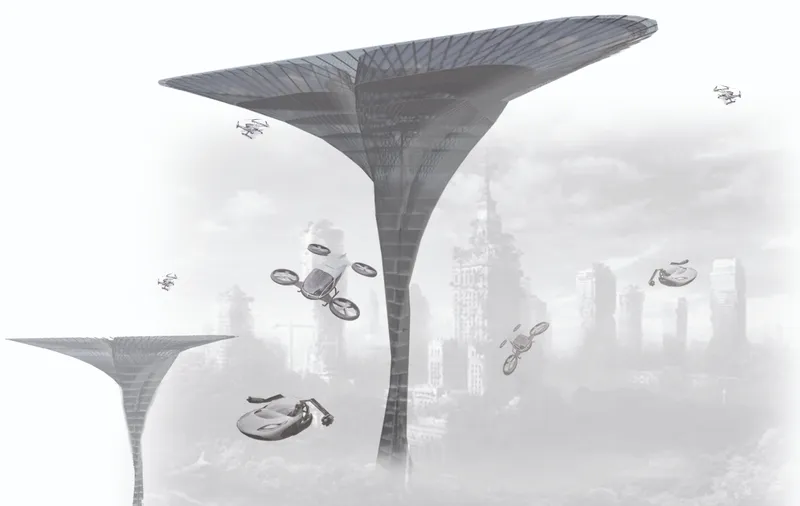
The rendering places the tower in a misty urban skyline, its funnel-shaped silhouette rising through cloud layers while small flying vehicles orbit its upper reaches. The image communicates scale and ambition simultaneously. At 1,300 meters, the structure dwarfs everything around it, but the tapered trunk and broad canopy give it a visual lightness that a conventional rectangular tower at this height would never achieve. The atmospheric haze softens the concrete materiality, lending the building an almost organic presence, as though it grew from the city rather than being imposed upon it.
The inclusion of aerial mobility hints at the project's broader speculation about future urban infrastructure. The tower isn't designed for today's city; it's a prototype for a post-carbon urbanism where buildings actively participate in climate adaptation, energy production, and ecosystem restoration. The rendering captures that forward gaze without descending into pure fantasy, grounding the vision in recognizable atmospheric conditions and a material palette that reads as buildable, even if the timeline remains distant.
Why This Project Matters
Biomimicry in architecture often stops at surface-level imitation: facades that look like leaves, plans that resemble flowers. "Reuse the Nature" pushes past aesthetics to engage with the operational systems of a biological organism. Water harvesting, solar collection, wind management, and programmatic stratification are all derived from how trees actually function, not from how they appear. That distinction elevates the project from formal exercise to genuine systems thinking, and it positions Tütüncü and Nacar as designers willing to interrogate the full depth of their conceptual premise.
Speculative projects at this scale are easy to dismiss as unbuildable daydreams. But their value lies precisely in establishing benchmarks for what architecture could demand of itself. If a tower can generate its own water, power its systems from a solar crown, and stabilize itself through aerodynamic form alone, then every building that falls short of those ambitions has something to answer for. The mega-tree may never be built, but the questions it raises about waste, integration, and ecological responsibility are ones the profession needs to confront now, not in some distant future.
View the Full Project
About the Designers
Designers: Ecenaz Tütüncü, Selahattin Nacar
Enter a Design Competition on uni.xyz
uni.xyz runs architecture and design competitions year-round that reward proposals with spatial conviction and real site intelligence.
Project credits: Reuse the Nature by Ecenaz Tütüncü, Selahattin Nacar.


Popular Articles
Popular articles from the community


Manzana Morphosis: Stretching Barcelona's Grid into a Living Landscape for 2050
A radical reworking of the Eixample manzana turns density into a tool for generous public space, vertical ecology, and environmental performance.
Extended Shell: Retrofitting Kolkata's Balconies as Living Urban Thresholds
A modular retrofit system recovers the social and environmental intelligence of Kolkata's historic verandas for contemporary Park Street residents.

Opera on the Sea: Driftwood Logic Shapes a Timber Opera House on Estonia's Coast
Trevor Orgill's opera house translates the entangled drift of floating timber into a civic building where wood, water, and music converge.
Opera by the Sea Estonia: Three Shells Dissolving Architecture into Tallinn's Coastline
A winning opera house proposal replaces monumental form with interconnected shells that blur the boundary between building, park and Baltic Sea.

Similar Reads
You might also enjoy these articles

The Amber Palace Opera: A Geological Fiction Surfaces on Tallinn's Baltic Waterfront
Pierre Brillard reimagines a Baltic legend as a public landscape, opera house, and waterfront promenade rooted in Tallinn's coastal identity.
Dynamic Modules Shelter: A Telescopic Ring for Mountain Pilgrimage
A circular modular framework of steel, bamboo, and fabric grows vertically with demand, wrapping communal ground in adaptable shelter.

Singing Woman: Contemporary Architecture Inspired by Estonia’s Voice and the Sea
Singing Woman turns Estonia’s song culture into flowing opera house architecture, blending public life, landscape, sea, and national memory.
HYPERBLOCK: Flexible Urban Design for Barcelona’s Future City
HYPERBLOCK reimagines Barcelona as flexible urban design, layering density, daylight, public space and adaptable housing above Cerdà’s grid.

Comments (0)
Please login or sign up to add comments
No comments yet. Be the first to comment!