

Revitalized Drusus Stadium in Bolzano: Modern Football Meets Historic Preservation
Drusus Stadium Bolzano blends historic preservation, modern football standards, increased capacity, heated turf, and modular design for future expansion.


The Drusus Stadium in Bolzano, Italy, has undergone an extensive refurbishment and upgrade, transforming the historic 1936 venue into a modern football arena that meets Serie B standards. Designed collaboratively by gmp Architects alongside Dejaco + Partner and Bergmeister Consulting Engineers, the project combines contemporary stadium design with a deep respect for the site’s historic character. Spearheaded by architects Meinhard von Gerkan, Stephan Schütz, and Ralf Dejaco, the renovation showcases a seamless integration of modern amenities, increased capacity, and sustainable building practices.

Spanning an area of 29,850 m², the renovation involved raising seating capacity from 3,100 to 5,500 spectators, achieved by elongating and extending both main grandstands down to the pitch. The historic portions of the stadium were carefully preserved, while new interventions include a heated natural turf field, complying with Lega Calcio requirements for year-round use, including winter matches. This ensures optimal playing conditions for FC Südtirol, the stadium’s home club representing all of South Tyrol.
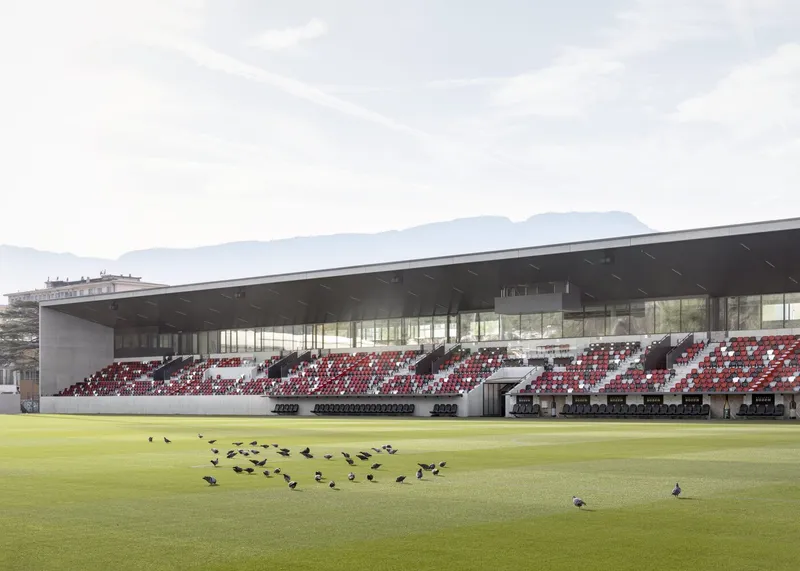
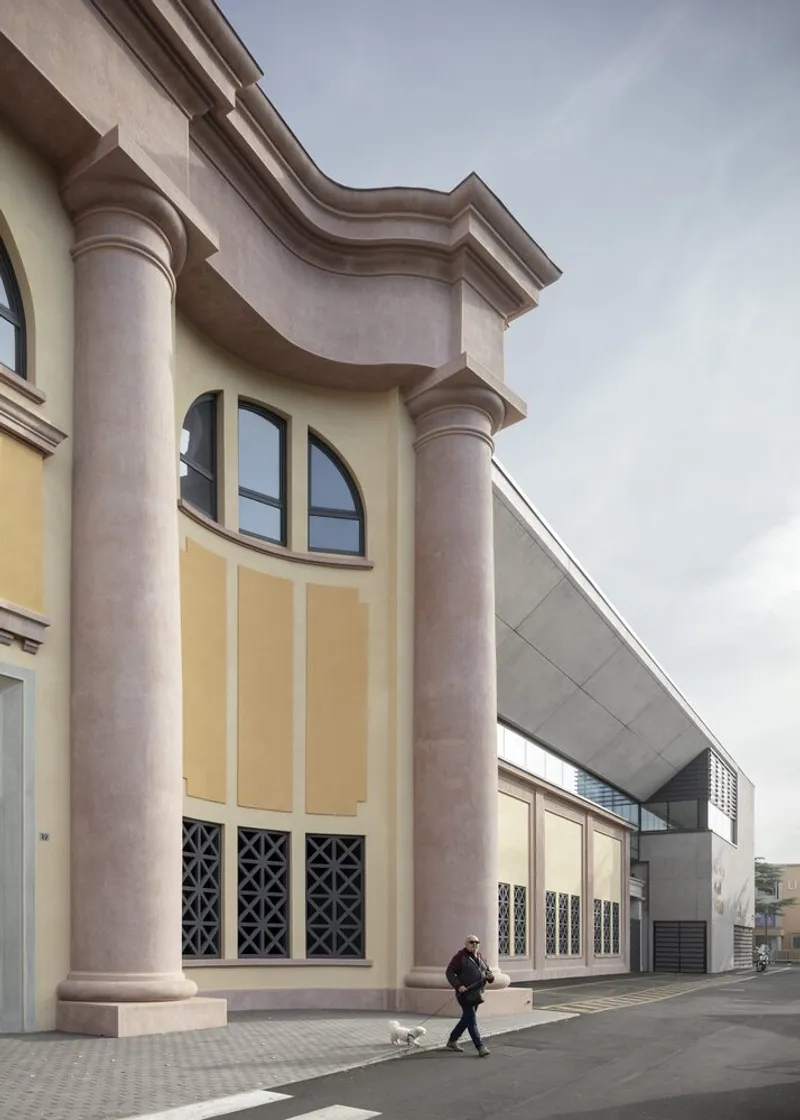
A signature feature of the refurbishment is the “Zanvettor” grandstand, a purist-style construction built behind the historic stadium portal. The monumental portal, a protected structure, has been sensitively integrated into a fair-faced concrete base and covered with steel lattice girders. Beneath the Zanvettor grandstand, all essential facilities for Serie B matches are housed, including upgraded team dressing rooms, a press room, and media workspaces overlooking the field. The historic portal also offers access to fan shops and eateries, usable even outside match days. Administrative offices are located on the upper floor for efficient stadium operations.
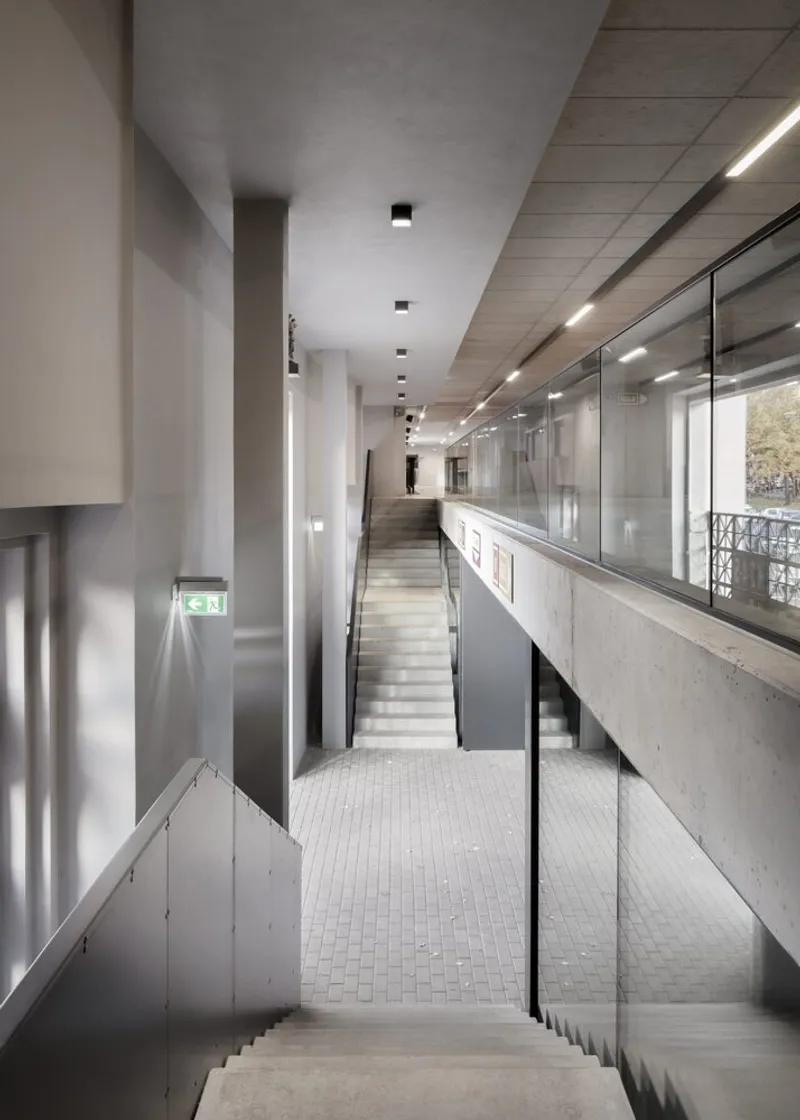
Opposite the Zanvettor, the narrower “Canazza” grandstand with its characteristic vaulted concrete shell roof has been preserved, extended, and upgraded with a simpler roof system that complements the new grandstand design. Future plans envision additional north and south grandstands to increase capacity up to 10,000 spectators. To accommodate this, a modular construction system has been implemented, ensuring straightforward expansion in a second construction phase while maintaining design continuity.
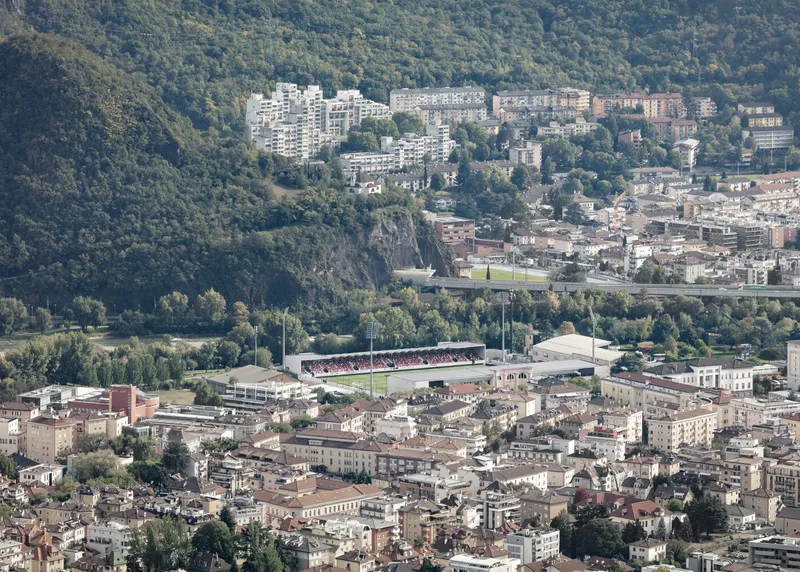
With an investment of approximately €15 million from the Province of South Tyrol and the City of Bolzano, the Drusus Stadium now combines historic preservation, modern football requirements, and sustainable architectural strategies, establishing a benchmark for stadium renovations in Italy.

All photographs are works of
Marcus Bredt


Popular Articles
Popular articles from the community


ETEH Reworks the Shared Spaces of São Domingos School in Brazil Around Timber, Color and Hanging Plants
At São Domingos School in Brazil, 436 m² of hall, refectory and library are recast with timber joinery, a yellow and blue code and trailing greenery.


Opera on the Sea: Driftwood Logic Shapes a Timber Opera House on Estonia's Coast
Trevor Orgill's opera house translates the entangled drift of floating timber into a civic building where wood, water, and music converge.

The Amber Palace Opera: A Geological Fiction Surfaces on Tallinn's Baltic Waterfront
Pierre Brillard reimagines a Baltic legend as a public landscape, opera house, and waterfront promenade rooted in Tallinn's coastal identity.

Manzana Morphosis: Stretching Barcelona's Grid into a Living Landscape for 2050
A radical reworking of the Eixample manzana turns density into a tool for generous public space, vertical ecology, and environmental performance.

Similar Reads
You might also enjoy these articles

Cube Design Draws an Ecological Corridor Between Two Shenzhen Hills with the Nankai Building
Beside Shenzhen's container docks, the Nankai Building pairs stacked balconies with a climbing green screen to connect two hillsides across its height.

Praksis A and Studio Sted Bend a Red Timber Cabin Across the Granite of Norway's Southern Coast
On the southern Norwegian coast, a 105 m² cabin follows the rock on slender posts, pairing red cladding outside with pine, brick and plywood within.

David Ortega Stacks a Two-Story Mexico City Penthouse Around a Steel Stair and a Pergola-Shaded Roof Terrace
In Colonia Roma, a 300 m² penthouse uses oak joinery, a planted steel stair and a slatted roof pergola to make a new-build apartment feel like a house.

PARALELA and LB2 Thread a Public Walkway Through the Base of a Las Condes Residential Tower
In Las Condes, Santiago, the Hamlet Building gives its fenceless ground floor to a 70-metre wooded passage linking two streets and the metro.

Explore Architecture Competitions
Discover active competitions in this discipline

Challenge to reimagine the Iron Throne

Photograph architecture without architects

Illustrate the lost glory of Angkor Wat - Render Challenge

Design challenge to reuse E-waste
Comments (0)
Please login or sign up to add comments
No comments yet. Be the first to comment!