
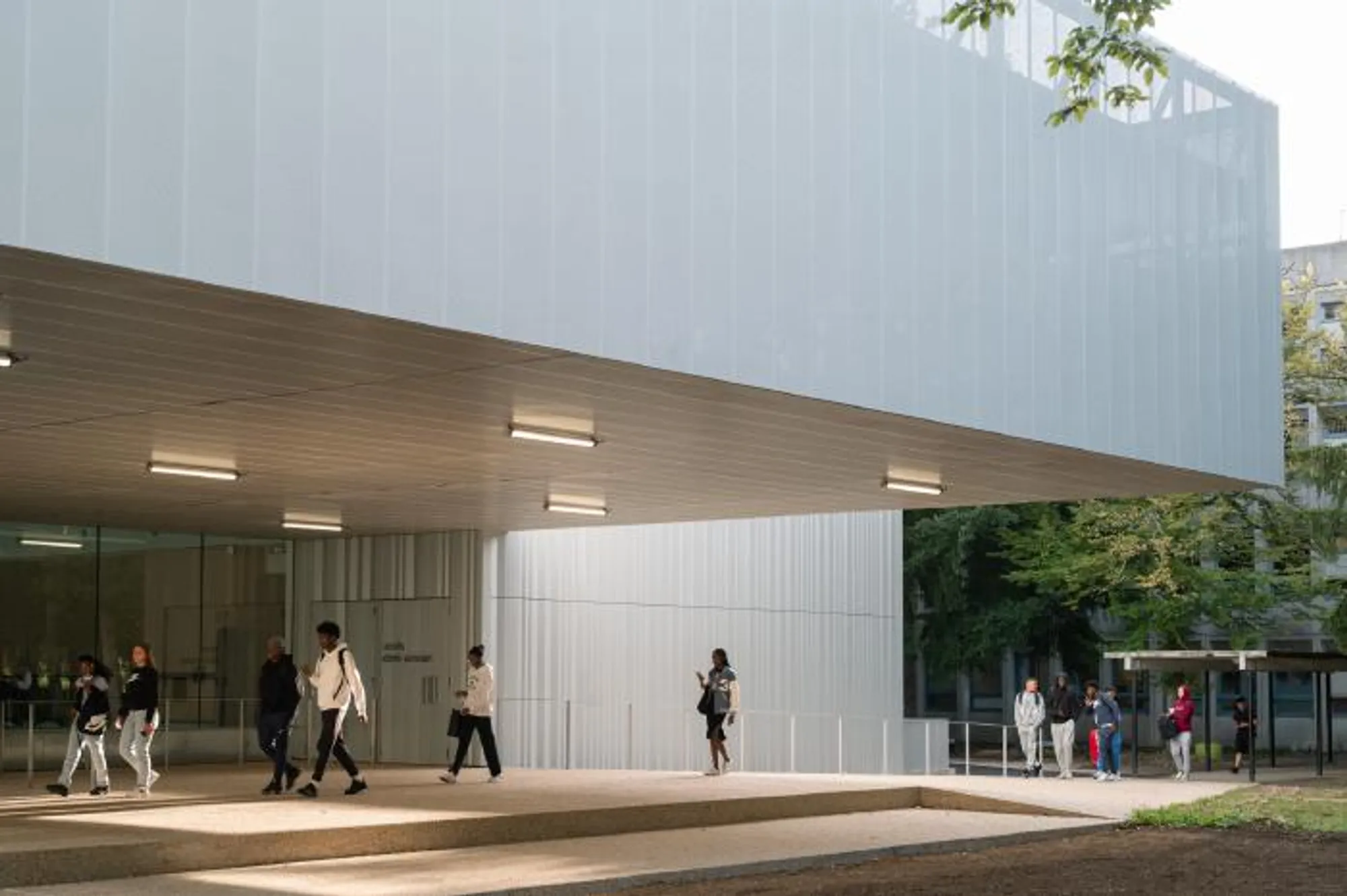
Revolutionary Designs Transcend Boundaries at Frédéric Joliot-Curie High School by Ateliers O-S Architectes
Does the Architectural Brilliance of Ateliers O-S Transform Frédéric Joliot-Curie High School into a Paradigm of Innovation?"


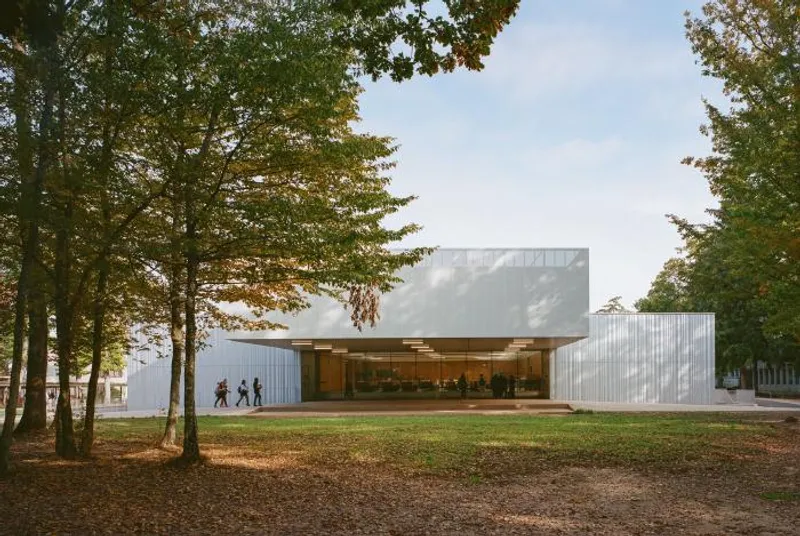
The Frédéric Joliot-Curie High School in Dammarie-les-Lys (Seine et Marne) is situated in the centre of the town. Constructed in 1965, the project covers an area of 5 hectares and comprises 6 buildings with a total constructed area of 10,000 m². These 6 buildings are independent of one another.
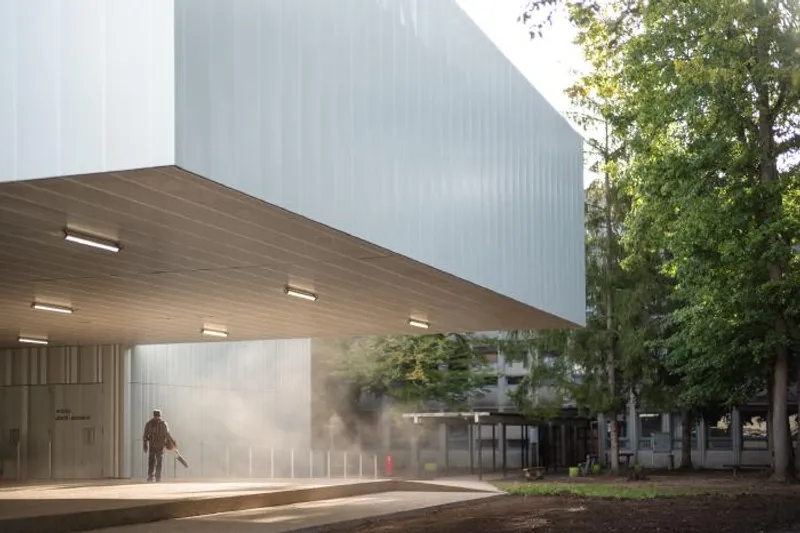
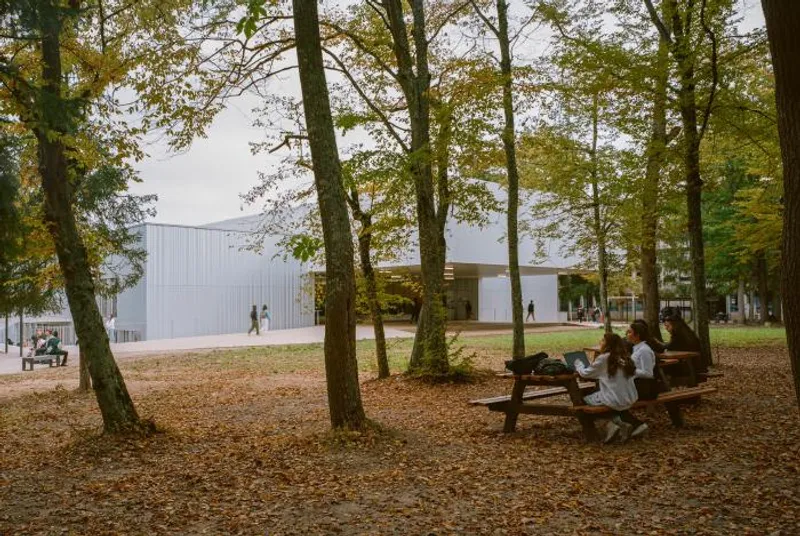
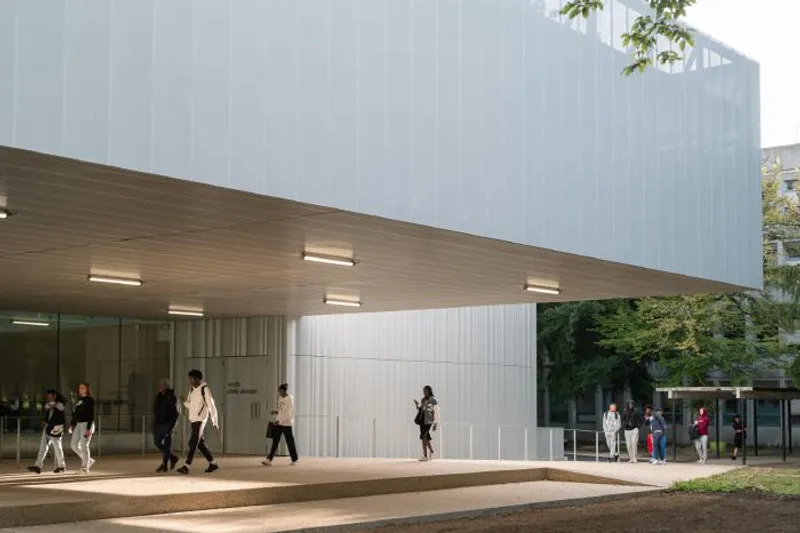
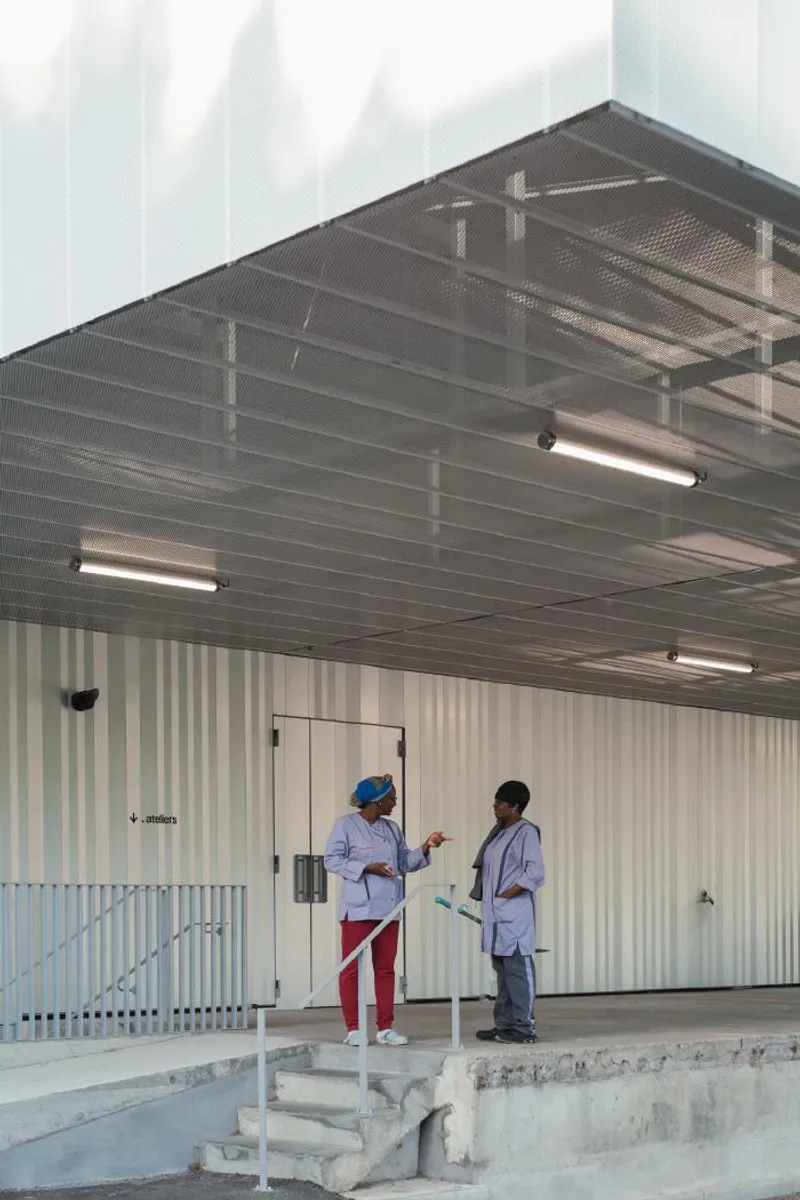
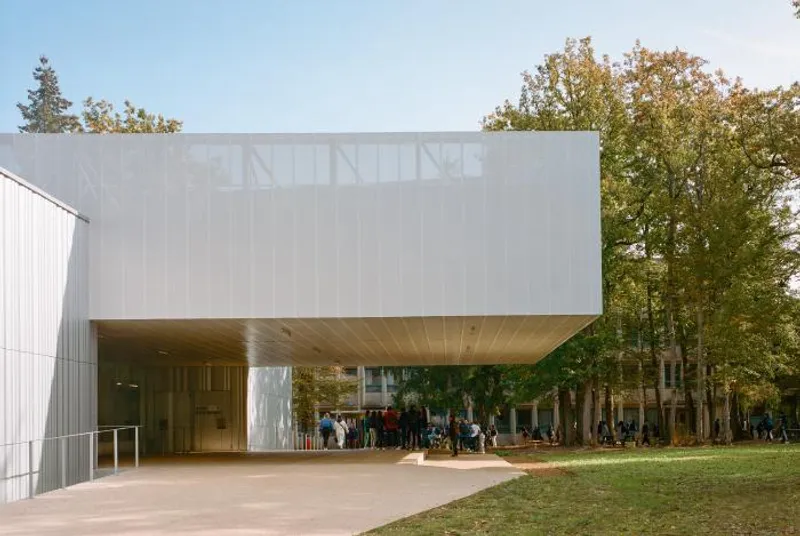
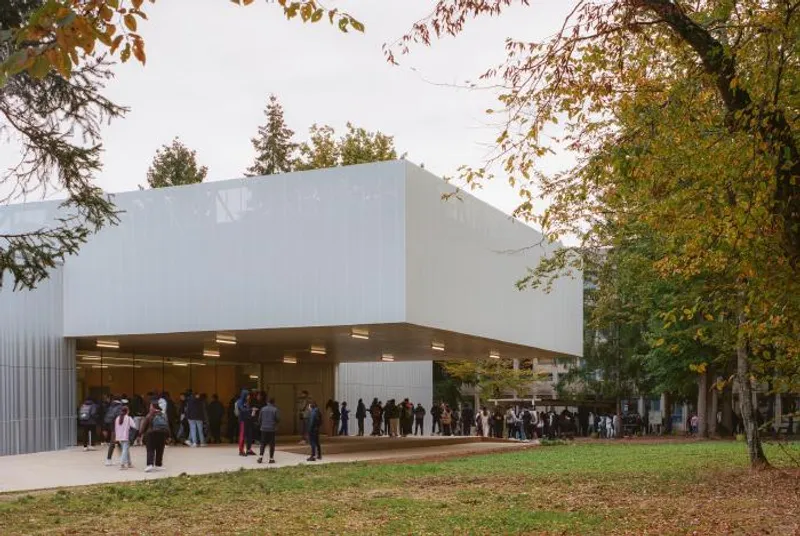
This operation seeks to reorganize Building C, which is situated in the centre of the school in a picturesque setting, bordered by the staff car park (north), the forest (south), and two teaching buildings (east and west). Covered galleries link the current refectory to the other buildings. On the south façade, a canopy provides shelter for students waiting to enter the cafeteria, and the roof design is oriented towards the forest. The ground levels enable the technical rooms on the garden level to be illuminated by natural light. Food for the refectory is unloaded onto a platform located on the north façade, near the staff car park.
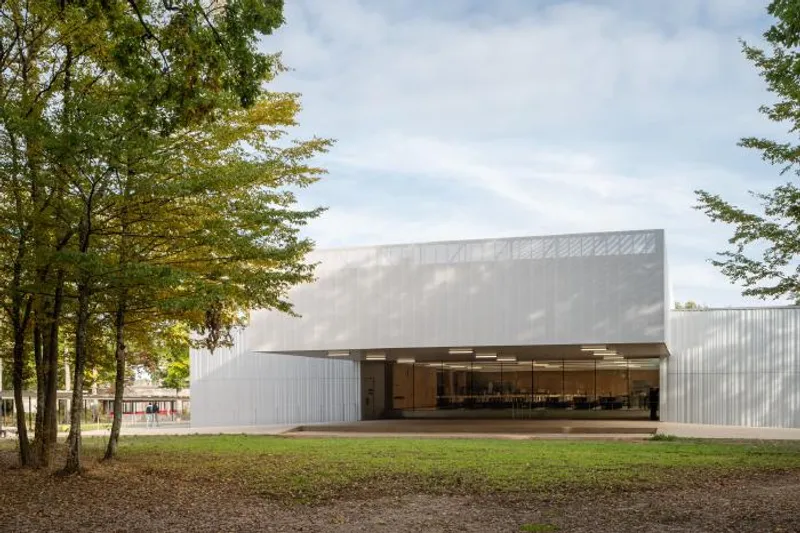
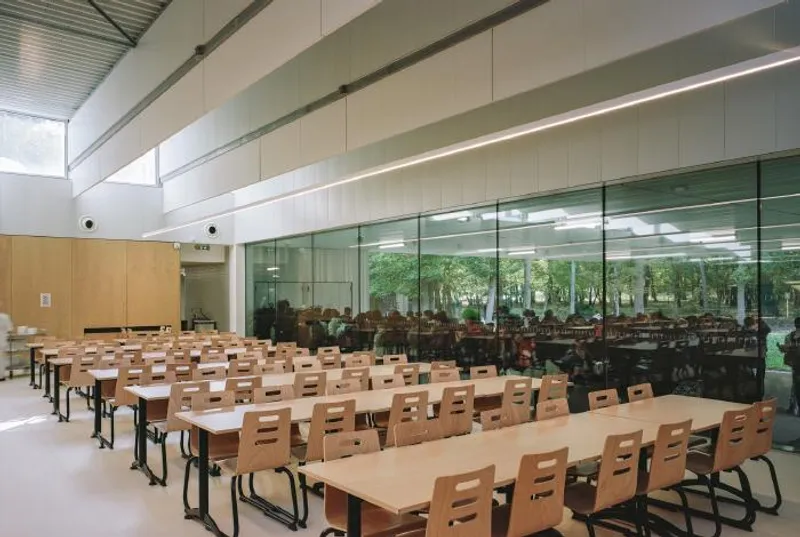
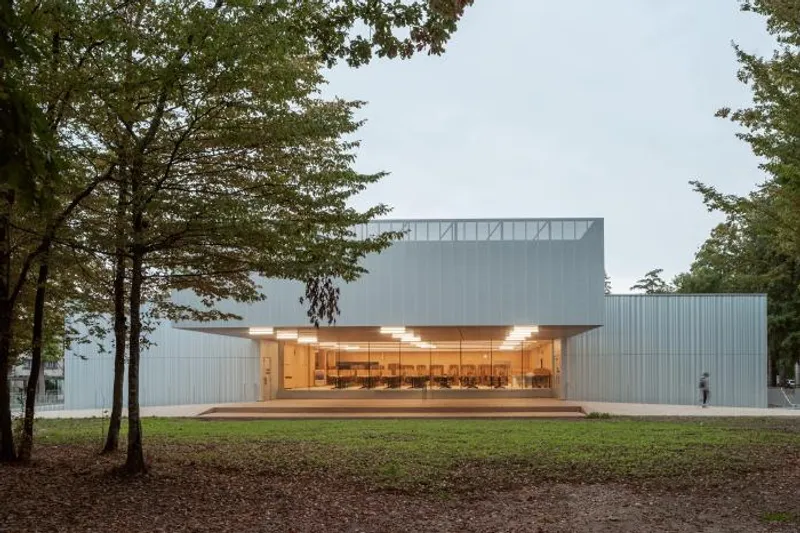
The building comprises a ground floor and a garden level. The ground floor houses the preparation, catering and dishwashing areas, the cold rooms, the storerooms, the student foyer and the delivery area. The garden level is divided into two zones. The first zone is accessible to the public from the outside and includes the rooms of the school life centre (student club, gym, music room). The second zone is accessible to staff and includes the archives, the furniture store, the staff changing rooms, the head teacher's office and the staff workshops. The project seeks to enhance the orientation by extending the high roof to the north and south. This roof provides a view of the forest from the large dining room. Additionally, the lateral "wings" open up to the west and east, with the creation of a main entrance from the west to the lower level of the garden level. As such, the project is presented as a straightforward volume, composed of two registers.
- A low metal register, composed of corrugated panels in a metallic grey hue, detaches the project from the ground, functioning as a base. It is organized according to the program, proposing a set of openings that reveal the interior volumetry.
In a remarkable architectural endeavour, Ateliers O-S Architects has breathed new life into Frédéric Joliot-Curie High School, revolutionizing the learning environment for students. The project's focal point was the incorporation of a clear and elegant upper register, crafted with perforated aluminium panels, which adds a touch of sophistication and serves a dual purpose of illuminating the dining areas while acting as a protective canopy for students during inclement weather.
The construction principle employed in this transformation adhered to the principles of economy, scalability, and ease of implementation. A steel portal frame structure, enveloped in metal cladding, ensured both simplicity and efficiency while allowing for substantial interior space for customized design and optimized functionality. This thoughtful approach catered to the diverse needs and specific uses of the high school.
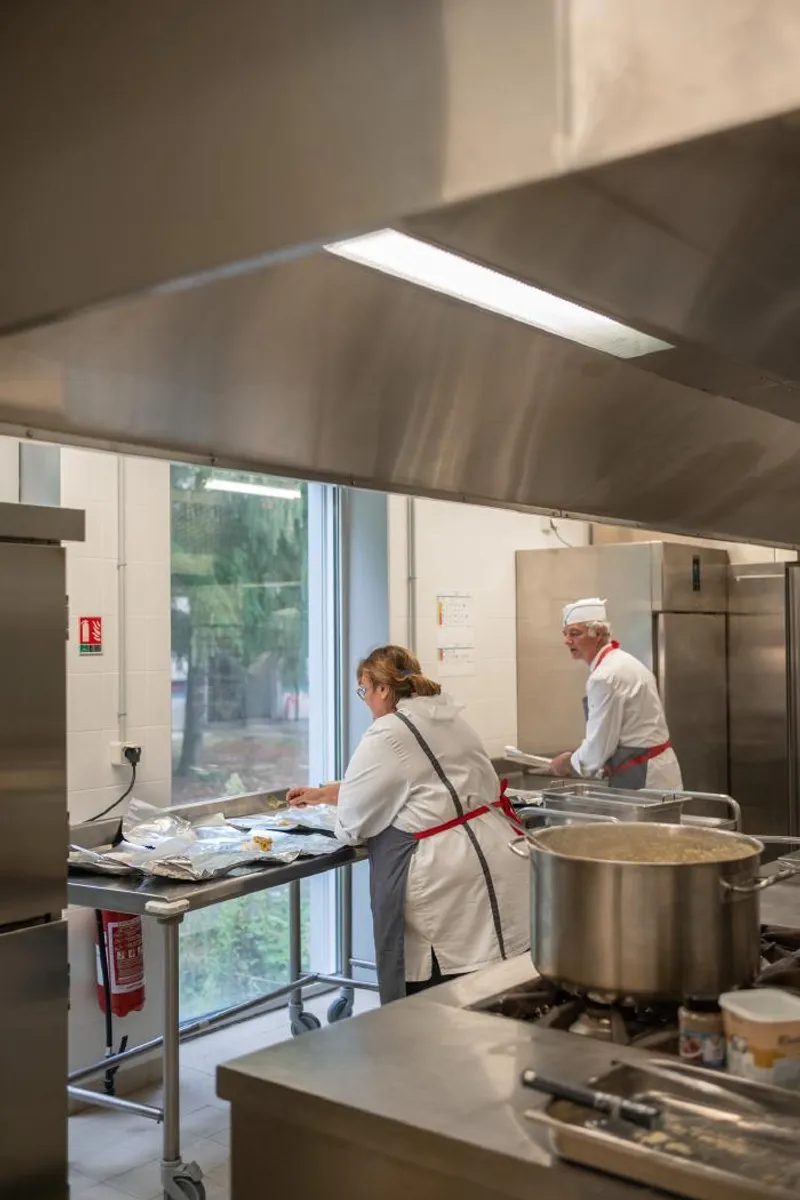
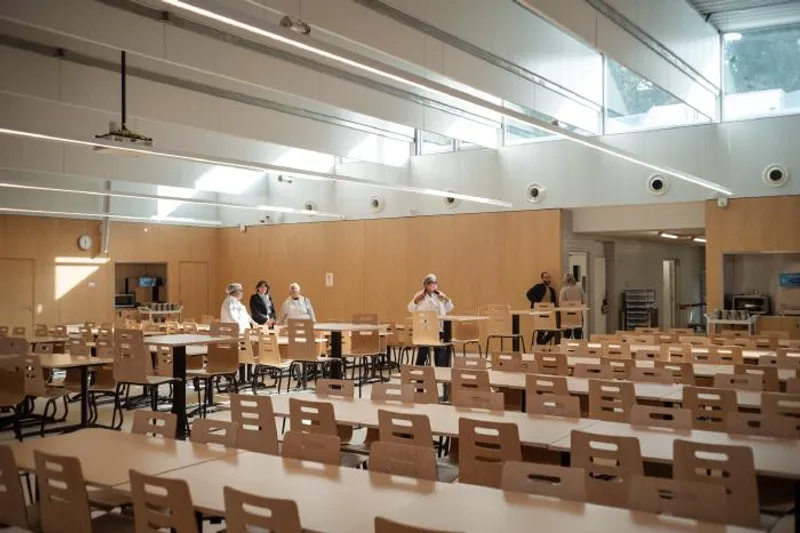
Building C underwent significant restructuring to consolidate all services related to the half-board facility on the ground floor, conveniently accessible from the south façade. The newly designed half-board centre features distinct zones, including preparation areas, a dining room, a work area, and a public space. With flexible programming and the ability to accommodate different configurations, this expansive dining area has the capacity to serve approximately 1200 guests daily, accommodating the high school's growing population.
The interior layout of the half-board facility is meticulously organized, adhering to regulations on food hygiene and implementing a forward-motion approach. The self-service distribution system, supported by a production kitchen, follows an "L" shaped food circuit design that ensures efficient and fluid operations. This well-planned flow is further enhanced by ample natural light and direct communication between spaces, maximizing circulation efficiency.
Moreover, the project emphasized accessibility, with a new lift situated at the entrance of the foyer and catering areas, providing seamless mobility throughout Building C for individuals with reduced mobility. The design considerations extended to the entire establishment, enabling both the half-board and living areas to be fully inclusive and accessible to all students.
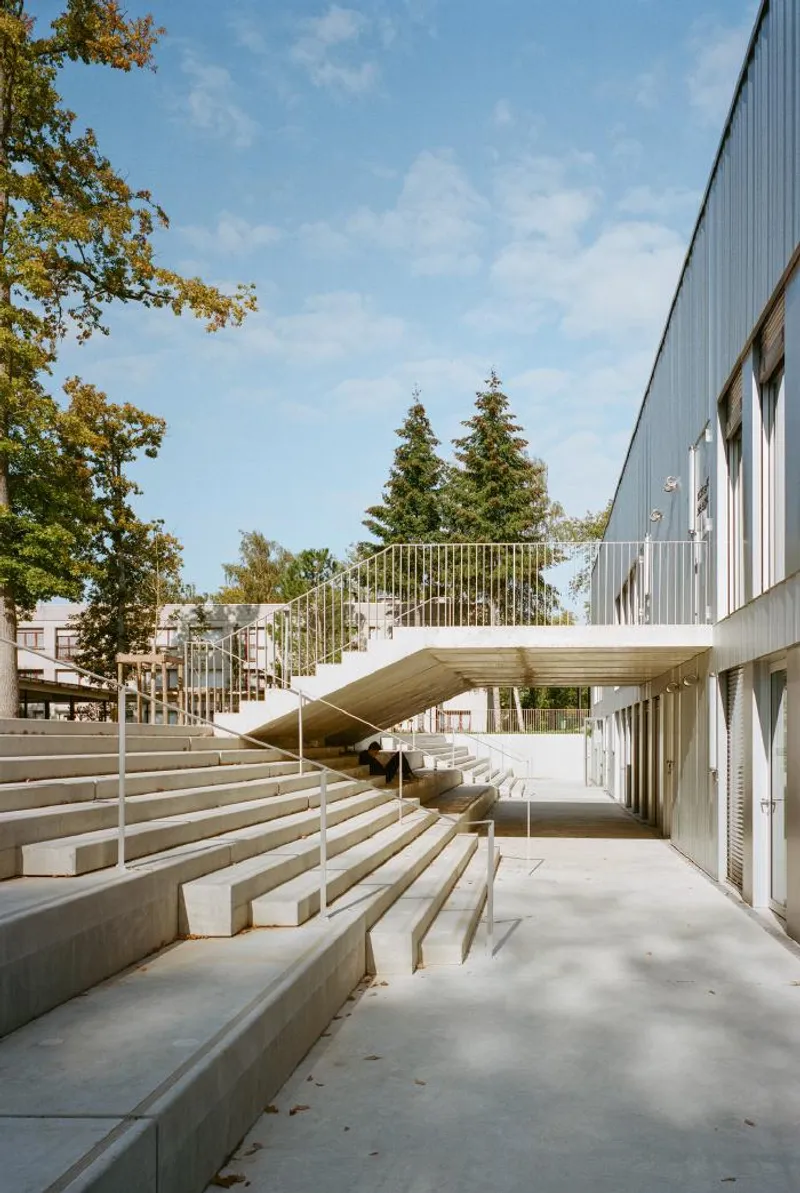
The lower level of the high school now boasts a vibrant living area, complete with club rooms, music rooms, a sports hall, and a versatile meeting and conference space that can be configured to accommodate various events. This independent section of the school can be accessed via a tiered forecourt reminiscent of an amphitheatre, fostering a sense of community and encouraging engagement among students.
To address maintenance and storage needs, the workshops have been strategically reorganized and are accessible from a controlled service area. This meticulous attention to detail and functionality ensures smooth operations behind the scenes, further enhancing the overall efficiency of the high school.
Situated in Dammarie Lys (77), this architectural project seamlessly blends existing structures with modern additions. By repurposing an outdated building plagued with asbestos and lacking spatial quality, Ateliers O-S Architectes successfully brought it up to contemporary standards. The design juxtaposes volumes, raising the main refectory and introducing lateral windows that flood the space with natural light. The new volumes also offer two canopies, one serving as a technical entrance on the north façade, while the other provides a spacious shelter for students on the south side, enabling covered waiting and gathering areas.
This transformative project not only rejuvenated the high school but also provided students with an immersive architectural experience. As the construction took place on an occupied site, Ateliers O-S Architectes navigated the challenge expertly, optimizing existing elements and engaging in meaningful dialogue with both the client and the end users. The result is a testament to the potential and adaptability of our built heritage, showcasing the discipline of architectural reuse.



Popular Articles
Popular articles from the community


The Earth Pod: 3D Printed Homes for Resilient Refugee Communities
The Earth Pod reimagines refugee housing through 3D printed homes made from clay, combining resilience, self-sufficiency, and rapid shelter.

Hill & Cross Opera: Sculptural Opera House Architecture Shaped by Tallinn’s Landscape and Identity
Hill & Cross Opera reimagines opera house architecture in Tallinn through its sculptural hill, civic plaza, glass wave and a luminous cross.

Play: Fragments of Their World
Familiar architecture becomes modular playground design, creating safe spaces where displaced children can learn, connect, imagine and play.

Co-life: Sustainable Architecture for Age-Friendly Community Living
Co-life reimagines sustainable architecture for seniors through courtyards, rammed earth, shared gardens, and spaces designed for belonging.


Similar Reads
You might also enjoy these articles
116 Rokeby Building, Collingwood
Sustainable Collingwood office building featuring double-skin façade, natural ventilation, rooftop amenities, and carbon-neutral design focused on wellbeing and longevity.
Contemporary Apartment Renovation in Spain: RV House by BIAN Opens Up to the Sea
A minimalist 1930s apartment in Santander is transformed into a flexible, sea-facing home through contemporary Spanish renovation.
3 Marías House: A Contemporary Mediterranean Courtyard Retreat by Bajet Giramé + Burckhardt
Mediterranean courtyard home blending traditional architecture with modern design, terracotta flooring, flexible interiors, sustainable climate strategies, and garden integration.
NZ10 Apartment by auba studio: Adaptive Reuse in Palma de Mallorca
Adaptive reuse apartment transforms bakery into light-filled home with patios, privacy layers, and wood interiors enhancing urban living experience.
Explore Educational Building Competitions
Discover active competitions in this discipline



Challenge to design public laboratory


Challenge to reimagine the Iron Throne


Photograph architecture without architects


Illustrate the lost glory of Angkor Wat - Render Challenge
Comments (0)
Please login or sign up to add comments
No comments yet. Be the first to comment!