

The Funnel: A Prison Designed Around Rehabilitation, Not Isolation
A phased correctional facility that borrows from kintsugi philosophy to reframe incarceration as a process of repair and reintegration.


What if a prison looked less like a fortress and more like a funnel, channeling people from confinement toward reentry? That is the provocation at the heart of The Funnel, a correctional facility concept that replaces the hermetic isolation of traditional penitentiary design with a graduated spatial sequence. Offenders move through four distinct phases: Reflect, Reform, Reintegrate, and Reborn. Each phase has its own architectural character, and the building's physical layout ensures that the journey from inward accountability to outward social participation is legible in section, plan, and everyday experience.
Designed by Christie Chin, The Funnel received a Special Mention in the Switching Prisons competition. The brief asked entrants to rethink prison infrastructure for a world that increasingly recognizes mass incarceration as counterproductive. Chin's response is notable for its clarity of concept: the building is not simply a container for punishment but a structured environment that integrates both offenders and the general public, using architecture as an instrument of rehabilitation rather than retribution.
Kintsugi as Conceptual Foundation
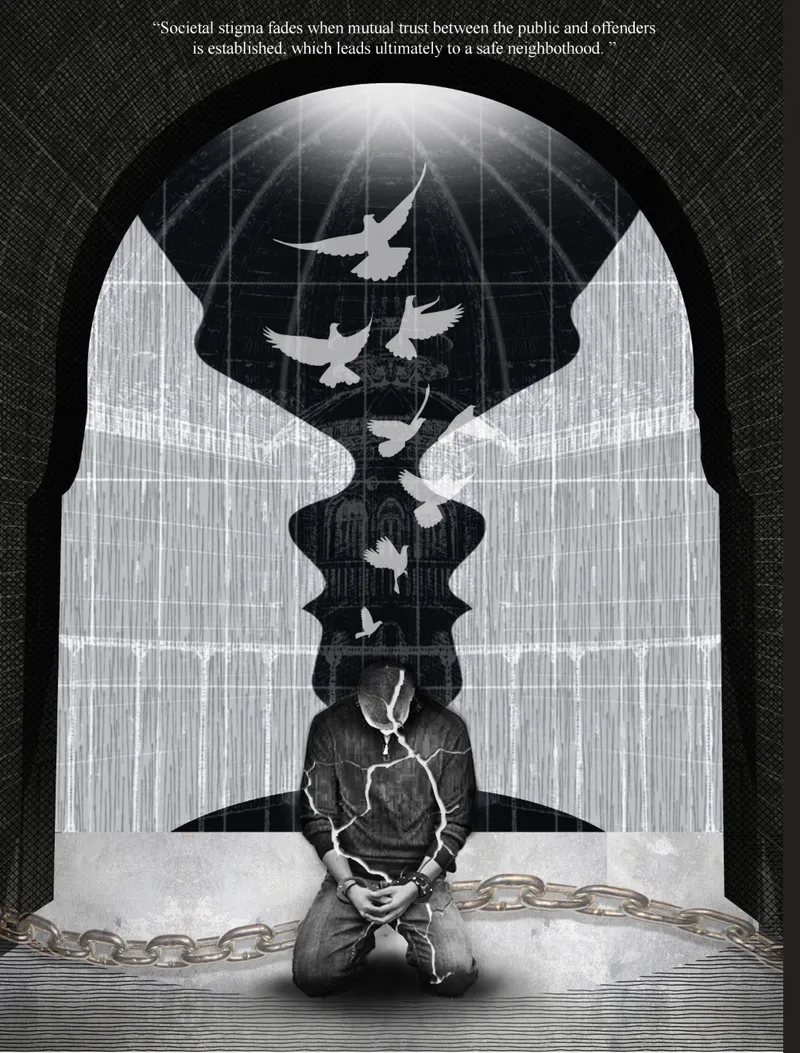

The project opens with two powerful conceptual images. A silhouetted figure sits before an arched window as birds fly free and chains lie broken, establishing the emotional register of the proposal. Alongside it, four views of ceramic bowls repaired with gold joinery (the Japanese art of kintsugi) make the design philosophy explicit: damage is not something to hide but something to acknowledge, repair, and ultimately celebrate. Chin positions incarceration itself as a crack in a life, and the facility as the gold that mends it. It is a metaphor that could easily feel decorative, but here it informs real spatial decisions about progression, visibility, and dignity.
A Central Void That Organizes the Whole

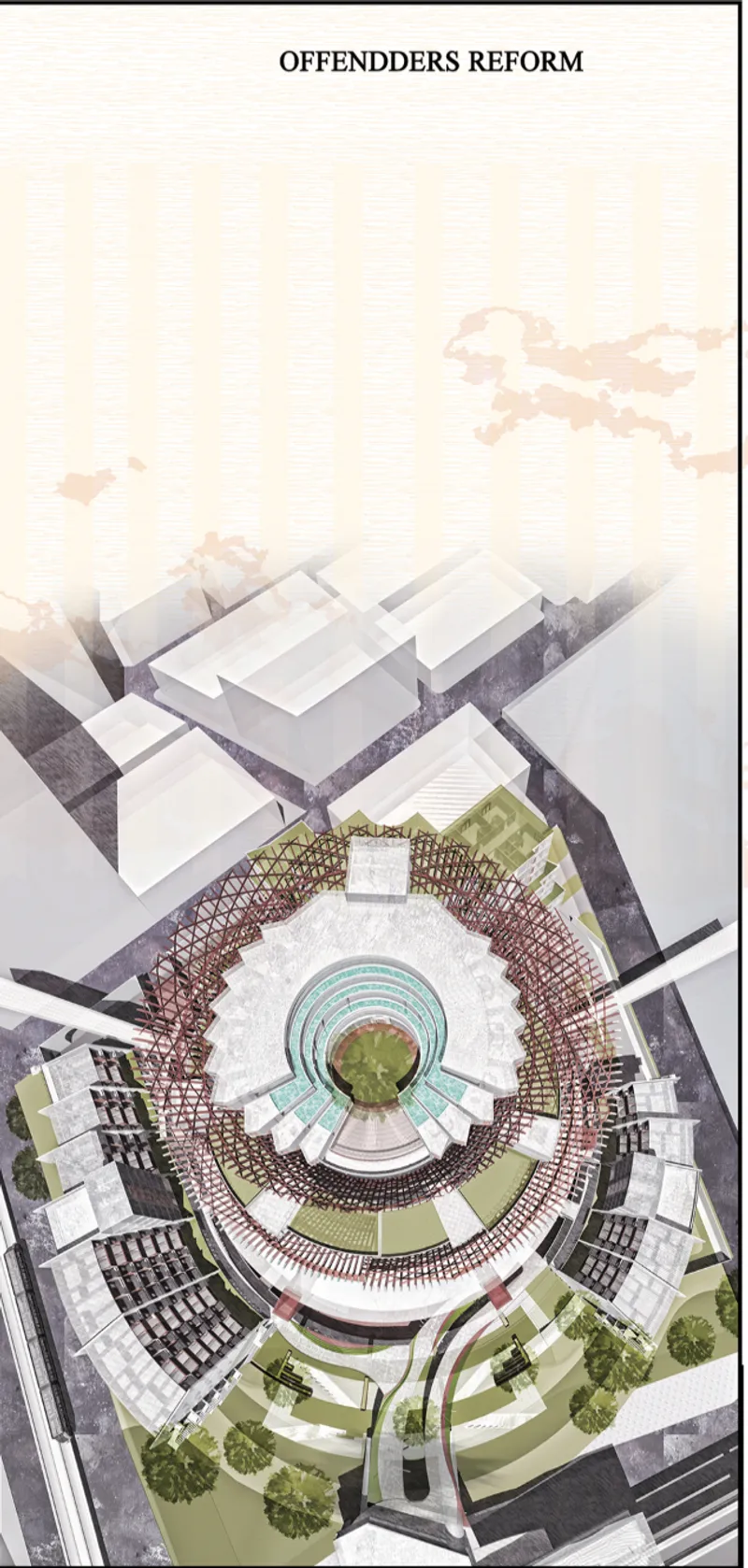
The section drawing reveals a multilevel complex organized around a central void, with terraced gardens stepping down toward it and birds overhead rendered in loose watercolor. The void functions as both a literal and symbolic core: natural light reaches deep into the building, planted terraces create transitional zones between programmatic areas, and the vertical openness counters the claustrophobia that defines most correctional architecture. In the aerial plan view, the facility reads as a circular form with radiating wings and a generous central courtyard ringed by trees. The geometry is deliberate. Radial organization means that each wing can house a different rehabilitation phase while still connecting to shared communal space at the center.
Latticed Facades and Terraced Living

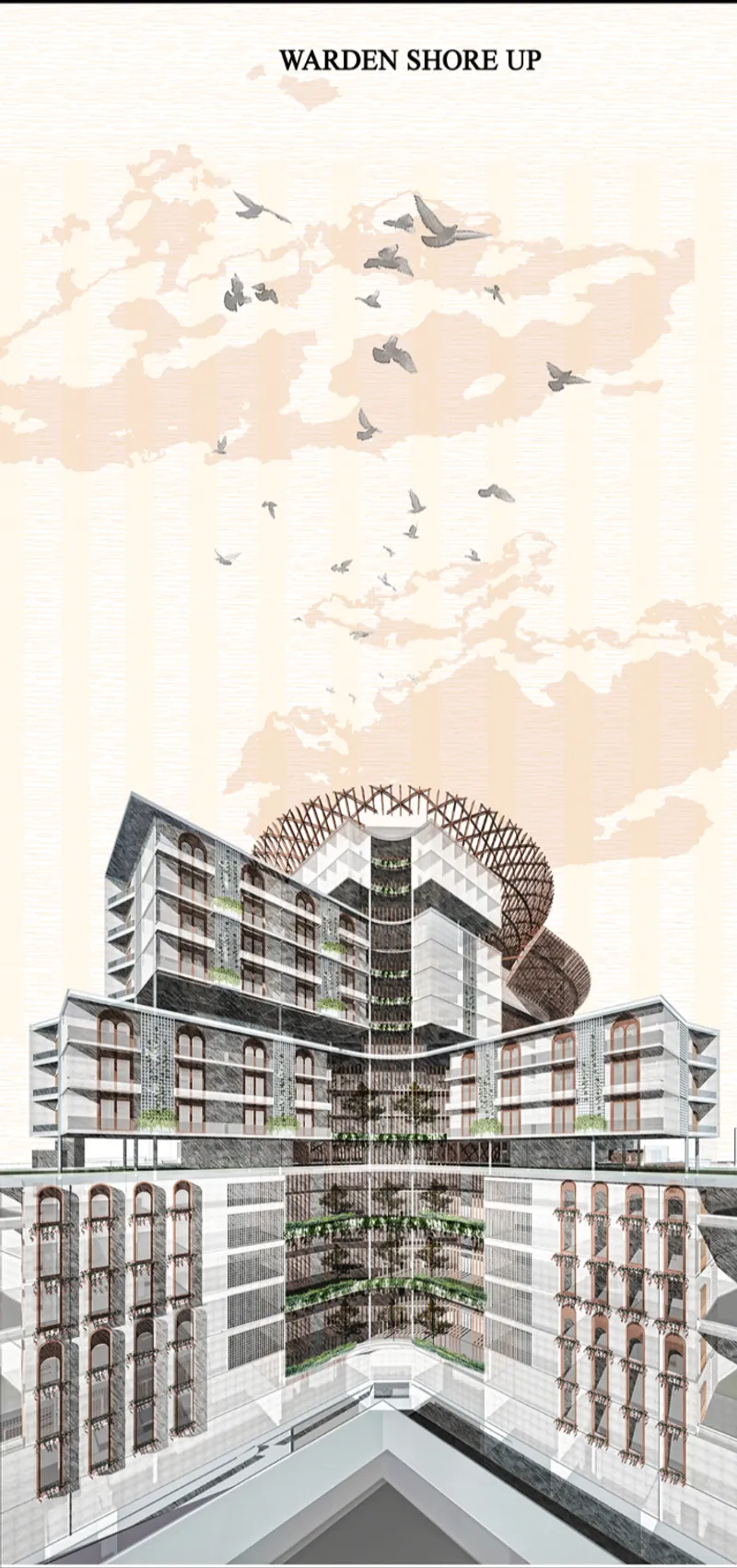
Two elevation and section renderings show how the building meets the sky. The exterior features latticed facades that filter light and allow controlled views outward, a meaningful gesture for a typology that typically presents blank walls to the world. Terraces punctuate the stacked volumes, creating outdoor spaces at multiple levels where both interaction and solitude are possible. In the sectional view, residential wings flank a central tower capped with planted terraces, and birds are a recurring motif, reinforcing the theme of eventual freedom. The massing avoids the monolithic quality of conventional prisons; instead, it reads as a layered, inhabited landscape.
Phased Rehabilitation Made Spatial


The exploded axonometric drawing is where Chin's four-phase framework becomes architecturally concrete. Stacked floor plates reveal varied programmatic zones arranged around the central core. The Reflect phase occupies the most enclosed, inward-facing levels, encouraging self-awareness and responsibility in spaces designed for quiet contemplation. Reform introduces classrooms and vocational training areas. Reintegrate opens the plan to social interaction, with shared workshops and skill-development facilities that bring offenders and members of the general public into proximity. Reborn, at the outermost and most permeable edge, facilitates the final transition to a productive societal role.
An accompanying diagram sheet annotates these functional zones with plan views and axonometric studies, mapping circulation routes and spatial relationships with precision. The logic is straightforward: as an individual progresses through the rehabilitation process, the architecture literally opens up, granting more light, more access, and more agency. It is a spatial argument that the path from incarceration to freedom should be legible, incremental, and humane.
Why This Project Matters
Prison design rarely attracts the attention of the broader architecture community, and when it does, the conversation tends to stall at critique without proposing alternatives. The Funnel goes further. By grounding its concept in a clear rehabilitative framework and then translating that framework into section, plan, and material strategy, Chin demonstrates that correctional architecture can be both rigorous and empathetic. The integration of public access is especially significant: it challenges the notion that prisons must be invisible to the communities they serve, and it positions architecture as a tool for reducing the stigma of incarceration.
Modern criminological research consistently shows that environments designed around punishment increase recidivism, while those designed around reintegration reduce it. The Funnel aligns with that evidence. More importantly, it does so without sacrificing architectural ambition. The central void, the phased spatial sequence, the kintsugi philosophy made material: these are design moves that would be compelling in any building type. That they are deployed here, in a typology long defined by deprivation, makes them all the more urgent.
View the Full Project
About the Designers
Designer: Christie Chin
Enter a Design Competition on uni.xyz
uni.xyz runs architecture and design competitions year-round that reward proposals with spatial conviction and real site intelligence.
Project credits: The Funnel by Christie Chin Switching Prisons (uni.xyz).


Popular Articles
Popular articles from the community

Tsunami Convergenics: Turning Catastrophic Ocean Forces into Underwater Housing Infrastructure
A speculative underwater settlement off the coast of Onagawa, Japan, treats tsunamis and typhoons as energy sources rather than threats.
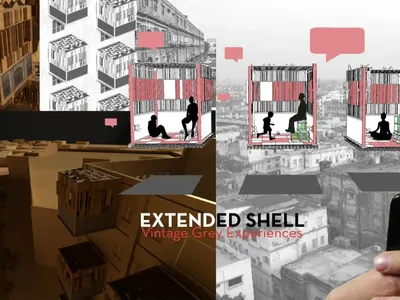
Extended Shell: Retrofitting Kolkata's Balconies as Living Urban Thresholds
A modular retrofit system recovers the social and environmental intelligence of Kolkata's historic verandas for contemporary Park Street residents.

Faces of the Soviet Avant-Garde: Turning Moscow's Street Names into an Open-Air Museum
A network of sculptural installations across a Moscow residential district transforms forgotten architect names into spatial encounters with cultural memor

Cloaked Colonization: A Mobile Underwater Habitat That Moves Like a Fish
Micah Abaya's shortlisted EHC Pacific entry reimagines ocean settlement as a dispersed network of self-sustaining architectural organisms.

Similar Reads
You might also enjoy these articles

Shakur's House: Exposed Brick as an Interior Organiser in a 168 m² Mashhad Residence
Brick moves indoors in this Mashhad residence, where masonry walls, glass partitions and teal planes sequence a compact home without closing it off.

Day and Night Park: A Time-Based Urban Newsstand in Beijing
A temporary urban newsstand in Beijing blending travel, light, and reading through poetic colors, compact form, and community-focused design.

Modernist Patio Renovation in El Masnou, Barcelona by Oliver Segura Arquitectura + Cebrià Arquitectura
Modernist patio renovation blending tradition and innovation with a movable pool, leveled floors, and Catalan materials in El Masnou.

Alto Residencial Coop: Cooperative Housing Development in Santiago de Compostela by Carbajo Barrios Arquitectos
A linear cooperative housing complex blending white volumes and perforated metal façades, enhancing community living, natural light, privacy, and urban integration.

Comments (0)
Please login or sign up to add comments
No comments yet. Be the first to comment!