
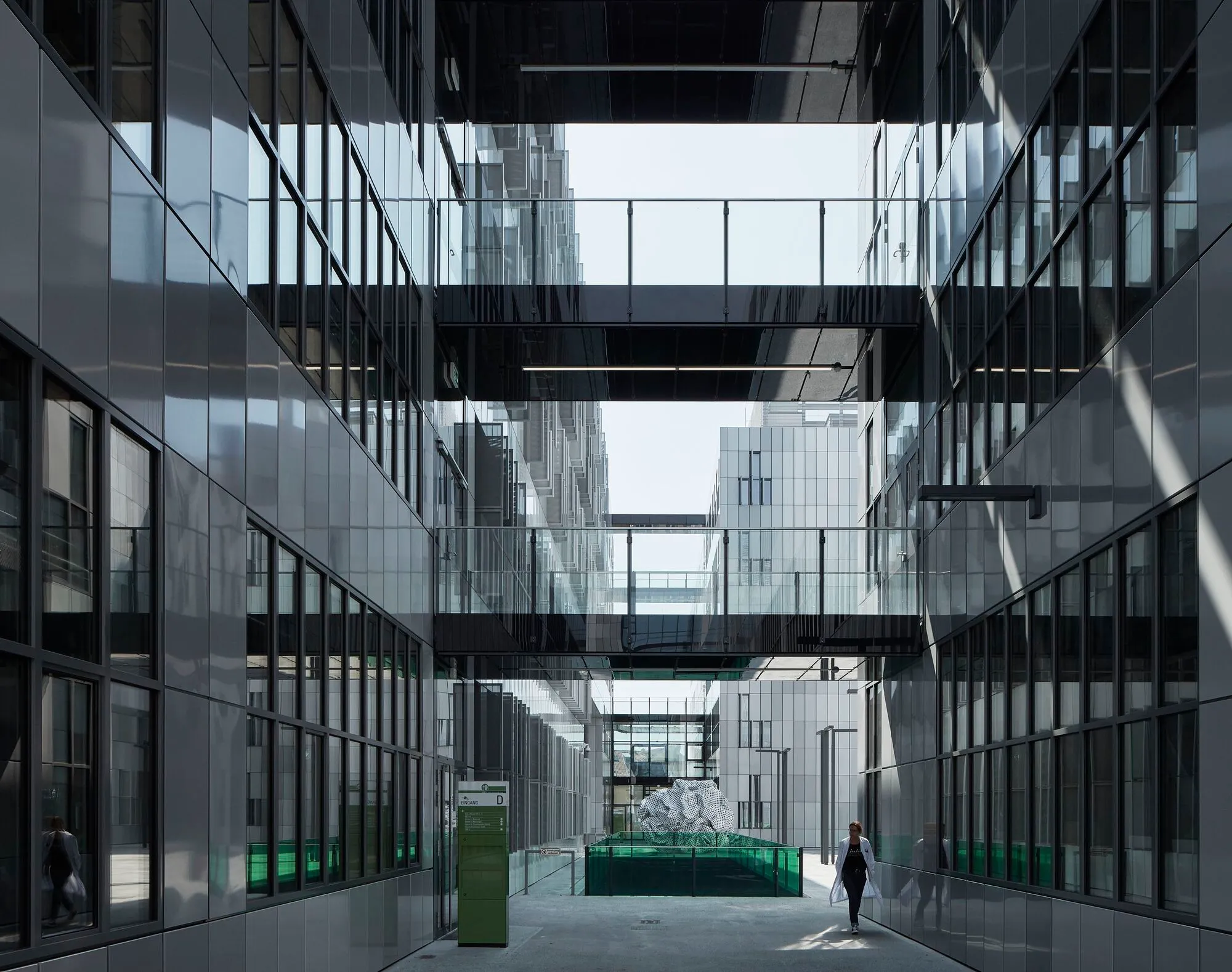
Riegler Riewe Architekten Builds a New Medical Quarter for Graz from 90,000 Facade Elements
A decade-long campus project consolidates Graz's dispersed medical university into a coherent inner-city ensemble of teaching, research, and public life.


Universities rarely get the chance to start over. The Medical University of Graz had its departments scattered across the city for decades, a legacy of incremental growth that made collaboration slow and identity diffuse. When Riegler Riewe Architekten won the competition in 2010, the brief was not just a building but an entire urban quarter: alleys, squares, bridges, and over 53,000 square meters of usable floor area stitched into the fabric adjacent to the LKH University Hospital. What opened in stages between 2017 and 2023 is a campus that accommodates 2,500 employees and roughly 5,000 students, all consolidated into a legible ensemble for the first time.
The most interesting move here is not the scale, which is substantial, but the discipline. Rather than producing a signature silhouette, Riegler Riewe treated the campus as an urban design problem. Narrow, longitudinally oriented volumes are arranged to maintain airflow into the Graz Basin and maximize daylight penetration. A raised campus level acts as a distribution plane: below it sit auditoriums, parking, and technical infrastructure; above it rise institutes and laboratories. The result is a place that functions like a small city rather than a single monument, and its Platinum ÖGNI/DGNB certification and the Austrian State Prize for Architecture 2023 confirm it performs as well as it reads.
An Urban Strategy, Not a Building
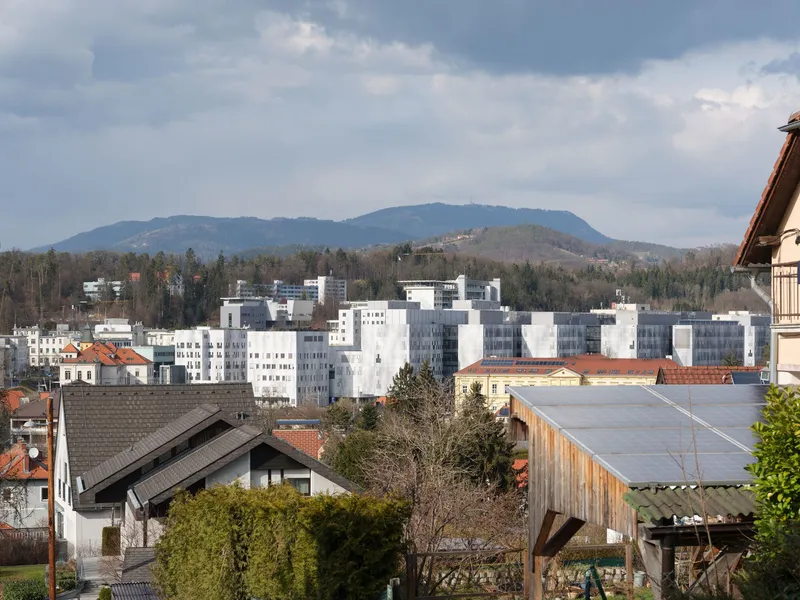
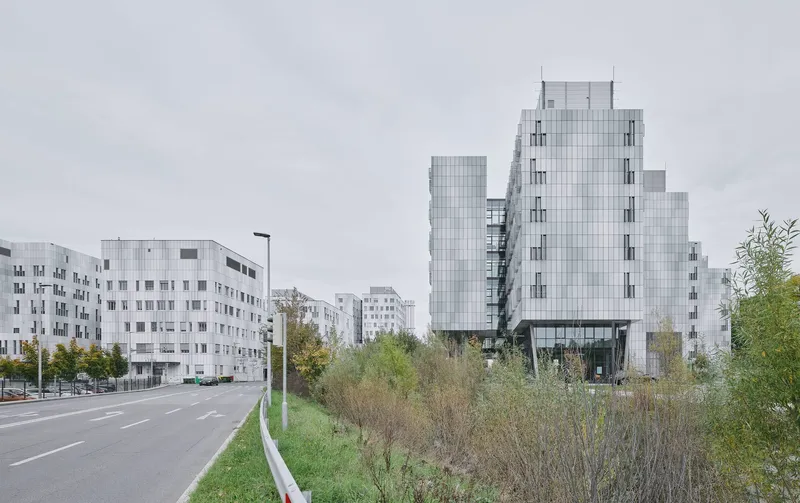
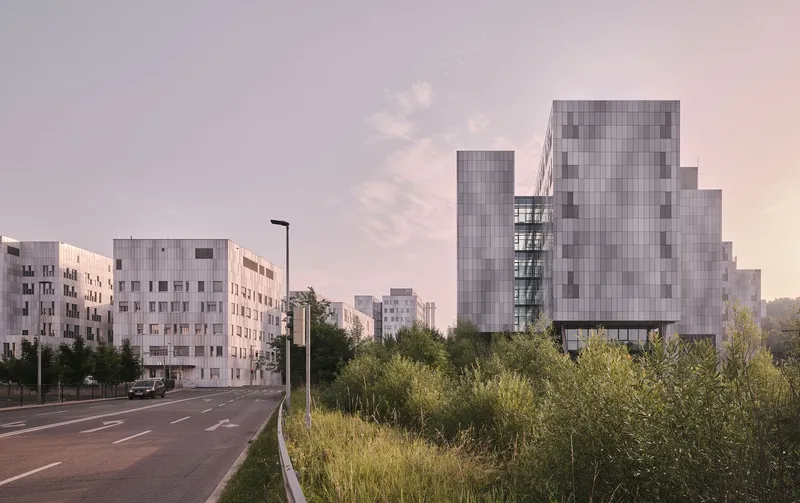
Seen from the surrounding rooftops, the campus registers as a family of white cubic volumes rather than a single mass. The stepped profiles create varied skyline relationships with existing residential blocks and the mountains beyond. Each building is differentiated in height and footprint, yet a shared material language holds them together. From the street, the complex reads as a new neighborhood that arrived with its own public realm rather than a fortress that turned its back on the city.
The narrow bar typology is a deliberate environmental choice. By orienting long, slender volumes along a consistent axis, the architects ensured that fresh air channels through the gaps between buildings, a critical consideration in the notoriously stagnant Graz Basin. Wildflower meadows and landscaped courts fill these interstices, turning what could be utilitarian setbacks into genuinely occupied outdoor spaces.
The Campus Level and Its Bridges
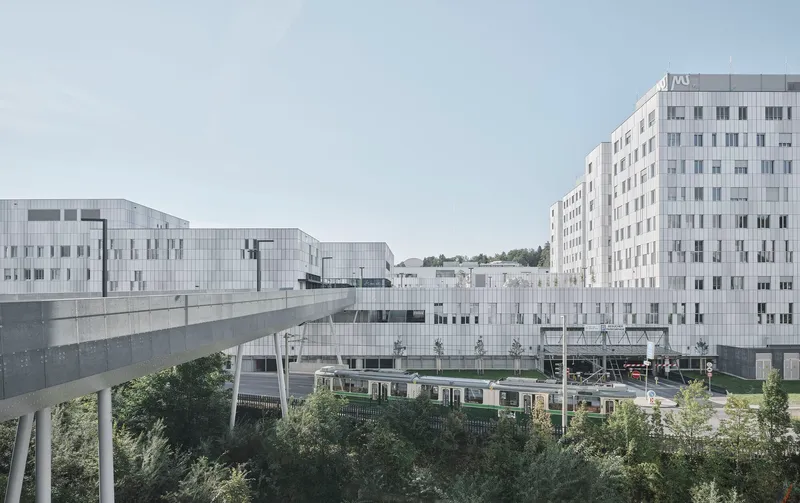
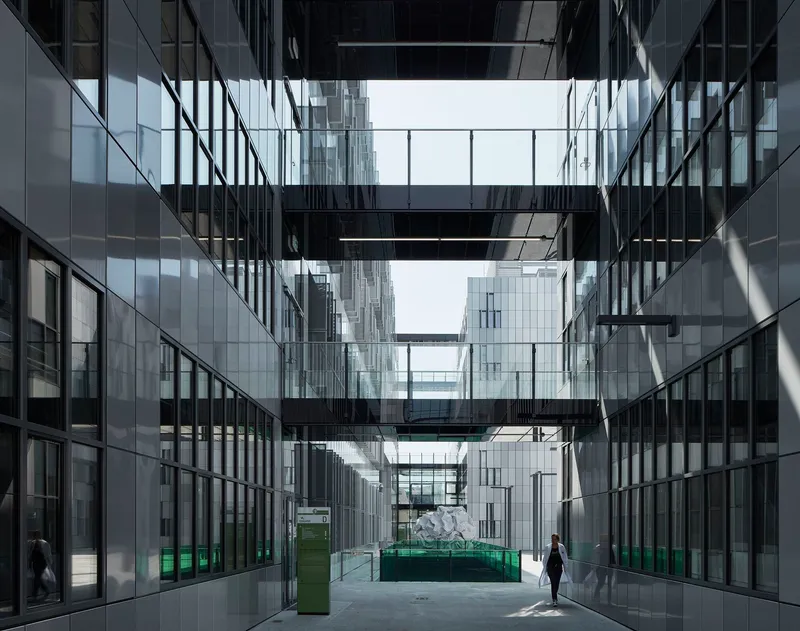
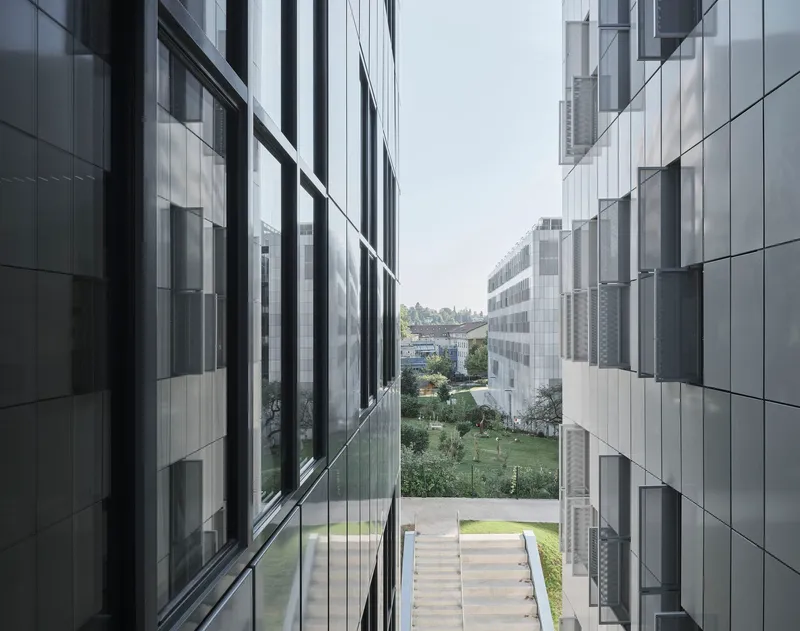
The campus level, raised one story above grade, is the organizational spine of the entire project. It functions as a pedestrian distribution plane from which you access every institute, laboratory, and research cluster. An elevated walkway even crosses over an active rail corridor, connecting the second construction phase to the first and extending the network to the adjacent teaching hospital. The bridges are not afterthoughts or marketing gestures; they are the circulatory system that makes a multi-building campus feel like a single institution.
Between the towers, glazed courtyards admit generous daylight to the lower levels. Black steel bridges span these voids, turning vertical circulation into a spatial event. A lone figure crossing one of these bridges captures the scale precisely: large enough to feel civic, narrow enough to feel intimate. The interplay between solid volumes and transparent gaps keeps the interior streets legible and well oriented.
90,000 Elements in Eight Shades of Grey
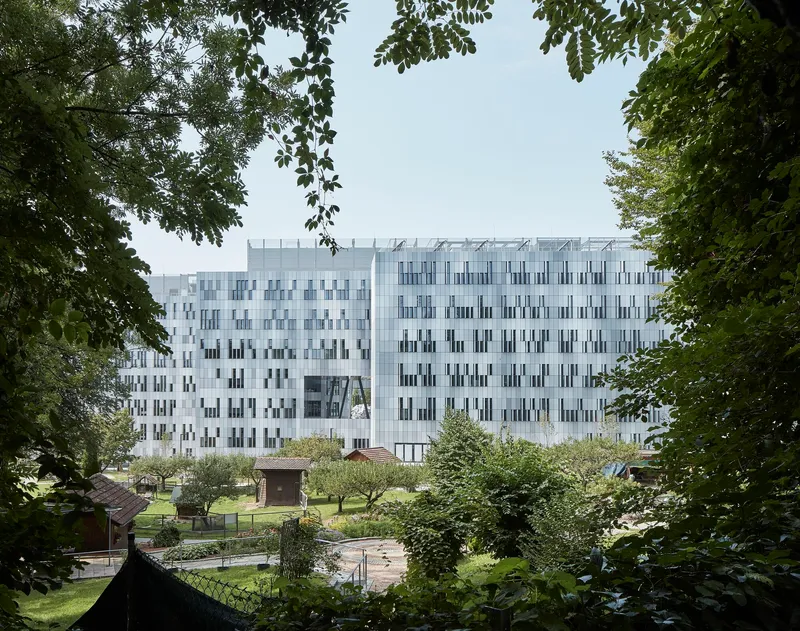
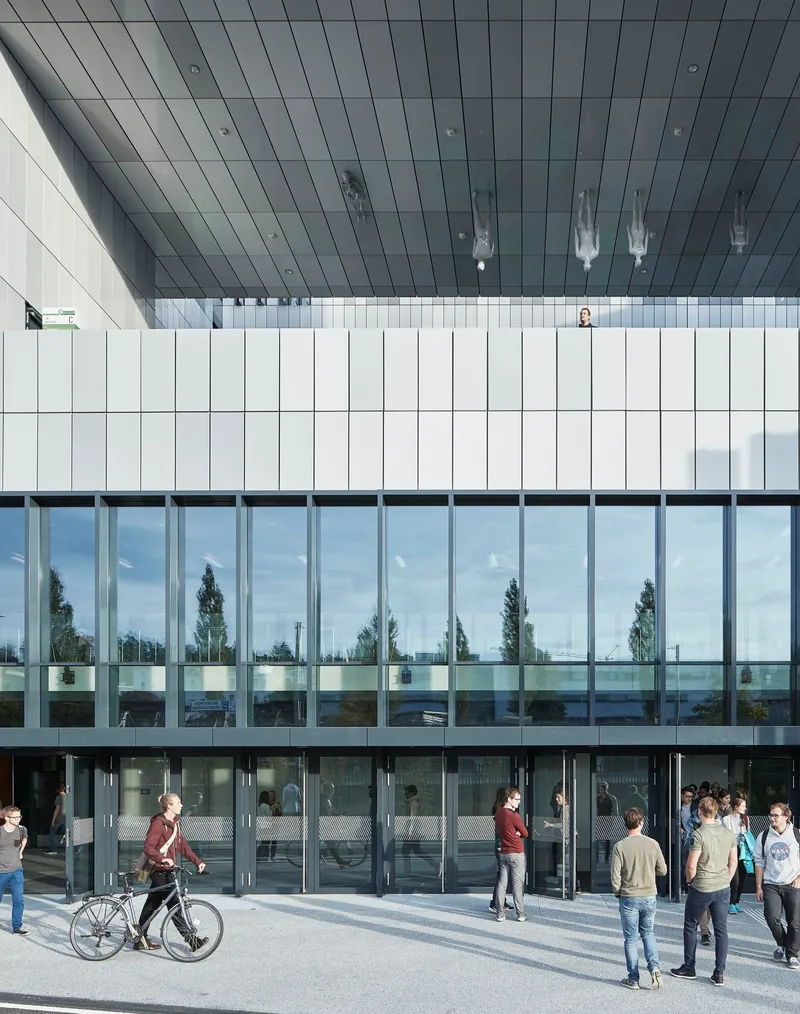
The facade is the campus's most distinctive technical achievement. Over 90,000 prefabricated elements, uniform in module but rendered in eight tonal variations of grey, wrap every volume in a restrained yet subtly animated skin. Up close, the tonal shifts create a textile-like grain. From a distance, the buildings appear uniformly white, giving the ensemble its cohesive identity. The vertical window rhythm is consistent but not monotonous, and the prefabricated logic kept construction tolerances tight across a decade-long build.
Beyond aesthetics, the element facade is doing real environmental work. It maximizes daylight admission while accommodating moveable sunshades and optimized thermal insulation. Combined with pollutant-free construction materials and operable windows for natural ventilation, the envelope is a performance layer, not a decorative one.
Teaching and Assembly Spaces Below
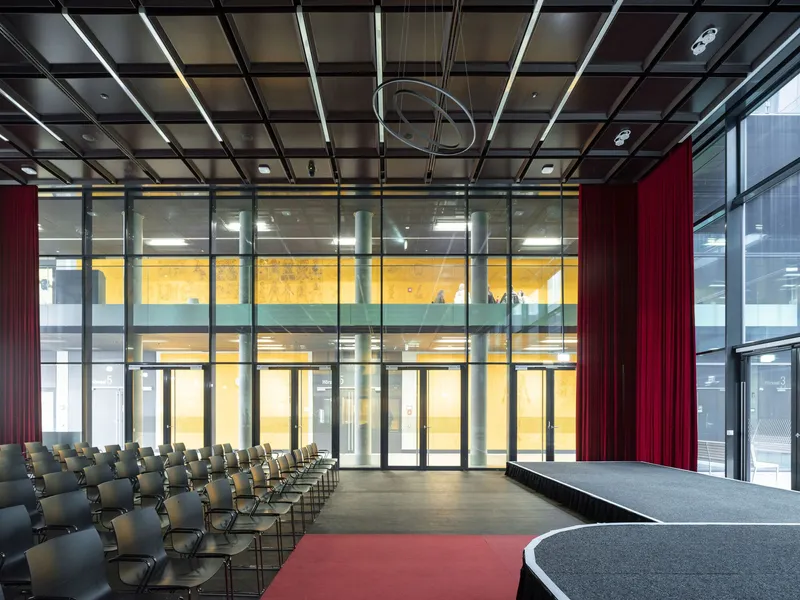
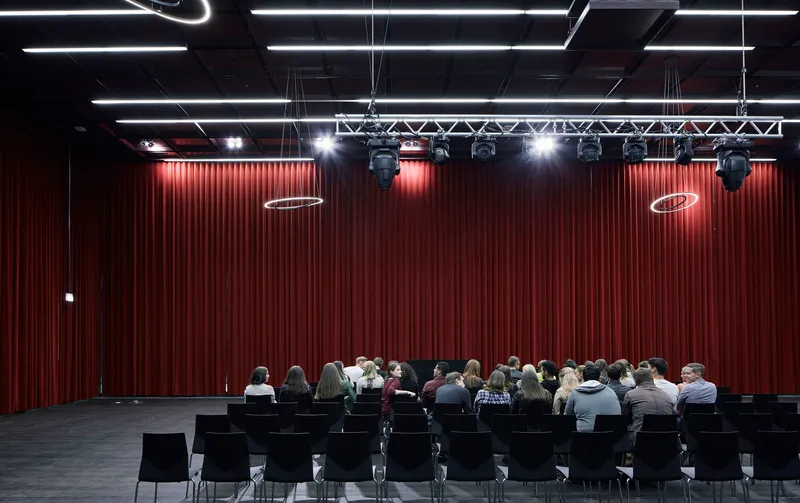
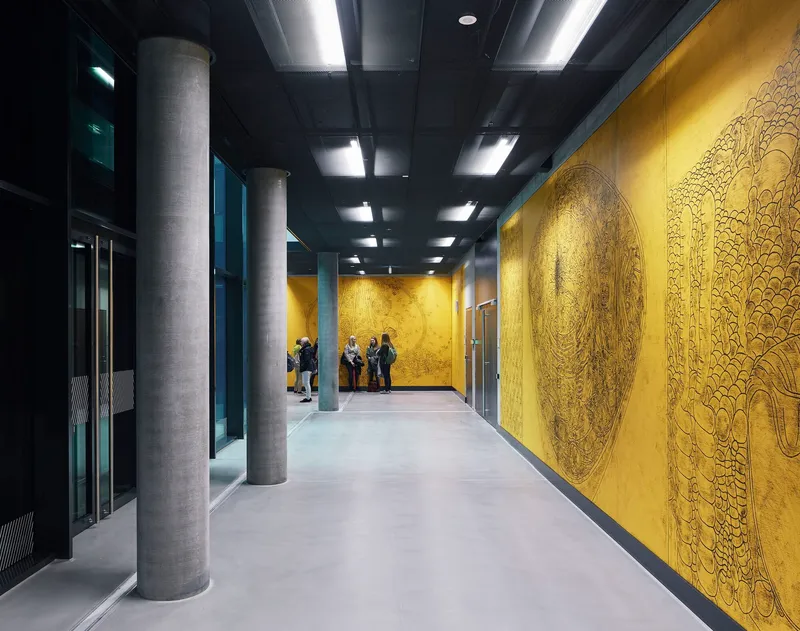
Below the campus level, the semi-basement floors house the most public and collective functions: multiple auditoriums, an assembly hall, and the major technical plant. The largest assembly space pairs a bold red pleated curtain with floor-to-ceiling glass walls that open onto a yellow-lit corridor, a theatrical move that gives what could be a buried room a strong visual connection to the campus at large. The auditorium's raked seating and integrated work surfaces suggest a space designed for working seminars, not passive lectures.
Even the elevator lobbies receive careful attention. Circular concrete columns stand alongside embossed gold wall panels near lift doors, lending a material warmth that counters the clinical associations of a medical campus. These small decisions accumulate: they signal that the architects understood a university is not just a container for research but a place where people spend entire careers.
Laboratories, Lounges, and Everyday Life
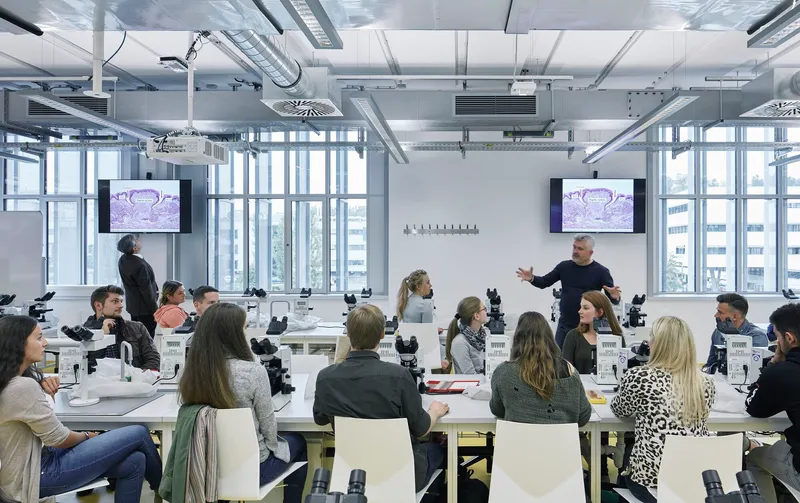
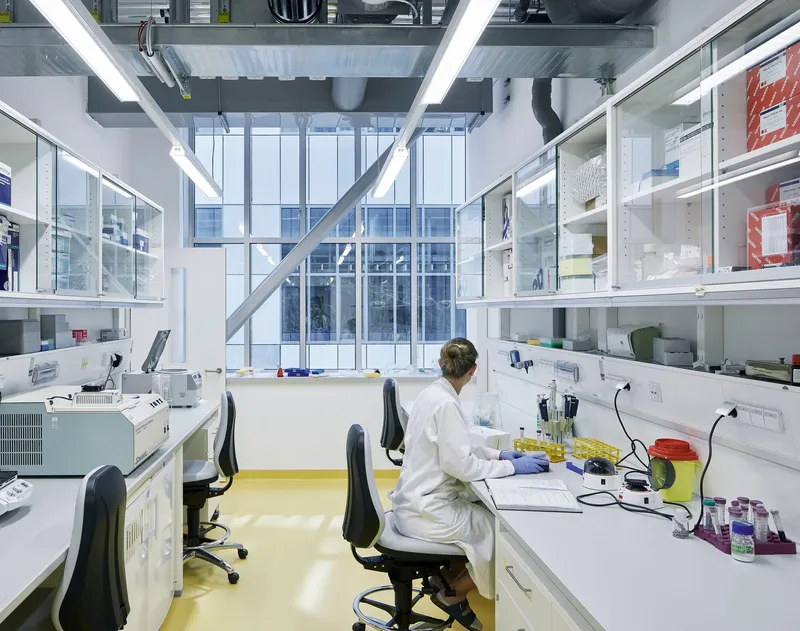
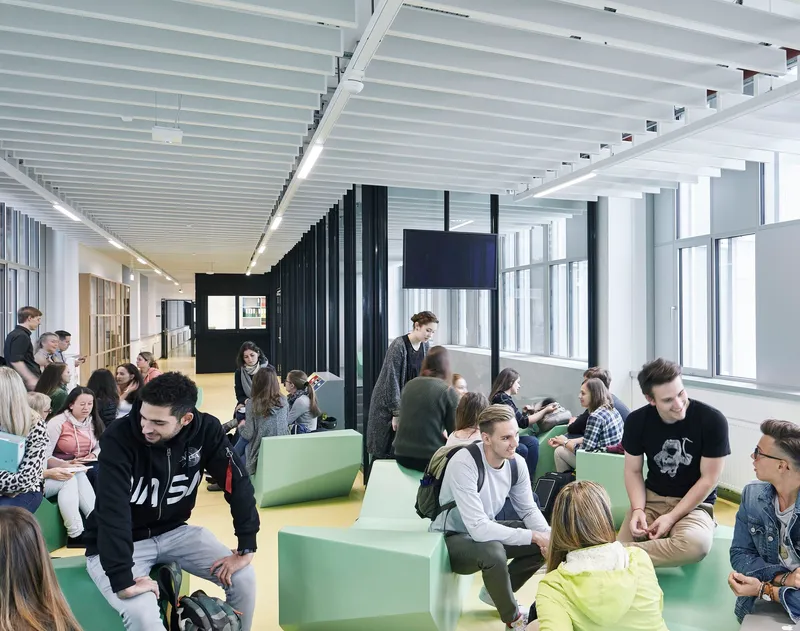
The research floors sit above the campus level, organized into institutes with offices and laboratories. Teaching labs feature orderly rows of microscopes beneath exposed ductwork, a pragmatic aesthetic that acknowledges these rooms will be reconfigured many times over the building's life. Research labs deploy yellow resin flooring and white workstations, cleanly lit and functionally spare. The vertical staffing of the building, shifting from deep-plan public spaces at the bottom to narrow lab bars at the top, responds precisely to the different environmental demands of each program.
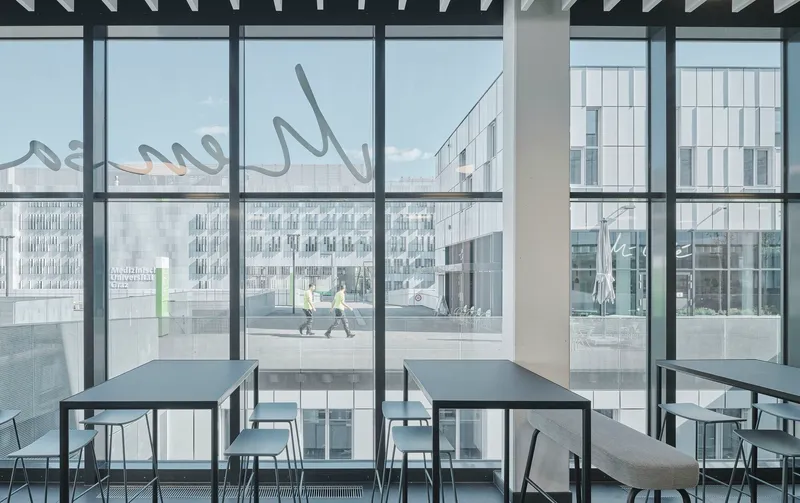
Between these technical zones, open lounges with lime green modular seating offer students decompression space. These informal gathering areas sit directly on the circulation routes, not tucked into dead ends, which means they actually get used. The dining area, wrapped in floor-to-ceiling glass overlooking the central plaza, reinforces the campus's commitment to visibility and social exchange.
Energy from Below and Above
The sustainability credentials here go well beyond the facade. A geothermal plant provides a significant proportion of the campus's heating and cooling demand. Thermally activated energy piles work in tandem with heat pumps, and warm exhaust air from server rooms and laboratory spaces is recaptured rather than vented. Solar panels supplement the energy mix. The Platinum ÖGNI/DGNB certification validates a holistic approach: pollutant-free materials, maximized daylight, natural ventilation, and deep geothermal integration all operating as a system rather than a checklist.
What separates this project from greenwashed institutional work is that the passive strategies, narrow plan depths for cross ventilation, orientation for solar control, the element facade as thermal buffer, are not add-ons. They shaped the urban design from the competition stage. The environmental performance and the architectural character are the same thing.
Plans and Drawings
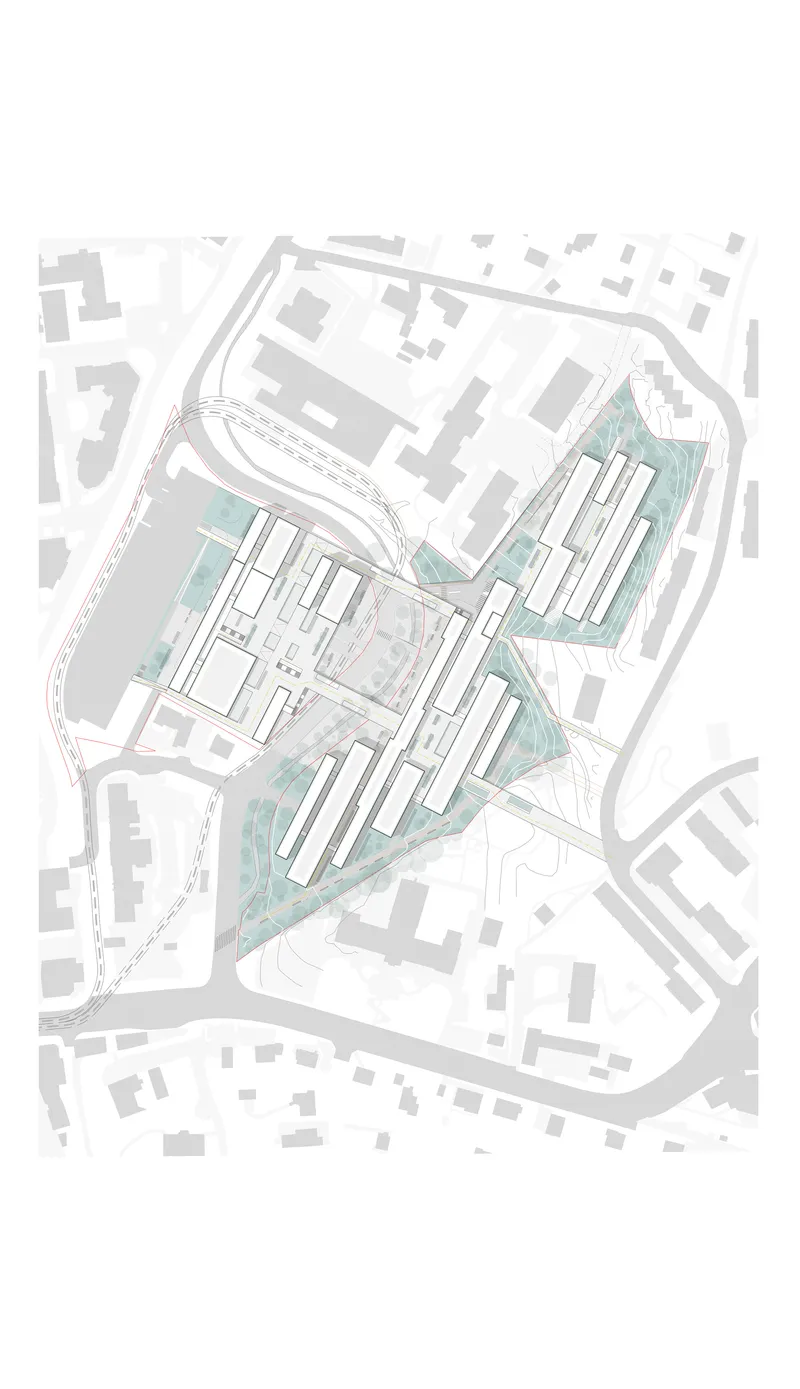
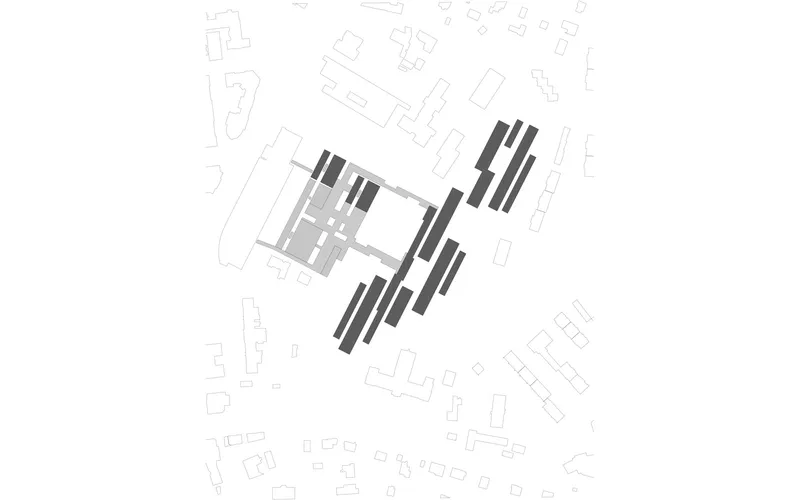
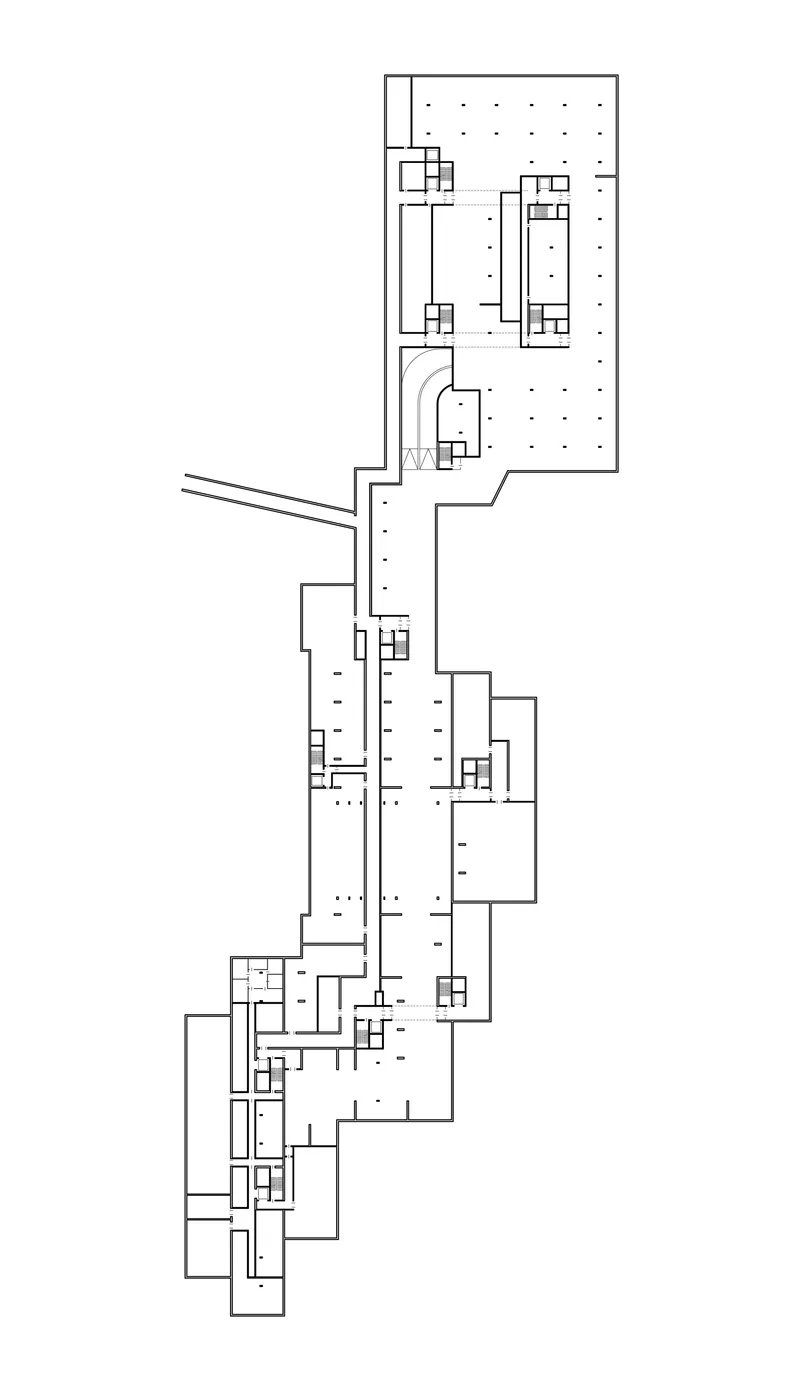
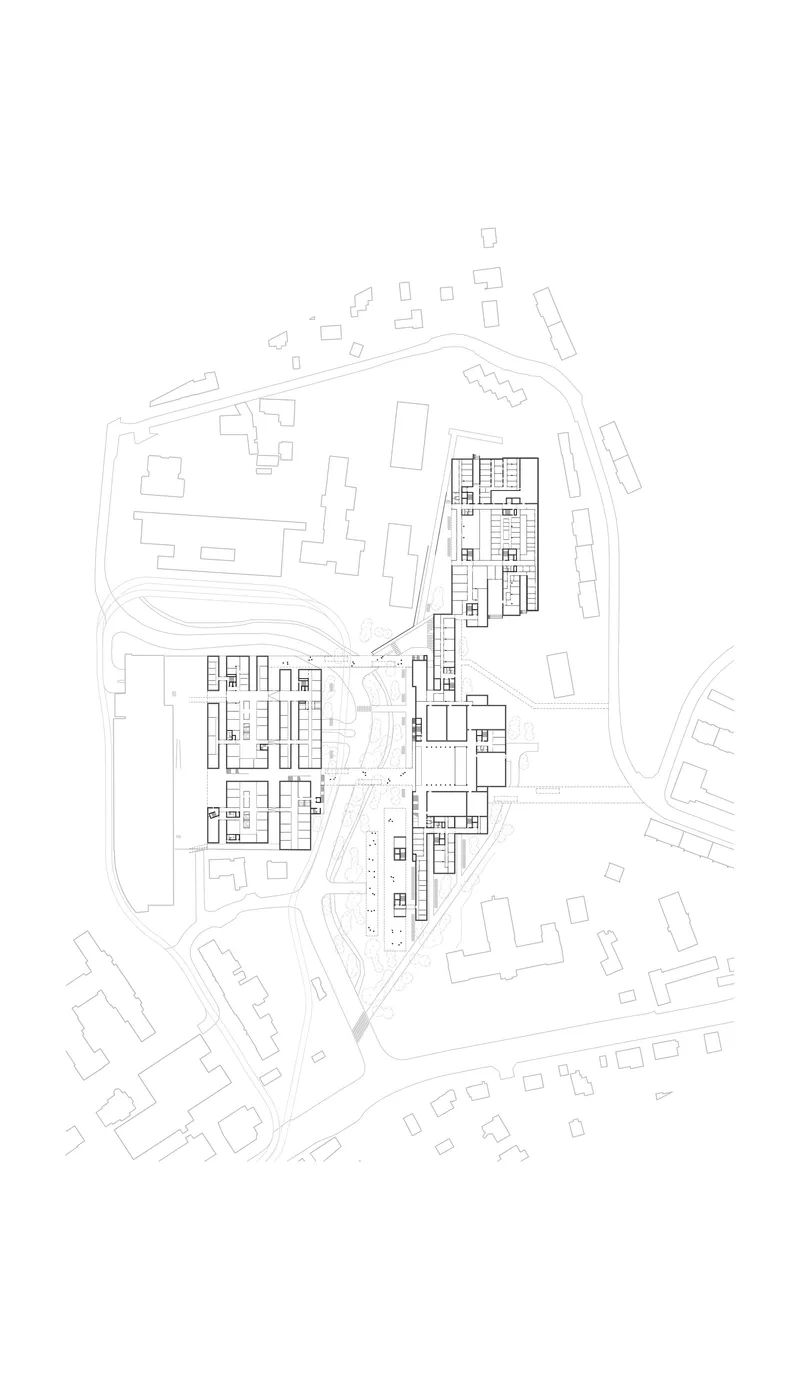
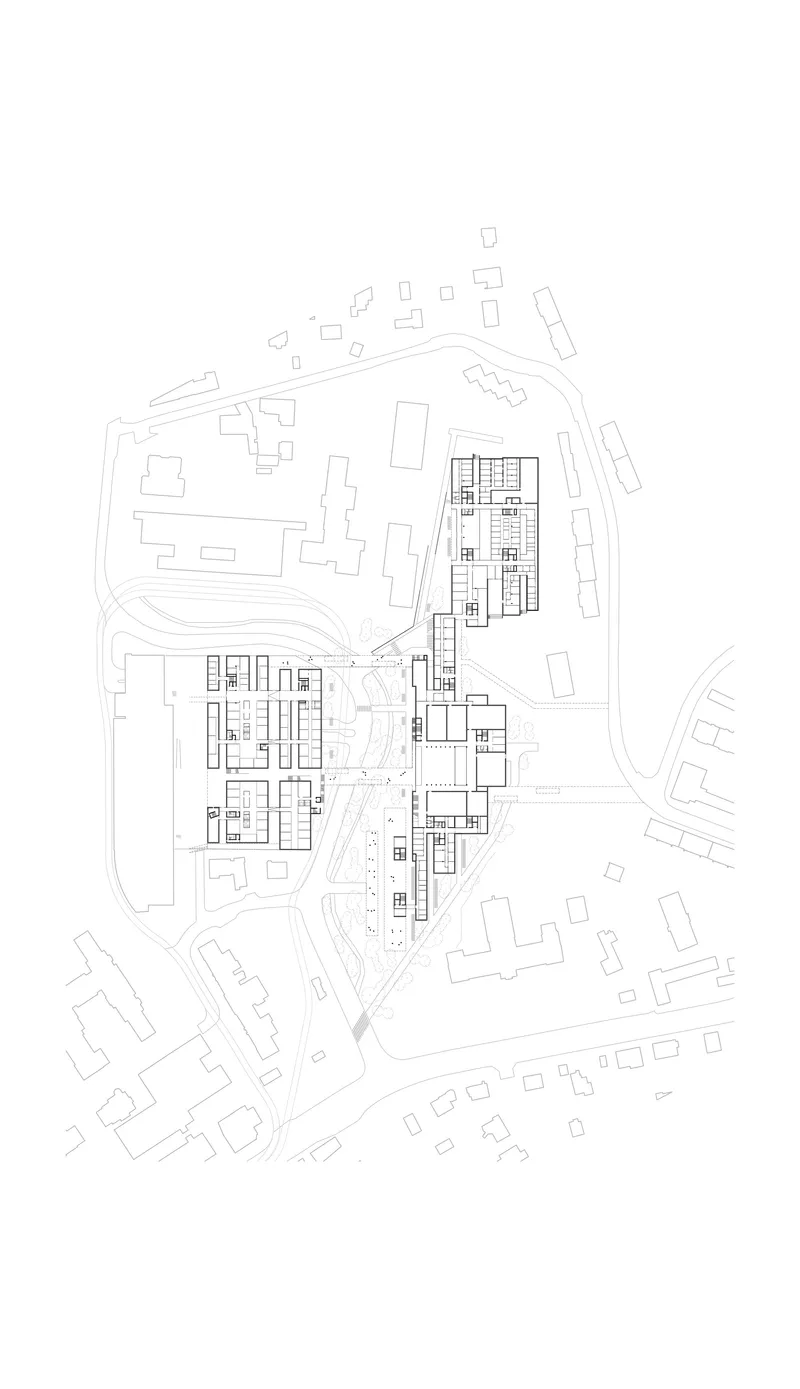
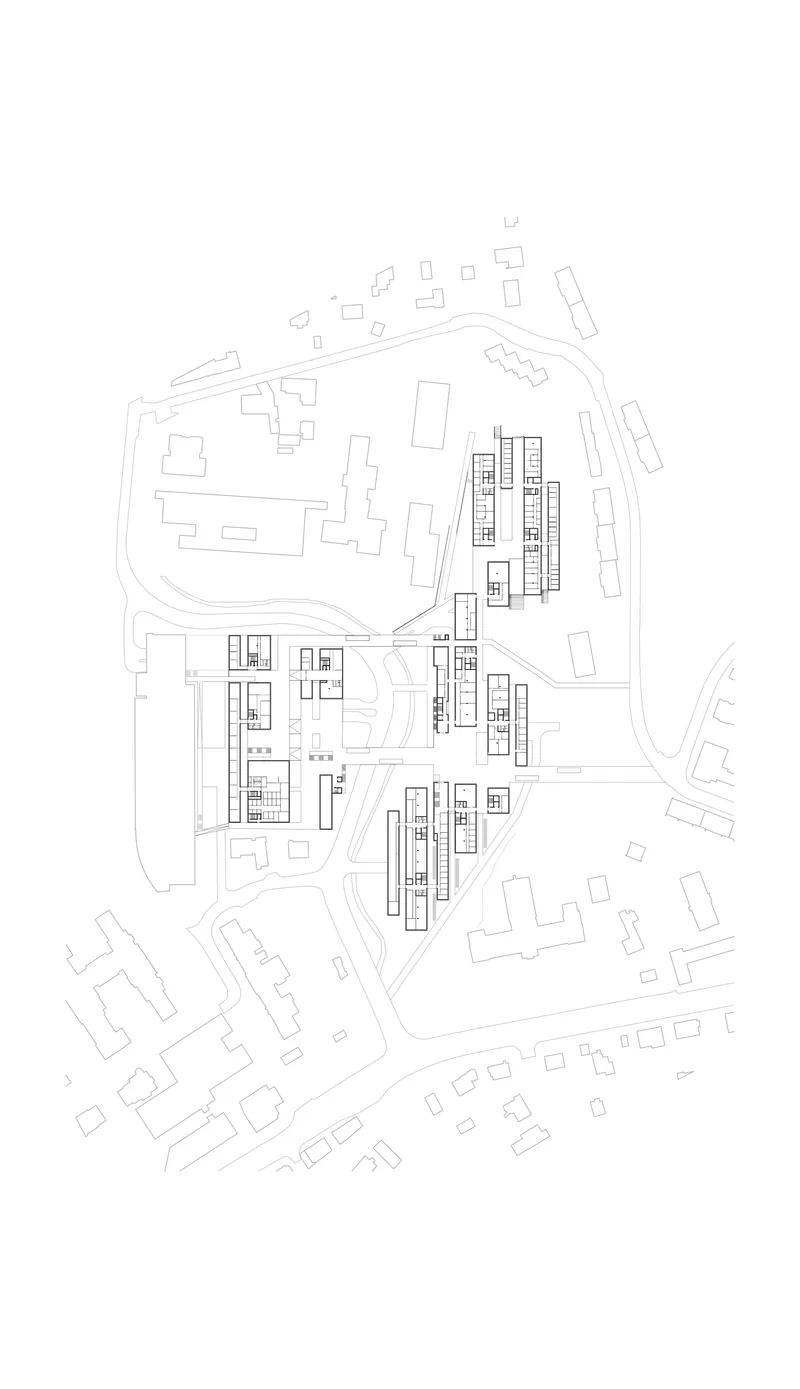
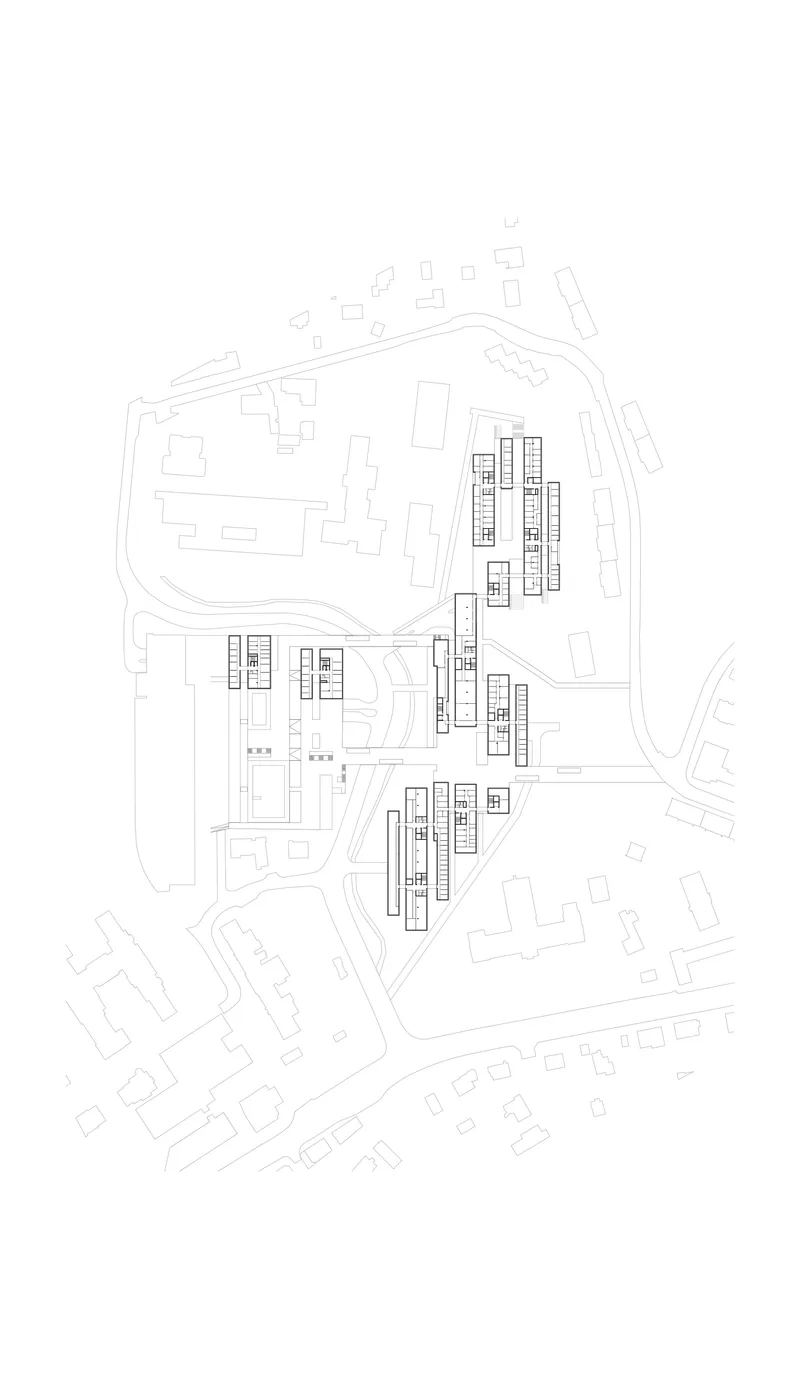
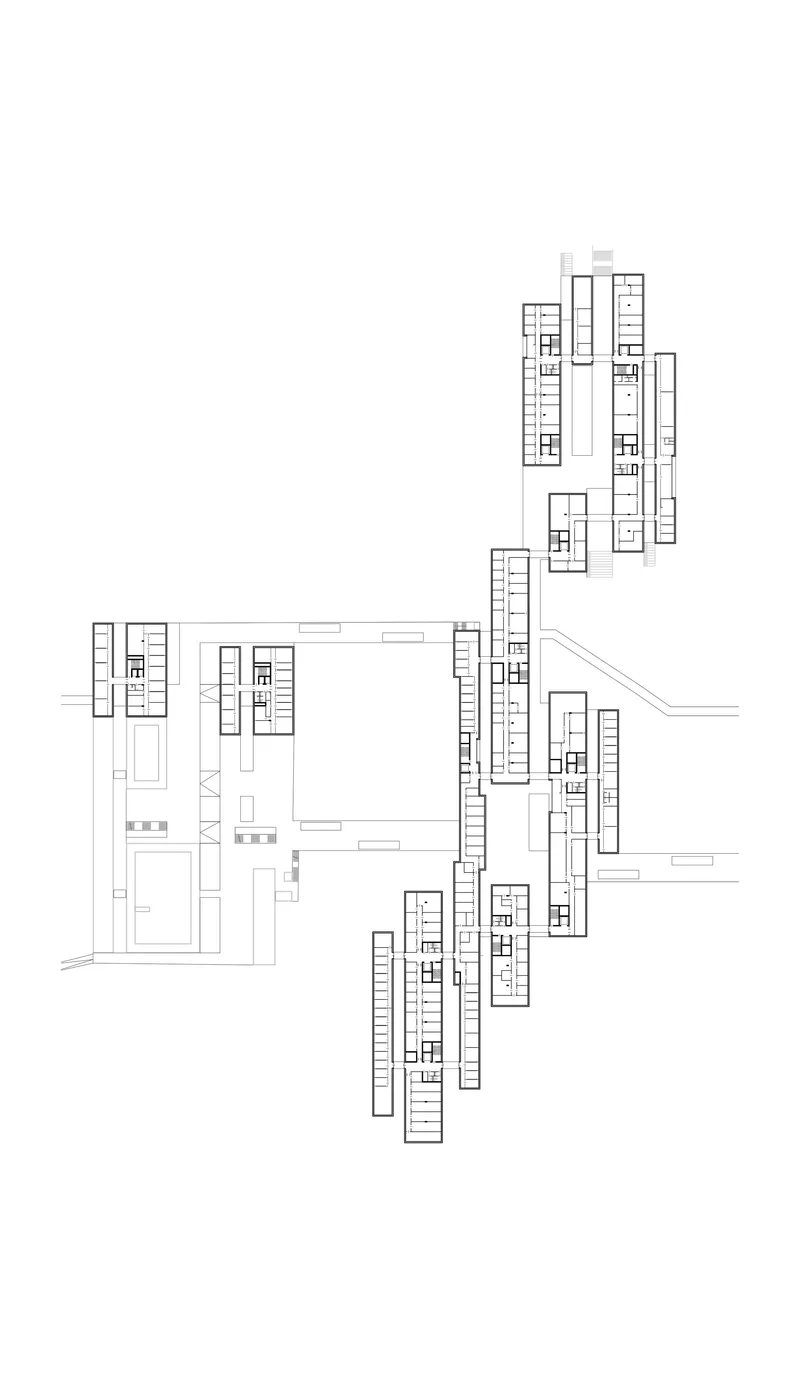
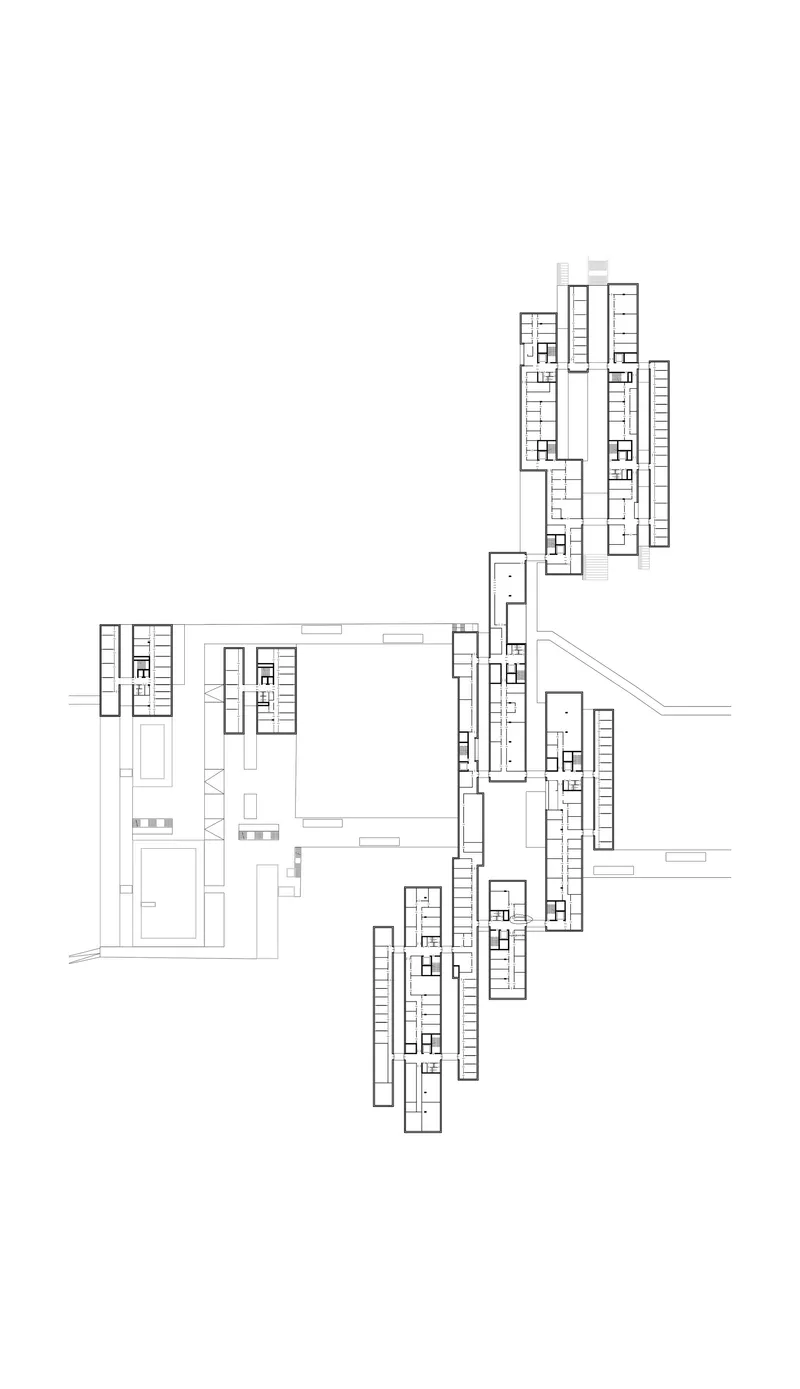
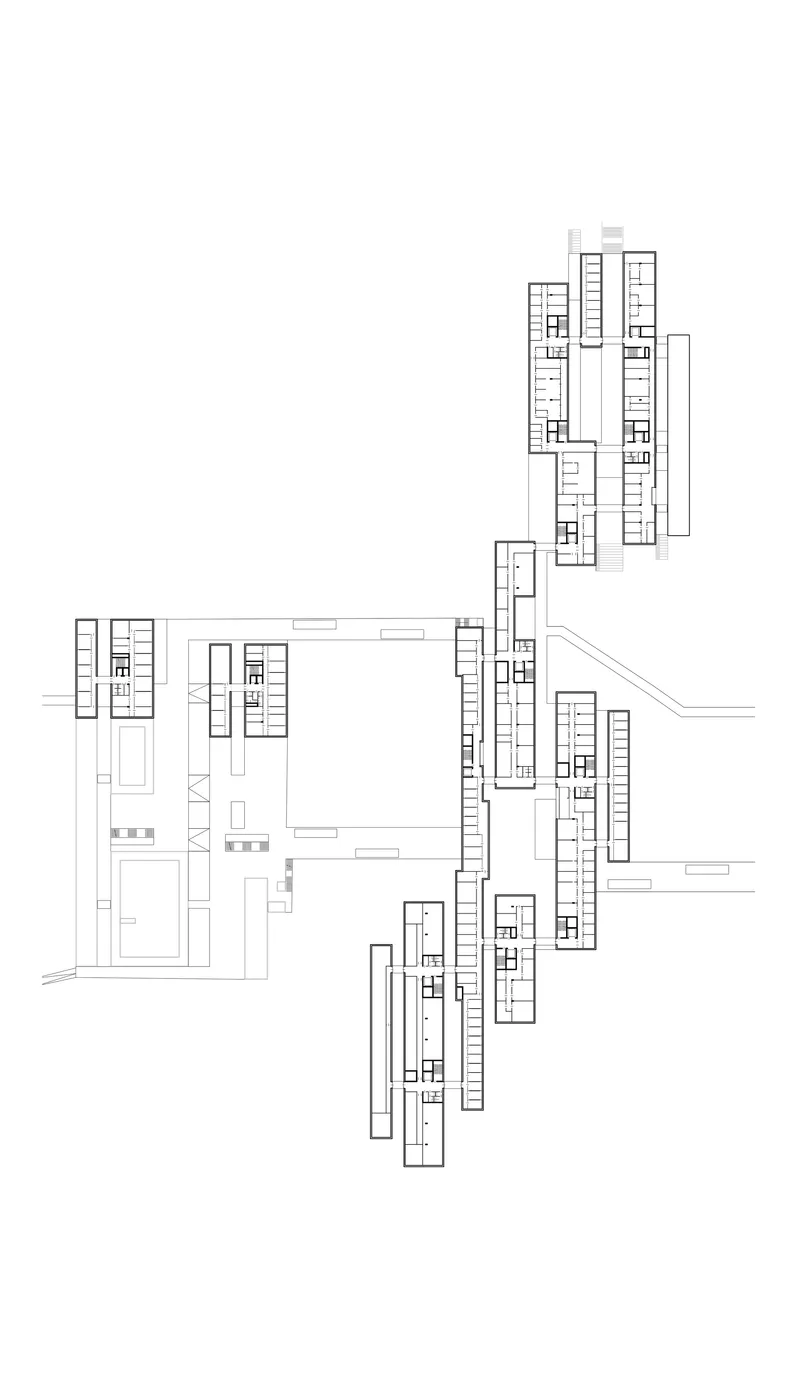
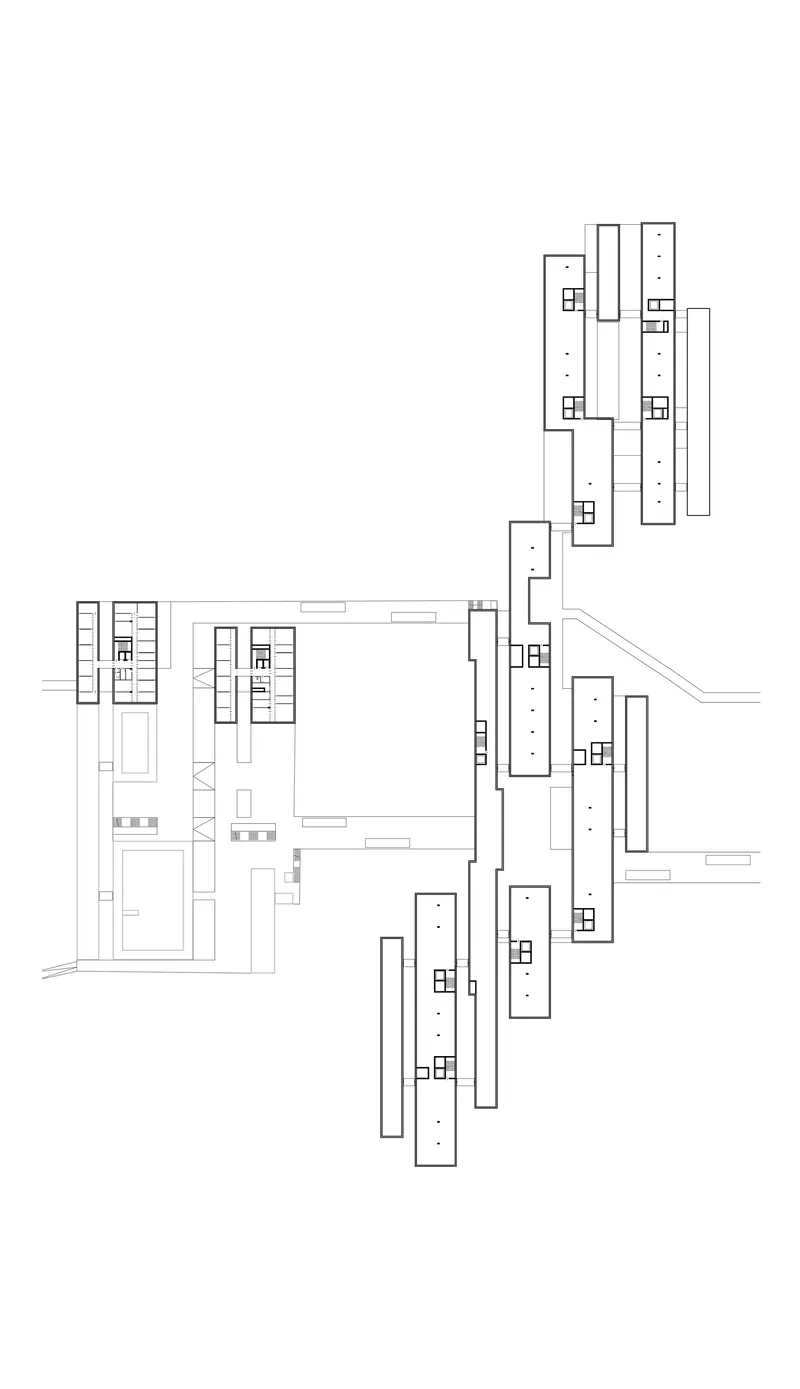
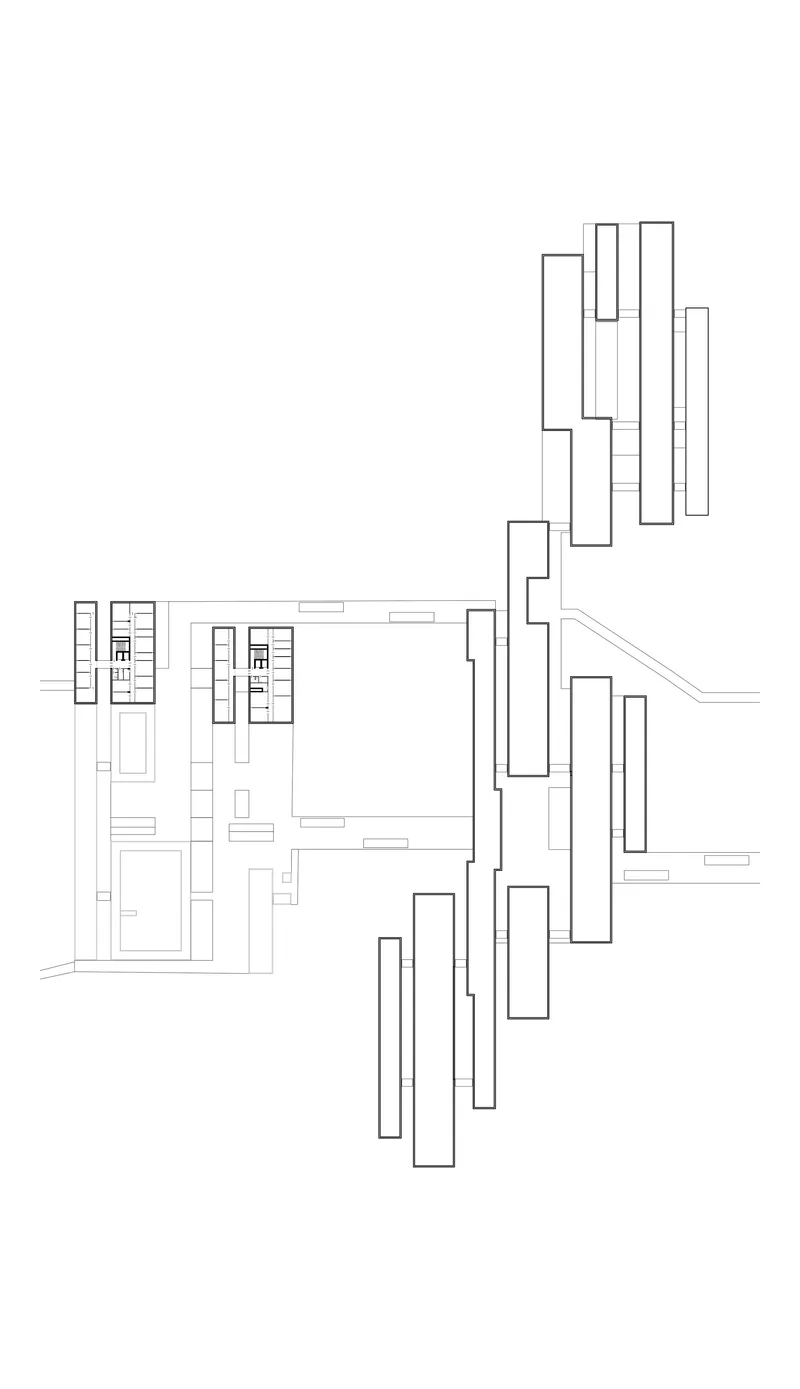
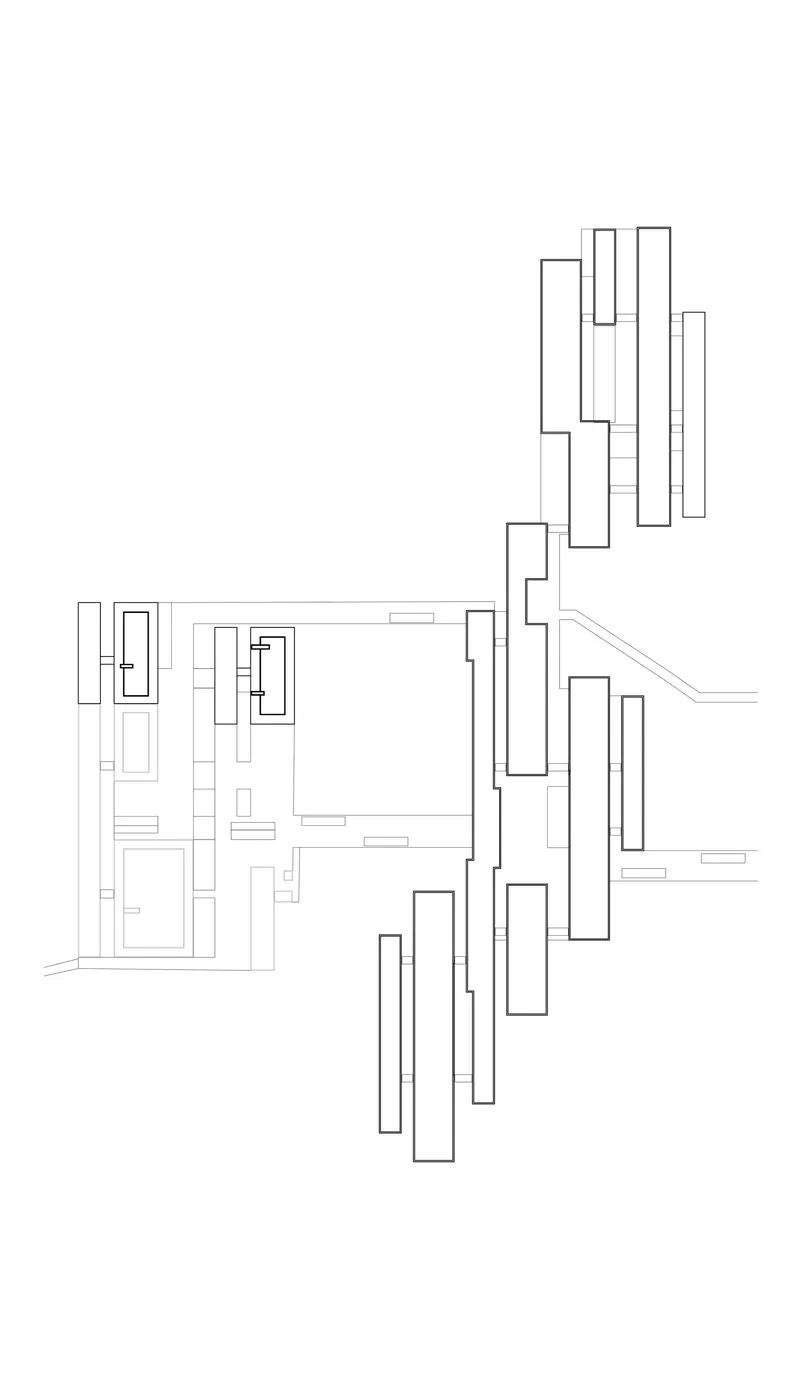
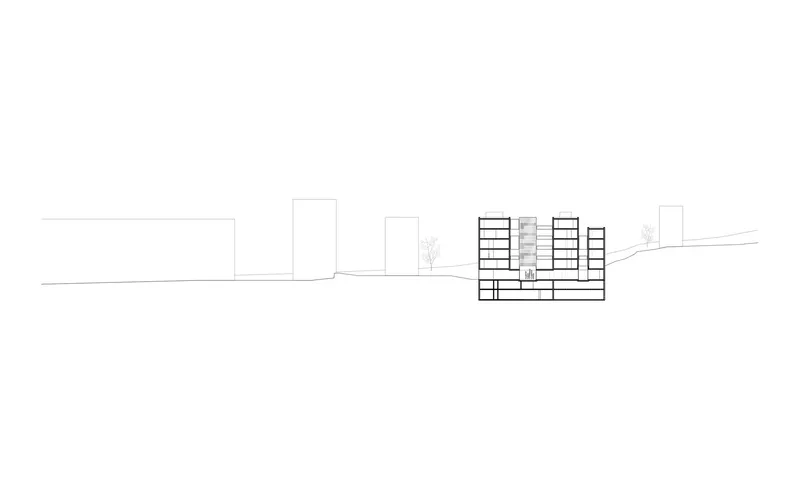
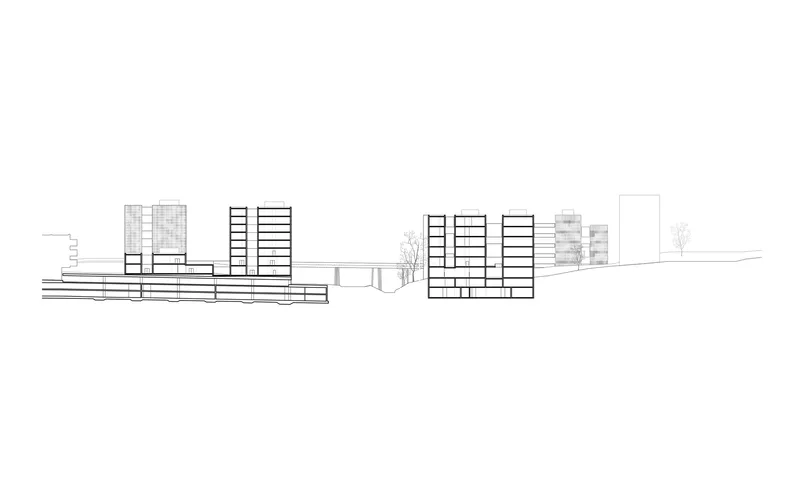
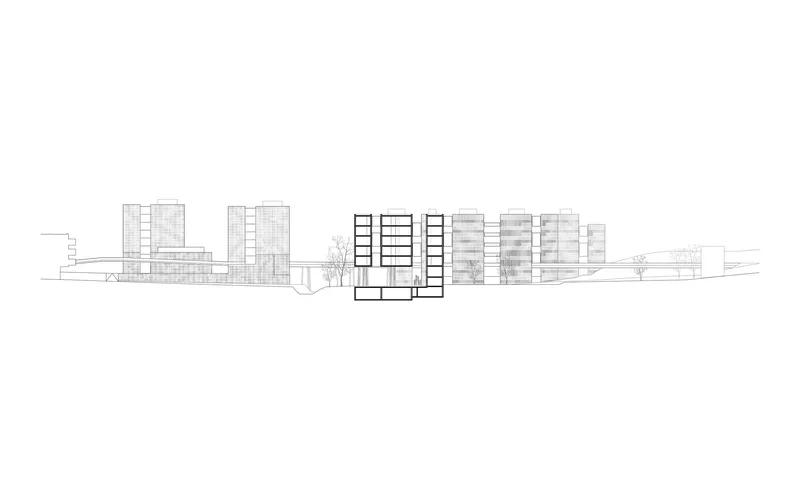
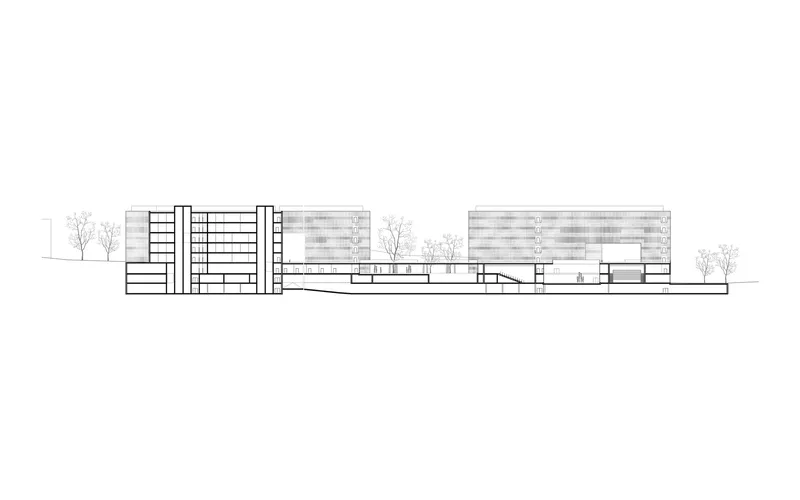
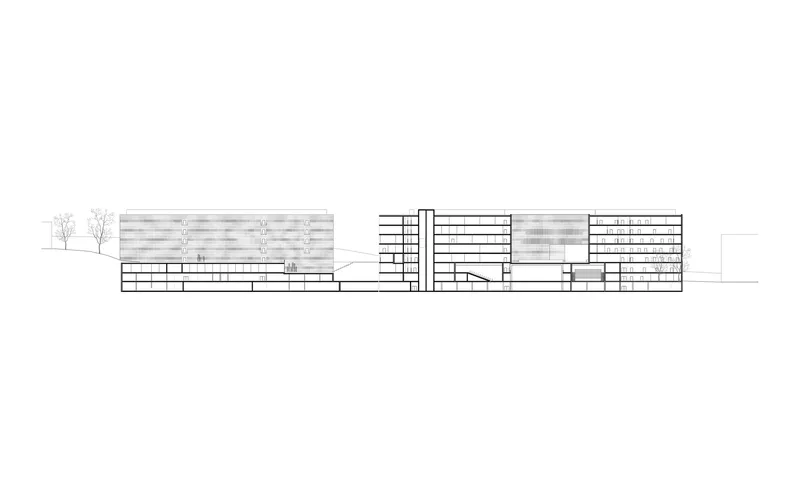
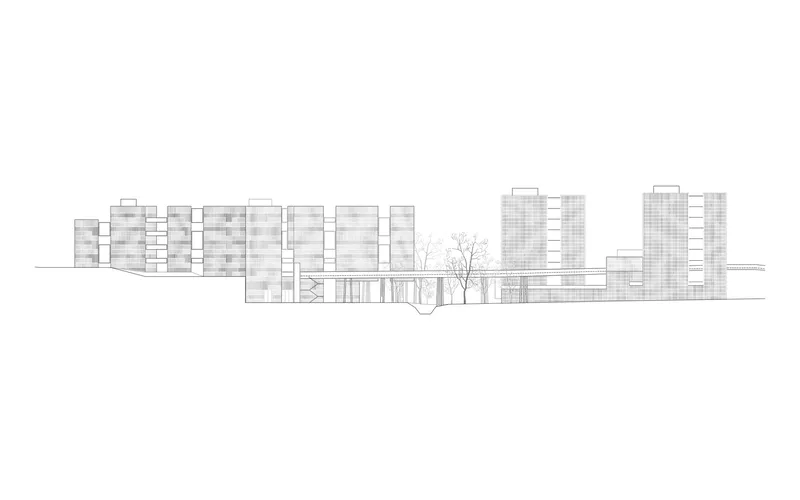
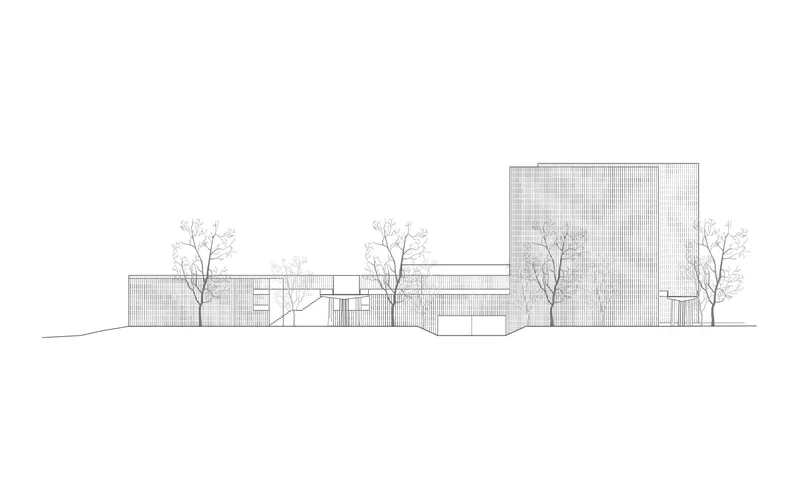
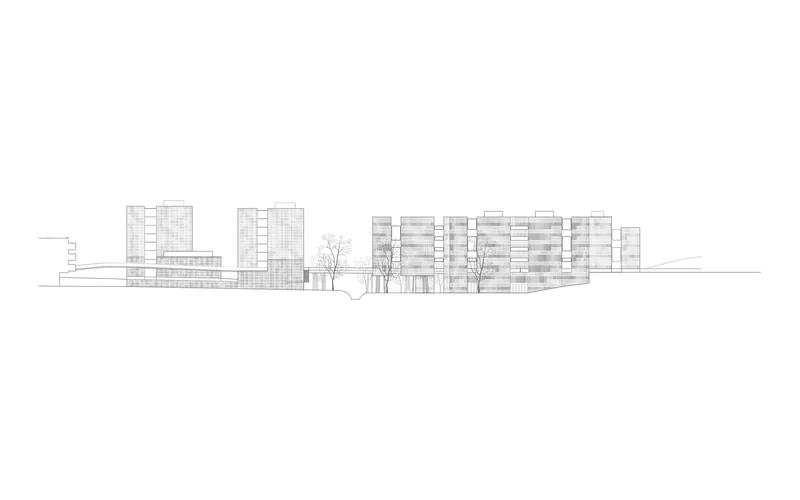
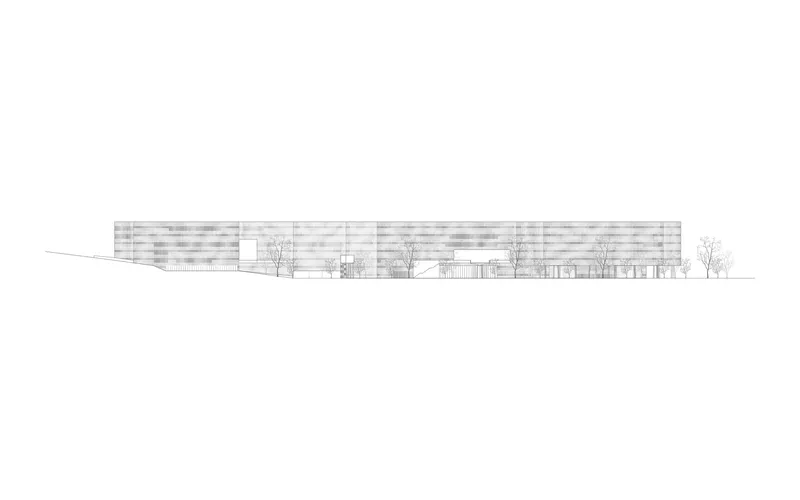
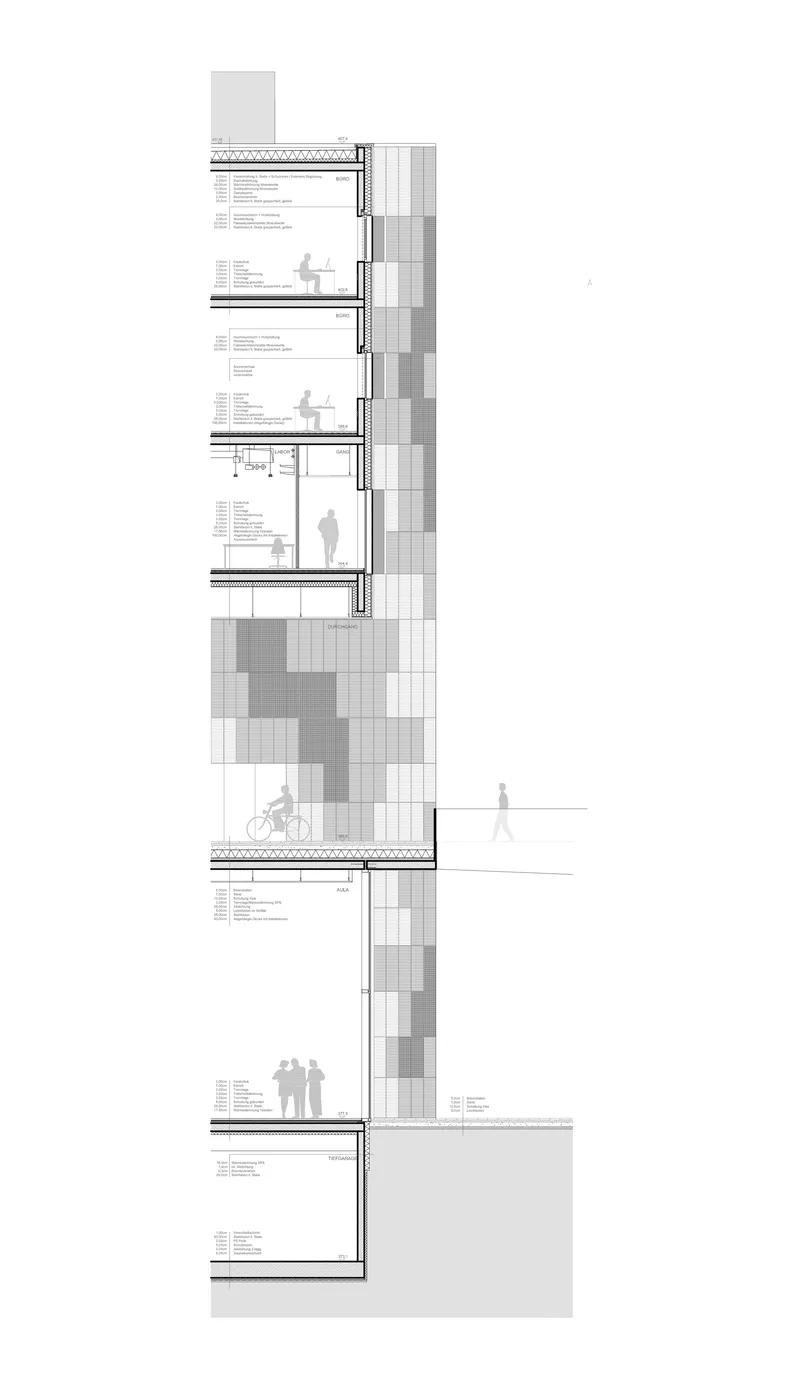
The site plans trace the evolution of the design through competition and development stages, showing how the staggered bar volumes were tested, rotated, and refined to balance density against airflow and daylight. Figure-ground drawings reveal how consciously the campus engages its urban edges: building footprints create defined streets and courts rather than floating in open landscape. The floor plans confirm the linear logic: narrow floor plates ensure that no workstation or lab bench sits far from a window.
The elevation and section drawings are particularly revealing. Varied tower heights create a stepped profile that avoids the monotony of uniform massing while the horizontal podium levels tie everything into a continuous ground plane. The section through the pixelated cladding shows how the 90,000 prefabricated elements stack and align, and how glazed connectors at the campus level serve as hinges between distinct programmatic blocks. These drawings demonstrate a project whose formal clarity is the direct consequence of systemic thinking, not imposed after the fact.
Why This Project Matters
The Med Uni Campus Graz is a case study in institutional patience. From competition win in 2010 to final completion in 2023, the project required sustained commitment from client and architect alike across political cycles, budgetary pressures, and a global pandemic. That it arrived intact, coherent, and certified Platinum is remarkable. That it also won the Austrian State Prize for Architecture suggests the jury recognized something beyond technical competence: a rare alignment between urban ambition and built result.
For architecture culture more broadly, this campus reasserts a position that large institutional projects do not need to rely on iconic form to achieve significance. Riegler Riewe's strength has always been systematic rigor, and here that rigor produced not a cold diagram but a genuine piece of city. The alleys between buildings feel lived in, the bridges feel purposeful, and the laboratories feel like places where serious work gets done. That is a harder achievement than any sculptural gesture, and it will age far better.
Med Uni Campus Graz by Riegler Riewe Architekten. Graz, Austria. 53,000 m² usable floor area (approximately 90,000 m² total campus). Completed 2023. Photography by David Schreyer, Paolo Rosselli, and Helmut Pierer.
About the Studio
Share Your Own Work on uni.xyz
If projects like this are the kind of work you want to make, uni.xyz is a place to publish your own, find collaborators, and enter design competitions.



Popular Articles
Popular articles from the community


Play: Fragments of Their World
Familiar architecture becomes modular playground design, creating safe spaces where displaced children can learn, connect, imagine and play.

Riyadh For All: Intergenerational Urban Design for Active Aging in Rabat
Riyadh For All reimagines urban design in Rabat with intergenerational co-living, adaptive courtyards, and Moroccan cultural exchange today.

Hill & Cross Opera: Sculptural Opera House Architecture Shaped by Tallinn’s Landscape and Identity
Hill & Cross Opera reimagines opera house architecture in Tallinn through its sculptural hill, civic plaza, glass wave and a luminous cross.

Co-Life: Senior Housing Design That Reconnects Older Adults With the City
Co-Life reimagines senior housing design through healing gardens, shared streets, workshops, and a sustainable community across generations.

Similar Reads
You might also enjoy these articles

Bao Huynh Watercolor Atelier: A Serene Art Retreat in Hội An
Bao Huynh Watercolor Atelier in Hội An blends multifunctional art spaces, sustainable design, local materials, and family-friendly living in a serene environment.

Atelier Macri Concept Store Interior Design by CASE-REAL
Atelier Macri store features a "ko" counter, walnut wood details, cork displays, blending retail, gallery, and seamless customer experiences.

Manuel Vargas Izquierdo Stadium and High-Performance Sports Center: Architectural Excellence in Jalpa de Méndez
The Manuel Vargas Izquierdo Stadium blends sustainable design, inclusive sports facilities, and cultural-inspired architecture, revitalizing Jalpa de Méndez’s public spaces.

KAKR Buluh Awar Hall: Revitalizing Community and Ecology Through Bamboo Architecture
Community built bamboo hall revitalizes Buluh Awar village, empowering youth, restoring ecology, celebrating vernacular craftsmanship through sustainable architecture and culture.

Explore Educational Building Competitions
Discover active competitions in this discipline



Challenge to design locus for the upliftment of human rights

Challenge to design public laboratory


Design challenge to reuse E-waste
Comments (0)
Please login or sign up to add comments
No comments yet. Be the first to comment!