
Rigcycling: Turning an Abandoned Offshore Oil Rig into a Self-Sufficient Island
Oskar Pstrongowski and Jakub Pietrzykowski reframe an extraction machine as a stepped, energy-producing island of terraces, greenhouses and homes.


An oil rig is built to take: it drills, pumps and ships away, and when the reservoir runs dry it is left standing in open water as a costly reminder of what was removed. Rigcycling asks what happens if that machine is reversed. Instead of dismantling the platform, the project keeps its foundations and turns the structure into an island that generates energy, grows food and houses people. The building is designed to produce resources where the rig once extracted them.
Designed by Oskar Pstrongowski and Jakub Pietrzykowski, the proposal treats adaptive reuse as both an environmental position and a design method. Avoiding demolition reduces material consumption and construction waste. Keeping the rig also preserves its history: the new programme of apartments, agriculture, research and cultural space settles onto an industrial monument without erasing it. The result is a habitat far from the mainland, intended for coexistence with the sea rather than exploitation of it.
A Stepped Green Block Lifted on the Rig's Concrete Legs

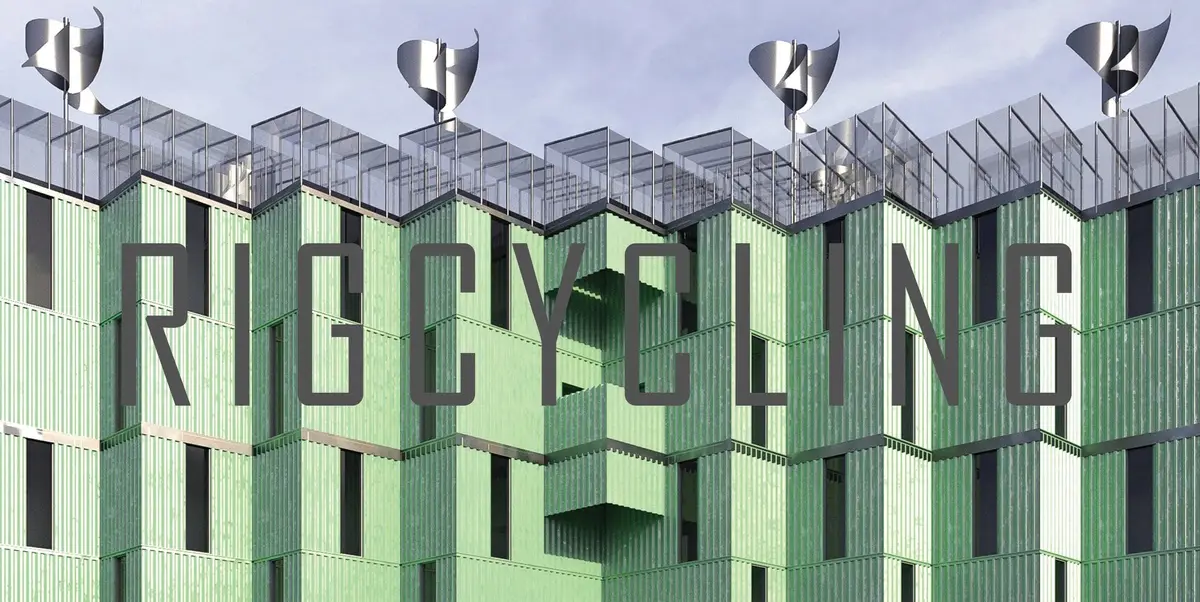
The opening view sets out the main tension clearly. A green-clad housing block rises in terraces above the water, supported on the rig's existing concrete piers, while a lattice mast stands beside it as a remnant of the platform's former use. The designers do not hide the industrial base or decorate it. They build on top of it and let the contrast between the old structure and the new block make the argument.
The stepped massing does practical work. Each setback opens a terrace for farming, observation, circulation or gathering, and the profile exposes as much surface as possible to sunlight and ocean wind. The block is organised around a central courtyard, which gives residents a sheltered core within a very exposed setting. That move matters on a site where wind and weather would otherwise dominate daily life.
A Roof That Works as Power Plant and Farm

The annotated aerial drawing shows how much the roof is expected to carry. Vertical axis wind turbines on the upper levels harvest offshore wind, solar water heating supplies thermal energy for daily operations, and a greenhouse brings food production onto the same surface. These systems are presented as part of the building's form rather than equipment added afterwards. The roof is a working layer of the island's energy and food supply.
The choice of turbine fits the site. Vertical axis turbines capture wind from any direction, which suits an exposed platform surrounded by open sea. Beneath the aerial view, the apartments plan shows two stacked units in a zigzag arrangement. This interlocking section appears to produce the terraced outline seen in the exterior views, so the external stepping follows from the way the homes are planned inside.
A Narrow Bridge Between the New Island and the Old Rig
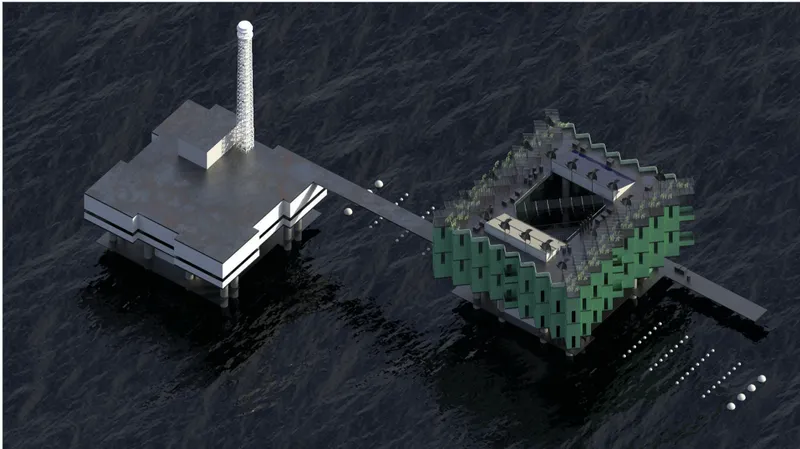
From above, the scheme reads as two platforms joined by a thin walkway. The green housing block sits on one, and the lattice tower stands on the other. Keeping the tower and linking it, rather than removing it, preserves the visual memory of the oil rig. Visitors cross a narrow line over dark water to move from the new habitat to the industrial past.
The walkway also sets the scale of the place. Surrounded by open water, the island depends on its own systems, and the slim connection makes that isolation clear. The circular approach the designers describe, with energy and food generated on site instead of imported from the mainland, becomes a basic requirement here. The site's remoteness is what makes self-sufficiency necessary.
Interiors Framed Around the Horizon

The interior view takes a quieter approach. A dark room with corrugated walls is lit by a square skylight overhead and a long horizontal window that frames the sea in one continuous strip. The corrugated surface recalls the industrial character of the rig. The horizontal opening directs attention to the horizon, which is the island's most constant feature.
This is where the ideas about living, learning and exploring become physical. The apartments are meant for visitors and researchers staying for long periods, and this interior suggests calm rather than spectacle. A painting of a beach hangs on the wall, a small reference to land in a home surrounded by water. The detail shows that the designers considered how long-term life offshore would feel, not only how it would be supplied.
Why This Project Matters
Thousands of offshore structures will reach the end of their working lives in the coming decades, and the usual response is costly removal. Rigcycling offers a credible alternative: keep the foundations, change the purpose, and let the structure that drained a landscape start supporting one. Its strongest point is consistency. The terraces, roof, courtyard and walkway all serve the same aim of turning an extraction site into a productive one.
The proposal also suggests a wider principle for regenerative architecture. Buildings can act as productive systems instead of passive consumers, and industrial heritage can be reused without being erased. Pstrongowski and Pietrzykowski show that the architecture of fossil-fuel extraction does not have to end in demolition. With careful design, it can become infrastructure for living with the ocean.
View the Full Project
About the Designers
Designers: Oskar Pstrongowski, Jakub Pietrzykowski
Enter a Design Competition on uni.xyz
uni.xyz runs architecture and design competitions year-round that reward proposals with spatial conviction and real site intelligence.
Project credits: Rigcycling by Oskar Pstrongowski, Jakub Pietrzykowski.


Popular Articles
Popular articles from the community


Jaramillo Van Sluys Arquitectura and Urbanismo Turn a Demolished Registry Lot in Quito into an Orchard Plaza
In Quito's Centro Histórico, a 2,800 m² plaza exposes the San Agustín convent wall and redraws its lost Augustinian orchard in volcanic stone.

Juan García Correa, John González and Claudia Rueda Sink a Circular Amphitheater into a Manizales Engineering Building
On the La Nubia campus in Manizales, Colombia, the S1 Building folds labs and offices into a hillside of ramped lawns that double as a campus route.

U.GA Architects Wraps an Oval Rooftop Pool in Curved Board-Formed Concrete on Busan's Jeollidan-gil
In Busan's Jeonpo-dong, a 454 m² mixed-use block stacks a neighborhood facility, guest rooms and an oval rooftop pool inside spiraling concrete walls.

longwave studio Reorganizes a 112 m² Tainan Apartment Around the Daily Routines of a Family and Two Cats
In Tainan, Taiwan, birch plywood, rust-red furniture and a freestanding plaster wall link arrival, storage, work and family life in one apartment.

Similar Reads
You might also enjoy these articles
Healing Façade: A Modular Chapel System That Restores Ethiopia's Sacred Forests
Winner of the Eco-Chapel competition, this circular timber façade collects water from air to rebuild soil and reforest degraded Ethiopian landscapes.
Kaffeebühnen: Where Coffee Shop Architecture Becomes a Civic Stage in Vienna
A linear sequence of timber boxes, transparent shells, and open yards turns the Viennese café tradition into a public performance space.
Eco Chapel: A Modular Forest Pavilion That Grows Like the Landscape It Protects
Hexagonal timber modules weave through existing trees, turning a chapel into a living system for prayer, education, and reforestation.


Urban Forest: A Vertical Ecosystem for 5,000 Workers in Singapore's Changi Business Park
Radially stacked pods and layered green decks turn a 7-acre plot into 47 acres of ecological workspace projected for 2040.

Explore Architecture Competitions
Discover active competitions in this discipline

Challenge to reimagine the Iron Throne

Photograph architecture without architects

Illustrate the lost glory of Angkor Wat - Render Challenge

Design challenge to reuse E-waste
Comments (0)
Please login or sign up to add comments
No comments yet. Be the first to comment!