

HDEC AIR-CoLAB Studio Floats a White Concrete Amphitheater on a Chengdu Lake Island
Ring of Starlight spirals a 25-meter pavilion into the water of Luxelakes Eco-City, merging Chinese garden logic with open-air theater.


Nearly a kilometer from the nearest entry point, sitting on an island at the center of Vortex Park in Chengdu's Tianfu New District, Ring of Starlight by HDEC AIR-CoLAB Studio is architecture that demands a pilgrimage. You reach it through dense forest paths or by boat across Luhu Lake, a deliberate choreography that frames the 490-square-meter white concrete structure as a revelation rather than a backdrop. Lead architect Zaiguo Lin designed the pavilion not as a destination to be seen from afar but as one to be discovered, step by step, in the tradition of Chinese garden design where every turn offers a new composition.
What makes Ring of Starlight genuinely compelling is how it collapses the categories we usually assign to small public structures. It is simultaneously a pedestrian bridge, an open-air amphitheater for 100, a sheltered pavilion, a reading nook, and a children's adventure. The 25-meter-diameter spiral descends from an elevated walkway to a stage that sits level with the water, shaped like a lotus leaf. At night the whole thing reads as a crescent of light reflected on the lake surface, visible to high-rise residents a world away from the island's enforced calm. It is a piece of infrastructure that earns its poetic name.
The Spiral as Procession
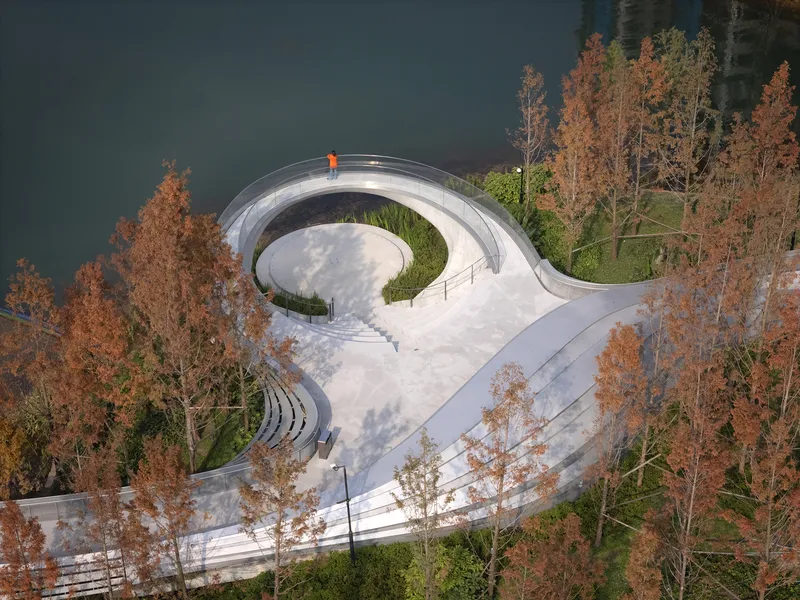
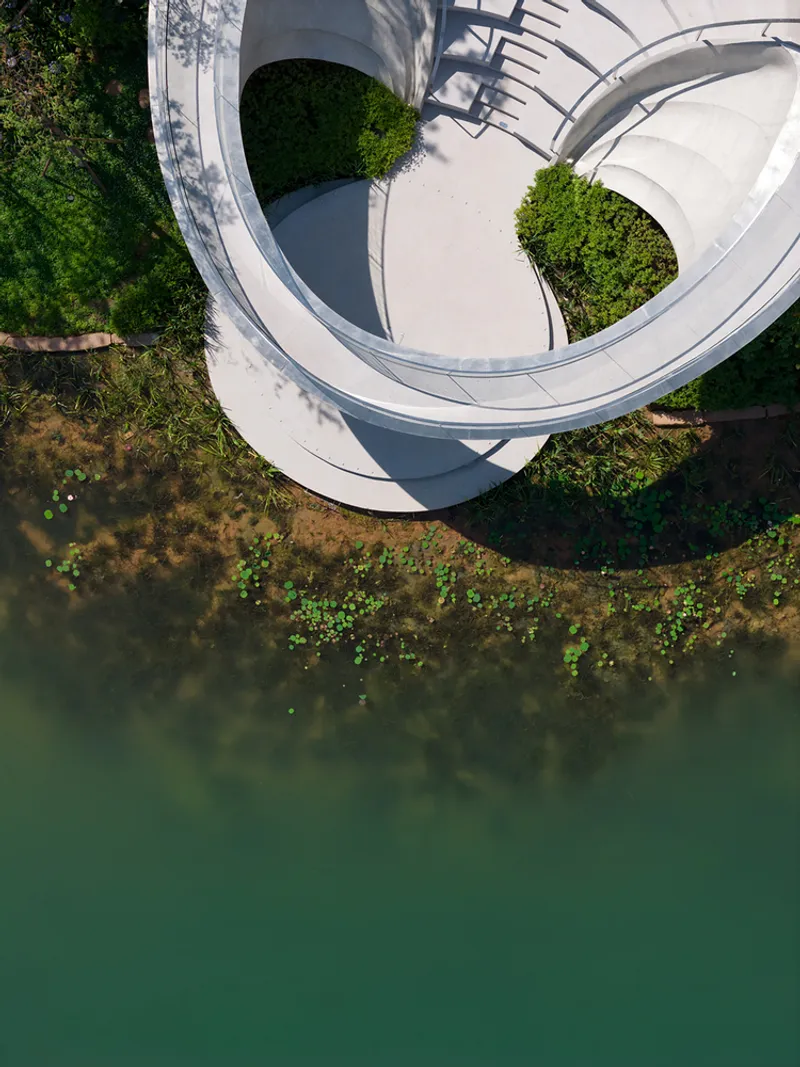
Seen from above, the logic is immediately legible: a white concrete path spirals inward, wrapping around planted voids punched through the structure. The walkway is not simply a means of circulation. Its expanded railings form a continuous canopy, turning passage into shelter. The spiral geometry compresses and releases views of the surrounding water and forest, so that a 25-meter-diameter structure manages to feel far larger than its footprint. Each loop brings you closer to the center and closer to the water's surface, a spatial gradient from sky to lake that gives the promenade a narrative arc.
The top-down views reveal how the architects carved circular openings for trees and planting within the concrete deck. These voids prevent the structure from reading as a sealed platform and instead weave vegetation directly into the path, reinforcing the Chinese garden principle of borrowed landscape at an intimate scale.
Water Theater and Lotus Stage
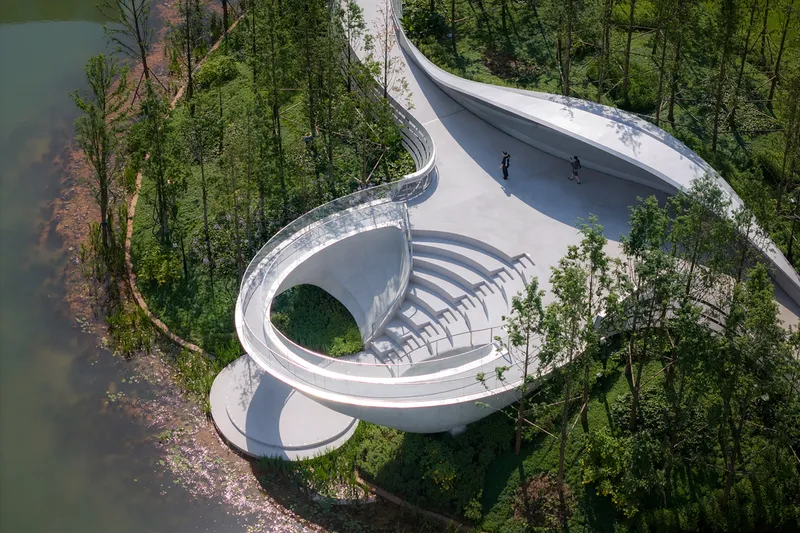
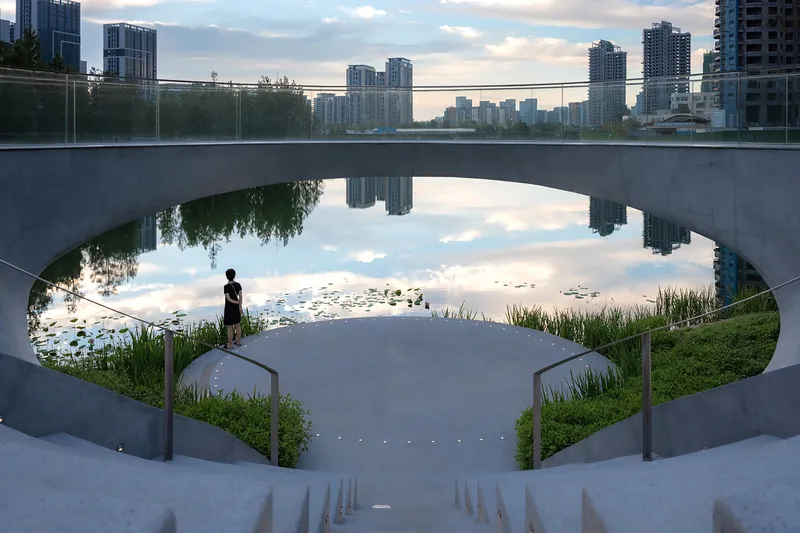
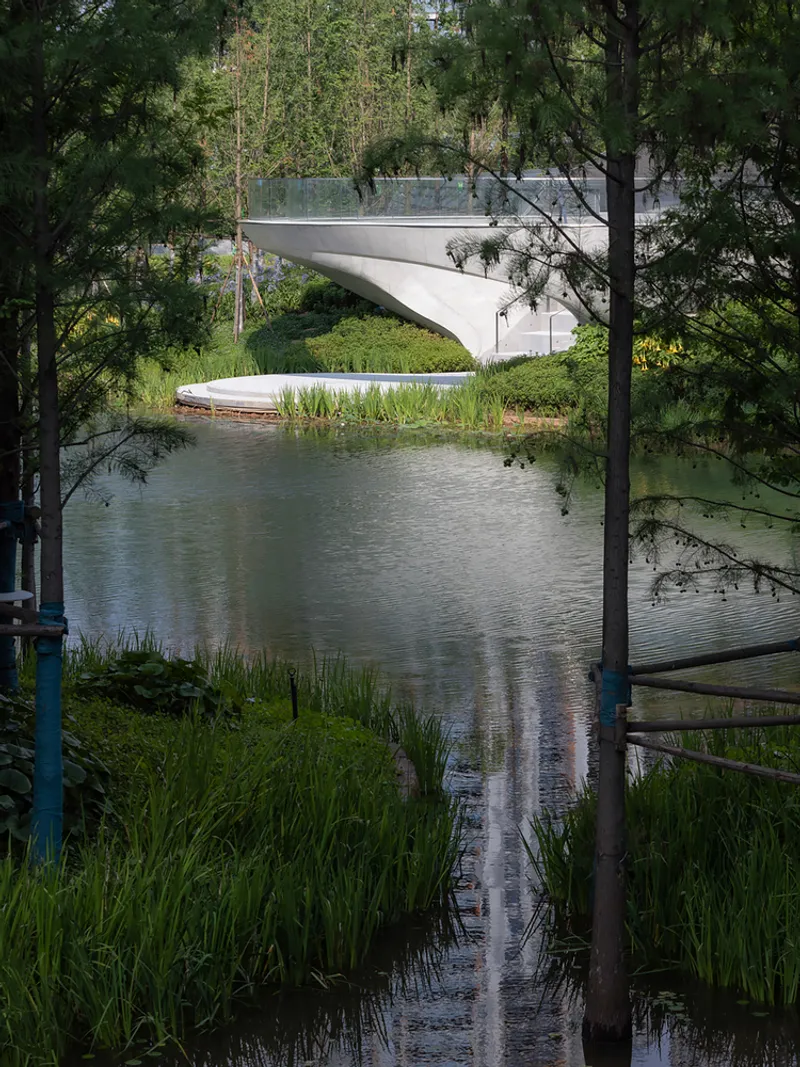
The amphitheater is the emotional core of the project. Concentric seating steps descend around a central planted opening, recalling the ancient theater at Hierapolis but recast in raw white concrete at the edge of a Chinese wetland. The stage sits flush with the water, so performers appear to float. For an audience of 100 this is an uncommonly powerful spatial setup: the horizon line of the lake becomes the backdrop, and the sound of water replaces any acoustical engineering.
On quieter days the stepped seating doubles as informal gathering space. A cantilevered deck extends over the wetland pond, narrow enough for single-file passage, which transforms it into a kind of tightrope for children. The multi-functionality here is not a marketing bullet point; it is a genuine consequence of the geometry. A spiral that descends to water naturally produces seats, ledges, and stages along the way.
Arrival by Land and Water
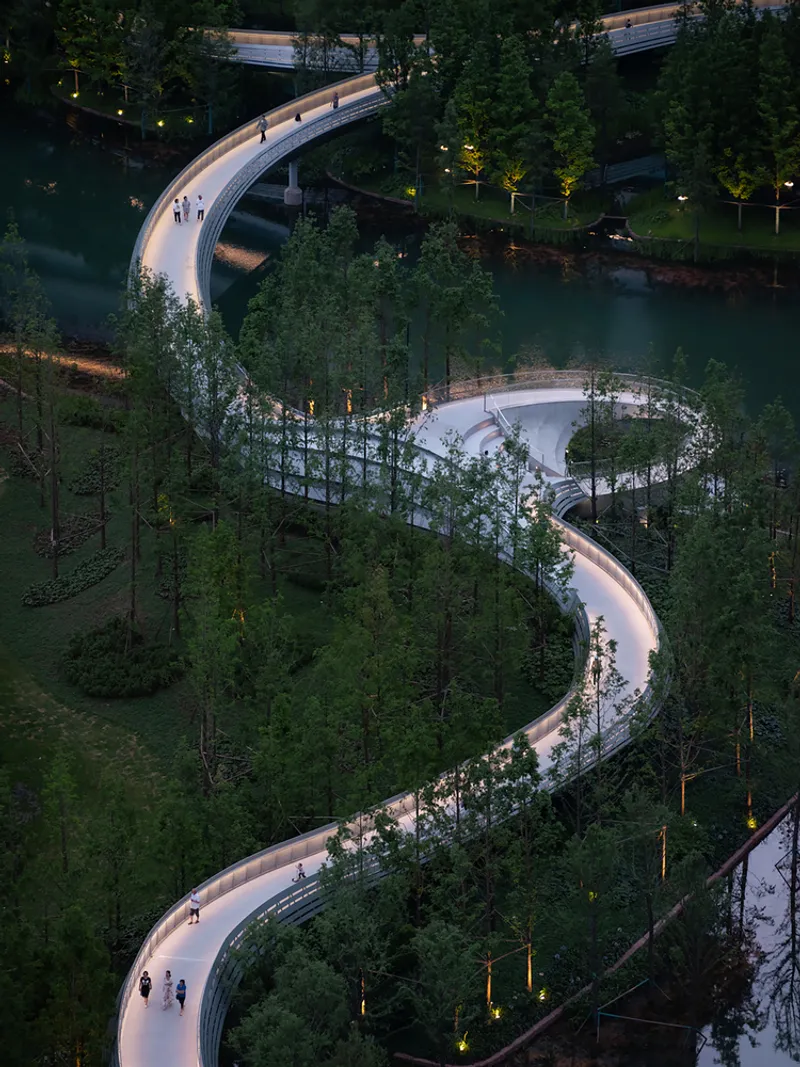
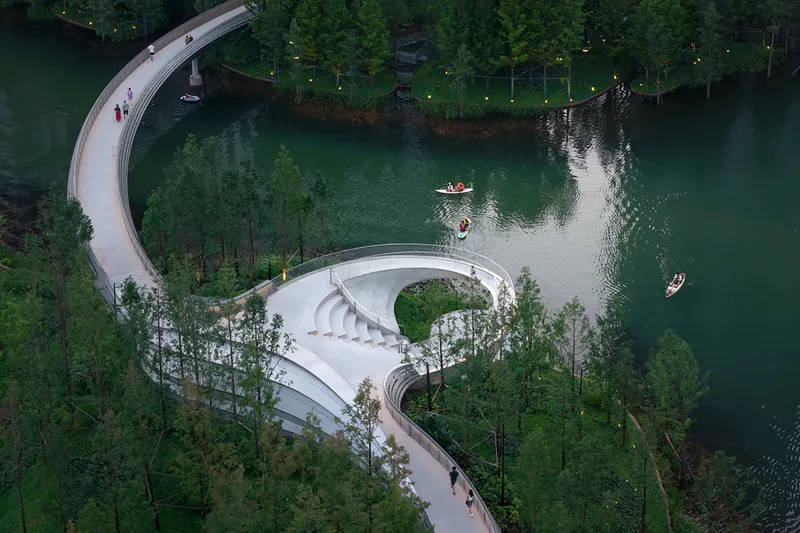
The two access routes are not an afterthought; they are fundamental to the design's experiential logic. Visitors arriving on foot follow a winding illuminated pathway through forested wetland, catching fragmented glimpses of the white structure through trees before the full form reveals itself. Those arriving by kayak or boat disembark at a platform and ascend stairs directly into the amphitheater. The land approach is cinematic, slow, layered. The water approach is immediate and theatrical. Both are deliberate, and the fact that the architects gave equal design attention to each says something about how seriously they take the idea of shifting viewpoints.
The aerial shot with kayakers on the lake captures this duality perfectly: the curving white form reads as both a destination and an extension of the shoreline, its concave face open to the water like a cupped hand.
White Concrete Against Green and Dark Water
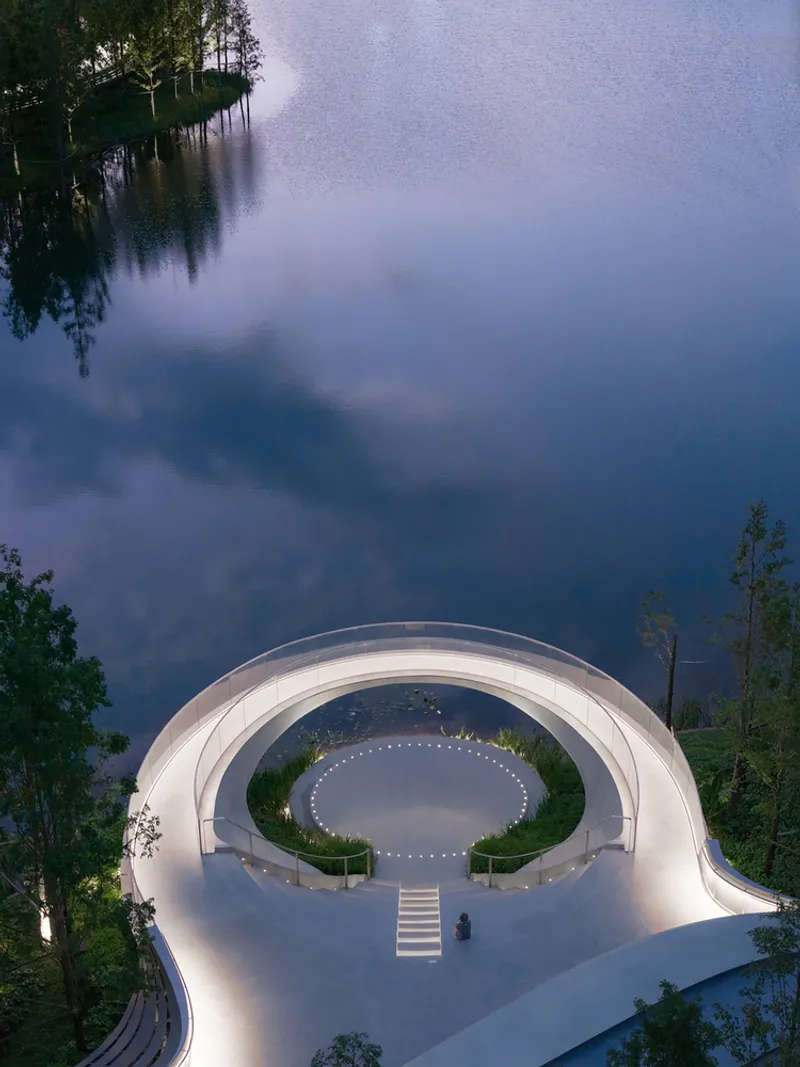
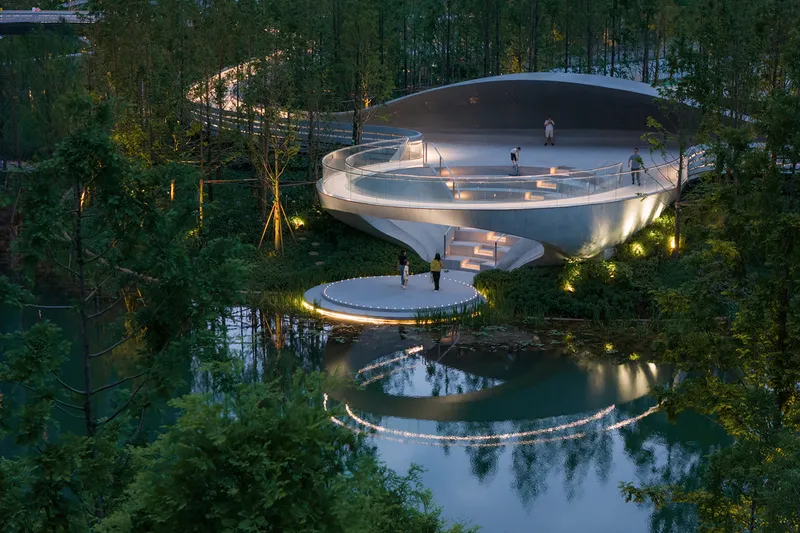
The material palette is deliberately reductive: white concrete and nothing else. No cladding, no secondary structure, no color. The raw concrete walls and soffits pick up the rhythm of light and shadow throughout the day, and the reflections off the surrounding water project shimmering patterns onto the curved surfaces. At twilight the structure glows, its illuminated edges doubling in the still pond below. The crescent-moon reading that the architects intended is most convincing in these evening photographs, where the building's mass dissolves and only its luminous outline remains.
The choice of white concrete also sharpens the contrast with the park's lush planting. Against the deep greens of the forested island and the dark water of Luhu Lake, the pavilion reads as something almost geological, a pale limestone outcrop surfacing from the wetland. It is a strong material decision that avoids the temptation to blend in while still respecting the landscape's primacy.
Nightfall and the Crescent Moon
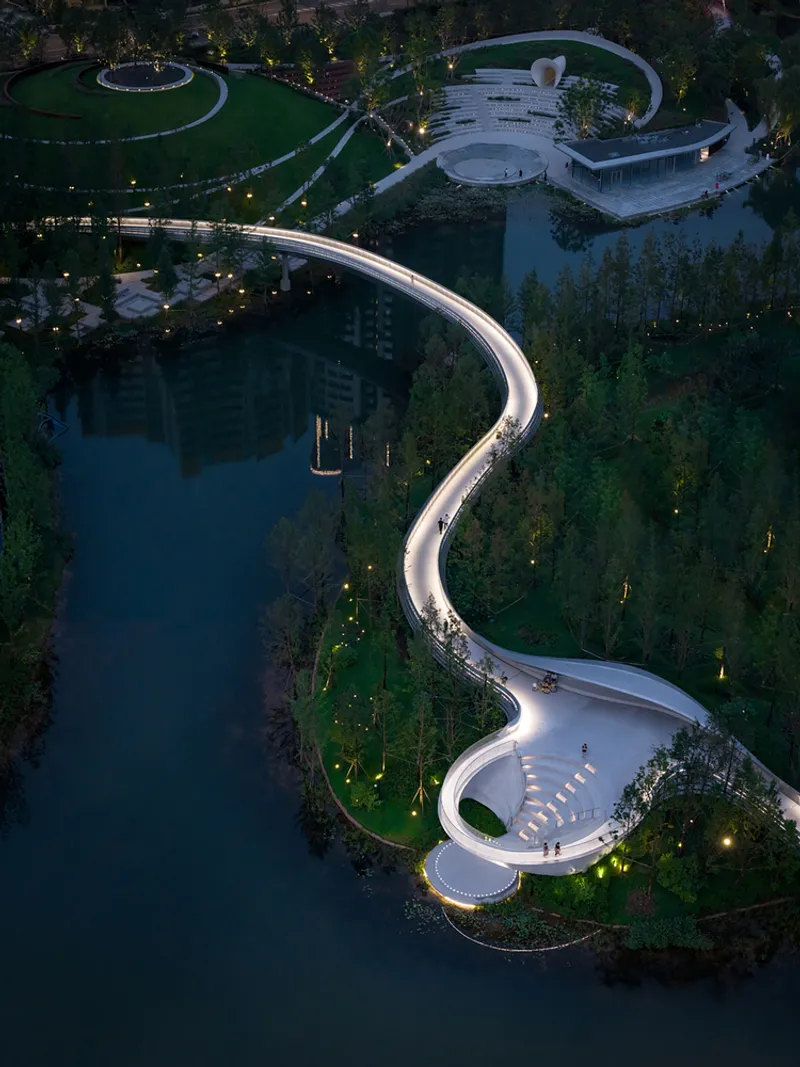
Ring of Starlight is one of those rare projects where the nocturnal reading is not merely an aftereffect of lighting design but a second life for the architecture. The evening aerials show how the illuminated pathways and amphitheater thread through forested islands, their glow outlining the spiral form in a way that daylight obscures. From the surrounding high-rises, residents see a crescent of light floating on the lake, a quiet beacon that signals the park's center without competing with the city skyline.
The lighting is restrained, concentrated along path edges and stair nosings rather than flooding the structure. This keeps the surrounding forest dark and preserves the sense of isolation that the design works so hard to establish. The pavilion at night is less a spectacle than a suggestion, a soft signal that something worth finding lies at the island's heart.
Why This Project Matters
Small public pavilions in Chinese landscape parks frequently default to one of two modes: the hyper-parametric gesture that overwhelms its setting, or the timid wooden shelter that disappears into it. Ring of Starlight does neither. It is assertive enough to serve as a landmark visible from surrounding towers, yet humble enough to require a 15-minute walk through wetland forest before you can touch it. The spiral geometry is not decorative; it solves real problems of access, shelter, seating, and staging within a 490-square-meter footprint. The result is architecture that performs as infrastructure, landscape, and theater simultaneously.
Zaiguo Lin and the HDEC AIR-CoLAB team have produced a building that takes the sensory principles of traditional Chinese garden design and executes them in the blunt, honest vocabulary of white concrete. The lotus-leaf stage, the single-file cantilevered bridge, the twin approaches by land and water: every move amplifies the visitor's awareness of light, sound, and reflection. In a development masterplan dominated by residential towers and commercial plots, Ring of Starlight insists that the most important space in Luxelakes Eco-City is the one hardest to reach.
Ring of Starlight by HDEC AIR-CoLAB Studio, lead architect Zaiguo Lin, with landscape design by Z+T Studio. Located on an island in Vortex Park, Luxelakes Eco-City, Chengdu, China. 490 m², completed 2024. Photography by Arch-Exist.
About the Studio
Share Your Own Work on uni.xyz
If projects like this are the kind of work you want to make, uni.xyz is a place to publish your own, find collaborators, and enter design competitions.


Popular Articles
Popular articles from the community


graciastudio Turns a Viewless Tijuana Lot Inward Around a Courtyard of Concrete, Timber and Trees
In Tijuana, Jorge Gracia's GA2 House stacks a timber-clad private floor over exposed concrete and replaces a missing view with a planted interior patio.

FCC Arquitectura Expands a Portuguese Granite House with a Board-Marked Concrete Wing
In Portugal, JV House pairs a cleaned-up whitewashed and granite dwelling with a timber-shuttered concrete extension, courtyards and a garden pool.


Aquadapt: An Underwater Habitat That Rewrites Its Rooms by the Hour
Curved modules ring the seabed while one shell shifts from breakfast room to cinema, farm and football pitch as residents' needs change.

Singing Woman: An Opera House That Performs Before the Curtain Rises
Ovidiu Cristian Pavel's conceptual opera house translates Estonia's choral identity into a sculpted waterfront landmark facing the Baltic Sea.

Similar Reads
You might also enjoy these articles


Hodi-Mandai Geram
Project Function: Preservation and revitalization of the Intangible heritage and socio-spatial identity of the Hodi by Housing, Cultural Memory Center, Sacred Grove, landscape, local tourism economy


Olio Towers: A Mid-Rise for Performers That Fuses Housing, Rehearsal, and Stage
Located blocks from Houston's Theater District, this modular tower stacks living units around a central performance atrium.

Oasis: Modular Green Housing Carved into Dhaka's Urban Fabric
A shortlisted Plugin Housing entry reclaims unauthorized settlements in Dhaka with stepped concrete volumes, green roofs, and ventilation-driven design.

Black Hole: A Floating Megastructure for the Post-Physical Era
Emiliano Mazzarotto envisions a spherical, self-scaling arena where e-sports, digital hotels, and holographic stadiums replace traditional public space.

Explore Landscape Design Competitions
Discover active competitions in this discipline

Challenge to reimagine the Iron Throne

Photograph architecture without architects

Illustrate the lost glory of Angkor Wat - Render Challenge

Design challenge to reuse E-waste
Comments (0)
Please login or sign up to add comments
No comments yet. Be the first to comment!