

Rolex Boutique Toronto by PARTISANS
Digitally fabricated limestone façade reshapes luxury retail on Toronto’s Bloor Street, blending computational precision, fluid geometry, and timeless craftsmanship.


Located on Toronto’s prestigious Bloor Street, the Rolex Boutique Toronto, designed by PARTISANS, represents a bold fusion of computational design, material innovation, and luxury retail architecture. Occupying the ground floor of a modernist high-rise, the boutique establishes a distinctive architectural identity within one of Canada’s most exclusive shopping corridors.
Known for their experimental approach to materials, PARTISANS continue a long-standing trajectory of architectural craftsmanship in this project. From sculpted cedar at the Grotto Sauna to CNC-milled mahogany at Bar Raval and the voxel-bond brickwork of Canvas House, the studio’s work consistently explores how traditional materials can be reimagined through contemporary fabrication techniques. At the Rolex Boutique Toronto, this exploration culminates in a digitally fabricated limestone façade, signaling what the architects describe as “future heritage.”
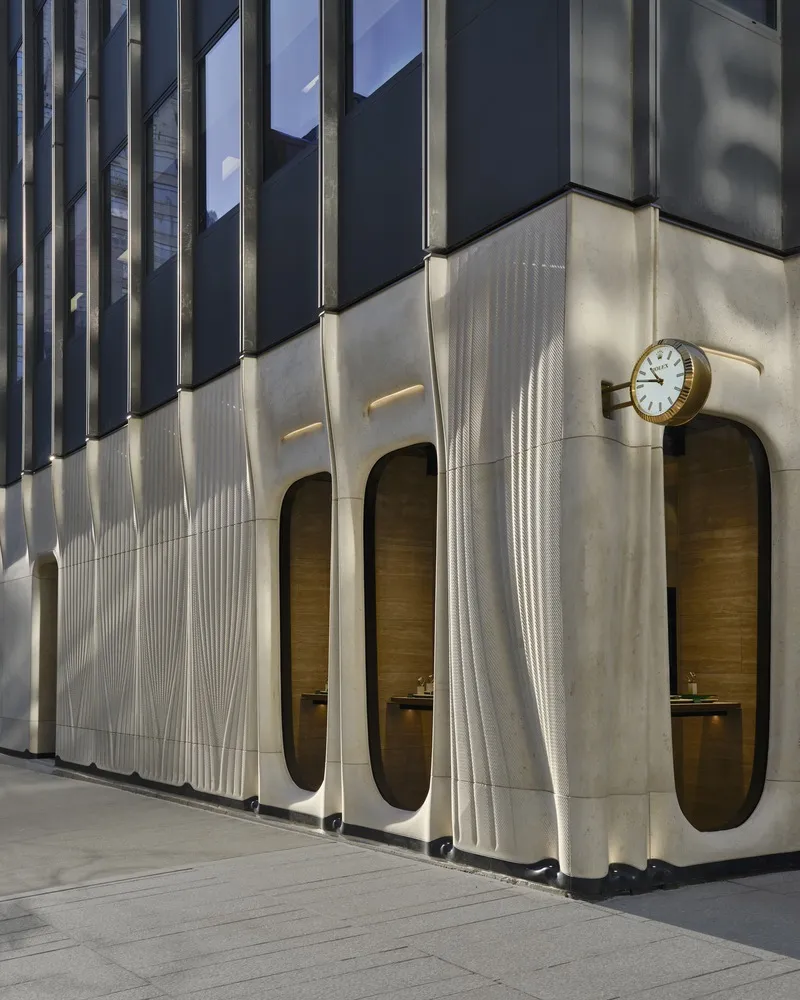
A Renaissance of Stone in Contemporary Architecture
The boutique was commissioned by Royal de Versailles Jewellers, who partnered with PARTISANS to create an architectural presence that would stand apart from neighboring luxury brands. Rather than relying on applied finishes or conventional storefront systems, the design embraces stone as both structure and ornament. “Stone is future heritage,” notes PARTISANS founder Alex Josephson, emphasizing the material’s renewed relevance in contemporary architecture.
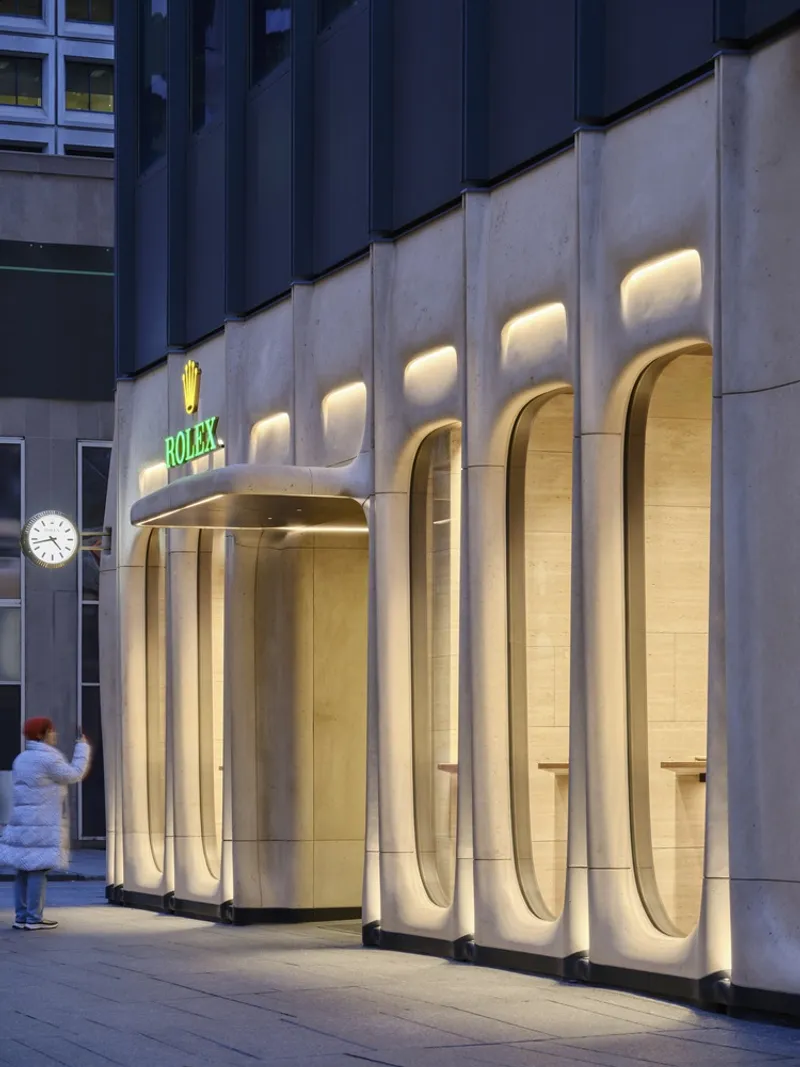
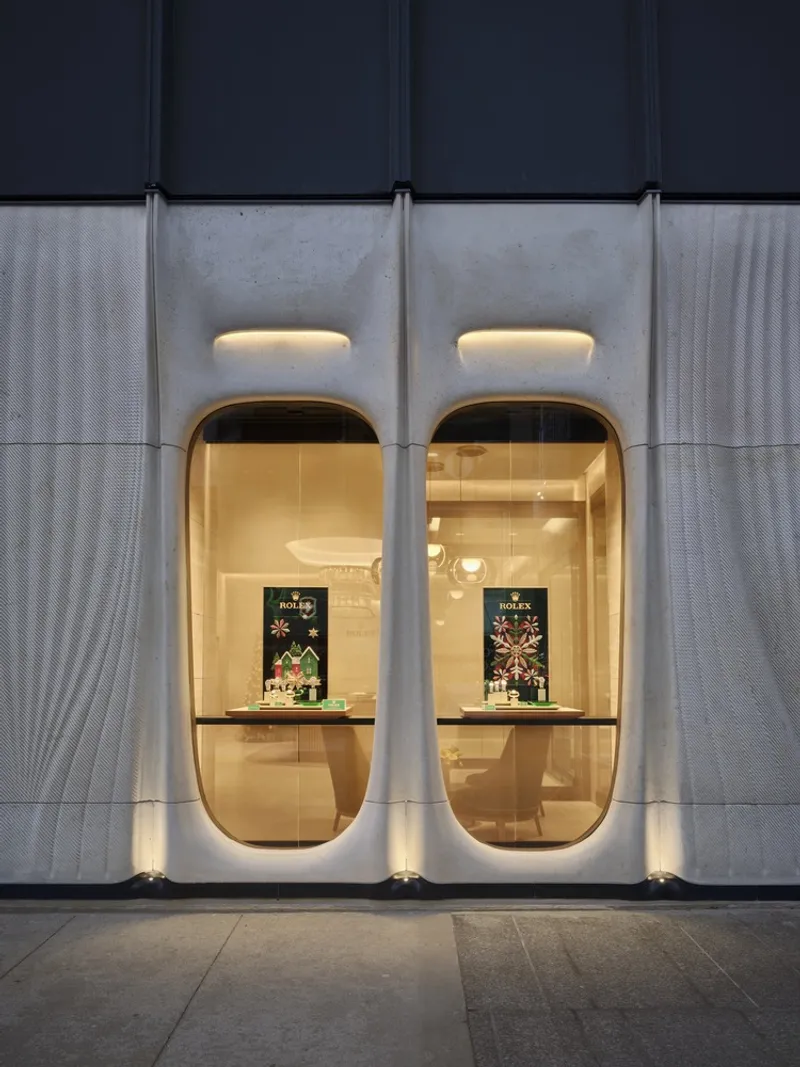
Set against the rigid steel and glass grid of the existing high-rise, the limestone façade introduces a sculptural counterpoint. Its fluid geometry creates a rhythmic sequence of vertical columns that subtly reference the articulated links of a Rolex watch band. This biomorphic expression contrasts sharply with the orthogonal base building while maintaining a seamless visual dialogue.

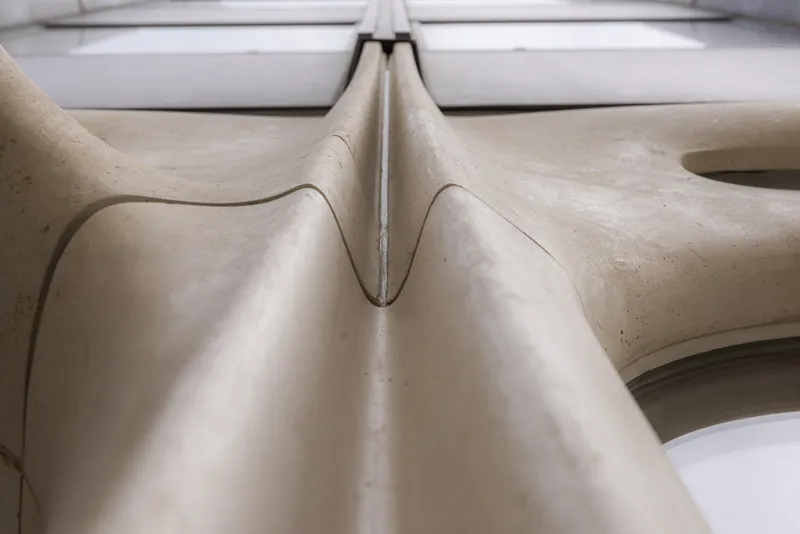
Computational Design and Precision Fabrication
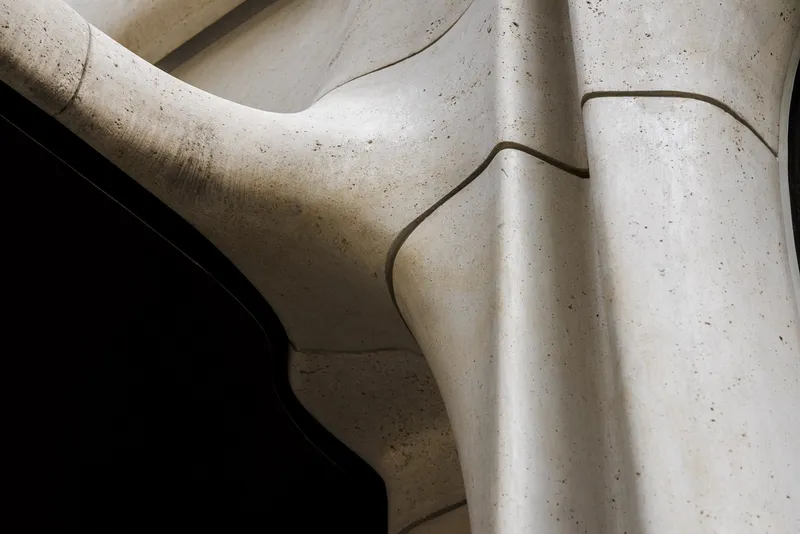
To realize the complex geometry of the façade, PARTISANS collaborated with Italian computational designer Arturo Tedeschi, employing advanced algorithmic modeling and CNC fabrication. Each limestone bay was digitally modeled and cut based on precise measurements obtained from 3D scans of the existing building, ensuring an exceptional level of accuracy.
The façade’s design required exact tolerances, particularly where the stone interfaces with the existing mullions and the curved glass display cases inside the boutique. Precision was critical: not only for visual continuity but also for performance requirements such as energy efficiency, maintenance access, and long-term durability. Window detailing had to align within a margin of just ¼ inch, underscoring the technical rigor behind the sculptural appearance.
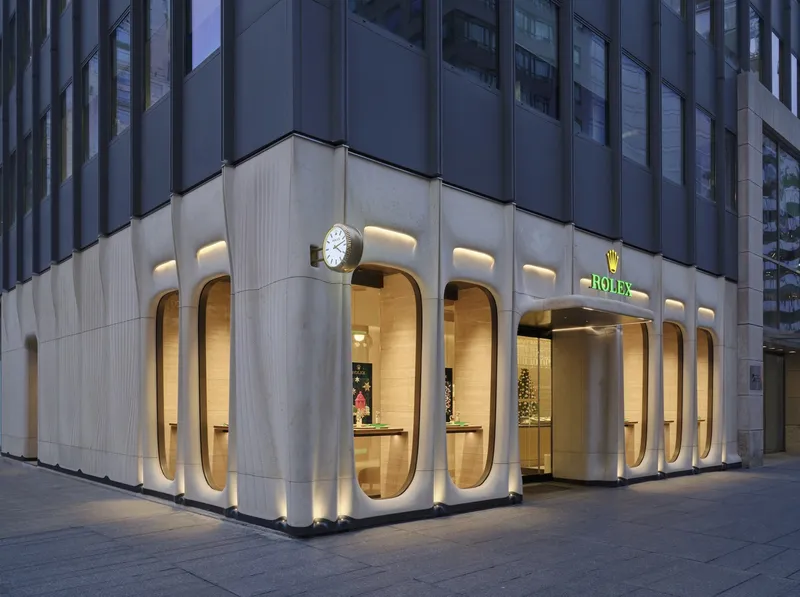
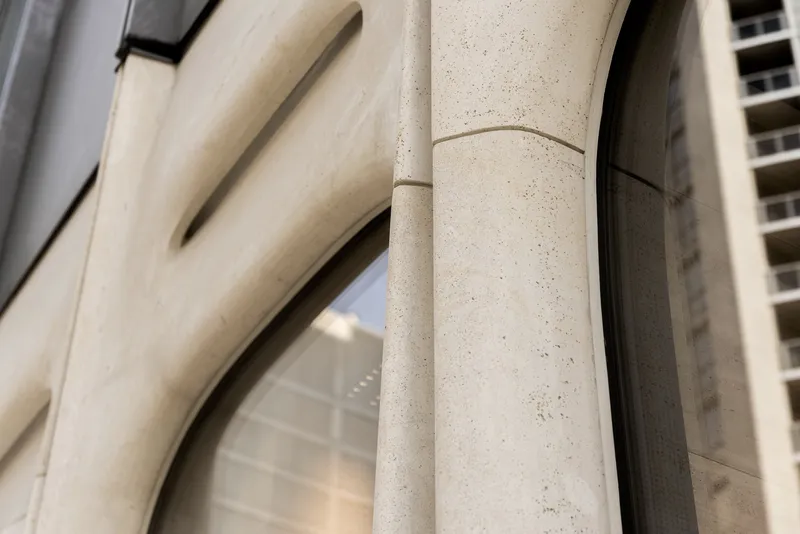
Seamless Integration of Exterior and Interior
One of the project’s defining achievements is the continuity between exterior architecture and interior experience. As the mullions descend along the building’s façade, they gradually bend into graceful arcs, transitioning fluidly from the limestone exterior into the boutique’s interior glazing and display elements. This spatial continuity reinforces the brand’s identity while enhancing the customer’s sensory experience.
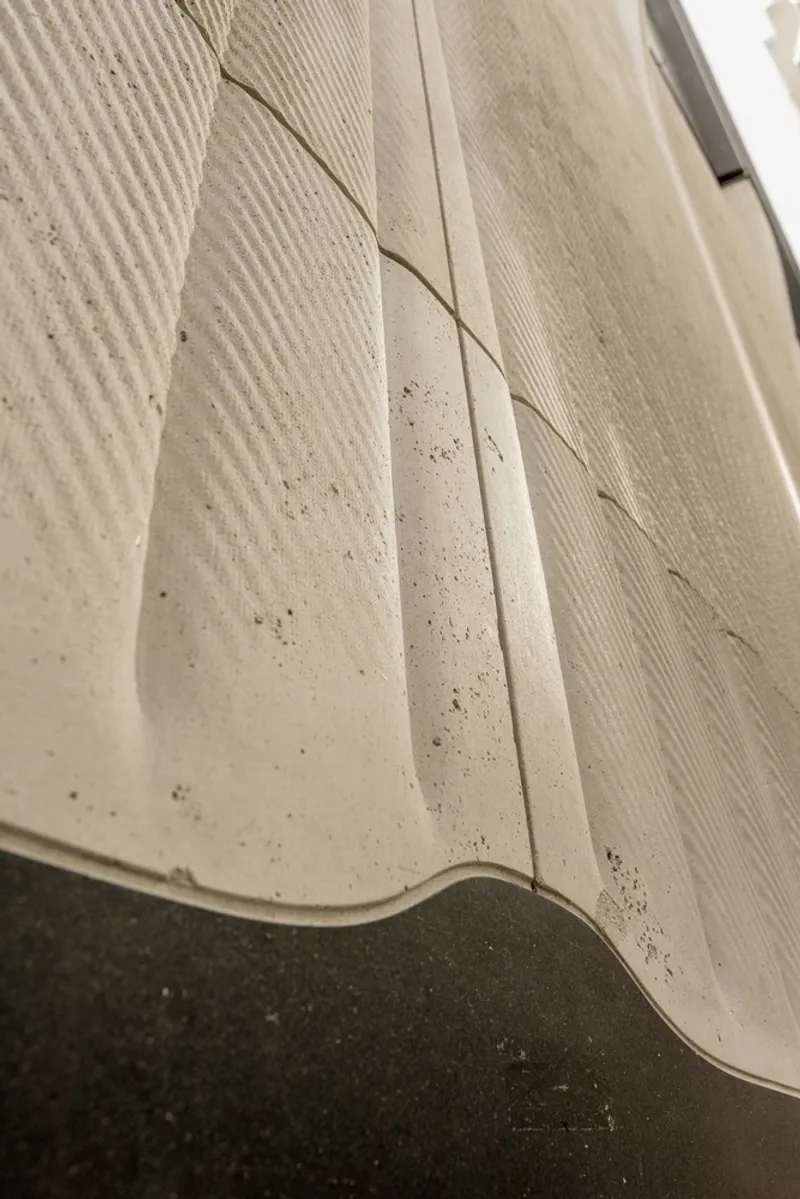
On the east façade, a parametric CNC-etched pattern is carved directly into the limestone. Developed through algorithmic processes, the pattern adds depth, texture, and refinement, reflecting both Rolex’s legacy of precision and Royal de Versailles’ commitment to craftsmanship. The result is an architectural surface that operates simultaneously as structure, ornament, and brand expression.
Redefining Luxury Retail Architecture in Toronto
The Rolex Boutique Toronto sets a new benchmark for luxury storefront design in the city. By merging computational design, digital stone fabrication, and heritage materials, PARTISANS deliver an architectural statement that is both contemporary and timeless. The project demonstrates how advanced technologies can elevate traditional materials, transforming a retail façade into an enduring piece of urban architecture.
More than a boutique, the building becomes a crafted object: an interface between city, brand, and material innovation, redefining what luxury retail architecture can be in the 21st century.
All photographs are works of
Doublespace Photography




Popular Articles
Popular articles from the community


Co-life: Sustainable Architecture for Age-Friendly Community Living
Co-life reimagines sustainable architecture for seniors through courtyards, rammed earth, shared gardens, and spaces designed for belonging.

Riyadh For All: Intergenerational Urban Design for Active Aging in Rabat
Riyadh For All reimagines urban design in Rabat with intergenerational co-living, adaptive courtyards, and Moroccan cultural exchange today.

The Earth Pod: 3D Printed Homes for Resilient Refugee Communities
The Earth Pod reimagines refugee housing through 3D printed homes made from clay, combining resilience, self-sufficiency, and rapid shelter.

EW PARK: Sustainable Architecture Reimagines the Future of Urban Parking
EW PARK reimagines city parking as a modular wooden tower combining automation, solar energy, electric mobility, and adaptable urban design.


Similar Reads
You might also enjoy these articles


FAMM Arquitectura Organizes Ten Villas Around Courtyards and Jungle in Nosara, Costa Rica
El Molino pairs two elongated volumes with deep overhangs and timber louvers to build a compact coastal community five minutes from the beach.

Oscar Niemeyer's Ibirapuera Park Pavilions Define São Paulo's Cultural Identity in Concrete and Curve
A constellation of modernist volumes set within São Paulo's most important urban park, conceived for the city's 400th anniversary in 1954.
How Henri Picq's 1889 Paris Pavilion Traveled 11,000 Kilometers to Become Santiago's Artequín Museum
A prefabricated iron and glass pavilion built for the Paris Universal Exposition found a second life as a children's art museum in Chile.

Sanjay Puri Architects Wraps a Jaipur Office Tower in Capsule-Shaped Green Buffers
A nine-level climate-responsive workplace near Jaipur Airport uses stacked planter terraces and aluminium screens to fight 40°C heat.


Explore Architecture Competitions
Discover active competitions in this discipline



Challenge to reimagine the Iron Throne


Photograph architecture without architects


Illustrate the lost glory of Angkor Wat - Render Challenge


Design challenge to reuse E-waste
Comments (0)
Please login or sign up to add comments
No comments yet. Be the first to comment!