

ROOMOOR Carves a Central Void Through a Dense Surat Townhouse to Let It Breathe
A multigenerational home in Surat turns inward, organizing life around a vertical core of light, air, and shared space.


In a city where narrow plots crowd against one another and open space is a memory rather than a given, a house that turns its back on the street and opens up to itself is not a retreat. It is a strategy. Veiled Void, designed by ROOMOOR and completed in 2025 in Surat, India, is a multigenerational townhouse that organizes all its habitable rooms in an L-shaped configuration around a vertically carved core. That core, a void running the full height of the building, serves simultaneously as light well, ventilation shaft, and social center. Every significant room in the house has a relationship to it.
What makes the project worth studying is not the void itself, which is a well-known device, but the precision with which ROOMOOR deploys it on a constrained urban site. The house reads as a series of layered filters: concrete structure, timber screening, translucent panels, planted edges. Each layer mediates between the dense residential fabric outside and the still, daylit rooms within. The result is a home that feels far larger and more generous than its footprint would suggest, with every floor connected visually and atmospherically through the central opening.
A Facade Built from Layers, Not Gestures
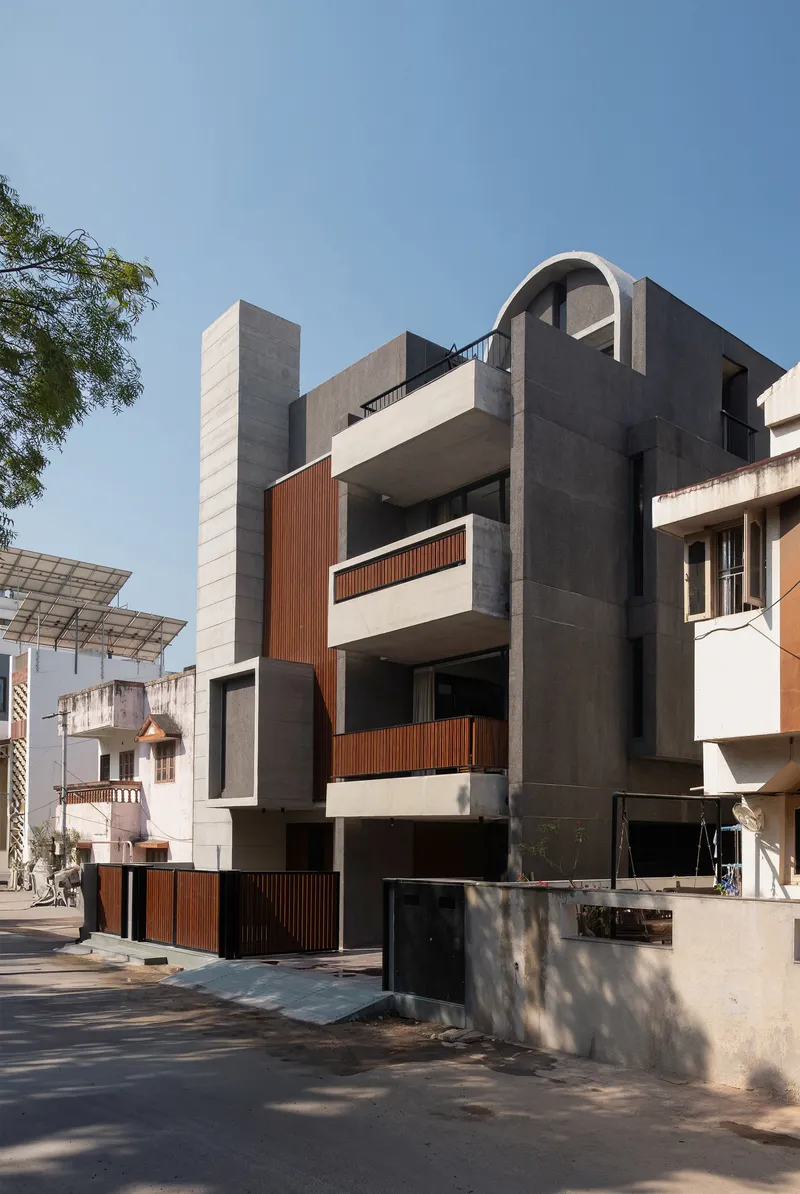
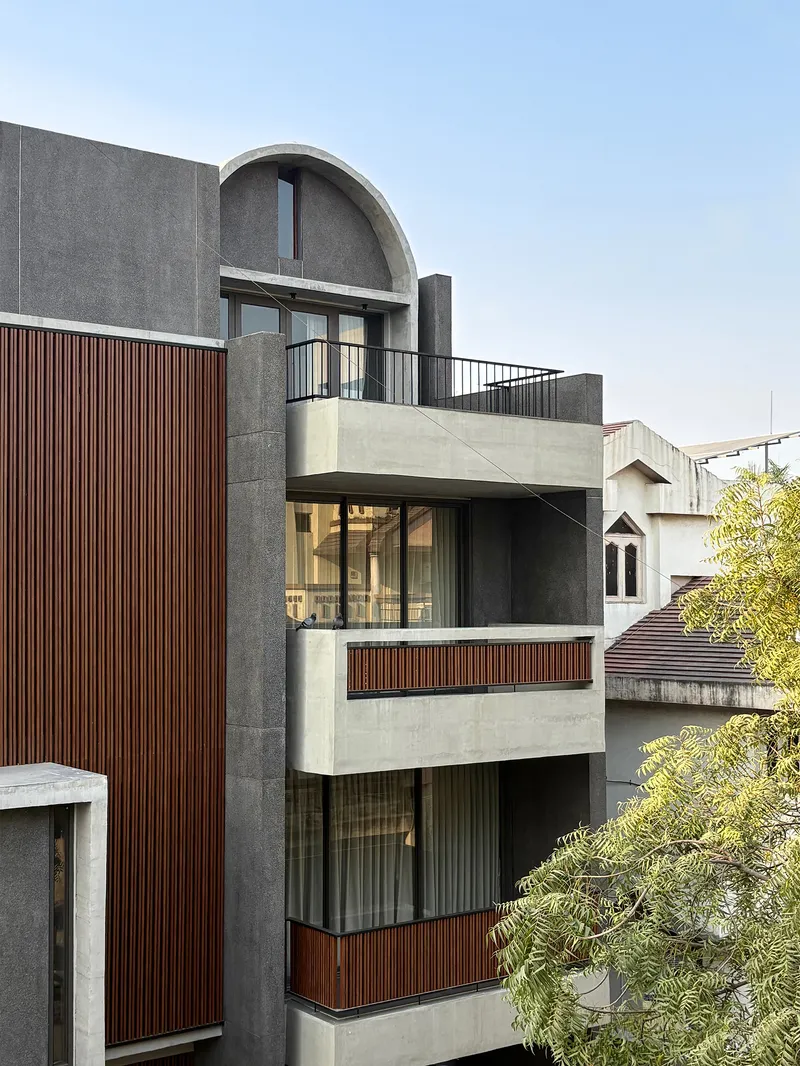
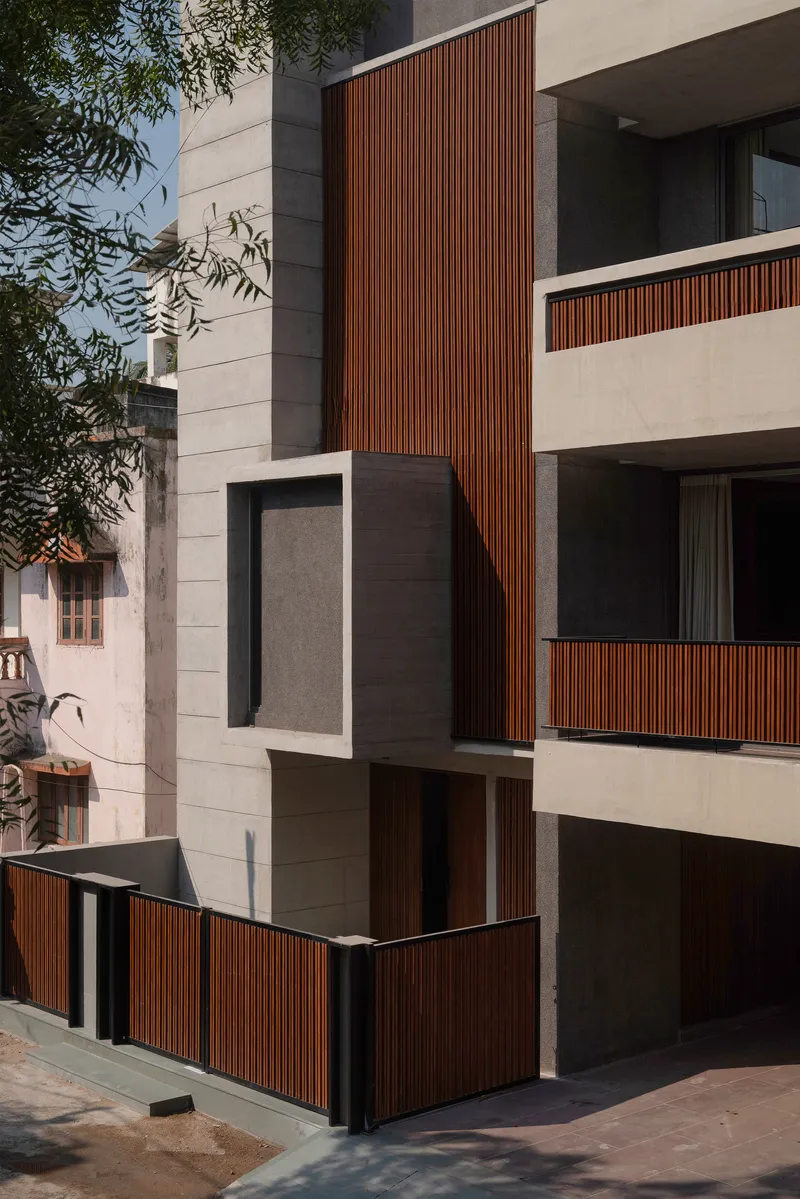
From the street, Veiled Void presents itself as a composition of materials rather than a single form. Concrete volumes, vertical timber slats, cantilevered balconies, and an arched vault at the top stack against one another in a way that is deliberate without being showy. The timber screening does real work here: it controls solar gain, provides privacy from close neighbors, and gives the facade a depth that flat walls never achieve. There is no single heroic move. Instead, the street elevation accumulates texture and shadow, changing character as the sun tracks overhead.
The corner entrance, framed by vertical timber slats and overhanging branches, sets the tone for the rest of the house. You are moving from exposed to screened, from public to filtered, from the compressed density of Surat's residential streets into a house that has found a way to be generous within severe constraints.
The Void as Organizing Principle
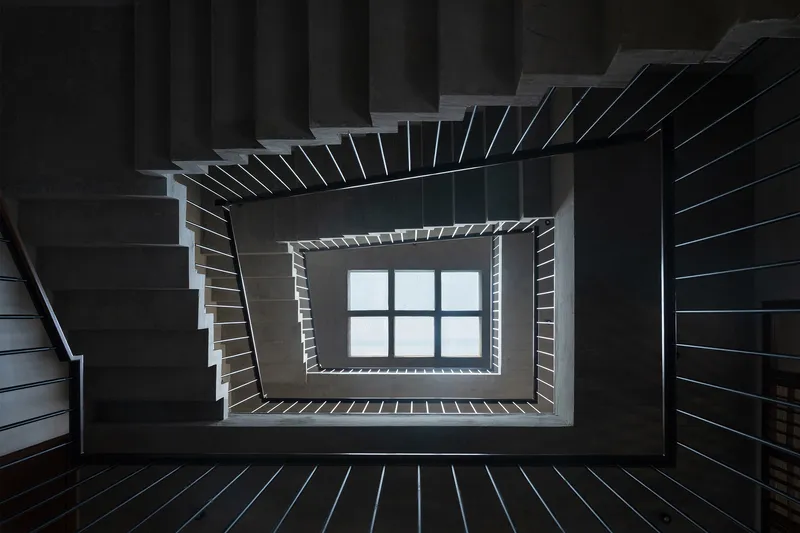
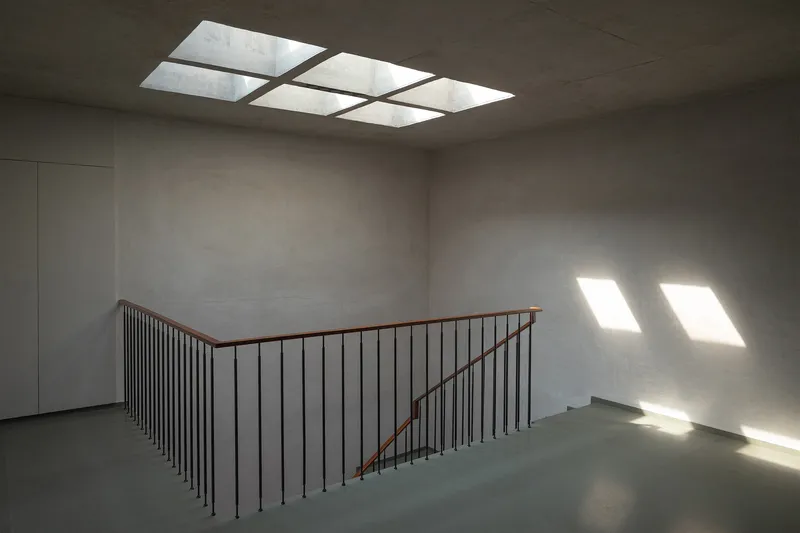
Look up through the stairwell and you see the void in its purest expression: dark timber treads spiraling around a rectangular opening that terminates in a skylight. This is the spine of the house, the element around which everything else is arranged. Natural light washes down the concrete walls at different angles throughout the day, and air moves vertically through the shaft, creating passive ventilation that reduces the house's dependence on mechanical cooling in Surat's brutal climate.
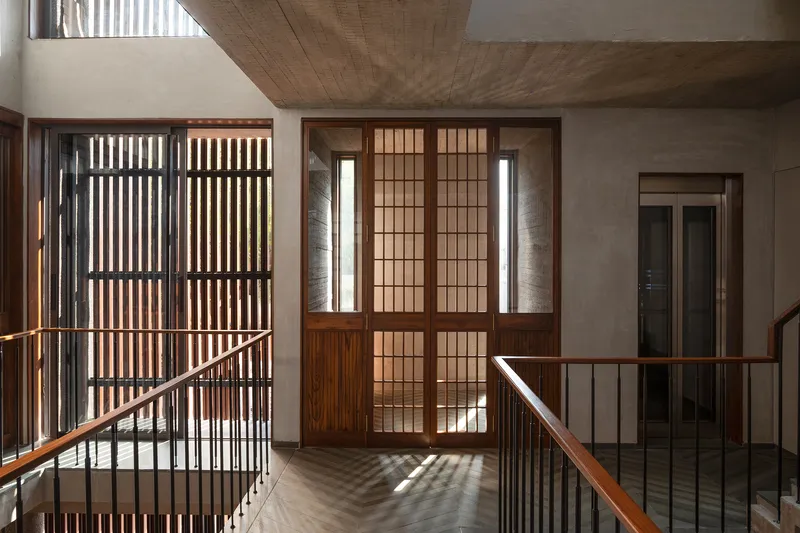
The stairwell landings are not throwaway circulation spaces. Gridded timber screens and translucent sliding doors turn each landing into a room in its own right, a place where light collects and where family members crossing paths might pause. ROOMOOR treats the staircase as the most public interior of the house, the space where generations overlap.
Timber Screens and Controlled Daylight
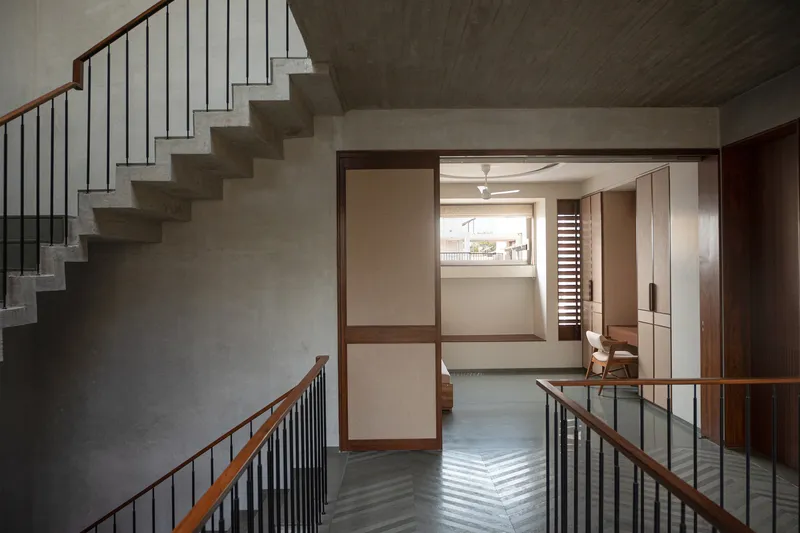
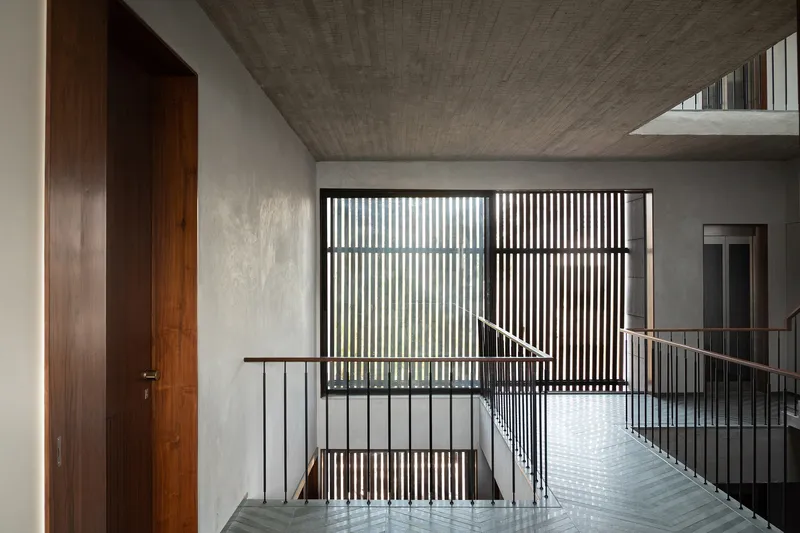
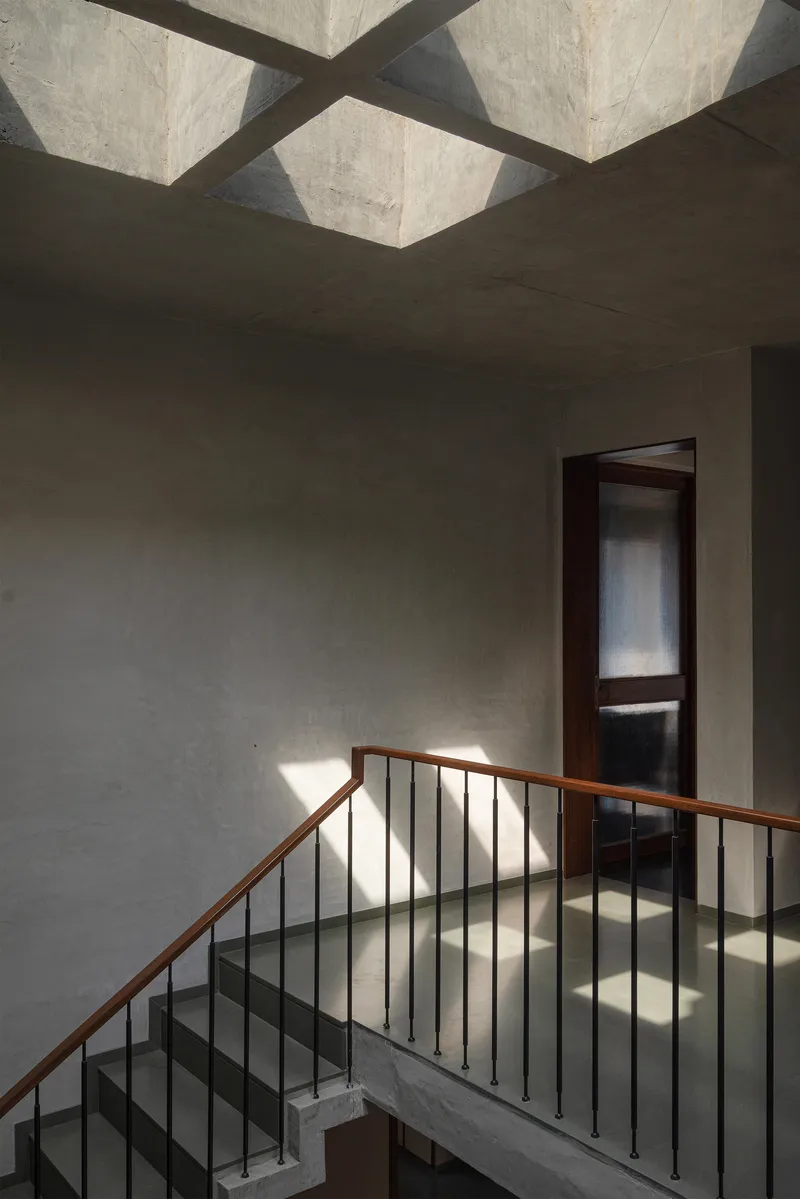
Timber appears everywhere in this house, not as decoration but as a calibrating device. Vertical slats on the exterior, horizontal louvers at mid-levels, and fine grid screens in the stairwell all filter daylight differently. The chevron-patterned floor tiles on one landing catch the shadows cast through a screen above, creating a graphic interplay that shifts by the hour. At the upper landing, vertical slat panels reduce the afternoon sun to thin stripes across the concrete ceiling, keeping the space cool without shutting it off from the outside entirely.
The coffers cast in the concrete ceiling above the stair railing are another small but considered move. They break up what would otherwise be a flat slab, giving sunlight a surface to model and deepening the play of shadow that the timber screens initiate. Nothing in this house is lit the same way twice.
Living Spaces That Anchor a Family

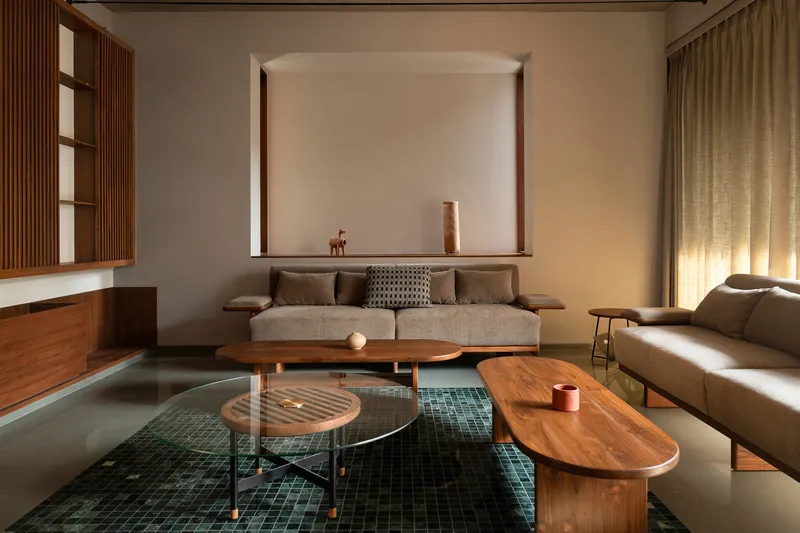
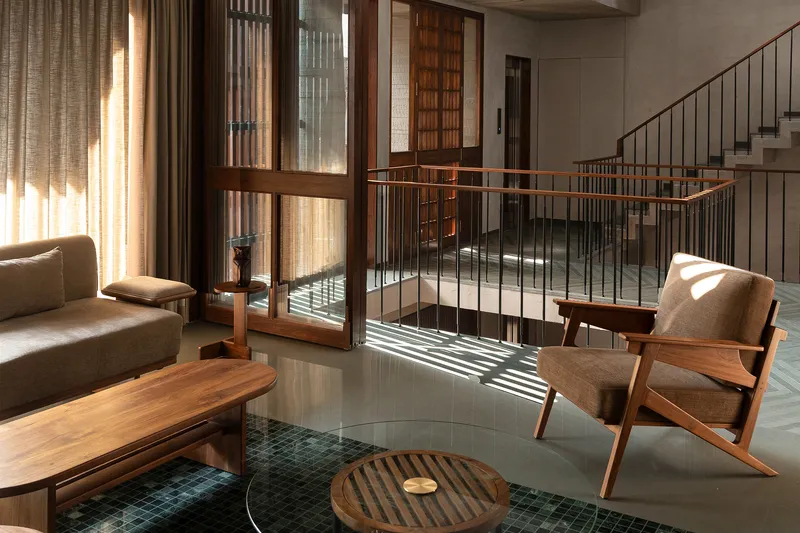
The double-height living room is the emotional center of the house. A cantilevered concrete staircase rises through the space, and afternoon sunlight fills the room from multiple directions, bouncing off the concrete and warming the timber surfaces. The furniture arrangement around a sunken green mosaic tile panel in the floor gives the room a focal point that is not a television or a fireplace but a material event: a pool of color recessed into the ground plane, around which the family gathers.
That sunken tile detail reappears in slightly different form elsewhere, always as a moment of material surprise embedded in the floor. It is a generous gesture in a house that could easily have been spartan, and it signals ROOMOOR's understanding that multigenerational living demands spaces that feel ceremonial even when they are casual.
Intimate Rooms Under Concrete Vaults
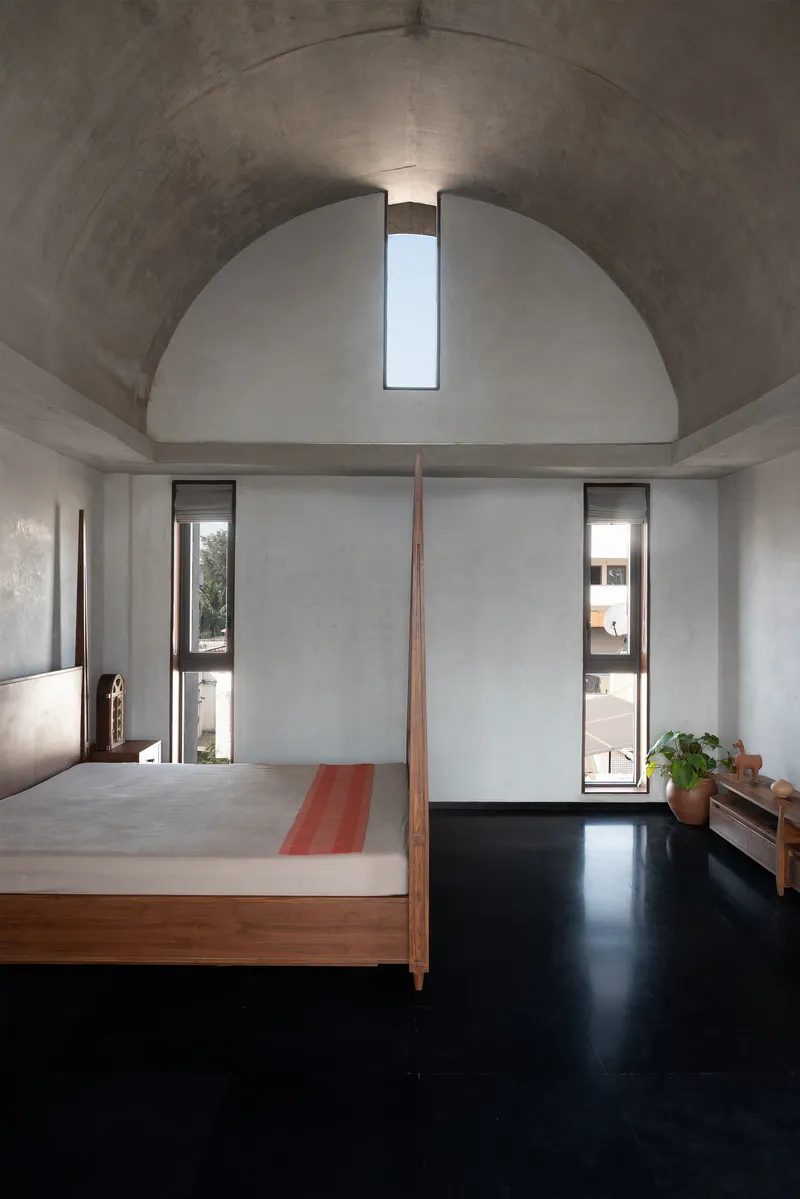
At the upper levels, the character shifts. A bedroom sits beneath a concrete barrel vault with a vertical slot skylight at the apex, creating a room that feels almost chapel-like in its stillness. The light enters as a thin blade, moving across the curved ceiling as the day progresses. It is a deeply private space, walled off from the density outside but connected to the sky.
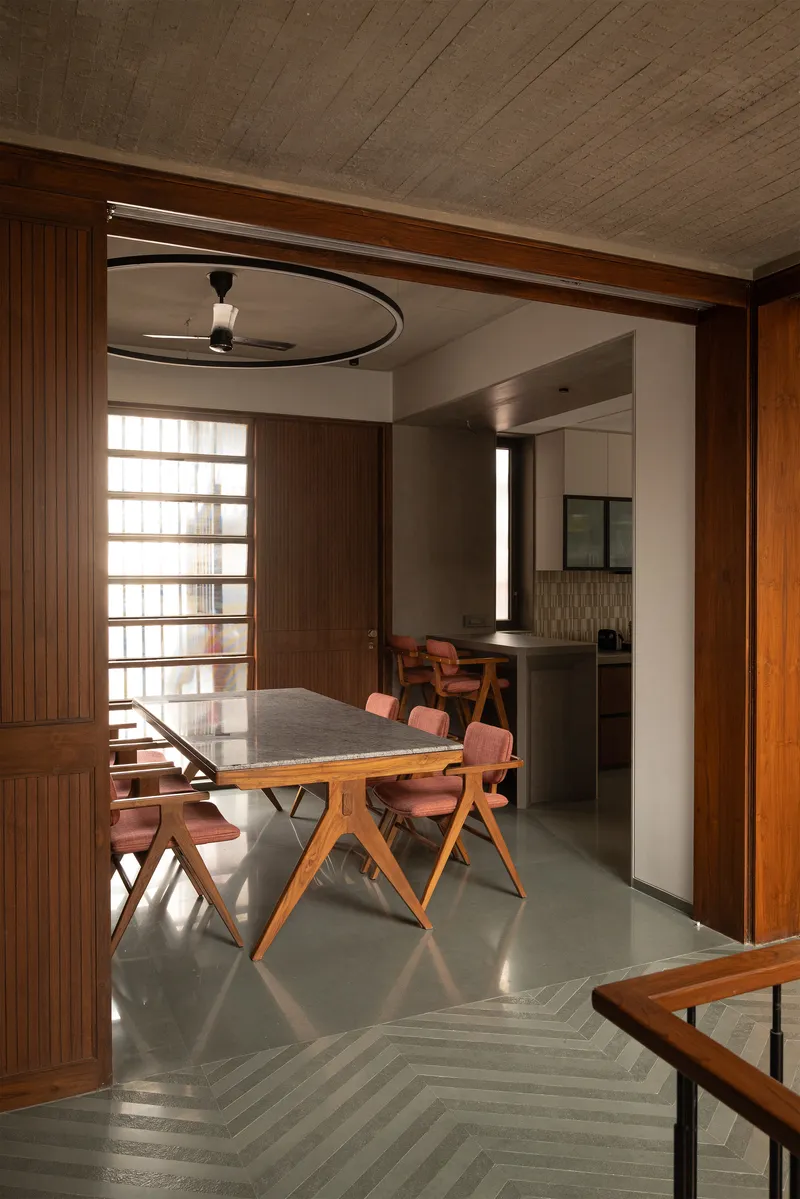
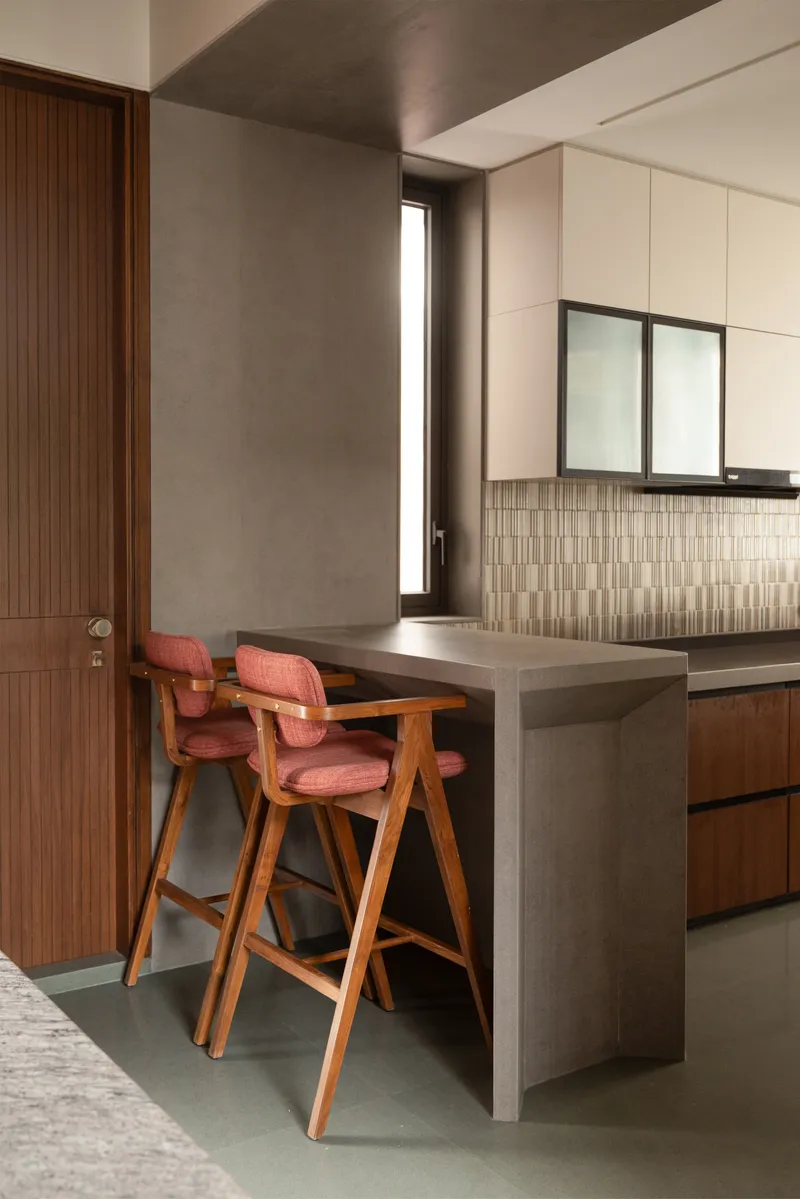
Elsewhere, a curved timber portal frames the transition into the dining room, where herringbone flooring marks the threshold. The kitchen, with its pink upholstered bar stools and narrow vertical window, is one of the more intimate corners of the house. ROOMOOR varies the mood room by room, using ceiling height, material finish, and aperture size to give each space a distinct identity within the shared language of concrete, timber, and filtered light.
The Rooftop as Release
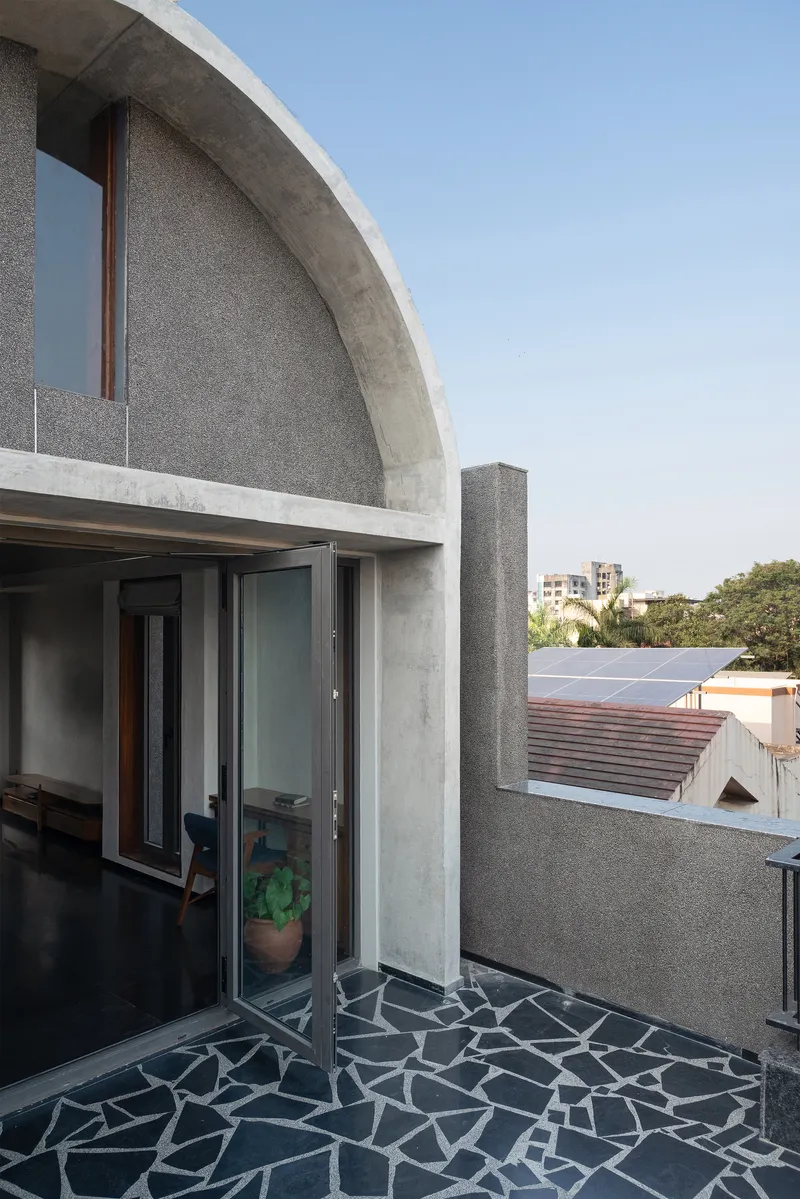
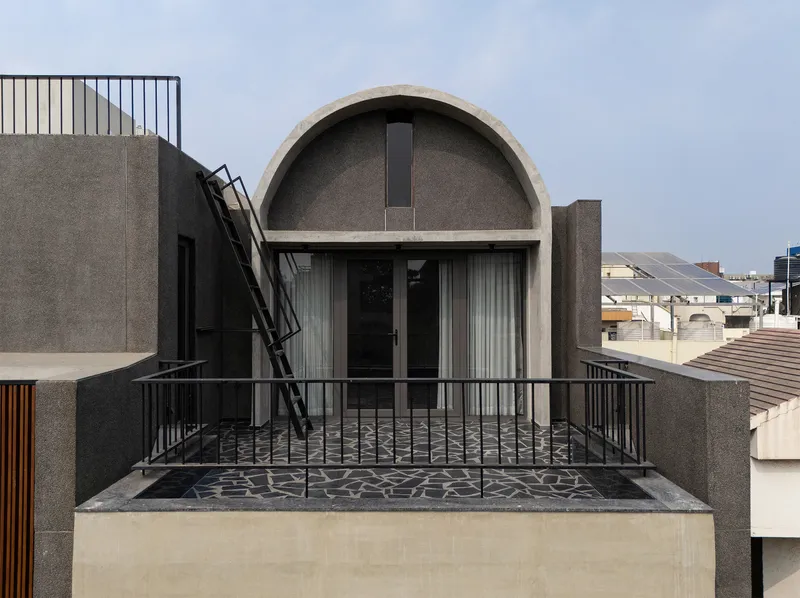
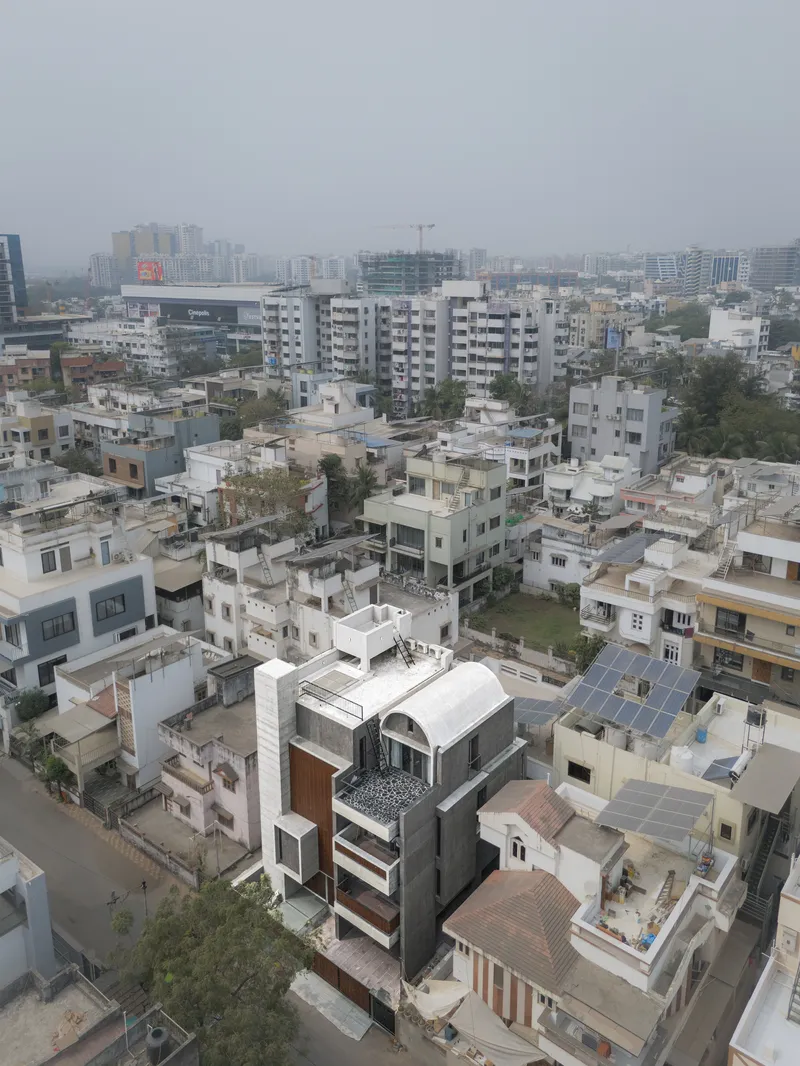
After moving through four floors of increasingly layered, screened, introverted space, the rooftop terrace is a release valve. The concrete barrel vault punctuates the skyline, and a broken tile mosaic floor introduces playful color underfoot. Black metal railings frame views over the surrounding rooftops, and for the first time in the house, you are fully exposed to the sky. The aerial view confirms just how tight the urban fabric is: the house is packed in on all sides, making the interior strategy of void and screen not a stylistic choice but an act of survival.
The arched rooftop volume, visible from the street below, does double duty. It defines the house's identity against the flat-topped neighbors and shelters part of the terrace from direct sun. It is one of the few outward-facing gestures in a building that otherwise keeps its pleasures to itself.
Between the Interior and the Outside
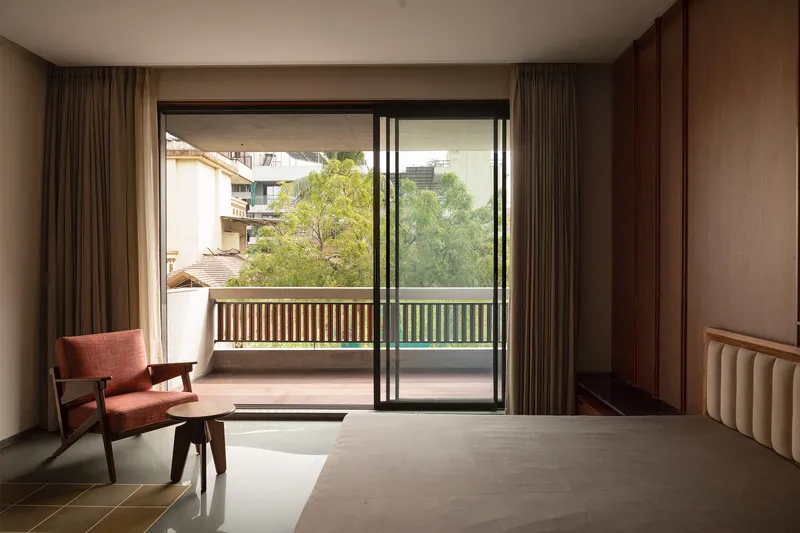

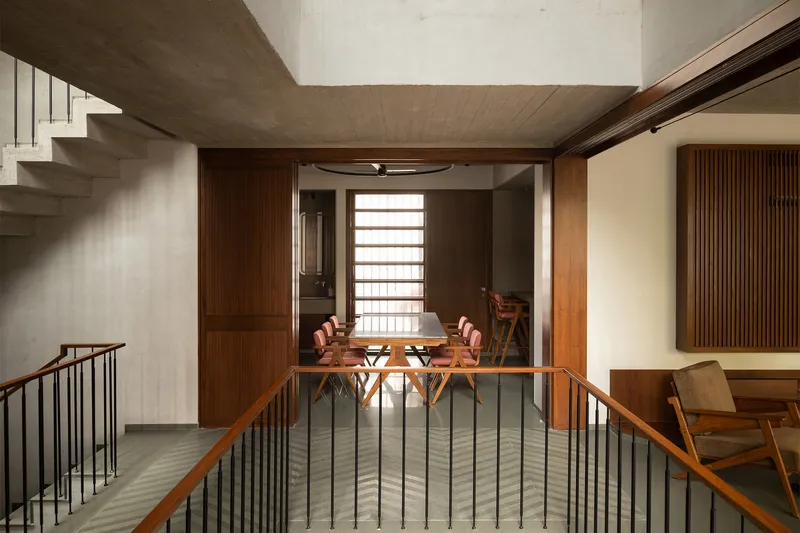
Several rooms occupy a threshold condition, neither fully inside nor fully out. A bedroom opens to a balcony with a slatted railing, treetops visible beyond the sliding glass doors. An upper living space collects afternoon light through timber screens while a circular ceiling fan ring marks the center of the room like a datum. The dining area, seen through a stair landing, sits behind horizontal slatted screens that blur the boundary between circulation and dwelling.
These in-between zones are where the house is most itself. Multigenerational living requires spaces that belong to no single person, places where encounters happen informally and where privacy can be negotiated rather than enforced. ROOMOOR understands this, and the house is richer for it.
Plans and Drawings
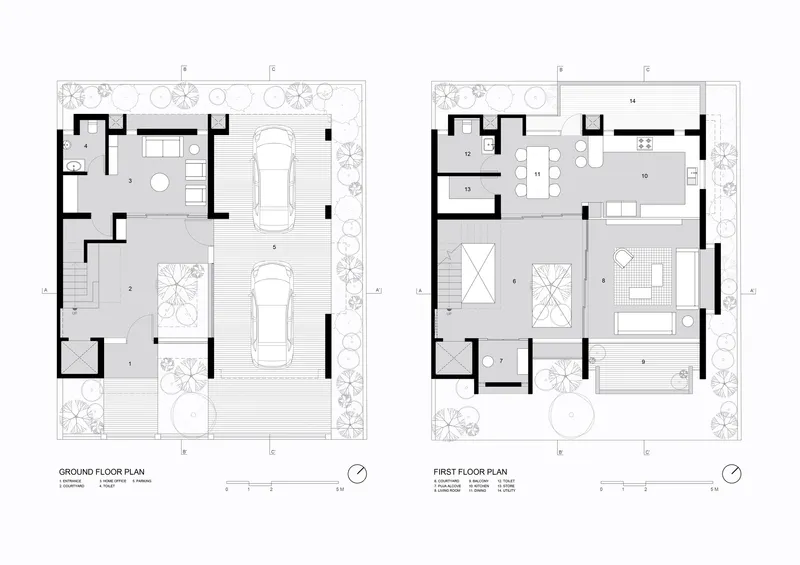
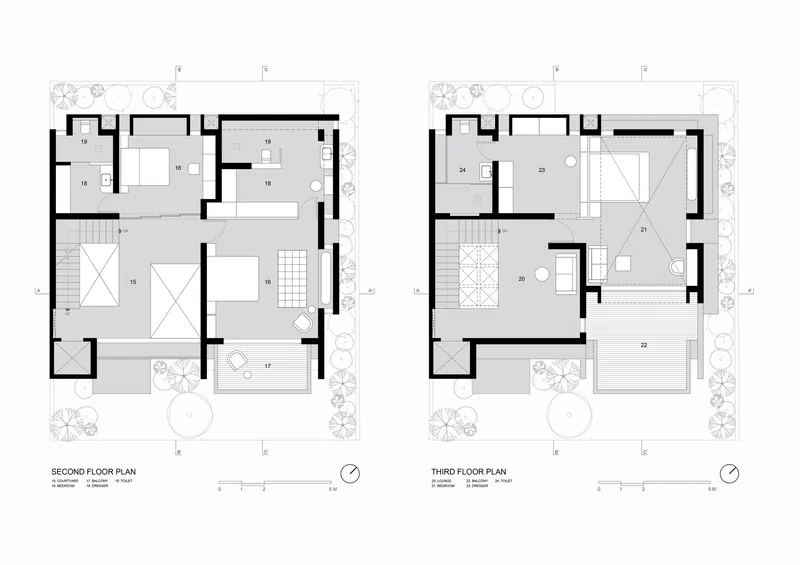
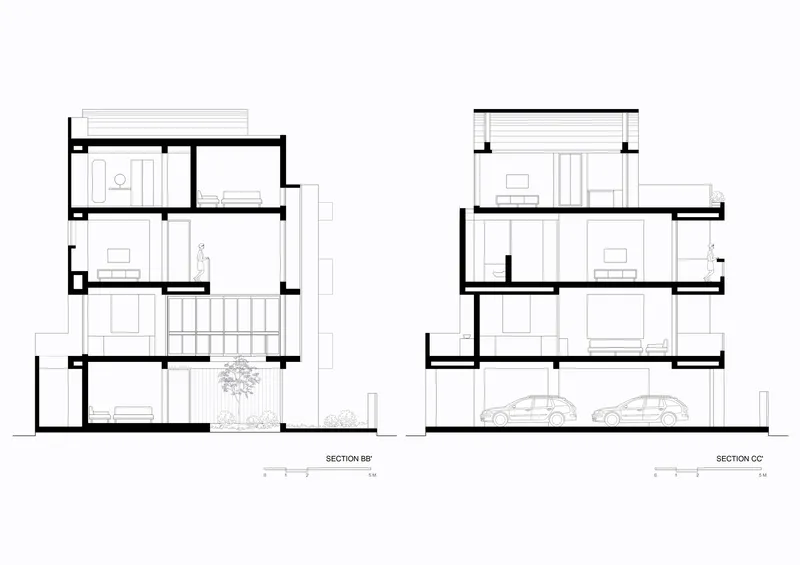
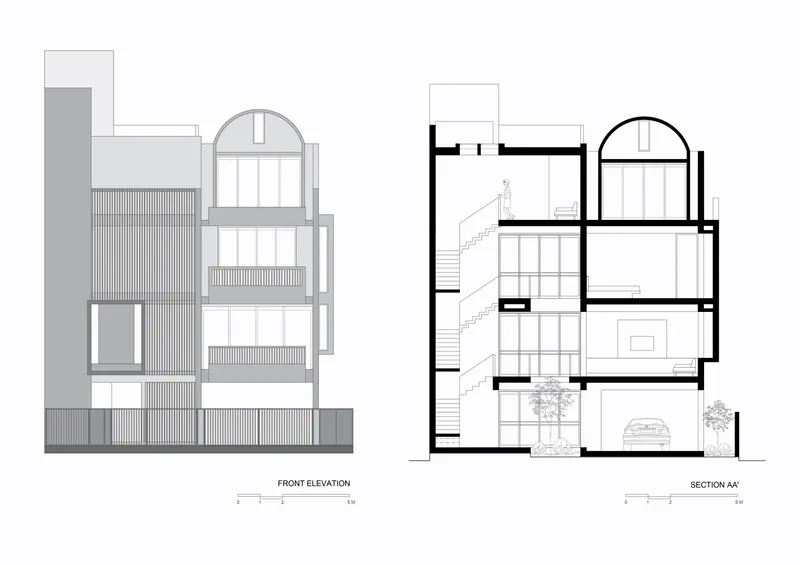
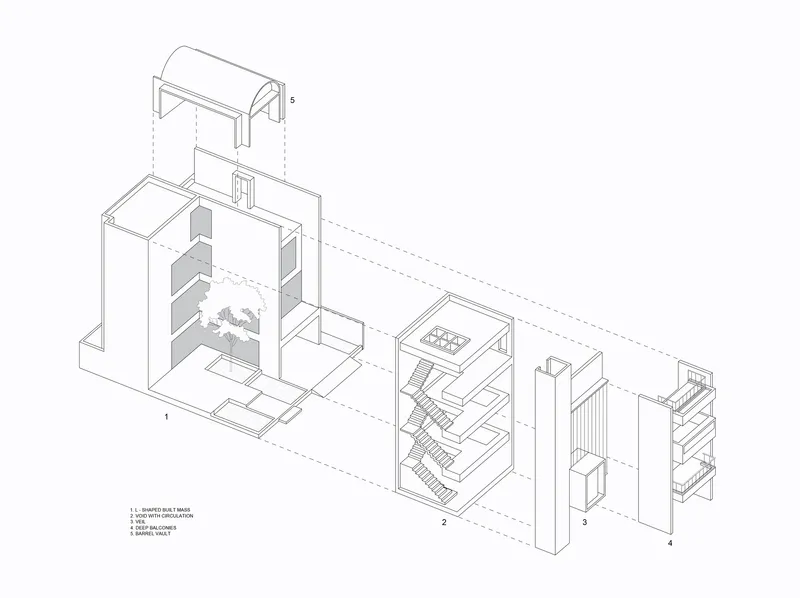
The drawings confirm what the photographs suggest: the L-shaped plan wraps tightly around the central void, with the staircase occupying the junction. The ground floor accommodates parking for two vehicles, a concession to Surat's car-dependent reality, while the upper floors progressively open up toward the rooftop terrace. The exploded axonometric reveals the layered assembly of walls, stairs, and the rooftop vault as distinct systems that interlock rather than merge. The sections are the most revealing documents, showing how the double-height living room, the stairwell void, and the barrel-vaulted bedroom stack vertically to create a continuous interior landscape connected by light and air.
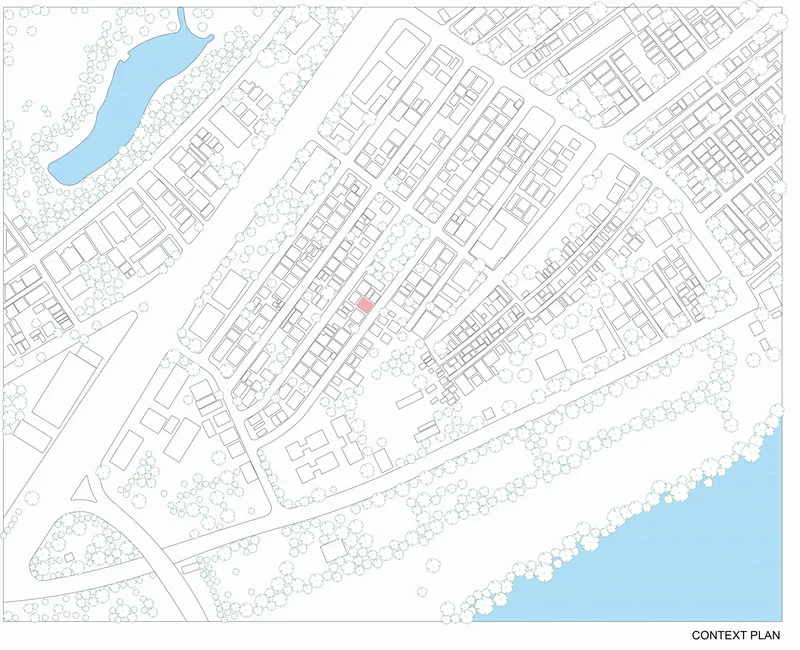
The context plan situates the house within its neighborhood, near two water bodies, confirming the dense residential grain against which the project pushes back. The front elevation and section drawings together expose the logic of the arched openings and horizontal louvers, and they make clear that the planted courtyard at the base of the void is not an afterthought but the seed from which the house grows.
Why This Project Matters
Veiled Void is a reminder that constraint is not the enemy of architecture but its most reliable collaborator. ROOMOOR did not have the luxury of a generous site, a picturesque view, or setbacks that would allow an extroverted plan. Instead, they turned the house inside out, making the void the protagonist and the screens its supporting cast. The result is a townhouse that manages to be airy, well-lit, and spatially varied on a plot where lesser buildings would be dark, cramped, and repetitive.
For anyone designing multigenerational housing in dense Indian cities, this project offers a clear thesis: carve the void first, then arrange life around it. The technical lessons in passive cooling, filtered daylight, and layered privacy are directly transferable. But the more lasting contribution is atmospheric. ROOMOOR has built a house where every room has a relationship to the sky, every landing is a room, and the space between floors matters as much as the floors themselves. That is not easy to achieve, and it is worth learning from.
Veiled Void by ROOMOOR, Surat, India, 2025. Photography by Jainee Gusain.
About the Studio
Share Your Own Work on uni.xyz
If projects like this are the kind of work you want to make, uni.xyz is a place to publish your own, find collaborators, and enter design competitions.


Popular Articles
Popular articles from the community


Extended Shell: Retrofitting Kolkata's Balconies as Living Urban Thresholds
A modular retrofit system recovers the social and environmental intelligence of Kolkata's historic verandas for contemporary Park Street residents.

Manzana Morphosis: Stretching Barcelona's Grid into a Living Landscape for 2050
A radical reworking of the Eixample manzana turns density into a tool for generous public space, vertical ecology, and environmental performance.

Opera by the Sea Estonia: Three Shells Dissolving Architecture into Tallinn's Coastline
A winning opera house proposal replaces monumental form with interconnected shells that blur the boundary between building, park and Baltic Sea.

Cloaked Colonization: A Mobile Underwater Habitat That Moves Like a Fish
Micah Abaya's shortlisted EHC Pacific entry reimagines ocean settlement as a dispersed network of self-sustaining architectural organisms.

Similar Reads
You might also enjoy these articles

Bao Huynh Watercolor Atelier: A Serene Art Retreat in Hội An
Bao Huynh Watercolor Atelier in Hội An blends multifunctional art spaces, sustainable design, local materials, and family-friendly living in a serene environment.

Atelier Macri Concept Store Interior Design by CASE-REAL
Atelier Macri store features a "ko" counter, walnut wood details, cork displays, blending retail, gallery, and seamless customer experiences.

Manuel Vargas Izquierdo Stadium and High-Performance Sports Center: Architectural Excellence in Jalpa de Méndez
The Manuel Vargas Izquierdo Stadium blends sustainable design, inclusive sports facilities, and cultural-inspired architecture, revitalizing Jalpa de Méndez’s public spaces.

KAKR Buluh Awar Hall: Revitalizing Community and Ecology Through Bamboo Architecture
Community built bamboo hall revitalizes Buluh Awar village, empowering youth, restoring ecology, celebrating vernacular craftsmanship through sustainable architecture and culture.

Explore Urban Void Competitions
Discover active competitions in this discipline

Challenge to reimagine the Iron Throne

Photograph architecture without architects

Illustrate the lost glory of Angkor Wat - Render Challenge

Design challenge to reuse E-waste
Comments (0)
Please login or sign up to add comments
No comments yet. Be the first to comment!