

Rotating Shifting Skyscraper: Kinetic Floors and Vertical Gardens Meet Energy Independence
A conceptual high-rise where independently rotating floor plates, 480 solar panels, and closed-loop water systems converge into a single vertical ecosystem


What if a skyscraper could turn its own floors to face the sun, harvest wind from its cold side, and recycle every drop of greywater into irrigation for the gardens climbing its façade? The Rotating Shifting Skyscraper proposes exactly that: a high-rise whose floors rotate independently, whose roof bristles with 480 solar panels, and whose vertical gardens function as carbon sinks, insulation layers, and food production zones simultaneously. It is a building conceived not as a static object but as a responsive organism, shifting its geometry in real time to optimize energy gain, ventilation, and occupant experience.
Designed by Rabah Saoud and Sedra M. Sharif Alshawish, the project confronts the converging pressures of climate change, resource depletion, and rapid urbanization expected by 2050. Rather than treating sustainability as an add-on, the designers embed renewable energy, water recycling, biophilic environments, and public transit connectivity into the tower's structural and spatial logic from the ground up. The result is a conceptual manifesto that asks how much a single vertical structure can do for its city.
Stacked Discs and Planted Terraces: A Tower That Breathes
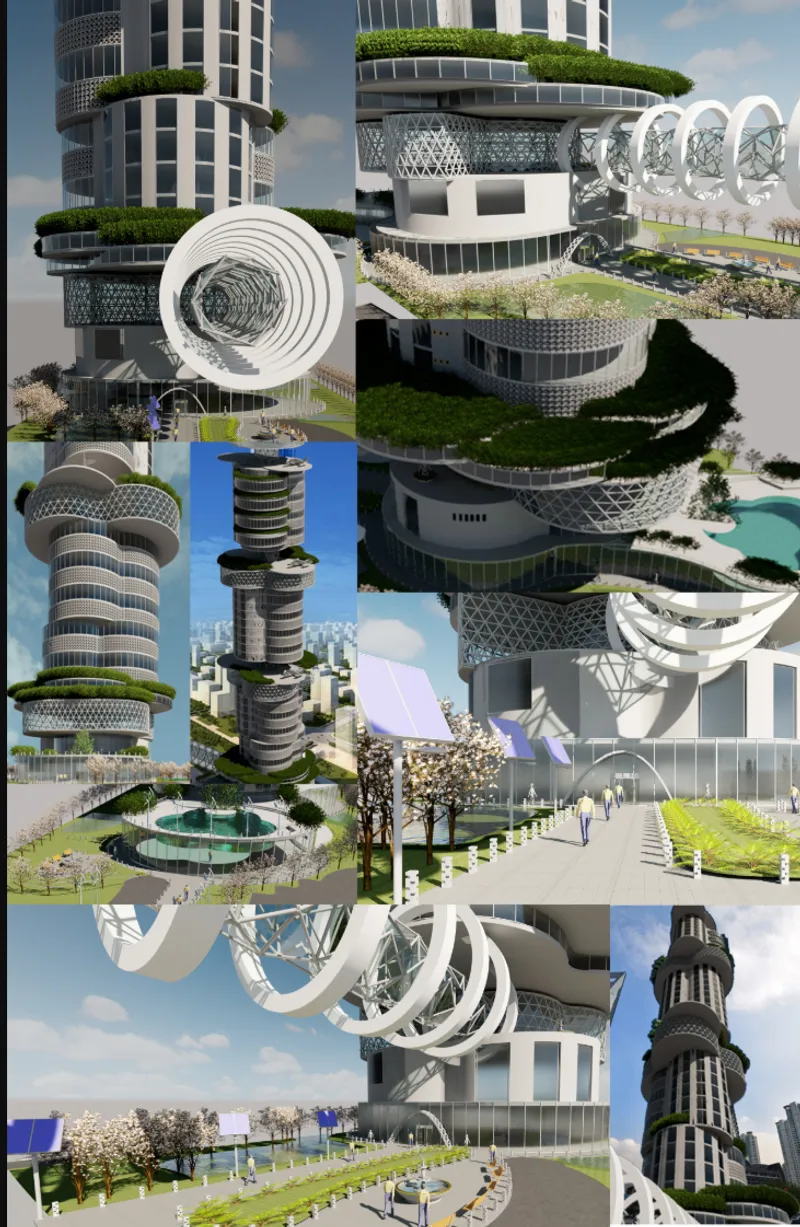
The composite rendering reveals the tower's most striking formal move: stacked disc-like floor plates separated by expansive planted terraces that wrap the building's perimeter. These horizontal and vertical gardens are far more than ornamental. They act as carbon sinks that absorb CO₂, reduce the urban heat island effect around the tower's base, and insulate interior spaces to lower cooling loads. The designers also envision them supporting food production, turning the building's skin into a productive landscape. Psychologically, the biophilic strategy matters too; occupants maintain a constant visual and physical connection to greenery at every level.
The disc geometry is not arbitrary. Independently rotating floor plates allow sections of the tower to reorient toward or away from the sun throughout the day, controlling passive solar gain without mechanical shading systems. This kinetic quality gives the building a constantly shifting silhouette, a dynamic façade that is also a performance instrument. Panoramic views rotate with the occupant, creating an experiential dimension rare in conventional high-rise design.
480 Solar Panels and 10 Wind Turbines: The Energy Strategy in Detail
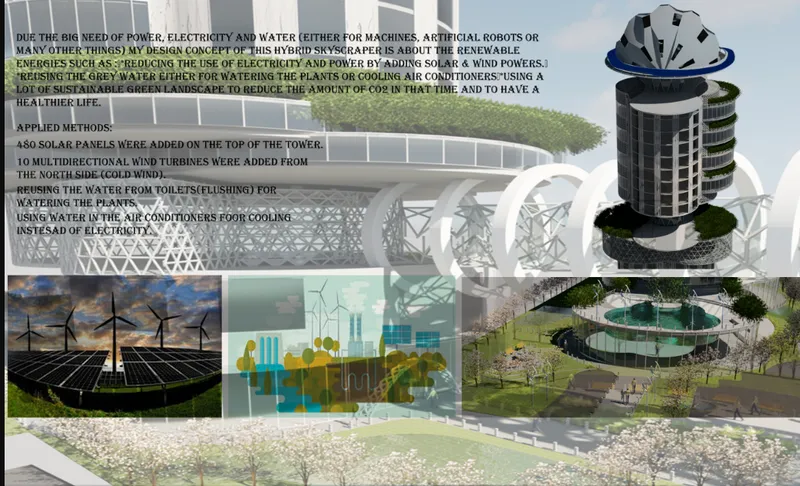
The sustainability board lays out the tower's energy infrastructure with diagrammatic clarity. On the roof, 480 solar panels are positioned to capture sunlight across the full arc of the day, a density made possible by the broad disc geometry of the upper floors. Alongside them, 10 multidirectional wind turbines are concentrated on the north-facing side, where prevailing cold winds deliver the highest kinetic energy yield. Together, these systems aim to drastically cut the building's dependence on non-renewable sources, positioning the tower as a net energy contributor rather than a consumer.
Water management is equally deliberate. A closed-loop greywater system collects water from toilets and redirects it for plant irrigation and vehicle washing at grade, minimizing waste and closing the resource cycle within the building's own footprint. The board makes clear that these are not isolated features but interconnected loops: energy powers water treatment, water sustains gardens, gardens insulate and cool interiors, and reduced cooling loads feed back into lower energy demand.
Central Core and Modular Plates: Engineering Rotation
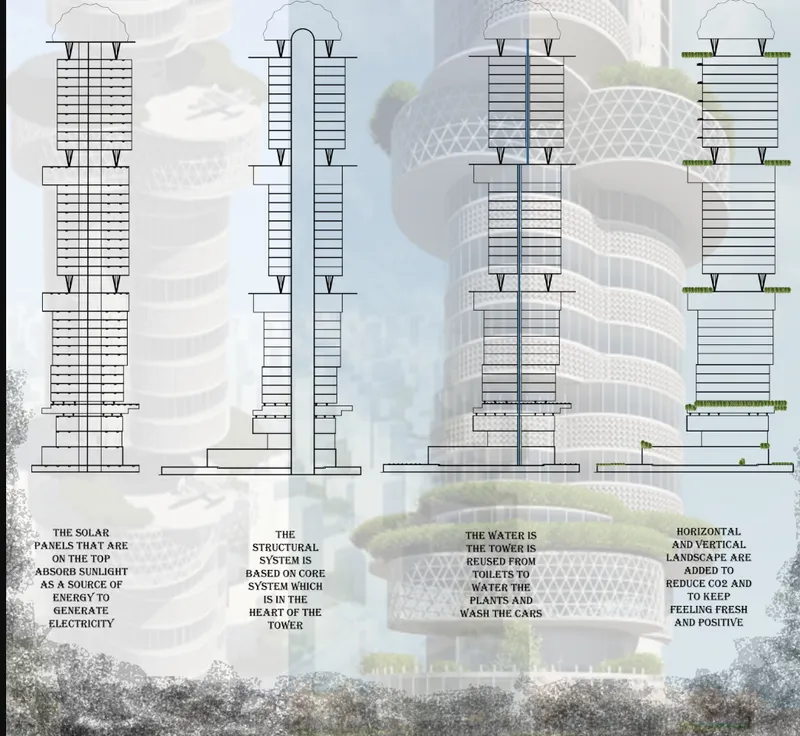
The section drawing sequence exposes the structural logic that makes kinetic floors feasible. A central structural core anchors the entire tower, housing vertical circulation, mechanical systems, and the bearings that allow individual floor plates to rotate around it. This core-and-plate relationship is critical: it provides the rigidity needed for seismic and wind resistance while granting each level the freedom to move independently. The annotated sustainability features in the drawing show how services, from greywater lines to electrical conduits, route through the fixed core so that rotating plates remain unencumbered.
Modularity is a secondary benefit. Because each floor plate connects to the core rather than to its neighbors, interior configurations can be reconfigured over the building's lifespan without structural intervention. Offices can become residences, libraries can become clinics, and the tower evolves with the city's needs rather than locking a single programme into concrete for decades.
Metro Bridge, Rooftop Library, and the Revolving Restaurant
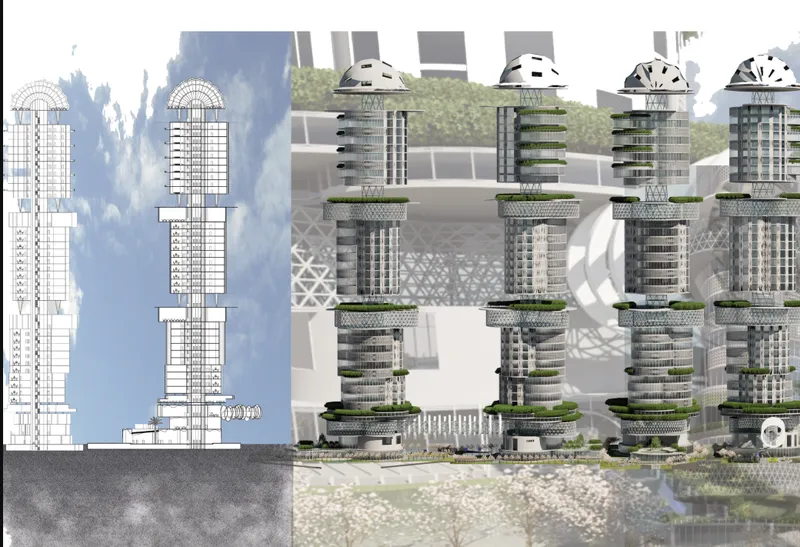
The elevation drawing and renderings highlight the tower's urban connectivity and public programming. A direct pedestrian bridge links the building to an adjacent metro station, a simple infrastructure move that reduces car dependency and positions the skyscraper as a transit-oriented development rather than an isolated landmark. At the top, a multipurpose panoramic library and a revolving glass restaurant transform the rooftop into a civic destination, inviting the public upward and giving the tower cultural weight beyond its residential or commercial floors.
The alternating rhythm of planted terraces and latticed structural bands visible in the elevation gives the tower a layered, textile-like quality that softens its mass. Each band registers a different programme or environmental strategy: green terrace, glazed occupied floor, structural lattice, open-air garden. The effect is a legible vertical section where you can read the building's sustainability logic directly from its façade.
Why This Project Matters
The Rotating Shifting Skyscraper operates at the speculative end of the design spectrum, and that is precisely its value. By bundling kinetic architecture, renewable energy harvesting, closed-loop water systems, biophilic design, and transit integration into a single conceptual structure, Saoud and Alshawish force a conversation about how many performance obligations a single building can shoulder. Not every detail here is buildable today at this scale, but the ambition to synthesize these systems rather than treat them as separate checklists is an important intellectual contribution.
More practically, the project demonstrates that sustainability and experiential richness are not in competition. The rotating floors that optimize solar gain also deliver panoramic views. The vertical gardens that sequester carbon also produce food and improve mental health. The metro bridge that cuts emissions also makes the building more accessible. When environmental performance and human delight reinforce each other this tightly, the case for green architecture stops being about sacrifice and starts being about better space.
View the Full Project
About the Designers
Designers: Rabah Saoud, Sedra M. Sharif Alshawish
Enter a Design Competition on uni.xyz
uni.xyz runs architecture and design competitions year-round that reward proposals with spatial conviction and real site intelligence.
Project credits: Rotating Shifting Skyscraper by Rabah Saoud, Sedra M. Sharif Alshawish.


Popular Articles
Popular articles from the community

Extended Shell: Retrofitting Kolkata's Balconies as Living Urban Thresholds
A modular retrofit system recovers the social and environmental intelligence of Kolkata's historic verandas for contemporary Park Street residents.

Singing Woman: Contemporary Architecture Inspired by Estonia’s Voice and the Sea
Singing Woman turns Estonia’s song culture into flowing opera house architecture, blending public life, landscape, sea, and national memory.

Tsunami Convergenics: Turning Catastrophic Ocean Forces into Underwater Housing Infrastructure
A speculative underwater settlement off the coast of Onagawa, Japan, treats tsunamis and typhoons as energy sources rather than threats.

Cloaked Colonization: A Mobile Underwater Habitat That Moves Like a Fish
Micah Abaya's shortlisted EHC Pacific entry reimagines ocean settlement as a dispersed network of self-sustaining architectural organisms.

Similar Reads
You might also enjoy these articles

Bao Huynh Watercolor Atelier: A Serene Art Retreat in Hội An
Bao Huynh Watercolor Atelier in Hội An blends multifunctional art spaces, sustainable design, local materials, and family-friendly living in a serene environment.

Atelier Macri Concept Store Interior Design by CASE-REAL
Atelier Macri store features a "ko" counter, walnut wood details, cork displays, blending retail, gallery, and seamless customer experiences.

Manuel Vargas Izquierdo Stadium and High-Performance Sports Center: Architectural Excellence in Jalpa de Méndez
The Manuel Vargas Izquierdo Stadium blends sustainable design, inclusive sports facilities, and cultural-inspired architecture, revitalizing Jalpa de Méndez’s public spaces.
KAKR Buluh Awar Hall: Revitalizing Community and Ecology Through Bamboo Architecture
Community built bamboo hall revitalizes Buluh Awar village, empowering youth, restoring ecology, celebrating vernacular craftsmanship through sustainable architecture and culture.

Comments (0)
Please login or sign up to add comments
No comments yet. Be the first to comment!