

Sailing Castle: Ren’ai by Cheng Tsung FENG Design Studio — A Poetic Dialogue Between Architecture, Art, and Memory
Sailing Castle: Ren’ai transforms Taipei’s modernist architecture into poetic wooden sails, blending light, memory, and community through Cheng Tsung FENG’s art.


Reimagining the City as a Fleet of Dreams
In Sailing Castle: Ren’ai, Taiwanese artist and architect Cheng Tsung FENG continues his celebrated Sailing Castle series, where cities are poetically transformed into fleets of ships gathered upon a shimmering sea. Through this series, FENG captures the rhythms of urban life and the poetic silhouettes of architecture, transforming static structures into living vessels that carry collective memory across time and space.

This installation, showcased at the Taiwan Lantern Festival, translates the architectural character of Ren’ai Village—a historic neighborhood in Taipei—into a striking visual narrative of sails, light, and structure. Each element invites viewers to see their city as both a landscape and a voyage.
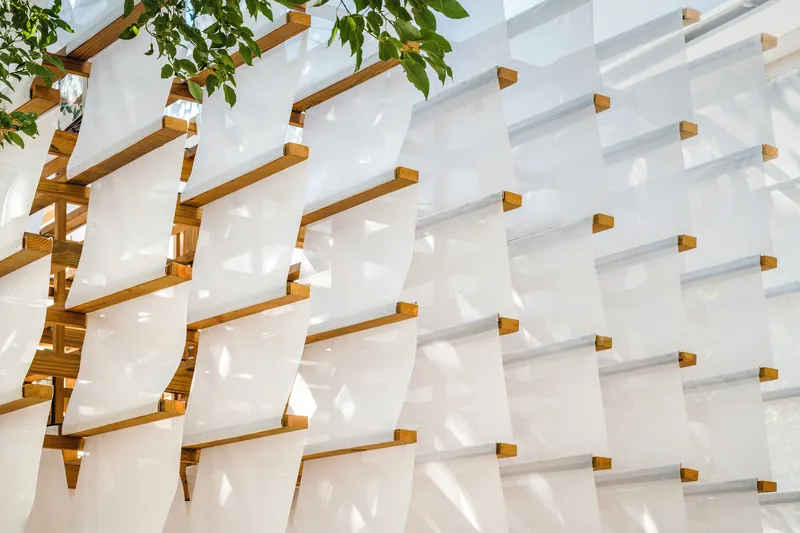
Ren’ai Village: A Modernist Heritage
Ren’ai Village, developed in the 1970s, stands as a testament to Taiwan’s modernist architectural movement. The neighborhood’s clean lines, geometric grids, and Bauhaus-inspired façades represent an era when Taiwanese architects embraced international design philosophies while maintaining local sensibilities.
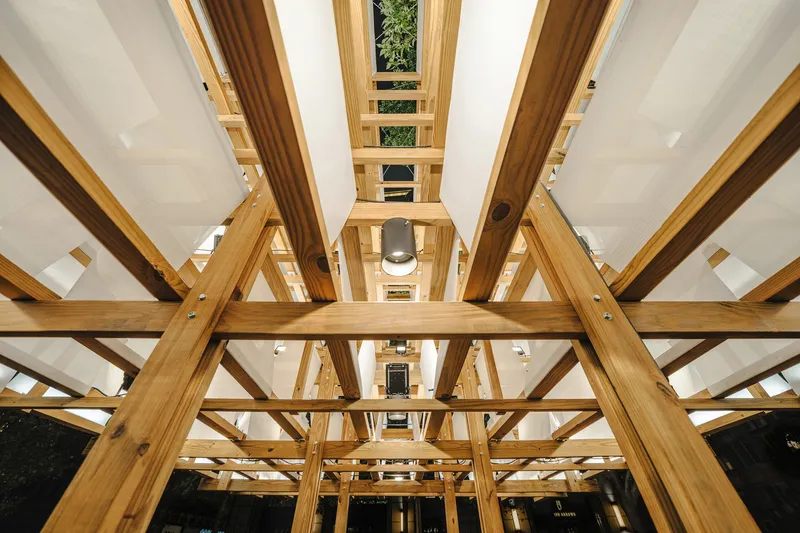
Cheng Tsung FENG pays tribute to this architectural legacy by reinterpreting its mid-century aesthetic through the metaphor of sailing. His Sailing Castle: Ren’ai installation captures the essence of these buildings—rigid yet rhythmic—and transforms them into sculptural “sails” that rise and sway in harmony, as though the city itself were preparing to set sail.
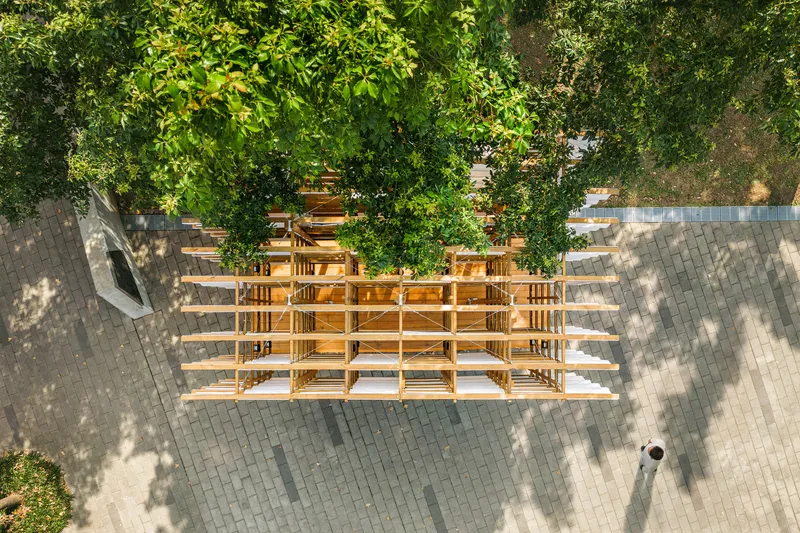
Structure, Light, and Symbolism
Constructed primarily from wood, the installation features layered frameworks that resemble a field of sails unfurling toward the horizon. The composition balances vertical and horizontal elements, mirroring the grid-like repetition of Ren’ai Village’s apartment façades while suggesting the organic motion of ships at sea.

During the day, the installation appears as a sculptural abstraction—a dialogue between architecture and nature. By night, dynamic lighting brings it to life. Soft illumination shimmers randomly between the sails, evoking the gentle glow of windows that define urban life. Each flicker represents moments of human experience—work, rest, solitude, and community—woven together into the shared fabric of the city.

A Living Landmark in Dunren Park
Installed within Dunren Park, a cherished public space in Taipei, Sailing Castle: Ren’ai is more than an art piece—it is a social and emotional landmark. The installation invites visitors to walk through its wooden corridors, pause beneath its illuminated sails, and reflect on the relationship between their everyday surroundings and the broader narrative of the city.

Here, FENG transforms public space into a ritual site where personal memory converges with collective history. The artwork becomes a stage for introspection and connection—a place where architecture, art, and humanity intersect.

A Journey of Departure and Return
“To board the ship, to raise the sail, to meet the wind, and to set forth toward the sea”—with these poetic gestures, Cheng Tsung FENG encapsulates the spirit of Sailing Castle: Ren’ai. The installation speaks to both departure and return, to the cyclical rhythm of urban life and personal journey.

All photographs are works of Fixer Photographic Studio




Popular Articles
Popular articles from the community

EW PARK: Sustainable Architecture Reimagines the Future of Urban Parking
EW PARK reimagines city parking as a modular wooden tower combining automation, solar energy, electric mobility, and adaptable urban design.

The Musturak Paradise: Senior Living Architecture for a Connected Future in Temara, Morocco
The Musturak Paradise reimagines senior living architecture in Temara via private homes, social spaces, culture, community, and shared care.

AL-JANNAH: Sustainable Architecture and Permaculture for Afghan Widows
AL-JANNAH uses sustainable architecture and permaculture to create resilient oasis of housing, learning, work and renewal for Afghan widows.

The Earth Pod: 3D Printed Homes for Resilient Refugee Communities
The Earth Pod reimagines refugee housing through 3D printed homes made from clay, combining resilience, self-sufficiency, and rapid shelter.

Similar Reads
You might also enjoy these articles


Hodi-Mandai Geram
Project Function: Preservation and revitalization of the Intangible heritage and socio-spatial identity of the Hodi by Housing, Cultural Memory Center, Sacred Grove, landscape, local tourism economy


Olio Towers: A Mid-Rise for Performers That Fuses Housing, Rehearsal, and Stage
Located blocks from Houston's Theater District, this modular tower stacks living units around a central performance atrium.

Oasis: Modular Green Housing Carved into Dhaka's Urban Fabric
A shortlisted Plugin Housing entry reclaims unauthorized settlements in Dhaka with stepped concrete volumes, green roofs, and ventilation-driven design.

Black Hole: A Floating Megastructure for the Post-Physical Era
Emiliano Mazzarotto envisions a spherical, self-scaling arena where e-sports, digital hotels, and holographic stadiums replace traditional public space.


Explore Cultural Architecture Competitions
Discover active competitions in this discipline



Challenge to reimagine the Iron Throne


Photograph architecture without architects


Illustrate the lost glory of Angkor Wat - Render Challenge


Bring back Drive In's
Comments (0)
Please login or sign up to add comments
No comments yet. Be the first to comment!