

SAIRA: A Phased Architecture of Flood Resilience for Kerala
From rapid shelters to permanent courtyard homes, a layered strategy rebuilds communities after disaster on their own terms.


What if the architecture of disaster recovery was not a single act of rebuilding but a slow, deliberate evolution from temporary shelter to permanent home? SAIRA (Shared and Individual Responsibility for Action) proposes exactly that: a phased housing system for flood-prone Kerala where rapid shelters grow into modular half houses, which in turn mature into resilient courtyard dwellings inspired by the traditional Nalukettu typology. The framework treats reconstruction not as a one-time intervention but as a sustained relationship between design, community governance, and environmental logic.
Developed by Seba Shukhur and Lekshmy Hirandas, SAIRA was shortlisted in HEAL+, a competition focused on regenerative housing solutions for Kerala in the wake of the devastating 2018 floods. The project layers immediate relief coordination with long-term spatial strategies: raised plinths, preserved drainage channels, shared resource centres, and modular expansion pathways. It reads as both an architectural proposition and a policy blueprint.
Living Above the Floodline
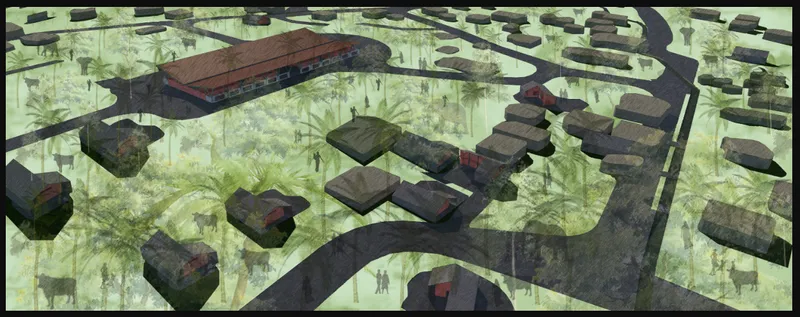
The aerial rendering reveals a cluster of low-rise, red-roofed buildings distributed across a landscape that accepts, rather than fights, inundation. Ground floors are raised 1.2 metres above grade to safeguard essential living spaces, and the settlement pattern preserves natural drainage channels so water flows through the site rather than pooling against structures. No-construction buffer zones along floodplains reinforce this logic. The result is a community that coexists with periodic flooding instead of being destroyed by it.
The Half House: Affordable, Expandable, Resilient
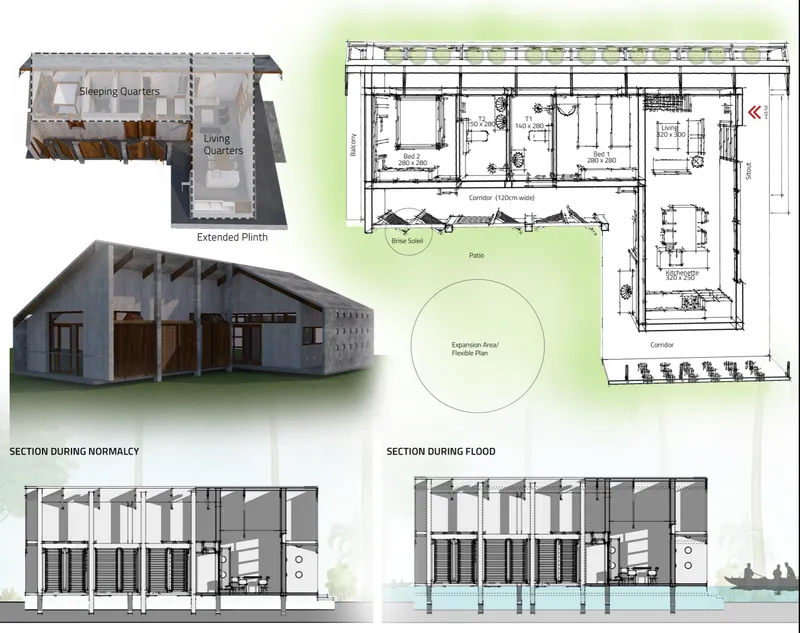
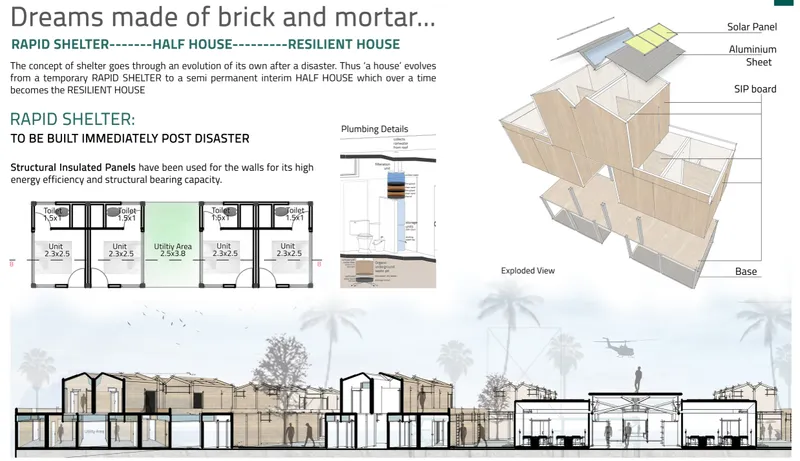
At the heart of SAIRA's phased approach is the Half House, a cost-effective modular unit containing a hall, bedroom, and toilet on an elevated plinth. The axonometric drawing and floor plan illustrate how this compact dwelling functions as a safe retreat during flood events while remaining architecturally open to future expansion. Vulnerable families receive a dignified, semi-permanent home within one to two years of a disaster, not just a tent or a temporary barracks.
The accompanying presentation board breaks down the prefabricated shelter system that precedes the Half House. Exploded axonometrics, plans, and elevations show how rapid shelters are assembled immediately after a disaster, then give way to the more permanent modular homes. Each phase is designed to absorb the materials and spatial logic of the previous one, reducing waste and construction time. The transition from survival infrastructure to livable architecture becomes a continuous, rather than disruptive, process.
From Courtyard Typology to Community Infrastructure
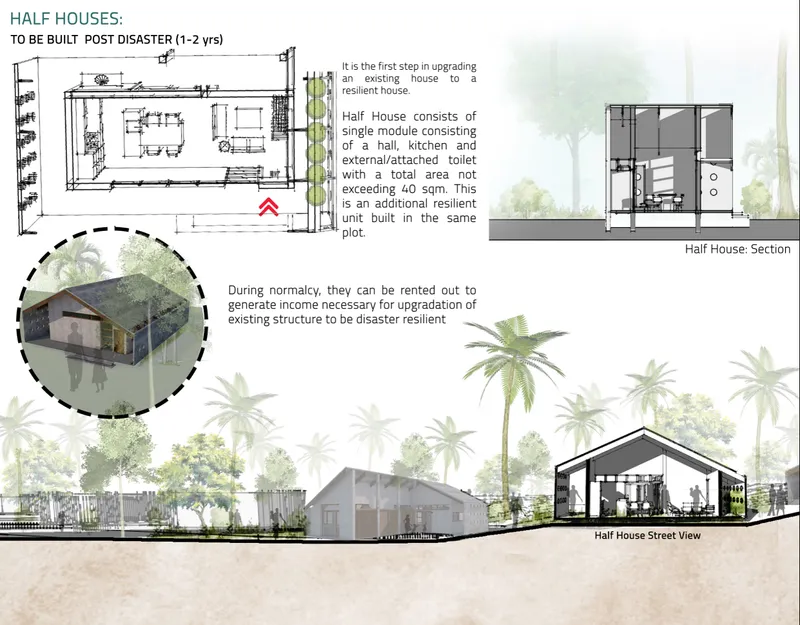
The plan, section, and street elevation drawings show SAIRA's final stage: the Resilient House. Inspired by Kerala's Nalukettu courtyard typology, these permanent dwellings organize rooms around a central open-air court that provides cross-ventilation and a shared social space. The gabled roofline, visible among palm trees in the street elevation, grounds the architecture in local building culture while accommodating flood-adaptive features such as strong foundations and raised plinths. Flexible modules allow the settlement to shift from low-density to high-density housing as resources and population demands change.
Water as a Design Partner
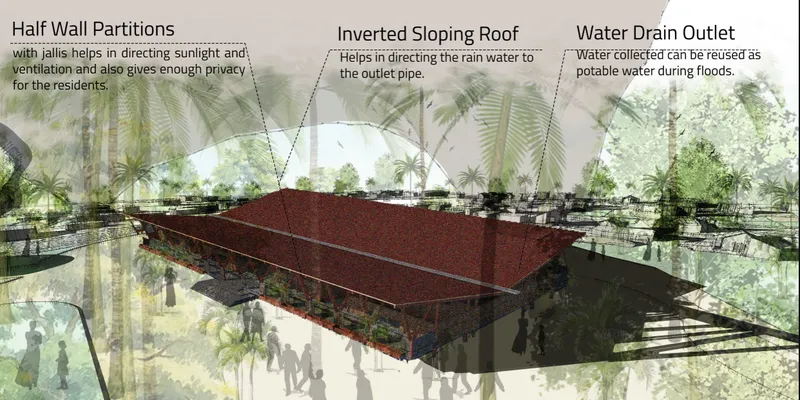
The perspective section rendering cuts through a red sloped-roof structure during a flood event, annotating the water management strategies embedded in the building's anatomy. Integrated water harvesting systems improve percolation and long-term sustainability, while culverts and bridges beneath circulation paths maintain drainage continuity. The drawing makes a persuasive case that flood resilience is not only about elevation; it is about designing every surface, joint, and threshold to acknowledge the presence of water as a recurring condition, not an anomaly.
Shared Resource Centres as Social Anchors
Beyond individual dwellings, SAIRA proposes Resource Centres as multifunctional community hubs. During floods, they serve as shelters. In calmer periods, they operate as educational hubs for disaster preparedness training, recreational spaces that strengthen social ties, and monitoring centres managed by local committees. These centres transform resilience from a private burden into a collective practice, distributing both responsibility and agency across the community.
Why This Project Matters
SAIRA's strength lies in its refusal to treat disaster housing as a single architectural gesture. The phased evolution from rapid shelter to half house to resilient courtyard dwelling acknowledges that recovery is a process measured in years, not weeks. Each stage is designed to be structurally and financially accessible, lowering the barrier for vulnerable families to participate in their own reconstruction rather than waiting for top-down solutions.
More importantly, the project insists that resilient architecture cannot be separated from resilient governance. The shared resource centres, local monitoring committees, and mapped drainage corridors all require ongoing community stewardship. Shukhur and Hirandas have proposed a system where buildings and social structures reinforce each other, where the physical act of raising a plinth is inseparable from the collective act of maintaining a floodplain. That reciprocity between construction and culture is what makes SAIRA more than a housing scheme; it is an argument for how architecture can organize responsibility.
View the Full Project
About the Designers
Designers: Seba Shukhur, Lekshmy Hirandas
Enter a Design Competition on uni.xyz
uni.xyz runs architecture and design competitions year-round that reward proposals with spatial conviction and real site intelligence.
Project credits: SAIRA (Shared and Individual Responsibility for Action) by Seba Shukhur, Lekshmy Hirandas HEAL+ (uni.xyz).


Popular Articles
Popular articles from the community


ETEH Reworks the Shared Spaces of São Domingos School in Brazil Around Timber, Color and Hanging Plants
At São Domingos School in Brazil, 436 m² of hall, refectory and library are recast with timber joinery, a yellow and blue code and trailing greenery.

graciastudio Turns a Viewless Tijuana Lot Inward Around a Courtyard of Concrete, Timber and Trees
In Tijuana, Jorge Gracia's GA2 House stacks a timber-clad private floor over exposed concrete and replaces a missing view with a planted interior patio.


Aquadapt: An Underwater Habitat That Rewrites Its Rooms by the Hour
Curved modules ring the seabed while one shell shifts from breakfast room to cinema, farm and football pitch as residents' needs change.

David Ortega Stacks a Two-Story Mexico City Penthouse Around a Steel Stair and a Pergola-Shaded Roof Terrace
In Colonia Roma, a 300 m² penthouse uses oak joinery, a planted steel stair and a slatted roof pergola to make a new-build apartment feel like a house.

Similar Reads
You might also enjoy these articles
Aquadapt: An Underwater Habitat That Rewrites Its Rooms by the Hour
Curved modules ring the seabed while one shell shifts from breakfast room to cinema, farm and football pitch as residents' needs change.

Play: Fragments of Their World: Remembered Architecture Rebuilt as a Modular Playground for Refugee Camps
Tom Gardner abstracts domes, arches and towers from the homelands of displaced families into a kit of child-scaled play parts for camp settlements.
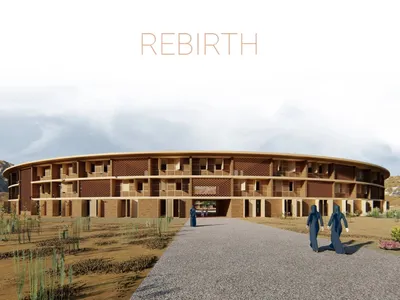
REBIRTH: A Circular Settlement Where Afghan Widows and Their Children Rebuild Life Together
A shortlisted Resile entry turns the circle into a protective ring of timber and brick, gathering homes, classrooms and gardens around a shared landscape.
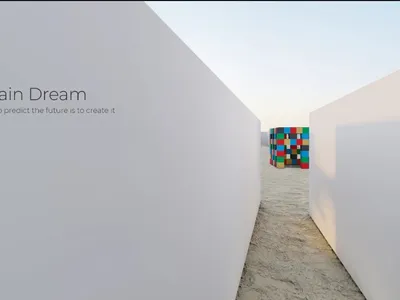
The Main Dream: A Recycled Plastic Kit That Lets Refugee Children Build Their Own Playground
Thirty-centimetre interlocking cubes that connect on three axes turn play into construction, letting children author the spaces they occupy.

Comments (0)
Please login or sign up to add comments
No comments yet. Be the first to comment!