
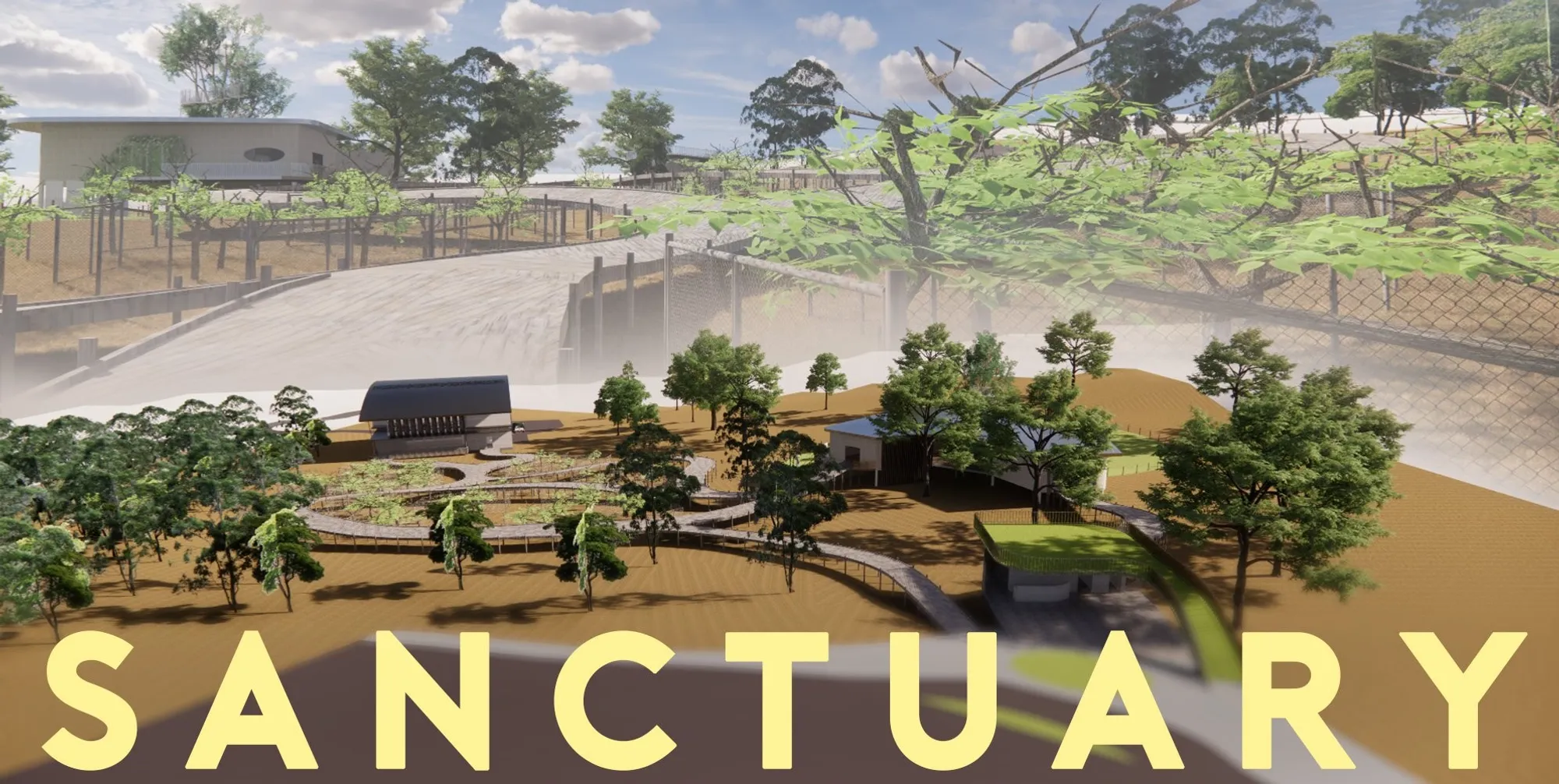
Sanctuary | Sustainable Wildlife Architecture Reimagining Koala Conservation
A sustainable wildlife architecture project by Joshua Ng creating immersive koala habitats through ecological design and human interaction.


As climate change, habitat destruction, and urban expansion continue to threaten Australia’s wildlife ecosystems, architects are increasingly exploring how design can become a tool for ecological restoration. Sanctuary, a visionary sustainable wildlife architecture project by Joshua Ng, proposes a carefully integrated environment where humans and koalas coexist within a shared ecological landscape.
Rather than imposing architecture onto nature, the project responds directly to the terrain, vegetation, and migratory patterns of koalas. Through elevated boardwalks, low-impact construction systems, rehabilitation spaces, and immersive educational environments, Sanctuary transforms architecture into a living ecological framework.
The proposal creates a flowing journey through the site where visitors gradually transition from urban life into the natural rhythms of the koala habitat. Every spatial decision prioritizes environmental sensitivity while simultaneously enhancing public awareness, rehabilitation efforts, and wildlife conservation.
Sustainable Wildlife Architecture Rooted in the Landscape
The central design philosophy of Sanctuary is based on minimizing disruption to the natural geography of the land. Instead of flattening or reshaping the terrain, the architecture adapts to the existing topography and eucalyptus forest systems.
The buildings curve organically through the site, following the natural contours of the terrain. Elevated walkways weave through the landscape while allowing koalas to migrate freely beneath them. This approach eliminates the need for excessive excavation, fencing, or invasive infrastructure.
The project is divided into several interconnected components:
- Visitor Centre
- Koala Museum and Exhibition Area
- Main Operational and Rehabilitation Building
- Koala Enclosures
- Eucalyptus Forest Zones
Each space contributes to an educational and ecological narrative that guides visitors through the lifecycle, struggles, and conservation of koalas.
Designing a Journey Through the Koala Habitat
Unlike conventional wildlife facilities that isolate animals from visitors, Sanctuary creates a gradual experiential journey. Visitors are not merely spectators. They become participants within the ecosystem.
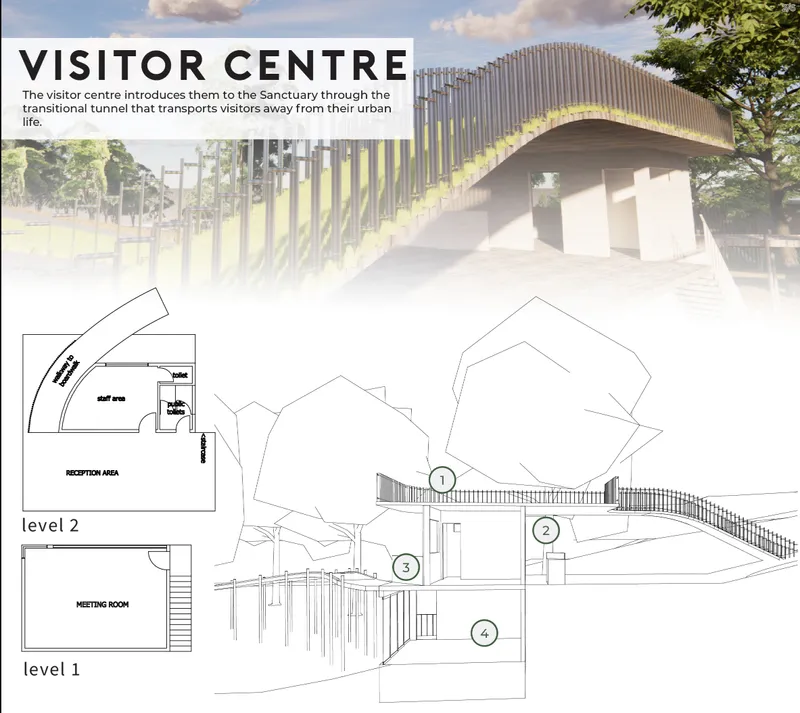
The experience begins at the Visitor Centre, where a transitional tunnel psychologically separates visitors from the urban environment. Curved circulation paths then lead guests through boardwalks, rehabilitation viewing areas, exhibition spaces, and koala habitats.
This narrative-driven circulation strategy helps create emotional engagement and environmental awareness.
The architecture intentionally avoids abrupt visual exposure to wildlife. Instead, moments of discovery are carefully choreographed through bends in pathways, framed views, elevated observation points, and filtered sightlines.
This slower, immersive movement mirrors the natural experience of traversing a forest ecosystem.
Visitor Centre Designed for Immersion
The Visitor Centre introduces visitors to the Sanctuary through an elevated structure integrated into the terrain. A gently sloping roof creates accessible viewing opportunities overlooking the koala habitat while minimizing the visual dominance of the building.
The project uses a transitional tunnel concept to create a psychological shift between city life and the natural environment. This spatial compression and release strategy heightens awareness and anticipation.
Key spatial features include:
- Elevated viewing gallery
- Reception and educational orientation spaces
- Transitional circulation tunnel
- Meeting and learning rooms
- Integrated rooftop viewing experience
The curved roof geometry and lightweight vertical screening elements create dynamic shadows that mimic surrounding tree canopies.
Koala Museum as an Educational Experience
The Koala Museum forms the emotional and educational core of the project. Inspired by the natural terrain and organic movement patterns, the museum is divided into multiple experiential zones that guide visitors through stories of ecological crisis, conservation, and coexistence.
Instead of functioning as a static exhibition hall, the museum becomes an interactive architectural narrative.
The sequence includes:
- Interrogation spaces questioning ecological awareness
- Climate crisis scenarios
- Interactive educational displays
- Theatre rooms
- Activity spaces for children
- Outdoor exhibitions
- The symbolic “Tree of Life”
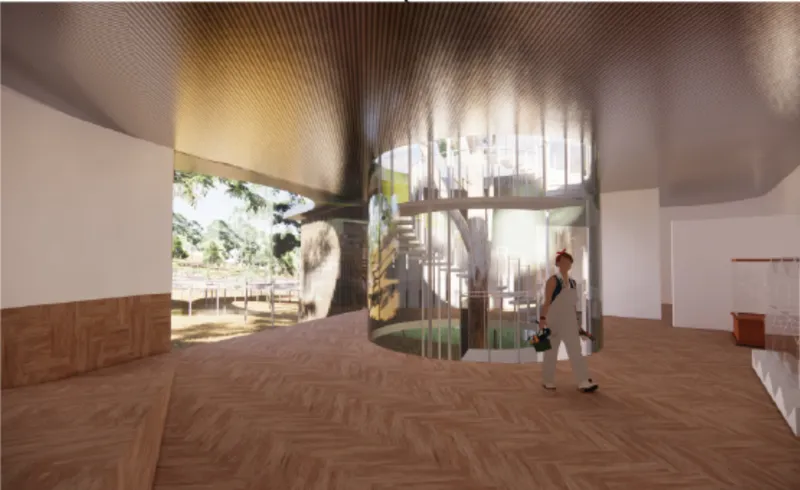
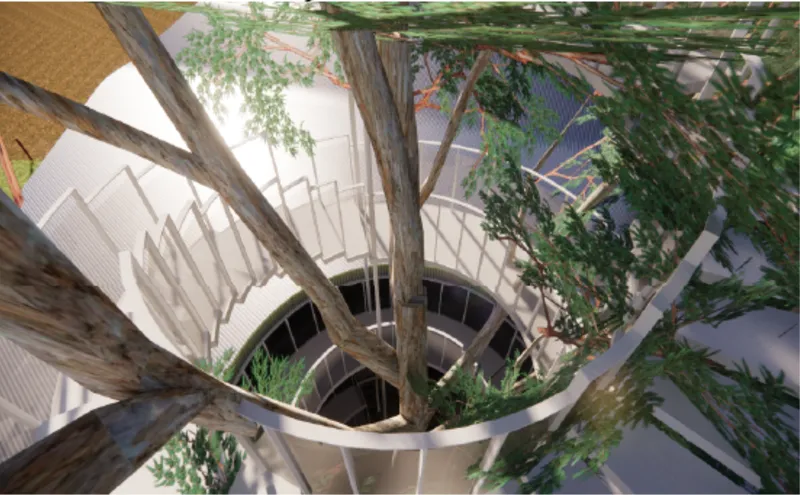
One of the project’s most powerful features is the central Tree of Life installation. Visitors climb around a living eucalyptus tree, gaining elevated perspectives across the Sanctuary while symbolically reconnecting with nature.
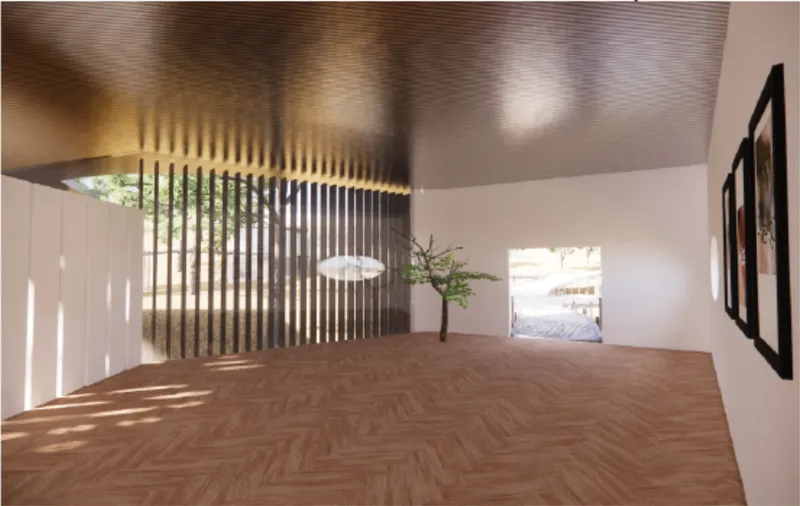
Natural lighting, timber interiors, and curved circulation paths create a calming atmosphere that contrasts with the urgency of the ecological issues presented within the exhibits.
Rehabilitation Architecture Focused on Animal Welfare
The Main Operational Building combines veterinary facilities, rehabilitation spaces, staff offices, and observation areas into a unified ecological healthcare system.
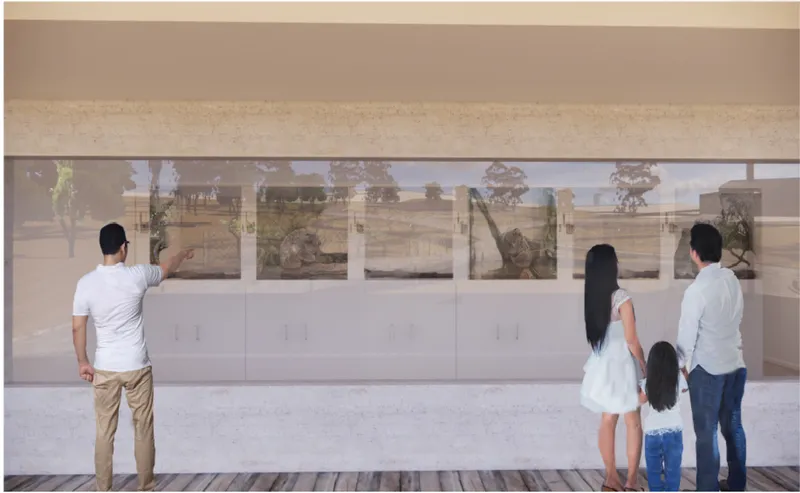
The project carefully balances transparency and privacy. Visitors are allowed to observe rehabilitation activities through controlled viewing galleries without creating stress for injured koalas.
The rehabilitation facilities include:
- Intensive care spaces
- Examination rooms
- Laboratory spaces
- Surgery and operation rooms
- Recovery areas
- Necropsy rooms
- Staff and operational offices
The architecture incorporates filtered daylight, acoustic control, thermal insulation, and non-invasive circulation patterns to create a low-stress environment for recovering wildlife.
A layered façade system using vertical shading elements reduces solar heat gain while maintaining outward visibility and natural ventilation.
Elevated Boardwalks Supporting Human and Wildlife Coexistence
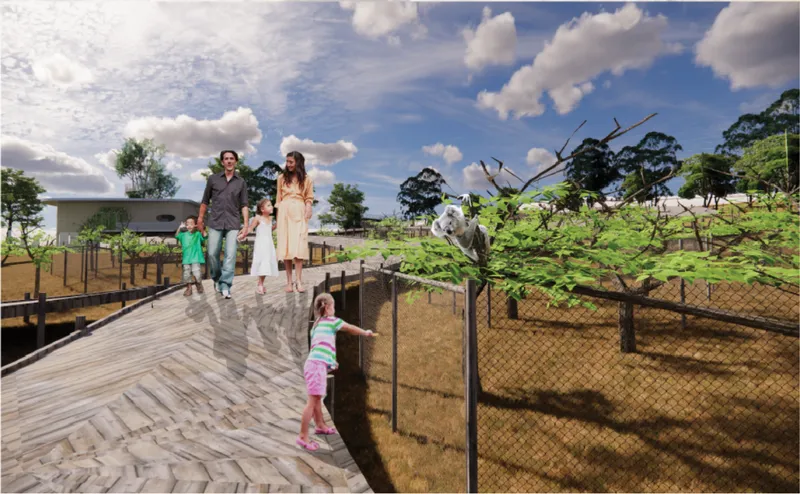
One of the defining architectural strategies of Sanctuary is its network of elevated boardwalks. Rather than creating barriers through fences or rigid circulation systems, the boardwalks float above the terrain.
This design serves multiple purposes:
- Preserving koala migration routes
- Reducing ecological disruption
- Enhancing visitor immersion
- Preventing soil compaction
- Allowing uninterrupted wildlife movement
The organic geometry of the boardwalks emerged from experiments comparing rigid linear systems against more fluid landscape-responsive pathways.
The final design embraces curved circulation that encourages slower movement and deeper engagement with the environment.
The boardwalks become transitional spaces where architecture dissolves into the landscape.
Sustainable Materials and Low-Impact Construction
Material selection plays a significant role in reinforcing the ecological mission of the project. Sanctuary incorporates environmentally conscious materials chosen for durability, thermal efficiency, acoustic performance, and reduced carbon impact.
The material palette includes:
- Geopolymer concrete
- Australian beech timber
- Bamboo
- Corrugated iron
- Mudbrick
- Reclaimed wood
- Low-E glass
- Aluminium
- Beige granite
- Steel
The project also minimizes concrete usage where possible and relies on stilt-based construction systems to reduce excavation and land disturbance.
Reclaimed wood is extensively used throughout the boardwalk systems, while bamboo and timber introduce renewable material systems into the architecture.
Low-E glazing improves energy performance by reducing infrared heat transfer while maintaining daylight penetration.
Architecture Inspired by the Natural Terrain
The landscape itself becomes a design generator throughout the project. Rather than treating architecture and site as separate entities, Sanctuary merges them into a single ecological system.
Curved roofs mimic the undulating terrain. Elevated pathways imitate natural movement through forests. Building orientations maximize shade from existing trees and minimize solar heat gain.
The structures intentionally maintain a subdued architectural language that allows the surrounding eucalyptus forest to remain visually dominant.
This creates an architecture of restraint rather than spectacle.
Ecological Awareness Through Spatial Experience
One of the strongest aspects of Sanctuary is its ability to educate through architectural experience rather than through signage alone.
Visitors witness:
- Healthy koalas in natural habitats
- Rehabilitation processes
- Environmental fragility
- Forest ecosystems
- Human impact on wildlife
By integrating learning directly into movement and spatial experience, the project creates emotional engagement that traditional exhibition methods often fail to achieve.
The architecture becomes an active participant in conservation storytelling.
The Future of Sustainable Wildlife Architecture
Sanctuary by Joshua Ng demonstrates how architecture can move beyond aesthetics and function as ecological infrastructure. The project proposes a future where wildlife rehabilitation, public education, and environmental stewardship coexist within one integrated architectural system.
As architects increasingly confront biodiversity loss and climate-related challenges, projects like Sanctuary reveal the growing importance of sustainable wildlife architecture as a critical design discipline.
By prioritizing coexistence over control, immersion over separation, and ecological sensitivity over monumentality, Sanctuary offers a compelling model for the future of conservation-focused architecture.


Popular Articles
Popular articles from the community


The Ocean Hive: Sustainable Architecture for a Self-Sufficient Civilization at Sea
The Ocean Hive imagines sustainable architecture at sea, where modular habitats, algae, wave power and ocean waste sustain a growing colony.

Play: Fragments of Their World
Familiar architecture becomes modular playground design, creating safe spaces where displaced children can learn, connect, imagine and play.

The Earth Pod: 3D Printed Homes for Resilient Refugee Communities
The Earth Pod reimagines refugee housing through 3D printed homes made from clay, combining resilience, self-sufficiency, and rapid shelter.

Co-Life: Senior Housing Design That Reconnects Older Adults With the City
Co-Life reimagines senior housing design through healing gardens, shared streets, workshops, and a sustainable community across generations.

Similar Reads
You might also enjoy these articles

Eco Chapel: A Green Architecture Pavilion Designed in Symbiosis with the Forest
Eco Chapel uses green architecture to weave prayer, learning and reuse into a forest pavilion shaped by modular hexagonal canopies for life.
Kaffeebühnen: Coffee Shop Architecture Designed as a Civic Stage Between Vienna’s City and Park
Kaffeebühnen turns coffee shop architecture into a civic stage, linking Vienna’s park edge, urban life, warm timber yards, and coffee craft.
Healing Façade: Sustainable Architecture for Reforestation, Community, and Sacred Ecology in Ethiopia
Healing Façade reimagines sustainable architecture as a living wall that restores soil, catches water and renews Ethiopia's forest churches.

Urban Forest: A Vertical Ecosystem for 5,000 Workers in Singapore's Changi Business Park
Radially stacked pods and layered green decks turn a 7-acre plot into 47 acres of ecological workspace projected for 2040.


Comments (0)
Please login or sign up to add comments
No comments yet. Be the first to comment!