

Sanjay Puri Architects Sculpts an Entire University Building as a Climbable Stepped Landscape in Indore
A 30,000-square-meter campus building in central India reimagines the ancient stepwell as a terraced ground plane for 3,000 students.


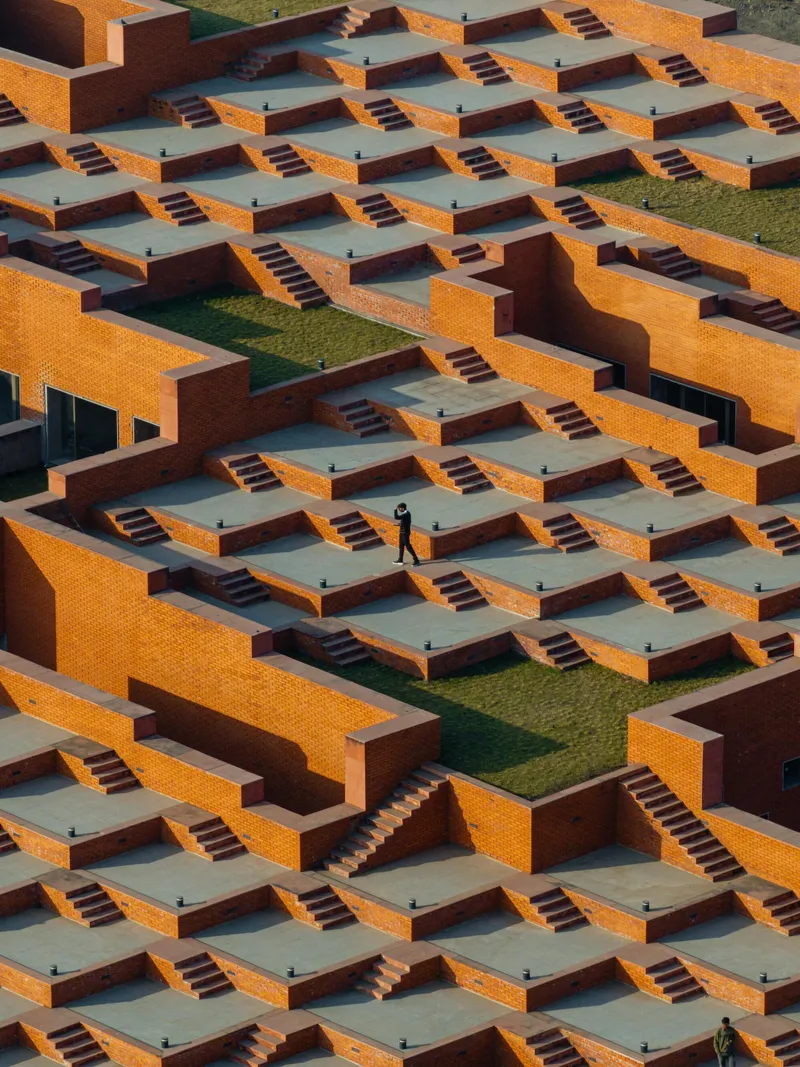
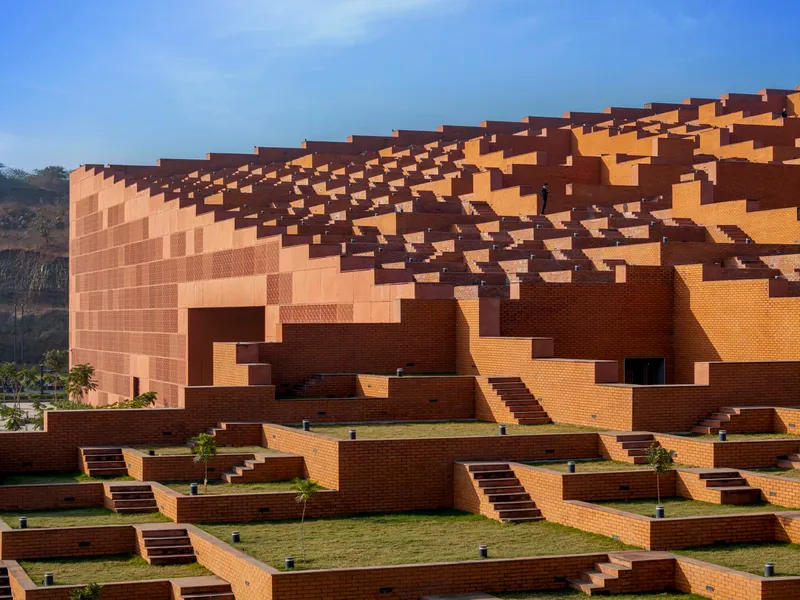
Most university buildings treat the roof as leftover space, a flat slab hosting mechanical equipment and forgotten satellite dishes. Prestige University in Indore, designed by Sanjay Puri Architects, treats the roof as the main event. Completed in January 2026 after nearly eight years of construction, the 30,843-square-meter building rises across five levels but reads from the approach as a diagonal cascade of 463 stepped platforms, each planted with grass, each walkable, collectively capable of seating up to 9,000 people. The entire section is the design move: a building conceived not through its facade but through its profile against the sky.
The reference point is the ancient stepped well, a building type that has survived across western India for over a millennium. Those structures carved social space out of the earth's section, turning descent toward water into a choreography of gathering, shade, and ritual. Here, the logic is inverted: the building steps upward from the ground plane, and the collective life of the campus plays out on an ascending topography of terraces, courtyards, and planted recesses. Beneath this inhabited landscape sits a dense program of classrooms, a 700-seat cafeteria, auditorium, library, seminar halls, and administrative offices, all organized around a continuous diagonal indoor street that runs the length of the ground floor.
A Roofscape You Walk On
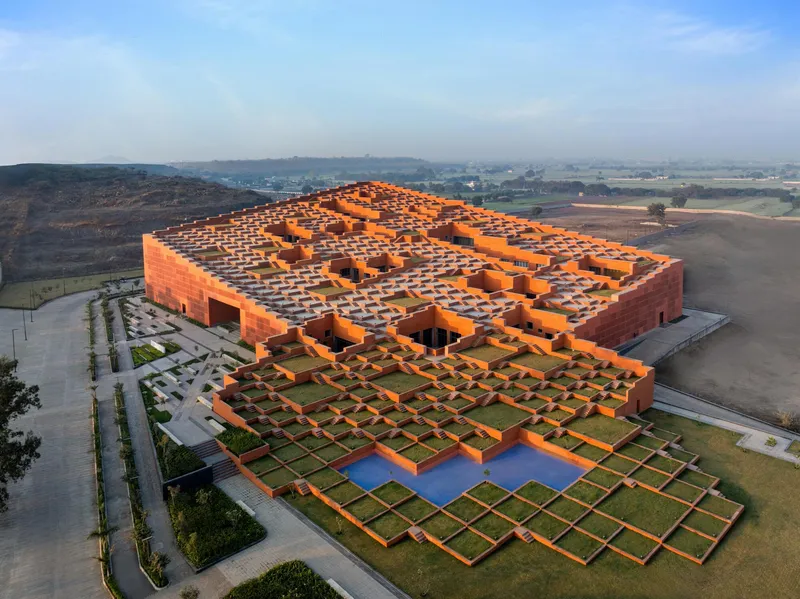
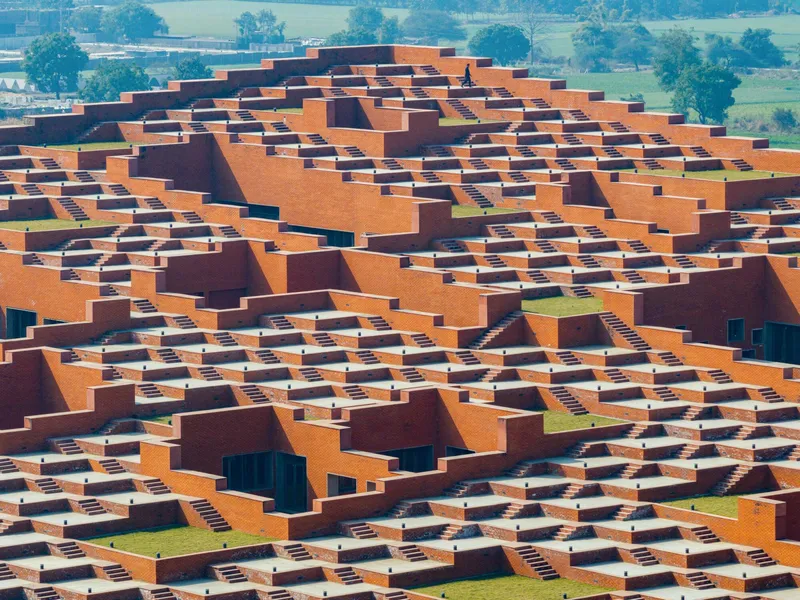
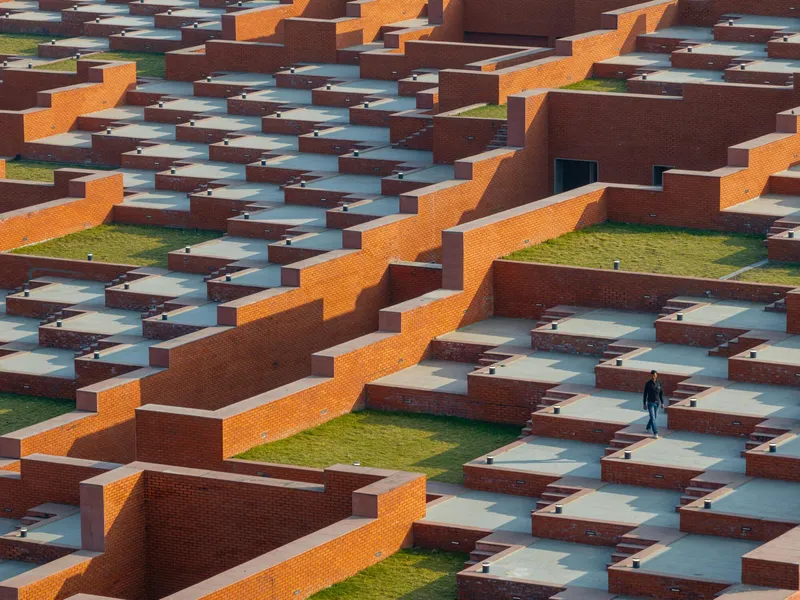
From the air, the building barely registers as a building. It looks more like a terraced agricultural landscape or a geological formation rendered in orange brick and concrete. The 9,000-square-meter rooftop is subdivided into hundreds of stepped platforms, each finished in brick or planted with grass, forming a continuous inhabitable surface that rises from near grade level on one side to the full 28-meter height on the other. The shallow reflecting pool at the base anchors the composition and performs double duty as a passive cooling element for Indore's punishing climate, where temperatures sit between 30°C and 40°C for roughly eight months of the year.
What makes this more than a formal gesture is the accessibility logic. Four terraces are connected by wheelchair hoists, and the stepping is gentle enough to function as casual outdoor circulation rather than monumental stairway. The roofscape becomes a second ground plane for the campus, one that is entirely public and entirely outdoors.
Brick and Screen as Climate Armor
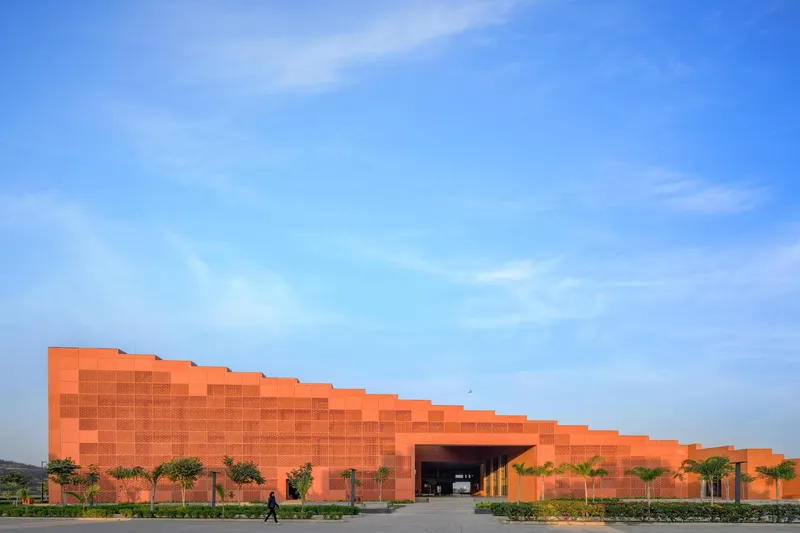
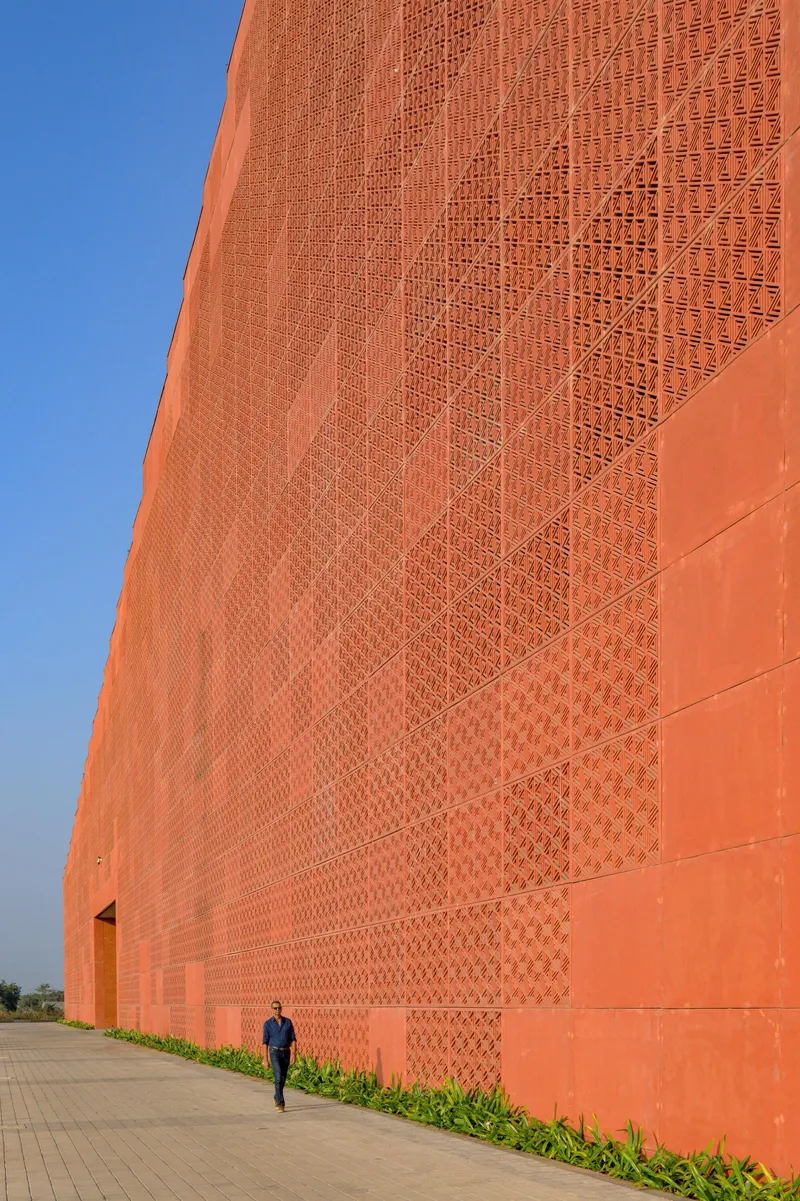
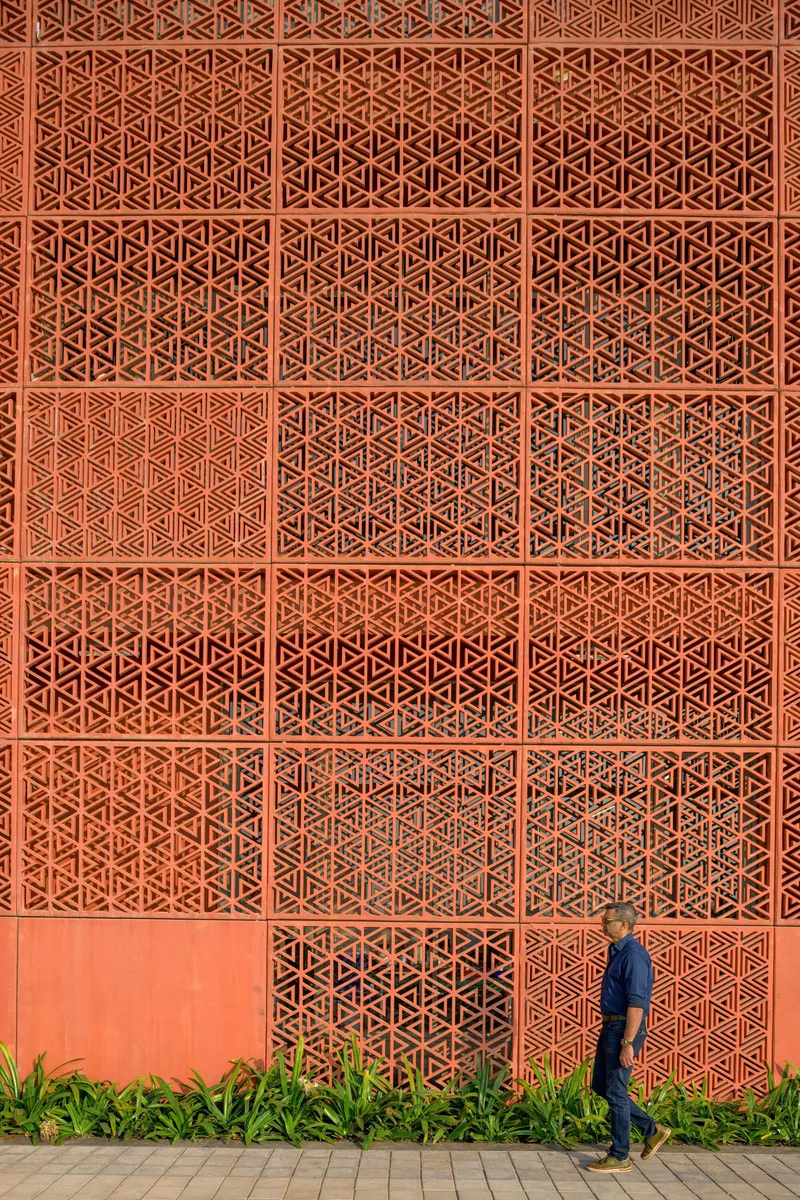
The material palette is restrained and regionally grounded: clay brick cladding over a reinforced concrete and fly ash brick structure, Indian sandstone on the interior floors, and perforated glass fiber-reinforced concrete (GFRC) screens on the east, west, and southern elevations. The brick is not decorative wallpaper. It is the primary strategy for mediating heat gain, and the GFRC screens layer a second ventilated skin that filters sunlight while allowing cross-ventilation through the building's deep plan.
The pixelated massing of the facade, visible most clearly from the long east elevation, produces a rhythm of solid and void that is both compositionally rich and functionally precise. Each setback, each punched opening, each perforated panel is calibrated to the solar geometry of its orientation. The result is a building that looks like it was assembled from hundreds of individual brick volumes, but which performs as a single, thermally coherent envelope.
Courtyards Punched Deep into the Section
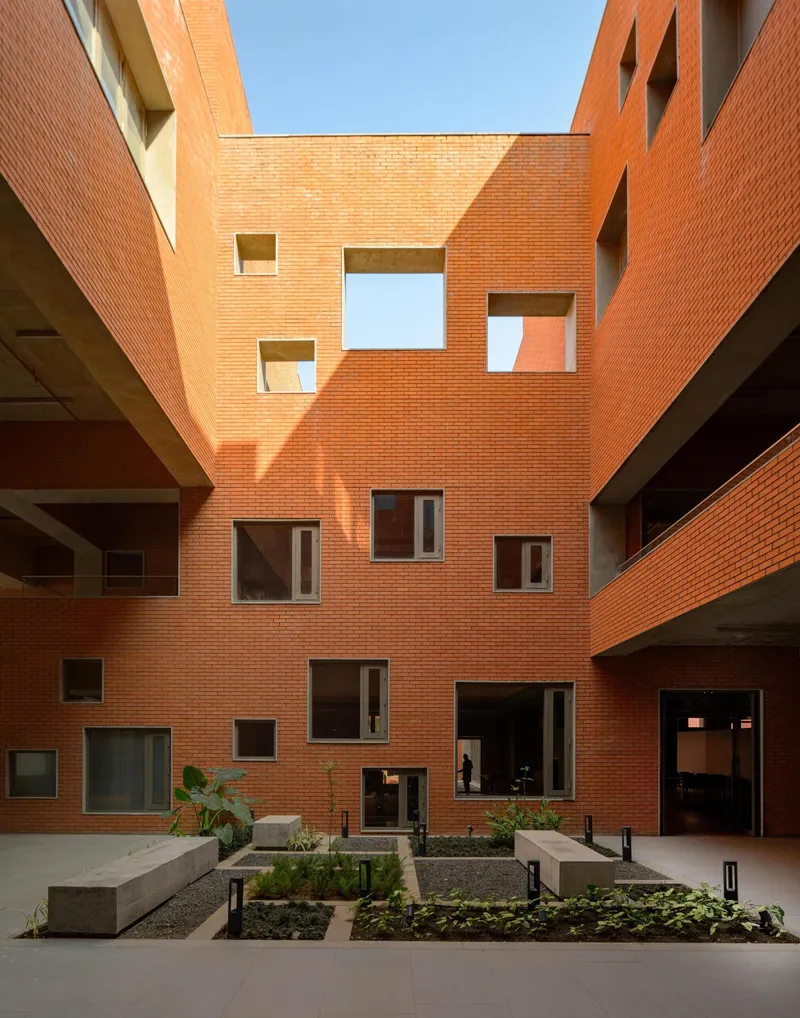
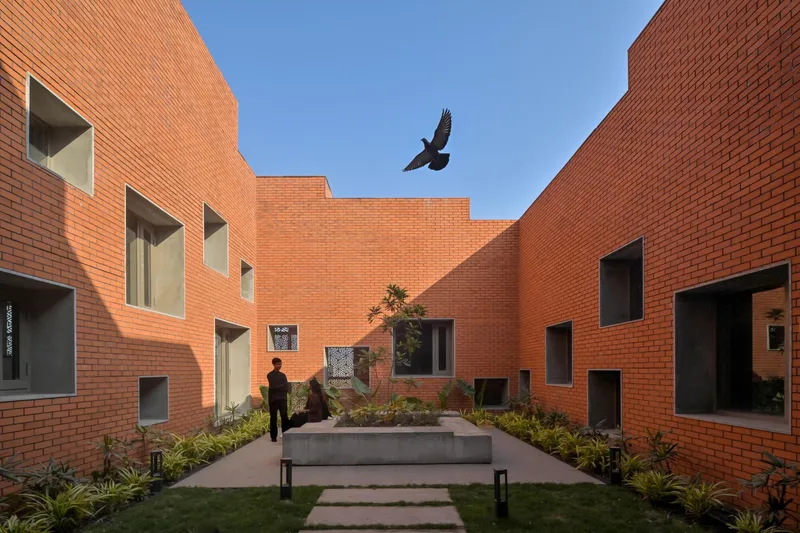
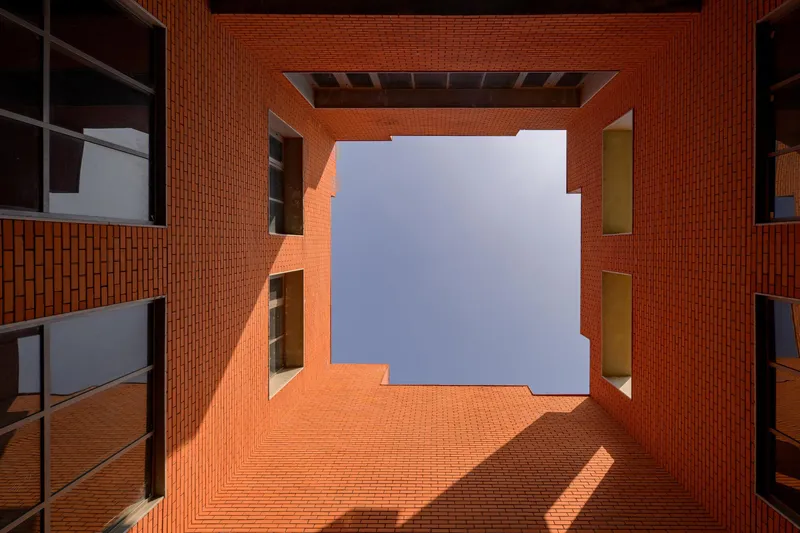
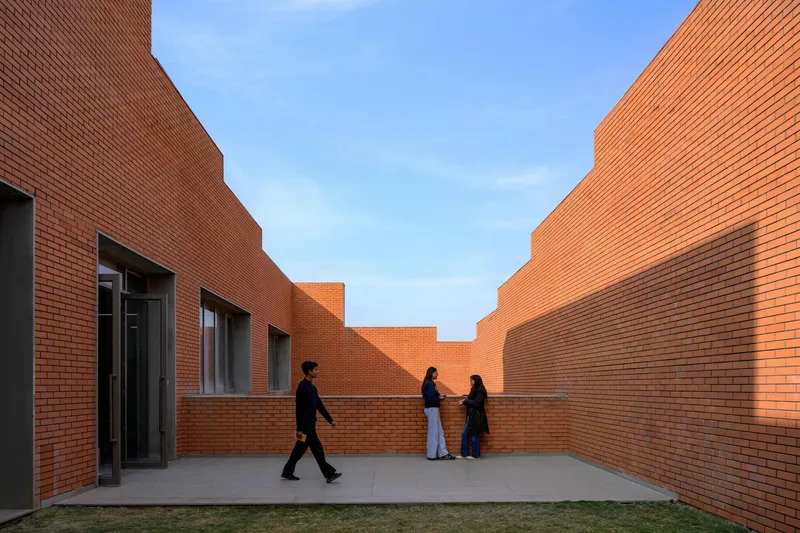
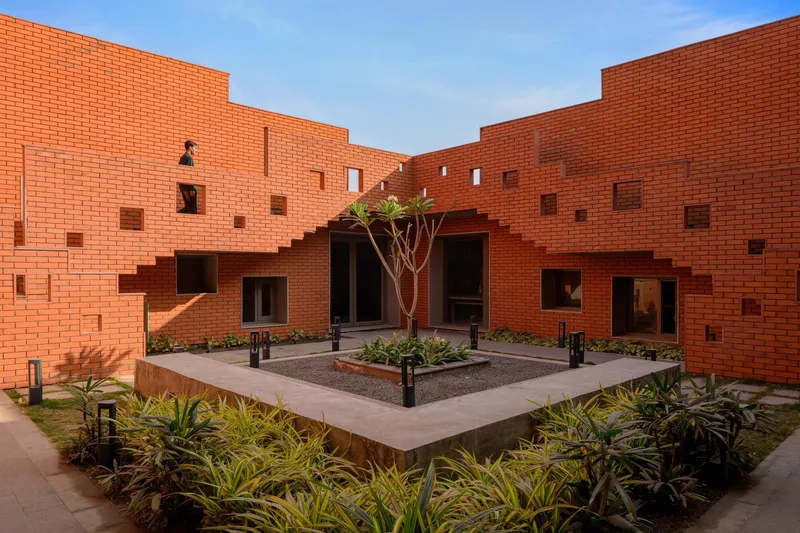
The courtyards are not arranged along a polite perimeter. They puncture the roofscape and carve vertical voids through multiple floors, pulling indirect light and moving air deep into the building's interior. Traditional Indian architecture has long relied on north-facing courts to control glare and heat; Sanjay Puri Architects extends that principle into a three-dimensional matrix where every level has access to a landscaped court. The brick walls that frame these voids act as thermal mass, absorbing heat during the day and radiating it slowly at night.
Standing inside one of the deeper courts, the experience is surprisingly intimate for a building of this scale. The tall brick walls with scattered punched windows create a quality of light that feels more domestic than institutional, and the planted beds at the base of each court soften what could otherwise be an austere concrete-and-brick canyon.
The Diagonal Street and Interior Life
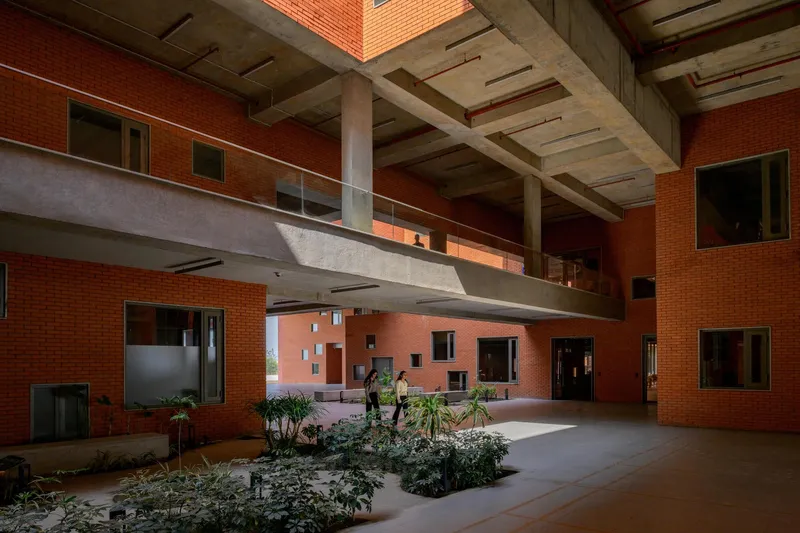
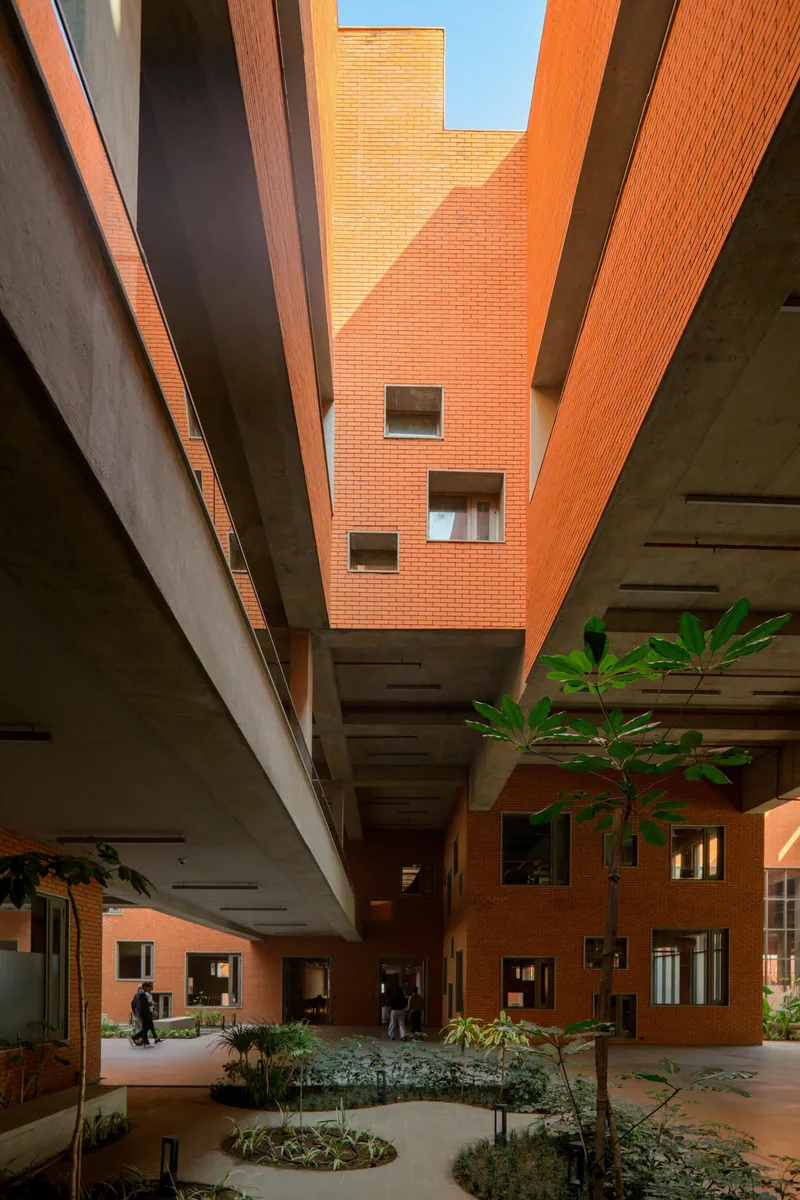
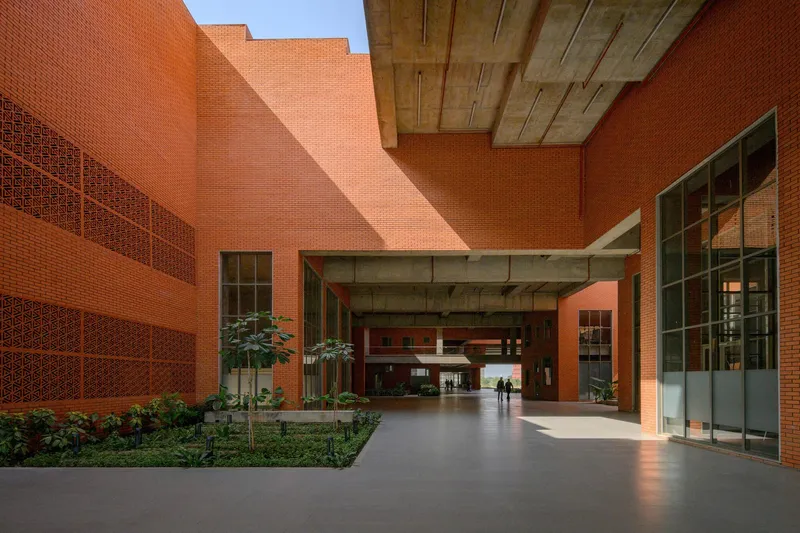
The ground floor is organized around a continuous diagonal indoor street that runs from one end of the building to the other, connecting the cafeteria, auditorium, and administrative offices. It is the social spine of the building, and its diagonal orientation means that it cuts across the structural grid at an angle, creating a sequence of widening and narrowing spaces that resist the monotony of a standard double-loaded corridor. Bridges at the first-floor level cross over this street, linking the two halves of the library and offering elevated views down into the gathering spaces below.
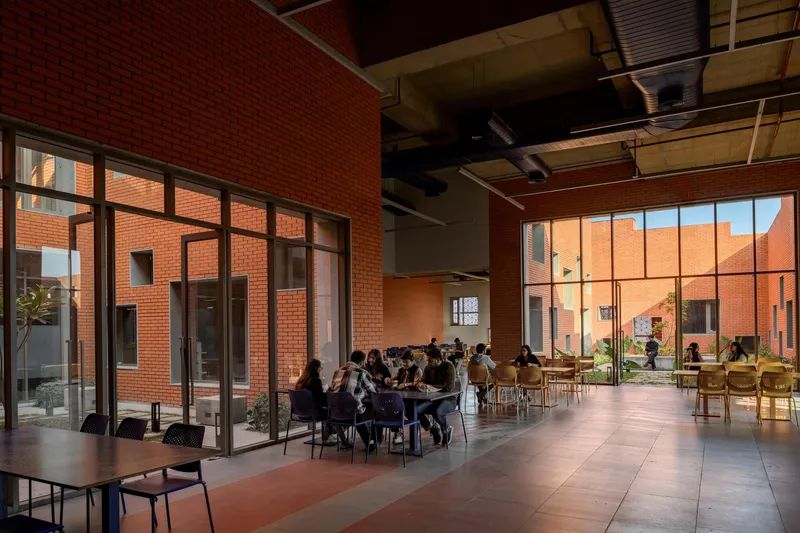
The exposed concrete structure is left visible throughout these communal zones. Columns, beams, and ceiling soffits are honest about the building's means of support, and the structural grid creates a legible rhythm that helps orient users within what is otherwise a very large and complex plan. The cafeteria, in particular, benefits from this legibility: the concrete frame provides a civic scale that matches the room's capacity while the brick infill and planted courts adjacent to it soften the atmosphere.
Stepped Amphitheater and Outdoor Rooms
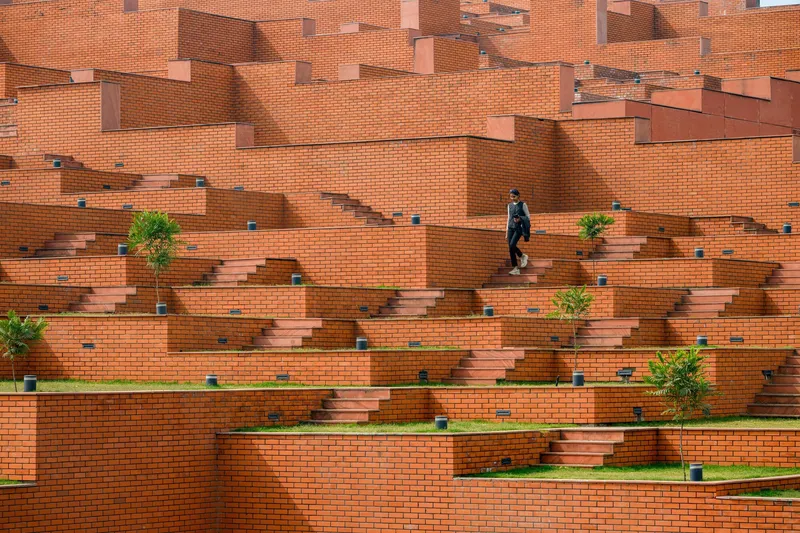
The terraced profile of the building is not uniform. In several locations, the stepping intensifies to form outdoor amphitheaters where the concrete platforms cantilever out from the brick walls, creating tiered seating with planted alcoves tucked beneath. These moments transform the building's section into a series of outdoor rooms scaled for groups of varying sizes, from a handful of students reading on a planted ledge to a few hundred gathered for an informal lecture.
The effect recalls the social choreography of the historic stepwells that inspired the design. In those structures, the geometry of descent organized encounters between strangers at multiple levels. Here, the geometry of ascent does the same, creating thresholds and landings where paths cross and people pause.
Interior Spaces and Material Warmth
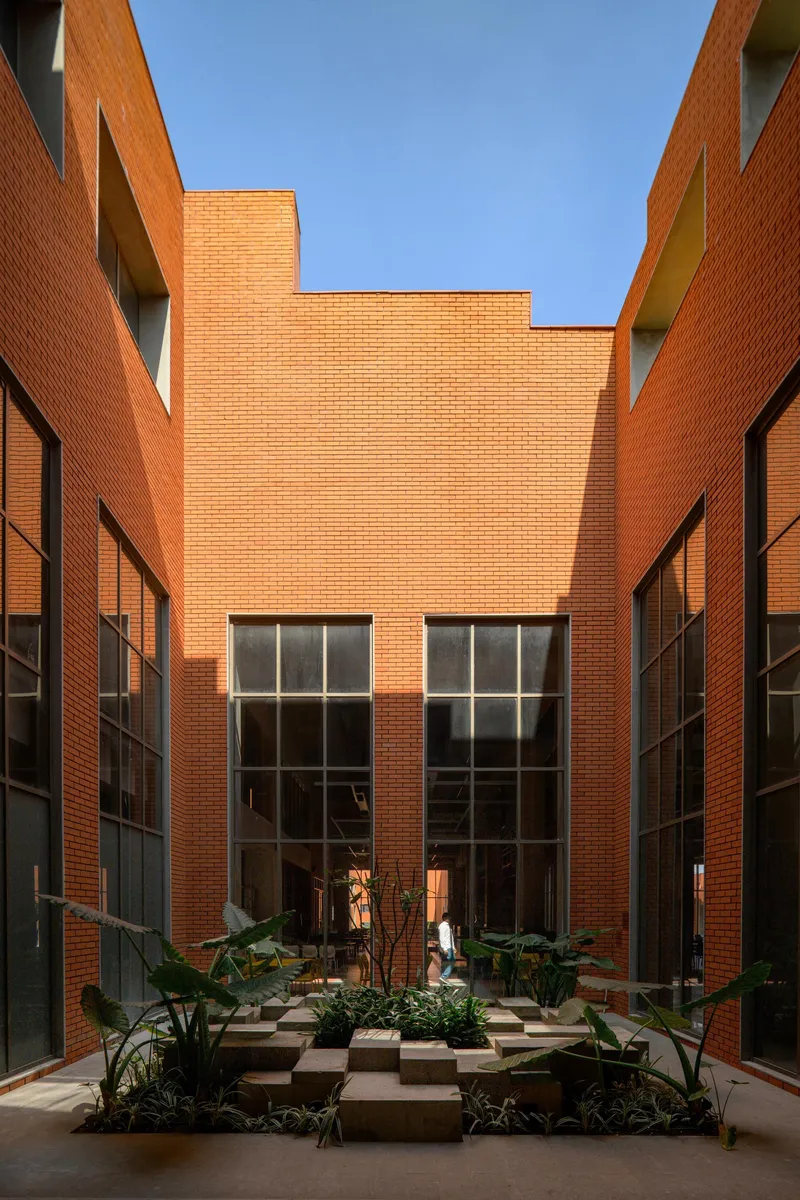
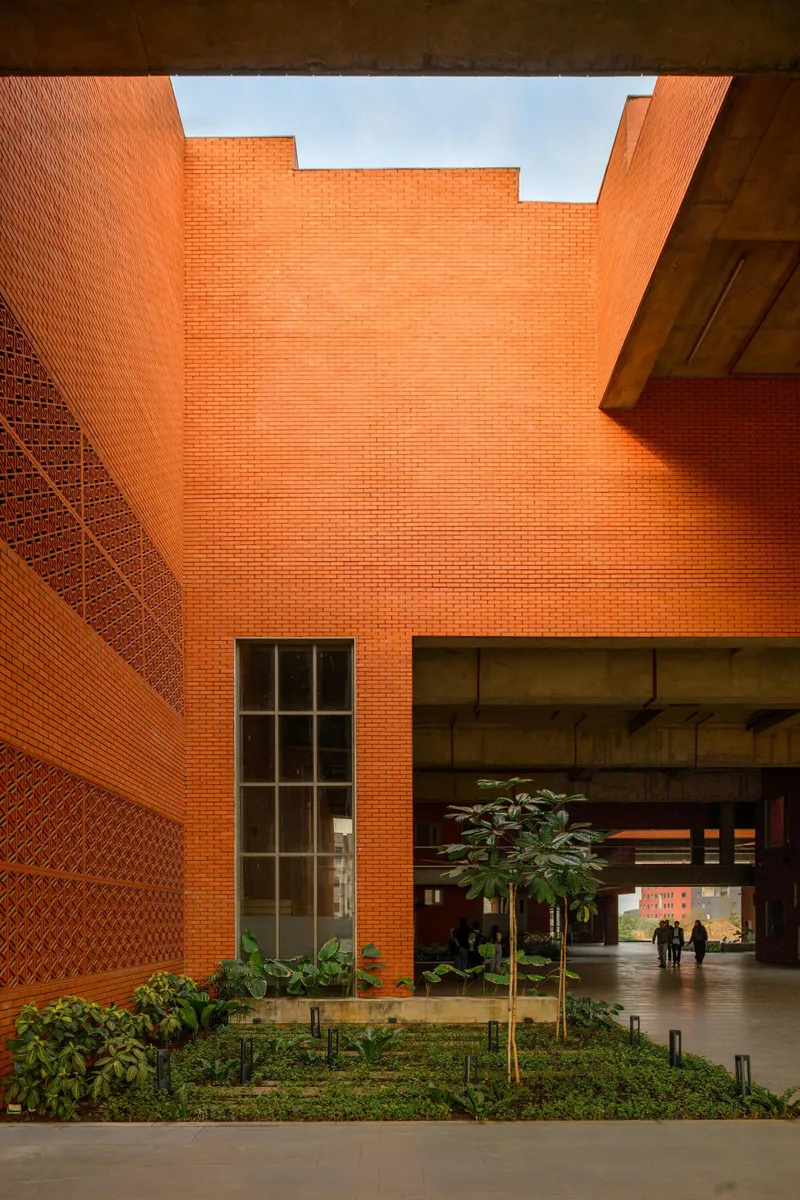
Inside, the classrooms are distributed across the second through fourth floors in a straightforward arrangement that prioritizes natural light from the courtyards and north-facing openings. The second floor houses standard classrooms, the third floor tiered lecture rooms, and the fourth floor administrative and faculty offices. It is a pragmatic stacking that reserves the ground and first floors for the building's most public and collective programs.
The communal interiors are the strongest spaces. The student gathering areas use a combination of exposed mechanical systems, timber ceiling panels, and sandstone flooring to produce an atmosphere that feels neither corporate nor institutional. Narrow courtyard passages between brick walls, lit from above, offer moments of compression that make the subsequent double-height volumes feel genuinely expansive. The building understands pacing.
Facade Detail and Massing
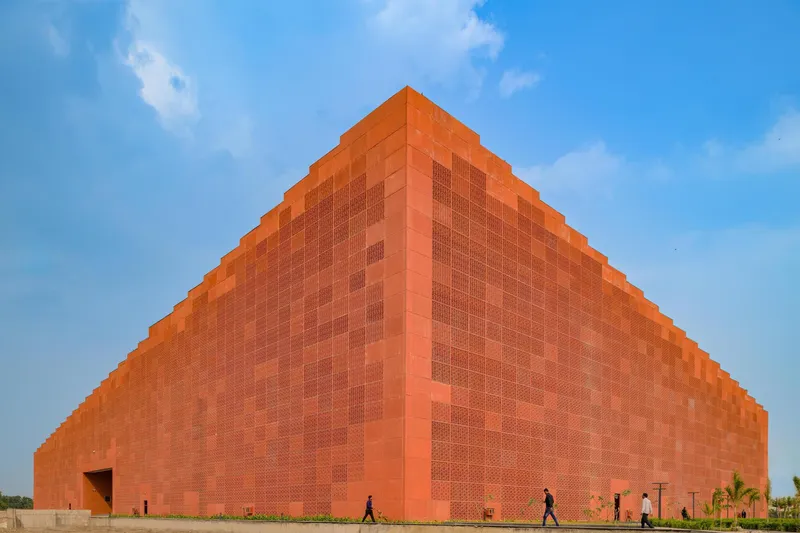
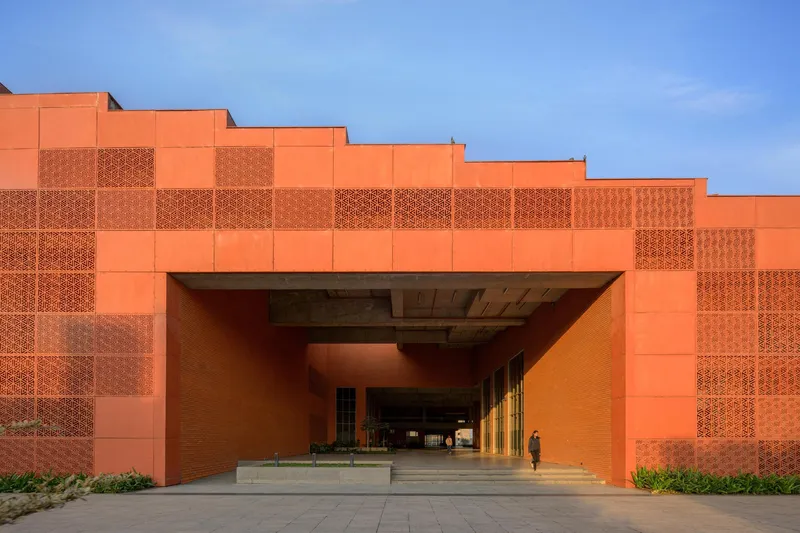
At close range, the facade reveals itself as a carefully composed field of brick tones and textures. Orange and brown clay bricks are mixed to create a subtle chromatic variation across the building's surface, and the GFRC screens introduce a finer geometric pattern that plays against the larger brick modules. At dusk, the pyramidal volumes at the building's tallest points take on a monumental quality, their textured surfaces catching raking light while figures walk along the base in silhouette.
The entrance portals are recessed deep into the brick mass, framed by stepped reveals that signal transition from exterior to interior. The perforated screens above these entries filter light into the threshold spaces, creating a dappled quality that makes the act of entering the building feel deliberate and sequential rather than abrupt.
Plans and Drawings
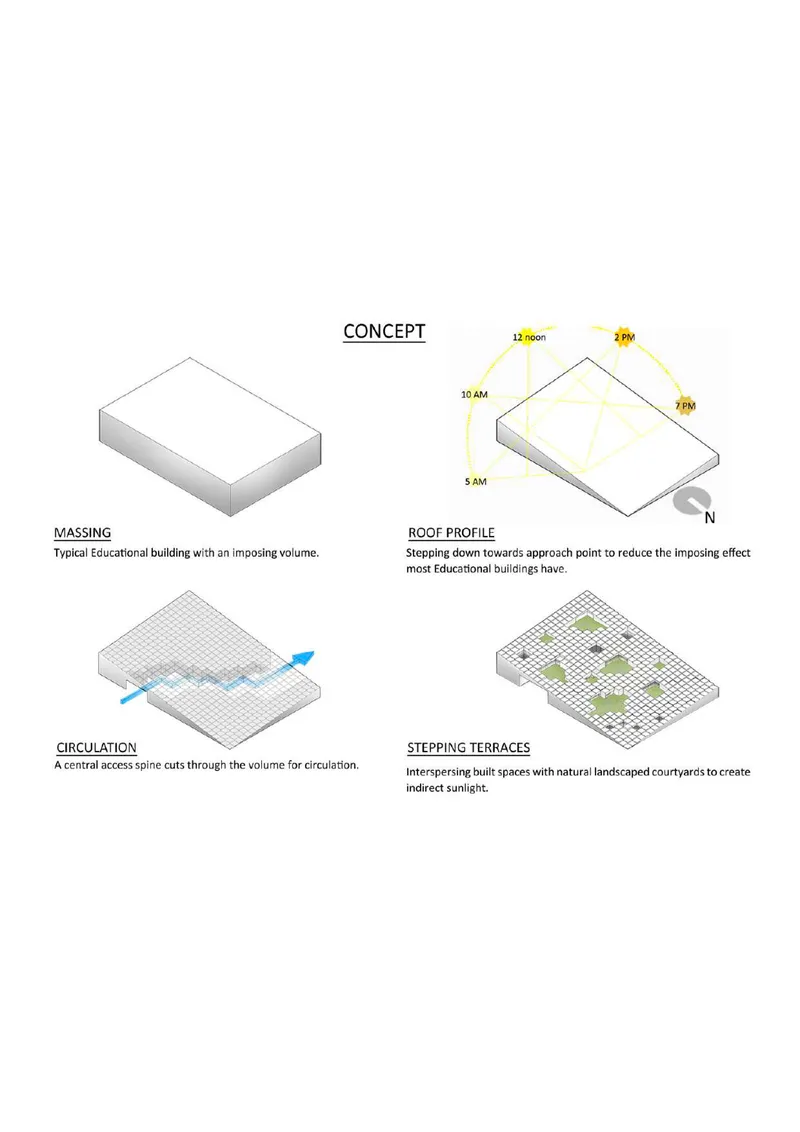
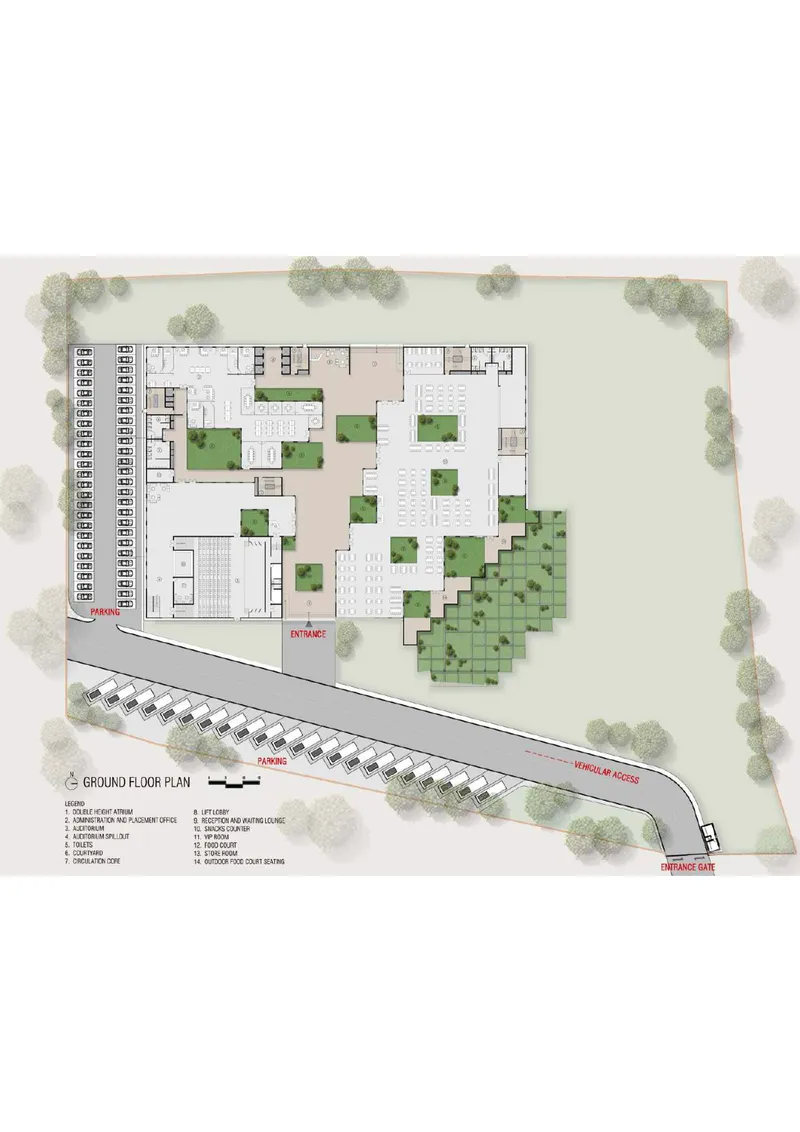
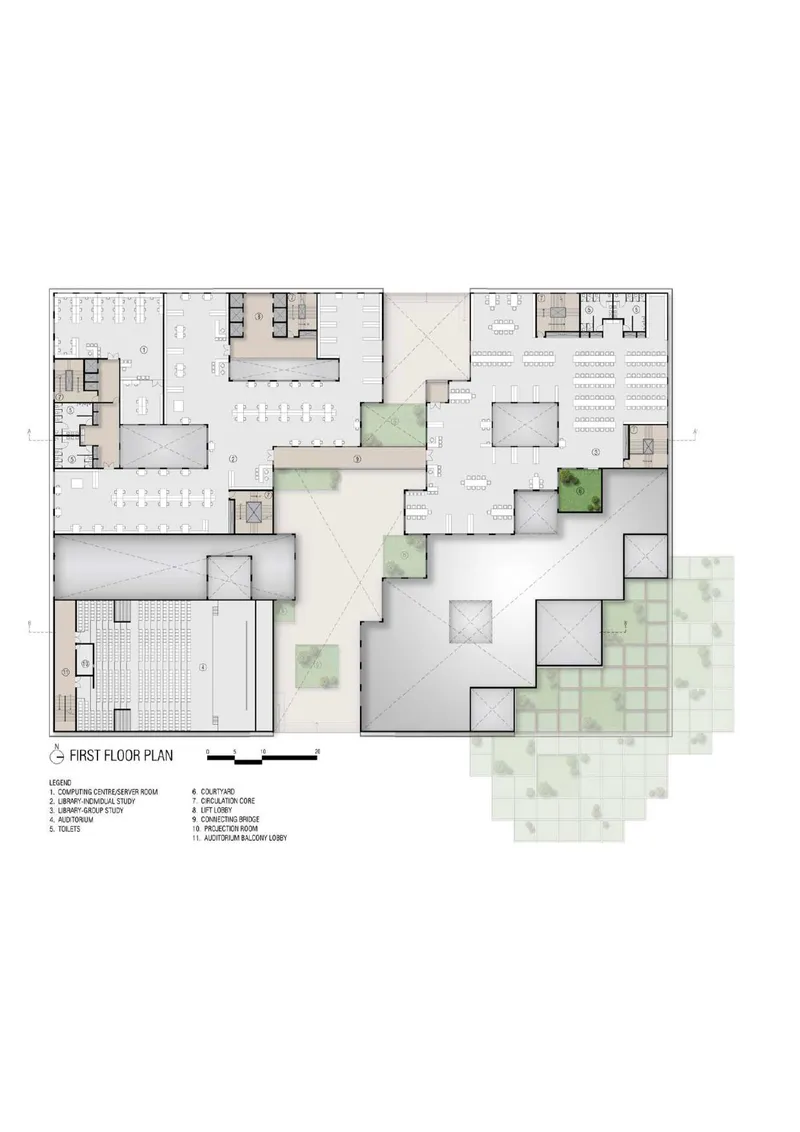
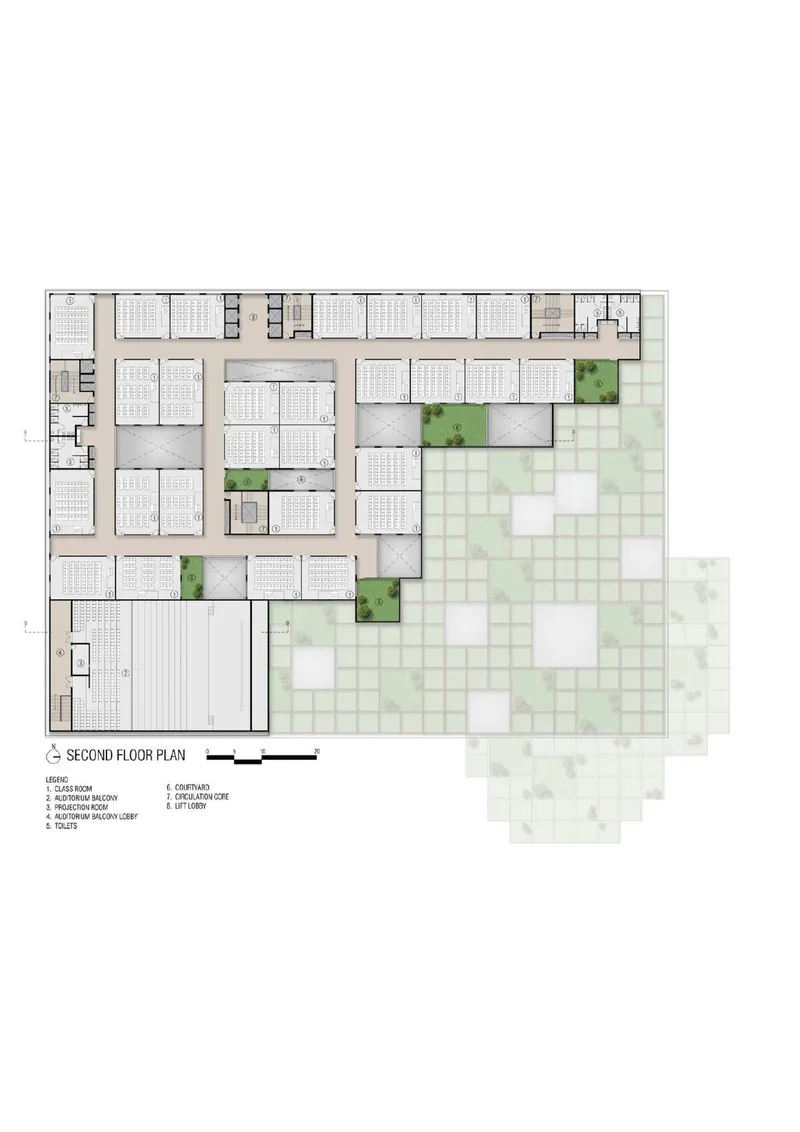
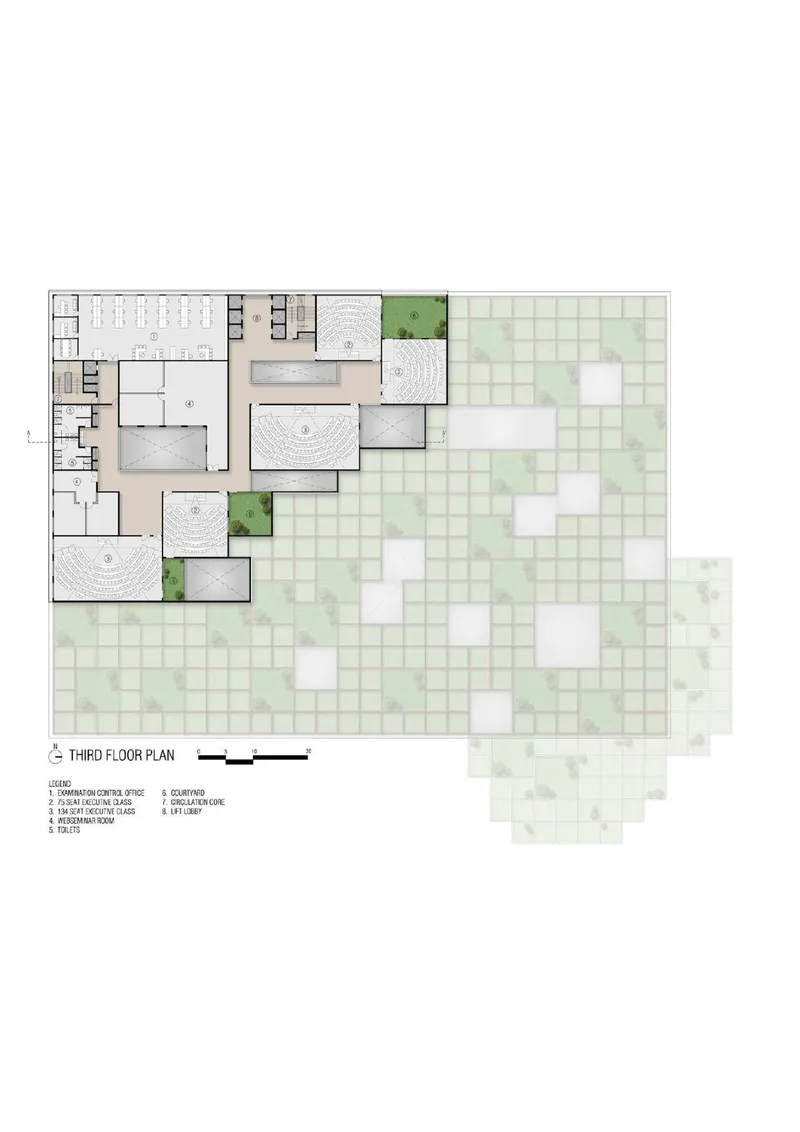
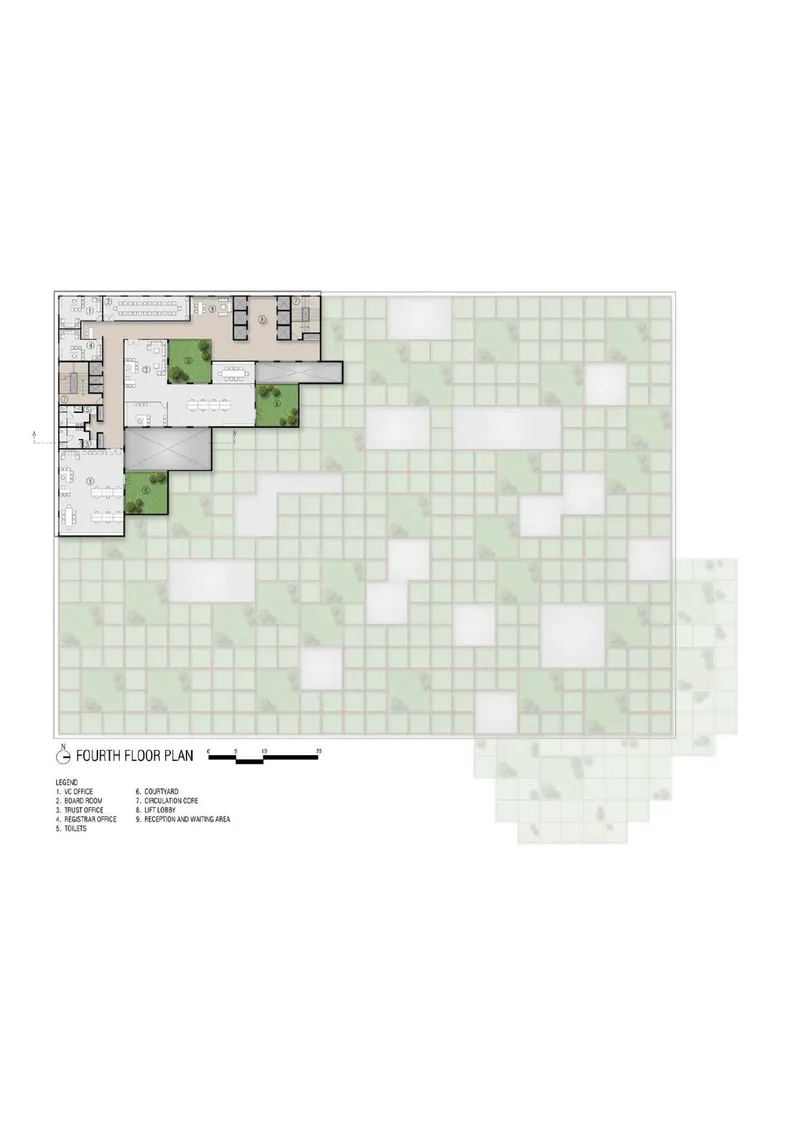
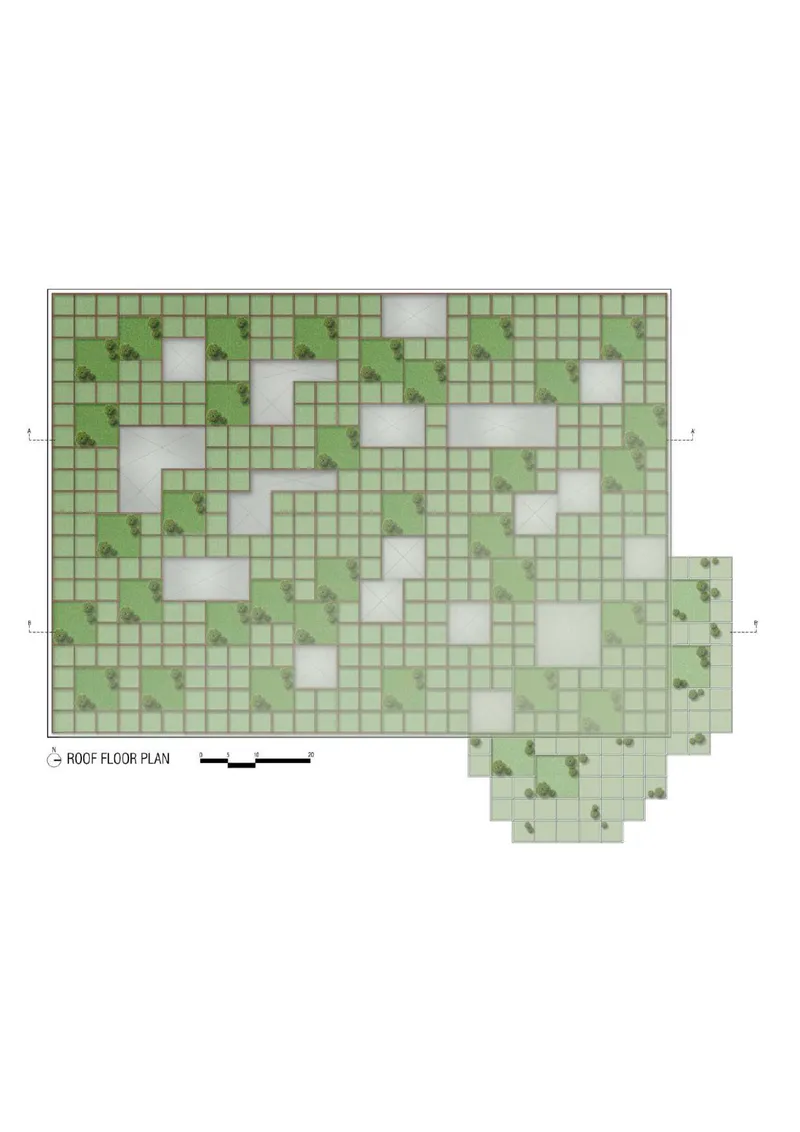
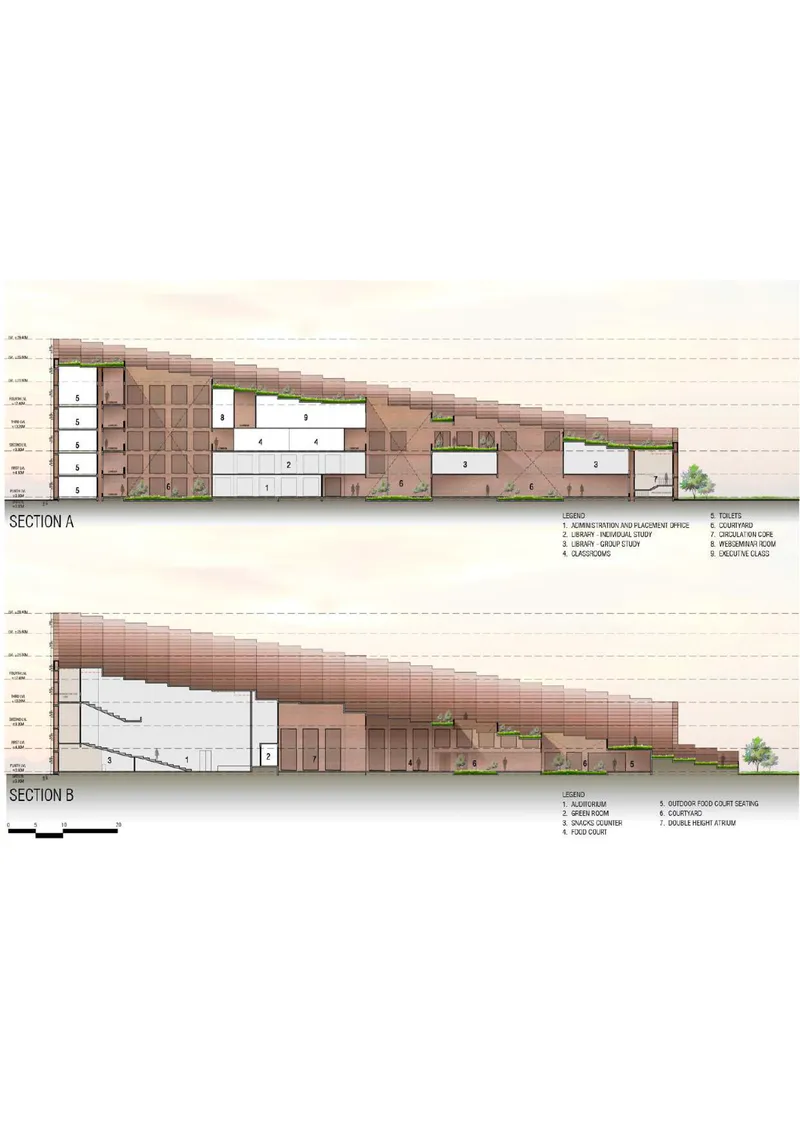
The floor plans tell the story of progressive dematerialization. At the ground level, the building occupies nearly its full footprint, with the diagonal street slicing through a dense program of cafeteria, auditorium, and offices. Each successive level reduces the enclosed area and expands the terraced landscape, so that by the fourth floor the plan is mostly outdoor platform with a small cluster of interior rooms. The roof plan reads as an almost entirely green grid with scattered tree plantings and white voids where the courtyards penetrate downward. The section drawings confirm what the photographs suggest: the building's slope is continuous and surprisingly gentle, more hillside than pyramid.
The design strategy diagram lays out the four governing principles: a sloping roof profile that responds to the approach sequence, stepped terraces that generate outdoor gathering space, planted courtyards that drive natural ventilation and light, and a layered screen system that manages solar heat gain. These are not abstract concepts; each is directly legible in the built work, which is rare enough to be worth noting.
Why This Project Matters
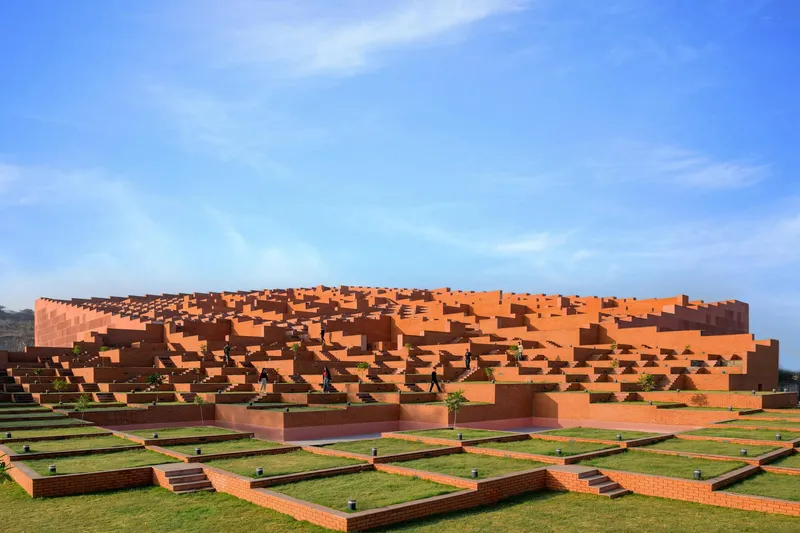
Prestige University matters because it demonstrates that climate-responsive design at institutional scale does not have to look like a technical exercise. The building is thermally intelligent, deeply informed by regional precedent, and constructed from locally sourced materials, but it is also spatially generous, socially ambitious, and architecturally compelling. The stepwell reference is not a nostalgic citation; it is a structural idea about how section can organize collective life, and Sanjay Puri Architects has translated that idea into a contemporary building type with real conviction.
The decision to make the roof the primary social space of the campus is the project's boldest move, and its most consequential. In a climate where outdoor comfort is limited for much of the year, the stepped terraces and shaded courtyards create a microclimate that extends the usable hours of the building's exterior surfaces. For 3,000 students, this is not a luxury; it is additional square footage at zero energy cost. The building proves that the most sustainable strategy is often the most spatial one: give the ground back, make the section work, and let people inhabit the result.
Prestige University by Sanjay Puri Architects, Indore, India. 30,843 m². Completed 2026. Photography by Vinay Panjwani.
About the Studio
Share Your Own Work on uni.xyz
If projects like this are the kind of work you want to make, uni.xyz is a place to publish your own, find collaborators, and enter design competitions.


Popular Articles
Popular articles from the community

Faces of the Soviet Avant-Garde: Turning Moscow's Street Names into an Open-Air Museum
A network of sculptural installations across a Moscow residential district transforms forgotten architect names into spatial encounters with cultural memor

Tsunami Convergenics: Turning Catastrophic Ocean Forces into Underwater Housing Infrastructure
A speculative underwater settlement off the coast of Onagawa, Japan, treats tsunamis and typhoons as energy sources rather than threats.

Cloaked Colonization: A Mobile Underwater Habitat That Moves Like a Fish
Micah Abaya's shortlisted EHC Pacific entry reimagines ocean settlement as a dispersed network of self-sustaining architectural organisms.

Opera on the Sea: Driftwood Logic Shapes a Timber Opera House on Estonia's Coast
Trevor Orgill's opera house translates the entangled drift of floating timber into a civic building where wood, water, and music converge.

Similar Reads
You might also enjoy these articles

Bao Huynh Watercolor Atelier: A Serene Art Retreat in Hội An
Bao Huynh Watercolor Atelier in Hội An blends multifunctional art spaces, sustainable design, local materials, and family-friendly living in a serene environment.

Atelier Macri Concept Store Interior Design by CASE-REAL
Atelier Macri store features a "ko" counter, walnut wood details, cork displays, blending retail, gallery, and seamless customer experiences.

Manuel Vargas Izquierdo Stadium and High-Performance Sports Center: Architectural Excellence in Jalpa de Méndez
The Manuel Vargas Izquierdo Stadium blends sustainable design, inclusive sports facilities, and cultural-inspired architecture, revitalizing Jalpa de Méndez’s public spaces.

KAKR Buluh Awar Hall: Revitalizing Community and Ecology Through Bamboo Architecture
Community built bamboo hall revitalizes Buluh Awar village, empowering youth, restoring ecology, celebrating vernacular craftsmanship through sustainable architecture and culture.

Explore Modern University Competitions
Discover active competitions in this discipline

Challenge to design public laboratory

Bring back Drive In's
Comments (0)
Please login or sign up to add comments
No comments yet. Be the first to comment!